
Interview assessment is a structured, competency-based process that uses consistent questions, anchored scoring, and recorded evidence to compare candidates fairly. In one Indian recruitment cycle, 2,410 applications became 38 eventual joiners, showing why assessment must work as a funnel rather than as one conversation.
You may be looking at a crowded applicant queue, preparing to interview several people for the same role, or trying to decide whether a confident candidate really has the skills the job requires. The pressure often leads managers to treat the interview as a conversation that ends with a personal impression.
That approach creates inconsistent decisions. One interviewer may reward confidence, another may focus on technical detail, and a third may remember the most recent candidate more clearly than the first. Interview assessment replaces that informal comparison with a repeatable process: define what the role requires, ask job-related questions, record evidence, score answers against shared standards, and combine the result with other relevant assessments.
In practice, the interview may sit beside a phone screen, work sample, coding exercise, group discussion, document check, or reference review. The important question isn't whether an interview feels thorough. It's whether the evidence gathered helps you make a fair, role-relevant, and defensible decision.
Why Interview Assessment Matters in Modern Hiring
A hiring manager facing 200 applications for one role needs more than opinions. They need a consistent way to decide which evidence matters and who should progress. Interview assessment supplies that structure, so a candidate does not advance just because one interviewer liked their communication style or remembered their response.
Without a shared process, interviews drift toward gut feeling, recency bias, halo effects, and interviewer mood. A polished answer may hide limited job knowledge. A nervous but capable applicant may receive an unfairly low rating. Panel members may spend more time debating whether someone seems likeable than checking whether the person demonstrated the required competency.
A sound assessment protects four outcomes:
- Candidate experience: Applicants should understand what the employer is assessing and receive a consistent process across the shortlist.
- Legal defensibility: The employer should show that questions and criteria relate to the job, were applied consistently, and were documented.
- Signal quality: The process should separate interview performance from technical capability, communication, motivation, and other distinct factors.
- Downstream performance: Results should connect to the work the person will perform and later be checked against outcomes such as probation progress or manager evaluations.
Practical rule: If you can't explain what a question measures, you can't reliably explain why the answer affected the hiring decision.
Modern recruitment needs breadth and depth. An AI-driven phone screen can check basic eligibility and motivation across a large applicant pool, while human interviewers examine judgement, collaboration, and problem-solving. A coding exercise or written case provides evidence of performance on a realistic task. These stages complement human judgement rather than replace it, because each gathers a different type of evidence.
An Indian Directorate General of Employment report illustrates this multi-stage model. For the 2022 Young Professionals intake, more than 7,000 applications were received and approximately 900 candidates were shortlisted, with document verification, personal interview, group discussion, and computer proficiency testing included in the process, as reported in The Directorate General of Employment report. The progression from applications to the next stage was roughly 12.9%. The report does not confirm that all applicants met identical eligibility criteria, so treat the 12.9% as indicative rather than definitive. The example shows why interview assessment works best as one part of a broader selection system.
The useful question is not whether an interview feels thorough. Ask which decision the stage must support and what evidence will make that decision fair, role-relevant, and defensible.
The Core Mechanics of Interview Assessment
Interview assessment has two connected layers. First, map a competency to a question. Second, map the response to a score. If either link is missing, the process becomes subjective.
Start with the work. For a customer support role, relevant competencies might include diagnosis, clear communication, ownership, and emotional control. For an analyst, they might include data interpretation, problem-solving, attention to detail, and stakeholder communication. Select competencies from real tasks, not from a generic list of desirable personality traits.
Then write questions that invite observable evidence. “Are you a good communicator?” produces self-description. “Tell us about a time you had to explain a complex finding to a non-technical stakeholder. What did you change in your explanation?” produces an example that can be probed and scored.
A useful assessment might look like this:
| Stage | Competency Measured | Question Type | Scoring Anchor |
|---|---|---|---|
| Preparation | Role knowledge | Targeted technical question | 1: cannot explain the relevant principle. 5: explains it accurately and applies it to the role |
| Evidence gathering | Problem-solving | Behavioural or situational question | 1: gives a vague response. 5: defines the problem, compares options, and explains the result |
| Verification | Communication | Follow-up and clarification | 1: answer remains unclear. 5: communicates logically and adapts to the listener |
| Panel review | Overall evidence | Independent scoring before discussion | 1: little job-related evidence. 5: repeated, specific evidence across questions |
Use the same core questions for every candidate, while allowing limited follow-up questions to clarify evidence. A shared interview evaluation form can help interviewers record the answer, relevant observations, rating, and supporting notes without turning the discussion into a memory exercise.
Use anchored rubrics, not impressions
A scale only improves consistency when each point has a behavioural meaning. “Strong” and “weak” mean different things to different interviewers. A 1-to-5 rubric might define a low score as no relevant example, a middle score as a relevant example with limited detail, and a high score as a specific example showing sound judgement, action, and a measurable work-related result.
The number isn't the evidence. The evidence supports the number.
Record what the candidate said, not a conclusion such as “not a culture fit”. Notes should capture the situation, action, reasoning, and outcome. After independent scoring, the panel can compare evidence and discuss differences. This reduces the risk that the first confident opinion controls the entire meeting.
Research from the Indian Institute of Management Bangalore reports substantial differences between interviewers in applicant-selection judgements. It discusses standardised questions, panel interviews, and multiple independent interviews as ways to improve inter-rater reliability, while citing prior evidence of 0.47 inter-rater reliability for interviewers rating empathy in real selection interviews. The IIM Bangalore working paper supports a practical conclusion: documentation and calibration aren't administrative extras. They're part of the measurement design.
Types of Interview Assessment and When to Use Each
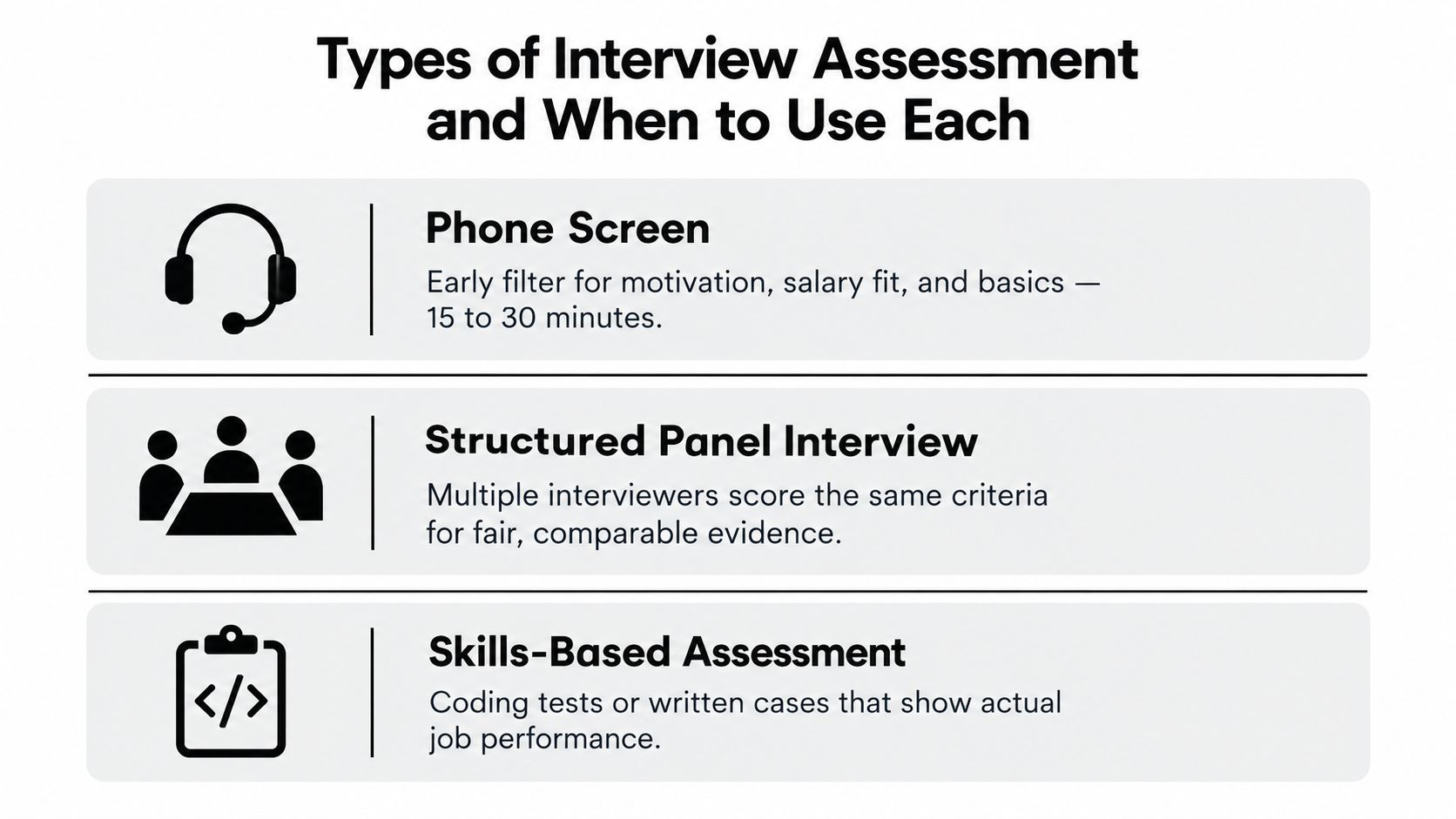
Different assessment formats answer different hiring questions. A phone screen asks whether a candidate should progress. A structured panel asks whether the person has demonstrated the required competencies. A skills-based assessment asks whether the person can perform relevant work.
| Format | Funnel position | Best signal | Main limitation |
|---|---|---|---|
| Phone screen | Early filter | Motivation, basic qualifications, availability, role understanding | Limited evidence of deep capability |
| Structured panel interview | Competency validation | Reasoning, communication, judgement, collaboration, past behaviour | Still relies on candidate responses in an artificial setting |
| Coding test or written case | Role-readiness verification | Execution, technical application, analysis, work quality | Can miss communication, context, and collaborative behaviour |
Match the method to the next decision
Use a phone screen when you need to resolve basic uncertainty efficiently. The recruiter can confirm interest, relevant background, work authorisation where applicable, expectations, and whether the candidate understands the role. This stage shouldn't attempt to predict every aspect of future performance.
Use a structured panel interview when several people need comparable evidence about the same competencies. Each interviewer can own a defined area, such as communication, technical reasoning, or stakeholder judgement, while all candidates answer the same core questions.
Use a coding assessment, written case, or work sample when execution is central to the role. A developer can discuss how they write code, but a practical task reveals how they structure, test, debug, and explain a solution. An analyst can describe attention to detail, but a short data exercise can expose how they interpret an ambiguous table.
A coding test without a structured interview can create false confidence. A candidate may complete a task with limited ability to explain trade-offs or work with others. The reverse is also true. A persuasive interview cannot substitute for job-like evidence in a technical role.
For technical hiring, an Indian recruitment study reported that combining technical assessments with structured interviews produced a correlation of r = 0.68 with subsequent job-performance ratings in a sample of 50 recent hires. The recruitment study describes the result as preliminary and small-sample evidence, so employers should validate the approach against their own performance data rather than treating the correlation as universal.
The decision rule is simple: choose the format that answers the uncertainty you need to resolve next.
Designing a Scorecard That Actually Compares Candidates
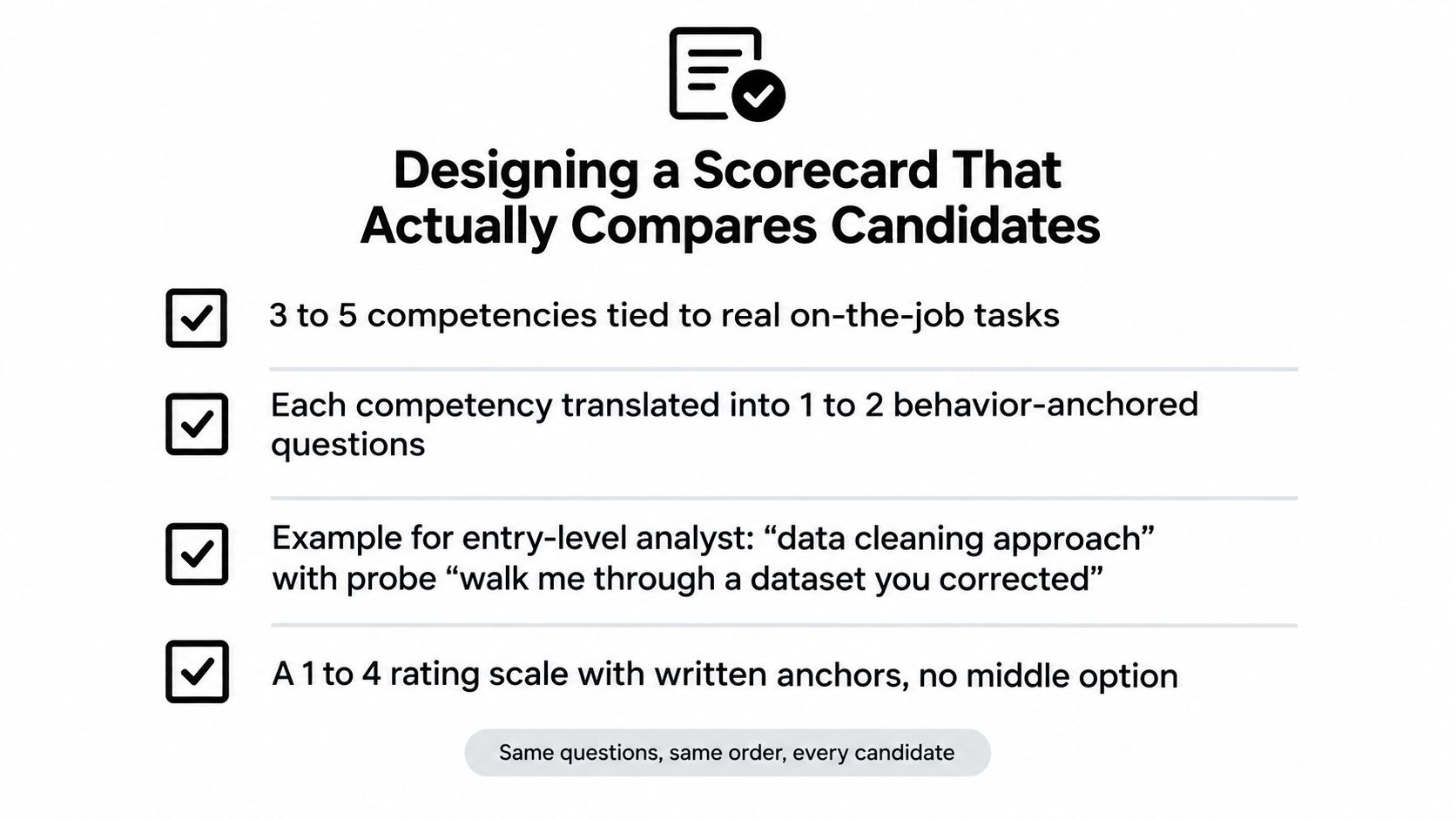
A scorecard should begin with the job, not with the interview platform. Review the role's recurring tasks, decisions, outputs, and relationships. From that analysis, choose three to five competencies that clearly separate effective performance from ineffective performance.
For an entry-level analyst, “data interpretation” is more useful than “intelligence”. You might ask the candidate to review a sample dashboard, identify an unusual result, and explain what they would investigate next. The score should reflect the quality of that reasoning, not the candidate's confidence while speaking.
Use this design sequence:
- Define the competency. Describe the work behaviour you need, such as checking data quality before presenting a recommendation.
- Write one or two anchored questions. Ask for a past example, a realistic scenario, or a short explanation of a work sample.
- Weight critical dimensions. Give greater importance to competencies that are essential to safe or effective performance. Keep the logic visible to the panel.
- Create written anchors. Describe what a low, adequate, and high-quality response contains. Avoid labels such as “good” or “strong” without definitions.
- Calibrate before interviewing. Have interviewers score a sample answer, compare ratings, and agree on what each anchor means.
- Store evidence in one rubric. Keep questions, notes, ratings, and decision rationale together so candidates are evaluated against the same standard.
A scorecard isn't a form that disappears after the interview. It's a hiring artefact that helps the panel ask consistent questions, separate evidence from interpretation, and explain the decision later. Reuse the framework for the role, then update it when the work changes. Don't reinvent the criteria for each candidate.
A candidate can be nervous in an interview and still provide strong evidence. The scorecard gives the panel a way to assess the evidence without pretending the setting is perfectly natural.
A Real Hiring Funnel and What It Reveals
A public recruitment cycle from India shows how quickly a broad applicant pool can narrow when employers use several assessment stages. The National Career Service Institute's 2023–24 annual report records a Young Professionals drive with 2,410 applications, 555 shortlisted candidates, 172 interview attendees, 54 selected candidates, 43 accepted offers, and 38 eventual joiners. The process included interview, group discussion, computer proficiency testing, and document verification. The NICS annual report makes the central point visible: the interview was important, but it wasn't the whole decision.
| Funnel Stage | Typical Candidates | Conversion Rate | Assessment Used |
|---|---|---|---|
| Applications received | 2,410 | 100% | Eligibility and application review |
| Shortlisted | 555 | Approximately 23.0% of applications | Screening and qualification review |
| Appeared for interview | 172 | Approximately 31.0% of shortlisted candidates | Interview, group discussion, computer proficiency testing |
| Selected | 54 | Approximately 31.4% of interview attendees | Combined assessment and verification |
| Joined | 38 | Approximately 1.6% of applications | Offer acceptance and joining |
The figures show two different conversion problems. First, the funnel narrows sharply between application and joining. Second, only about 22.7% of shortlisted applicants who appeared for interviews were selected, which indicates that reaching an interview did not establish suitability.
The final gap between selection and joining also deserves attention. 43 candidates accepted offers, while 38 joined, so selection quality alone doesn't explain hiring outcomes. Employers must also examine role expectations, communication, offer experience, timing, and candidate commitment.
For a private-sector HR team, the lesson isn't to copy the exact stages. It's to label the decision at each transition:
- Application to shortlist: Does the person meet defined requirements?
- Shortlist to assessment: Can the person demonstrate relevant ability?
- Assessment to interview: Can the person explain reasoning and behaviour?
- Selection to offer acceptance: Does the role match the candidate's expectations?
- Acceptance to joining: Did the organisation maintain trust and clarity?
A recruitment yield pyramid can help hiring teams inspect each stage instead of blaming the interview for every drop-off.
Why Interview Scores Alone Do Not Predict Success
An interview is a snapshot under artificial conditions. Candidates may prepare rehearsed examples, feel pressure, misunderstand a question, or perform better or worse than they normally would at work. Interviewers also bring their own expectations, habits, and preferences to the room.
That doesn't make interview evidence useless. It means the score needs boundaries. A structured question about resolving a customer escalation can reveal how a candidate thinks about ownership and communication. It can't, by itself, prove how that person will perform across a full workload, team environment, or period of changing priorities.
The IIM Bangalore research discussed earlier reports substantial interviewer variation and cites prior evidence of 0.47 inter-rater reliability for empathy ratings in real selection interviews. That finding supports a cautious approach to scores. Two trained interviewers can hear the same answer and interpret its quality differently unless the organisation defines the competency, asks comparable questions, and records behavioural evidence.
Triangulate the signal
A stronger decision combines evidence that comes from different methods:
- Structured interview: Can the candidate explain past behaviour, judgement, and communication?
- Work sample: Can the candidate perform a representative task?
- Technical assessment: Can the candidate apply relevant knowledge under defined conditions?
- Reference or verification step: Do other sources support the candidate's account?
- Realistic job preview: Does the candidate understand the actual pressures and expectations?
For technical roles, the Indian recruitment study cited earlier found r = 0.68 between combined technical assessments and structured interviews and later job-performance ratings in its sample. That result is useful as a design signal, not a promise. Each employer should compare hiring scores with post-hire outcomes such as probation success, productivity, retention, or manager evaluations.
Decision standard: Never ask whether the interview score is high enough in isolation. Ask what the score explains, what it cannot explain, and which evidence is still missing.
This approach also improves fairness. A candidate's accent, confidence, familiarity with interview conventions, or similarity to the interviewer should not outweigh evidence from a relevant task and clearly defined competency criteria.
Where AI-Driven Interview Assessment Fits In
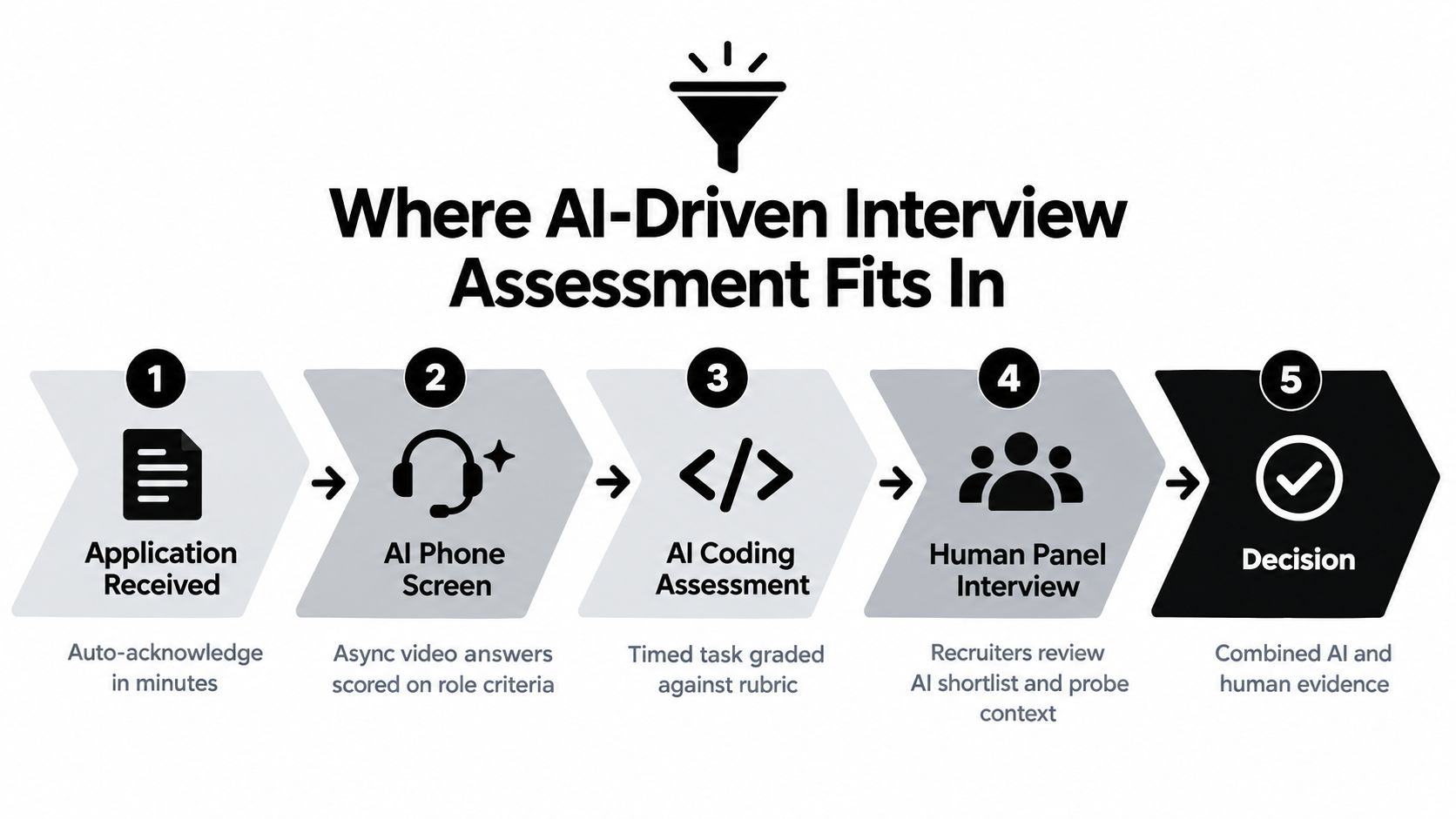
An AI tool can shorten parts of the hiring funnel, but it cannot decide whether someone will succeed in the role. A sound process gives automation a defined task and keeps people responsible for interpreting evidence, checking results, and making the final decision.
An AI-driven phone screen works well for repeatable early questions about background, motivation, role understanding, or basic scenarios. It can present the same core prompts, capture transcripts, organise responses, and flag answers for review. For example, a recruiter handling many applicants might use it to identify which candidates meet an initial communication or experience criterion. The tool should score only the competencies it was designed to assess, not broad impressions such as personality or “fit.”
A coding assessment belongs at another point in the funnel. As outlined in our overview of candidate assessment tools, it can evaluate a defined task against a rubric covering correctness, testing, readability, or problem-solving. That result still needs context. The hiring team should check the task conditions, confirm whether outside assistance was allowed, and use a human interview to explore trade-offs, communication, and collaboration.
Separate automation from accountability
A fully automated screen may reject a candidate without a meaningful review path. An AI-assisted screen can organise evidence and prioritise cases for attention, while a recruiter or hiring manager checks context, reviews the original response when needed, and overrides an unsuitable recommendation.
Before introducing AI, define its operating boundaries:
- Scope: Which competencies can the tool assess, and which decisions stay with people?
- Evidence: Can reviewers access the transcript, answer, task output, and scoring rationale?
- Consistency: Do candidates receive comparable prompts and conditions?
- Human review: Who examines borderline, unusual, or potentially misinterpreted responses?
- Candidate communication: Are applicants told that AI is involved and given a way to raise a concern?
- Validation: Does the score relate to later job outcomes, or only to familiarity with automated hiring?
Research reported by The Hans India says 54% of Indian HR professionals report that at least half of their applications meet required and preferred qualifications. The same brief identifies technical skills and soft skills as major hiring challenges, reported by 61% and 57% respectively. These findings support a practical distinction: qualification screening shows who appears to meet the entry criteria, while assessment evidence shows how a person may perform relevant work.
AI should make evidence easier to collect and connect each score to a measurable hiring outcome. It should not turn a narrow result into an automatic verdict. Recruiters still need to test whether the competency is job-related, whether the rubric produces useful evidence, and whether human review changes the decision appropriately.
Key Takeaways and Frequently Asked Questions
Use this checklist when reviewing your own process:
- Define competencies: Tie each one to a real task or decision.
- Standardise questions: Give candidates comparable opportunities to provide evidence.
- Anchor scoring: Describe what each rating means in observable terms.
- Combine methods: Pair structured interviews with work samples or technical assessments where the role requires them.
- Keep human review: Let people investigate context and own the final decision.
- Validate outcomes: Compare assessment results with later performance and fairness indicators.
Is interview assessment the same as a job interview?
No. A job interview is an interaction between the candidate and employer. Interview assessment is the wider method used to design questions, collect evidence, score responses, and connect the result to other selection stages.
How does a structured interview differ from an unstructured interview?
A structured interview uses predefined competencies, comparable core questions, consistent scoring anchors, and documented evidence. An unstructured interview lets each interviewer decide what to ask and how to judge the answer, which makes candidate comparisons less reliable.
What does a defensible scorecard include?
It includes role-related competencies, behaviourally anchored questions, written scoring criteria, space for evidence, and a clear decision process. The panel should calibrate its interpretation before live interviews and score independently before discussing candidates.
How are coding assessments graded?
They should be graded against a role-relevant rubric, such as correctness, testing, readability, reasoning, or handling of edge cases. The technical result should be combined with a structured conversation about decisions and communication rather than treated as a complete hiring verdict.
Can AI interview tools replace recruiters?
They can support repeatable screening and evidence capture, but they shouldn't replace human accountability. Recruiters and hiring managers must review context, monitor fairness, validate the assessment, and make the final decision.
Career Central provides AI-driven phone screening, first-round interviews, and coding assessments for organisations that need consistent early-stage evidence. Visit Career Central to see how those tools can fit into a structured hiring funnel.