You're probably dealing with some version of the same hiring problem most talent teams in India face right now. A role goes live, applications flood in, recruiters move fast, hiring managers still want “quality only”, and somewhere in the middle the process becomes a mix of CV keyword matching, rushed screening calls, and interview feedback that says more about confidence than competence.
That model breaks first at volume. Then it breaks at consistency. Then it breaks candidate trust.
The answer isn't to ask recruiters to work longer hours or reviewers to read every resume more carefully. The answer is to build a hiring process that measures what matters early, uses human time where it adds the most value, and fits the reality of a mobile-first, linguistically diverse market. That's where candidate assessment tools stop being a nice-to-have and start becoming core hiring infrastructure.
Table of Contents
- Moving Beyond the Resume Pile
- What Exactly Are Candidate Assessment Tools
- A Guide to Different Assessment Tool Types
- How to Choose the Right Assessment Tools
- Implementing Assessments and Mitigating Bias
- The Rise of AI-Driven Interview as a Service
- Measuring the ROI of Your Assessment Strategy
Moving Beyond the Resume Pile
The classic hiring scene looks efficient on paper. A recruiter posts a role, the ATS collects applications, resumes are filtered, interviews get scheduled. In practice, it often turns into a resume pile where polished applicants rise early and capable individuals get buried because their CVs aren't as searchable, structured, or fluent.
That's not a recruiter performance issue. It's a process design issue.
A resume tells you where someone has worked, what they chose to include, and how well they present themselves in document form. It doesn't reliably tell you how they solve problems, how they communicate under pressure, or whether they can do the work your team needs done next month. For high-volume hiring, the resume becomes a weak first signal that too many teams treat as a final filter.
The market has already started moving away from that. Globally, 54% of organisations now use pre-employment assessments, and 78% of those report improved hiring outcomes, according to HireTruffle's review of recruitment assessment tools. The same source notes that, in a US example, self-assessments reduced the time to generate a certified candidate list from 27 days to 12.
Practical rule: When application volume rises, the answer isn't more manual screening. It's better early-stage signal.
In India, that shift matters even more. Hiring teams often manage large applicant pools, aggressive timelines, and mixed candidate access conditions. Some applicants complete everything on a laptop. Others do most of the process on a phone with uneven connectivity. A resume-first funnel doesn't just miss talent. It creates delay, inconsistency, and unnecessary interviewer load.
The strongest talent teams move the first decision point away from “Does this CV look impressive?” and towards “Can this person demonstrate job-relevant ability in a consistent format?” That's the point of candidate assessment tools. They replace guesswork at the top of the funnel with structured evidence.
What Exactly Are Candidate Assessment Tools
Think of hiring the way a good doctor approaches diagnosis. A doctor doesn't rely on one signal and make a decision from there. They combine observation, tests, history, and context. An X-ray answers a different question from a blood test. A physical exam adds another layer. Together, those inputs create a more reliable picture.
Candidate assessment tools work the same way.
A coding test measures something different from a structured screening call. A cognitive assessment reveals something different from a situational judgement exercise. A one-way video response tells you something different from a live interview. None of them should carry the whole decision. Used well, each one answers a specific hiring question.
What they're really designed to do
At their best, candidate assessment tools help teams do four things well:
- Reduce subjectivity: They create common criteria instead of relying on individual interviewer instinct.
- Measure job relevance: They focus on skills, judgement, reasoning, and role fit rather than CV polish.
- Standardise evaluation: They let every candidate face the same core hurdle before the process becomes conversational.
- Protect recruiter time: They help teams spend live interview time on the strongest candidates, not on basic filtering.
That last point matters more than many leaders admit. In most organisations, recruiter and hiring manager time is the scarcest hiring resource. Every unnecessary interview costs focus, calendar capacity, and decision quality.
What they are not
Candidate assessment tools are not a licence to automate away judgement. They're also not a pile of generic tests attached to every vacancy. When teams get this wrong, they create a process that feels impersonal, bloated, and disconnected from the job.
A bad assessment process feels like an obstacle course. A good one feels like a fair audition.
The right approach is selective. Use only the assessments that answer a real decision question. If the role requires coding, test coding. If it requires handling ambiguity with customers, use a scenario. If the role depends on careful reasoning, use a structured cognitive measure. If the role is senior and cross-functional, assess judgement and communication in combination rather than chasing a single score.
For talent leaders, the strategic shift is simple. Stop asking whether assessments are “extra steps”. Start asking whether your current process produces enough evidence to justify hiring decisions. In many teams, it doesn't.
A Guide to Different Assessment Tool Types
Not all candidate assessment tools solve the same problem. The mistake I see most often is teams buying one broad platform and expecting it to cover every role, every stage, and every hiring challenge. It won't.
Why one tool is never enough
A sales role, a customer support role, and a backend engineering role don't need the same evaluation path. Even within the same company, early-career screening should look different from executive hiring. The stack has to match the role.
In the Indian tech market, this becomes especially important because structured cognitive assessments show a 0.51 correlation with job performance for technical roles, compared with 0.31 for unstructured interviews, and standardised coding challenges can reduce false-positive hires by about 28%, according to Recruiterflow's summary of NSDC data. That gap is large enough to change how technical hiring should be designed.
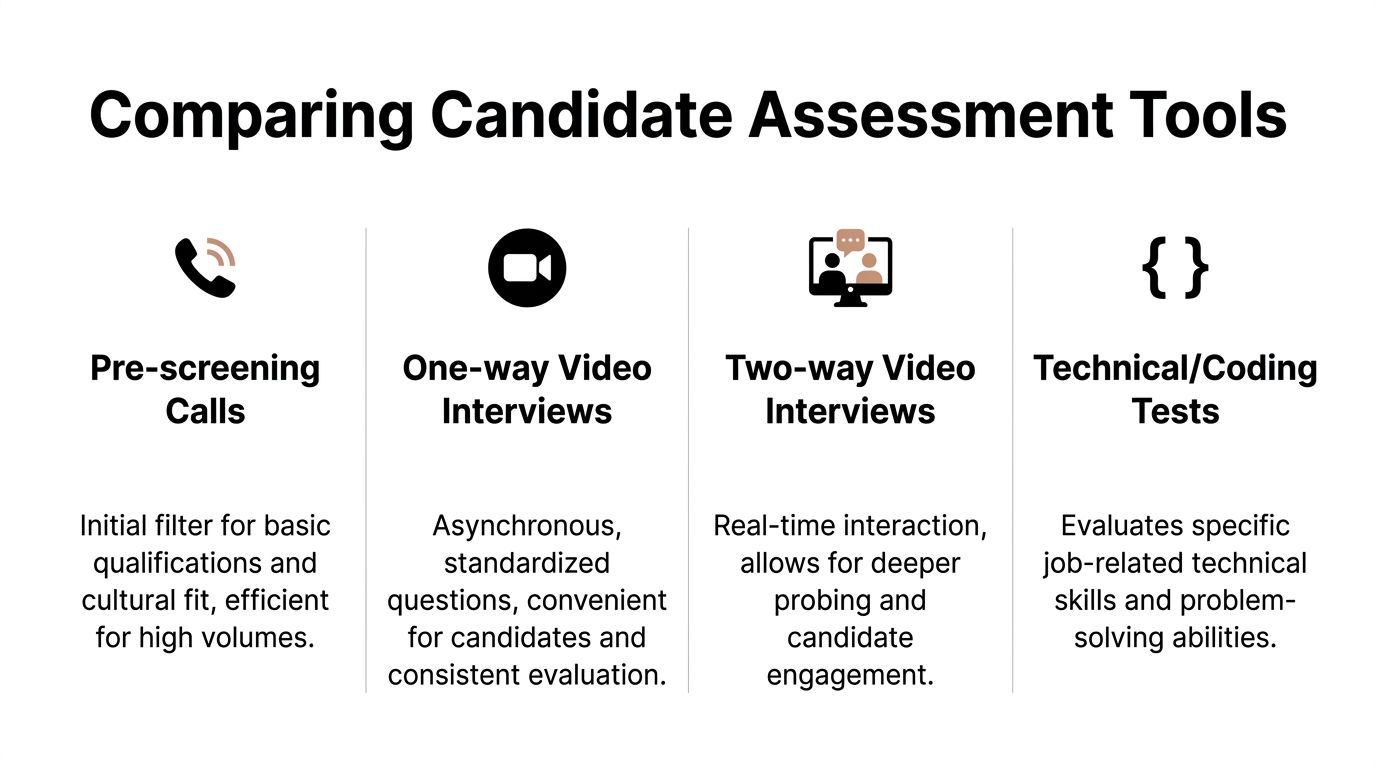
Comparison of candidate assessment tool types
| Tool Type | What It Measures | Best For | Example |
|---|---|---|---|
| Pre-screening calls | Basic fit, communication, availability, motivation | High-volume early filtering | Phone screening for customer support hiring |
| One-way video interviews | Structured communication, clarity, role interest | Distributed hiring where scheduling is hard | Recorded answers to standard screening prompts |
| Two-way video interviews | Live interaction, probing depth, stakeholder fit | Mid to late stage evaluation | Recruiter or manager video interview |
| Technical or coding tests | Job-specific technical capability and problem solving | Engineering, data, product analytics roles | Coding challenge or technical task |
| Cognitive assessments | Reasoning, learning agility, pattern recognition | Roles requiring analytical ability | Structured aptitude or reasoning test |
| Psychometric assessments | Behavioural tendencies, work style, interpersonal orientation | Team-fit discussions, support roles, leadership contexts | Personality or behavioural questionnaire |
| Job simulations or work samples | Real-task performance | Content, operations, design, support, sales | Draft response, case exercise, role-play |
When each assessment type works best
Pre-screening calls are useful when you need a quick early pass on basics. They work well for shift fit, notice period, salary alignment, location constraints, and role interest. They don't work well when teams try to judge deep competence from a brief conversation.
One-way video interviews can create consistency at scale. Every candidate receives the same questions, and reviewers can score against the same rubric. They tend to work best when the questions are short, relevant, and tied to real scenarios. They work badly when teams use them as a lazy replacement for all human interaction.
Two-way video interviews are strongest when you need to probe, allowing hiring managers to test judgement, ask follow-ups, and explore trade-offs. The quality depends almost entirely on the interviewer's discipline. An unstructured live interview is still an unstructured interview, whether it happens in person or on a screen.
Technical and coding tests should be mandatory for technical roles where output quality matters. Tools such as Codility and WeCP are often used for this purpose because they make skill demonstration visible before the team commits significant interview time.
Psychometric and cognitive assessments are useful, but only when interpreted properly. They shouldn't become personality theatre. Use them to enrich decisions, not to let a dashboard pretend it understands a human being completely.
Use assessments to narrow uncertainty, not to create false certainty.
The best assessment stack is layered. Start with light, role-relevant filters. Add deeper evaluation only when the candidate has earned the next step. That keeps the process fairer for applicants and far more efficient for the business.
How to Choose the Right Assessment Tools
Most assessment buying decisions go wrong because the shortlist is built around features, not hiring outcomes. Demos look polished. Dashboards impress stakeholders. Then the tool goes live and the team realises it doesn't match the actual workflow, candidate profile, or compliance expectations.
The shortlist criteria that matter
Start with predictive validity. Ask a simple question. Does this tool measure something that is meaningfully related to success in the role? A beautiful interface won't help if the test itself is weak, generic, or disconnected from the job.
Candidate experience comes next. In India, candidate behaviour is shaped by device access, bandwidth, language comfort, and time pressure. If a tool is clunky on mobile, confusing in its instructions, or slow to load, the assessment result becomes contaminated by the platform experience rather than candidate ability.
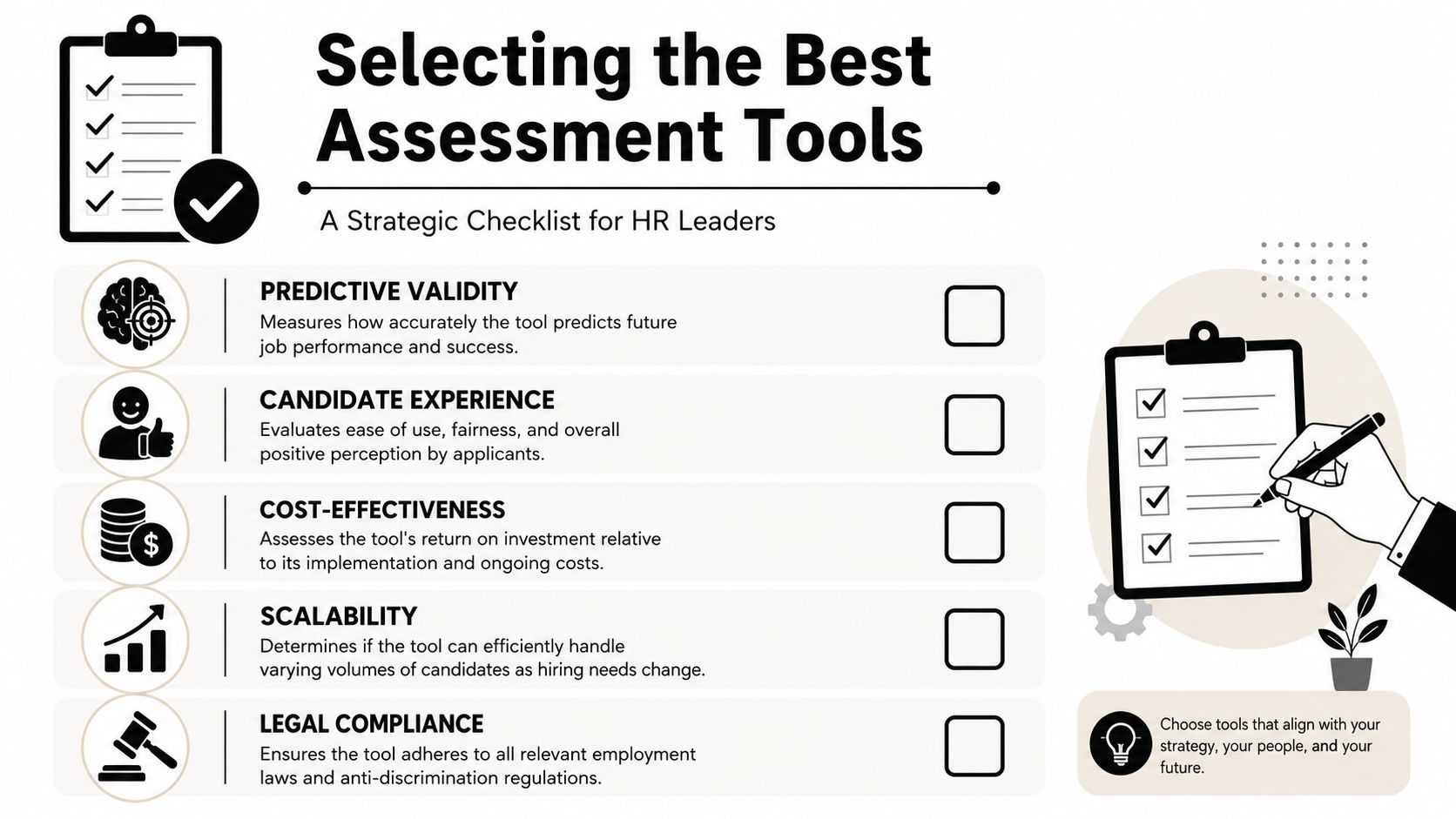
Then assess role relevance. Broad test libraries can be useful, but only if your team can configure them well. A customer support role may need situational response and language clarity. A developer role needs coding and problem solving. A field sales role may need communication and judgement in realistic scenarios. The more generic the assessment, the less useful the result tends to be.
Scalability and integration matter because operational friction destroys adoption. If recruiters have to move manually between the ATS, the test platform, email threads, and score spreadsheets, the process will become inconsistent fast. The tool should fit your recruitment operating model, not force the team into awkward workarounds.
Questions worth asking every vendor
Use these during evaluation meetings:
- Show mobile usability: Ask the vendor to demonstrate the complete candidate flow on a phone, not just on a desktop dashboard.
- Ask for localisation detail: If you hire across regions, ask how the tool handles language preference, communication clarity, and bandwidth constraints.
- Request score explainability: Recruiters and hiring managers need to understand what the score means, not just receive a rank order.
- Probe workflow fit: Check how scheduling, reminders, status changes, and reviewer access work inside your existing ATS process.
- Review governance: Ask how candidate data is stored, who can access it, and how audit trails are maintained.
- Challenge fairness claims: If a vendor says the tool is unbiased, ask what evidence they have for your market and your use case.
Don't buy the platform that looks smartest in a demo. Buy the one your recruiters can run consistently and your candidates can complete without friction.
A practical buying decision usually comes down to this. Choose the tool that gives stronger evidence, creates less candidate drop-off, fits into recruiter workflow, and can withstand scrutiny from legal, HR, and business leadership.
Implementing Assessments and Mitigating Bias
Buying the platform is the easy part. Implementation is where talent teams discover whether their assessment strategy is serious or superficial.
A good roll-out starts with process design. Decide which roles need which assessments, where each step sits in the funnel, who reviews results, what score thresholds trigger movement, and how exceptions are handled. If those rules stay vague, recruiters will bypass the system the first time hiring pressure spikes.
Design the flow before you buy the tool
In India, sequencing matters more than many global playbooks acknowledge. A critical gap exists in validating AI tools for the Indian market, and 83% of Indian candidates drop off assessments longer than 45 to 60 minutes, according to Pin's discussion of pre-employment assessment tools. That makes assessment design a candidate experience issue as much as a measurement issue.
For high-volume roles, a practical sequence often looks like this:
- Start light: Use a short eligibility or screening layer to remove obvious mismatch early.
- Test one core capability next: Don't stack multiple heavy assessments before the candidate has shown basic fit.
- Keep the total journey compact: Long, fragmented assessment paths create fatigue and abandonment.
- Match the medium to the market: If your candidates are likely to apply and respond on mobile, the process must work cleanly on mobile.
- Use humans where interpretation matters: Recruiters and hiring managers should spend time on nuance, not repetitive filtering.
Many teams create their own drop-off problem by front-loading too much effort. A lengthy cognitive test, followed by a recorded video, followed by a coding task, followed by a live interview is not rigorous. It's undisciplined funnel design.
Bias and compliance need local validation
Global tool marketing often presents a danger. A vendor may claim fairness because the product has been used internationally or because it was benchmarked on a broad dataset. That's not enough for India.
The Indian hiring environment involves multiple languages, varied educational pathways, strong differences in digital access, and diverse communication norms. If an AI screening tool hasn't been validated for those conditions, your team can't assume its decisions are fair. You also can't assume that a strong result in one market translates cleanly into another.
What should a bias mitigation process include?
- Role-based validation: Confirm that the assessment predicts success for the specific job family, not hiring in general.
- Regional review: Check whether language, accent, response style, or device constraints affect outcomes.
- Human override rules: Define when recruiters can escalate a candidate for review despite a weak automated result.
- Adverse impact reporting: Track outcomes by relevant groups where legally and operationally appropriate.
- Ongoing review: Revalidate after role changes, market changes, or major shifts in candidate mix.
If a vendor cannot explain how the tool behaves in India, the burden of risk shifts to your organisation.
Bias control isn't only an ethics issue. It's a business control. Poorly validated assessments screen out capable candidates, distort diversity outcomes, and expose the company to avoidable challenge. In a competitive market, that's a hiring quality problem long before it becomes a legal one.
The Rise of AI-Driven Interview as a Service
The next shift in assessment strategy isn't just better testing. It's the packaging of screening, interviewing, and structured evaluation into an operational service model.
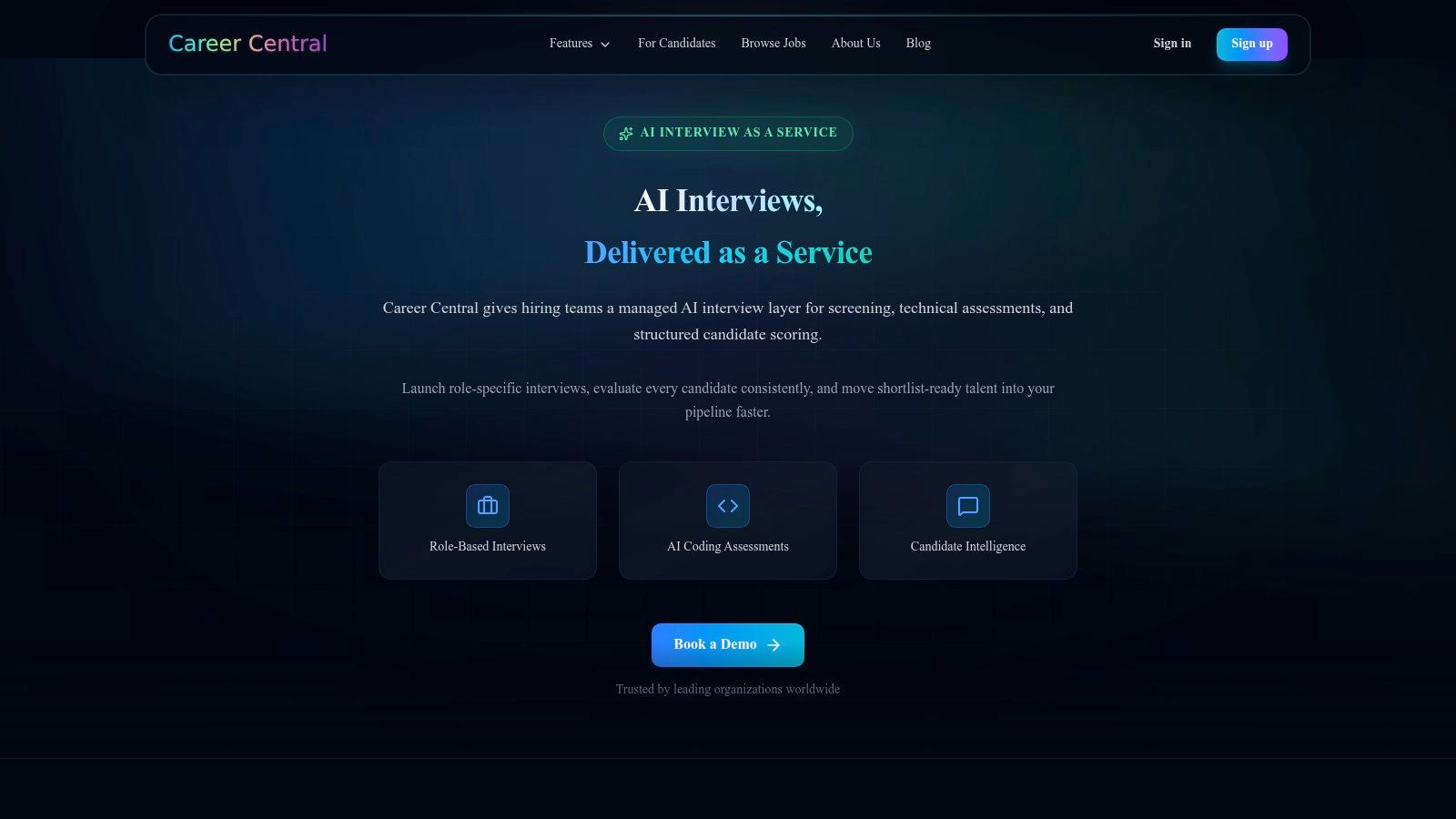
Instead of asking internal recruiters to manually run every phone screen, first-round conversation, and technical filter, Interview as a Service moves those repetitive top-of-funnel steps into a more standardised system. In practice, that means structured phone screening, first-round interviews, and technical assessments can be delivered with greater consistency and far less calendar burden.
Why this model is gaining traction
This approach solves a real operating problem. Recruiters shouldn't spend most of their week repeating the same screening questions, coordinating schedules, and trying to document inconsistent notes from hurried calls. That work is necessary, but it doesn't require the highest-value human judgement at every moment.
An Interview as a Service model works best when it does three things well:
- Standardises the early funnel: Every candidate gets the same core questions and evaluation criteria.
- Creates structured output: Hiring teams receive comparable responses, not scattered notes.
- Scales without chaos: Volume can increase without forcing recruiters into reactive triage mode.
That makes the model especially relevant for organisations hiring across multiple roles or geographies, where consistency is hard to maintain manually. It also fits businesses that want a cleaner audit trail for hiring decisions.
For a closer look at how the model is structured in practice, the Interview as a Service approach described by Career Central is a useful reference point.
Where human recruiters still matter most
This doesn't remove recruiters from hiring. It sharpens where they add the most value.
Recruiters still need to calibrate role requirements, manage candidate relationships, coach hiring managers, interpret edge cases, and protect experience when the process becomes complex. Hiring managers still need to assess judgement, team fit, and business context. The service layer handles repetition. Humans handle interpretation.
Here's a product walk-through that shows the kind of workflow this model supports:
The strongest use case for AI-driven interviewing isn't replacing people. It's making sure people spend their time where their judgement is worth the cost.
Measuring the ROI of Your Assessment Strategy
If you can't explain the business value of assessment, the programme will always be vulnerable to budget pressure. Talent leaders need an ROI story that goes beyond “the team likes the platform”.
The metrics leadership actually cares about
Start with operational outcomes tied to hiring quality and delivery speed:
- Time to hire: Measure whether qualified candidates move through the funnel faster after assessment adoption.
- Interview load: Track whether recruiters and managers spend less time interviewing poorly matched applicants.
- Quality of hire: Compare assessment outcomes with later manager feedback, ramp-up quality, or early performance review patterns.
- Offer confidence: Look at whether hiring managers make faster, more consistent decisions with structured evidence.
- Retention signals: Review whether hires selected through the new process remain stronger fits over time.
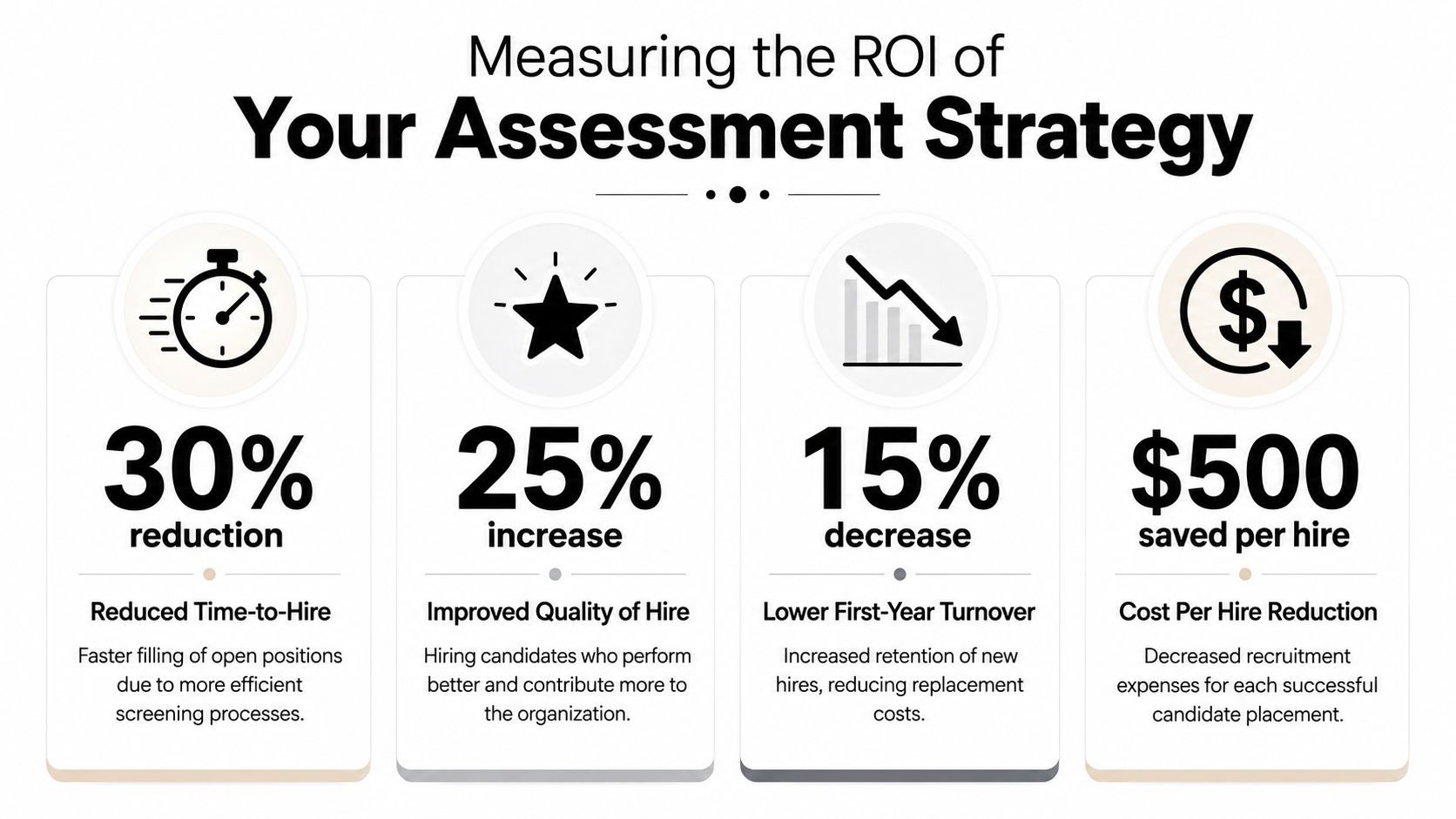
Don't promise perfect attribution. Hiring outcomes always reflect multiple inputs. What matters is showing a credible relationship between a more structured process and stronger talent decisions.
A simple ROI story for the business
A practical ROI narrative usually sounds like this:
- The old process relied too heavily on resume screening and unstructured interviews.
- That created wasted interviewer time, uneven judgement, and preventable mis-hires.
- The new process inserts structured, role-relevant candidate assessment tools earlier in the funnel.
- Recruiters now spend time on better-matched candidates, and managers decide with stronger evidence.
- The business benefits through improved hiring efficiency, better role fit, and lower process friction.
Build the case with before-and-after process metrics from your own hiring environment. Leadership rarely needs a complicated model. They need a clear story that connects the tool to team capacity, hiring quality, and business risk reduction.
If your team is rethinking how to run phone screening, first-round interviews, and coding assessments at scale, Career Central is worth a look. It's built around AI-driven Interview as a Service for organisations that want a more structured, scalable, and consistent hiring process without overloading recruiters and hiring managers.
Composed with Outrank app