Your talent team is probably dealing with the same mess I see in boardrooms and hiring reviews every week. Application volume is up, hiring managers want shortlisted candidates yesterday, recruiters are buried in coordination work, and the first interview round has become an expensive bottleneck. Everyone says they care about candidate quality. Then they run a process that forces strong candidates to wait while weak candidates consume interviewer time.
That's the environment where interview as a service has become attractive. Not because it's fashionable, but because internal recruiting teams can't keep scaling manual screening without damaging speed, consistency, or recruiter focus. In India especially, the pressure is sharper. Hiring is more digital, startup activity is high, and teams need structured processes that can handle volume without collapsing into chaos.
The problem is that most discussion about interview as a service is too clean. Vendors promise speed, standardisation, and bias reduction. Some of that is real. Some of it is incomplete. If you're a CHRO, the essential decision isn't whether IaaS sounds modern. It's whether it improves hiring economics without subtly harming fit, fairness, or retention.
Table of Contents
- What Is Interview as a Service
- The Business Case for IaaS Your ROI and Strategic Benefits
- Understanding IaaS Models and Core Technology
- Your IaaS Implementation Roadmap
- How to Choose the Right IaaS Partner
- Common IaaS Pitfalls and How to Avoid Them
- Frequently Asked Questions About IaaS
What Is Interview as a Service
Interview as a service is the outsourcing of structured interview work to a specialist platform or partner. In practice, that usually means someone else handles high-volume early-stage screening, first-round interviews, technical assessments, or coding evaluations using a mix of trained interviewers, workflow automation, and AI-assisted tools.
Think of it as hiring an expert screening bench on demand instead of asking your internal recruiters and engineers to absorb every first-round interview themselves. Your team keeps control of hiring standards, decision rights, and final-round judgment. The IaaS partner takes over repetitive operational load.
What it looks like in the real world
A head of talent at a fast-growing company often starts with a familiar complaint. Recruiters are spending too much time arranging calls, chasing panellists, and filtering candidates who should have been screened out earlier. Hiring managers then complain that shortlisted candidates are inconsistent because every interviewer runs a different process.
Interview as a service solves that specific problem. It doesn't replace hiring leadership. It creates a more organised front end to the funnel.
Typical use cases include:
- High-volume technical hiring: Early coding assessments and technical screens happen outside the engineering team's calendar.
- Distributed hiring: Video-first first rounds create consistency when candidates and interviewers are spread across cities.
- Specialist role pipelines: Structured screening prevents ad hoc evaluation when internal teams lack interview discipline.
- Recruiter bandwidth constraints: Talent teams stop burning senior recruiter time on repeatable screening steps.
Practical rule: If your best internal interviewers are spending most of their time rejecting obvious mismatches in round one, your process is misallocated.
What IaaS is not
It's not a magic outsourcing layer that fixes a broken hiring strategy. If your role definitions are vague, scorecards are weak, or hiring managers disagree on what good looks like, IaaS will only industrialise that confusion.
It's also not just software. The useful version of interview as a service combines process design, structured evaluation, scheduling discipline, and candidate handling. That's why I advise CHROs to treat it as an operating model decision, not a procurement line item.
The right mindset is simple. Use IaaS to remove low-value operational friction from the top of the funnel so your internal team can focus on calibration, final selection, and closing the right people.
The Business Case for IaaS Your ROI and Strategic Benefits
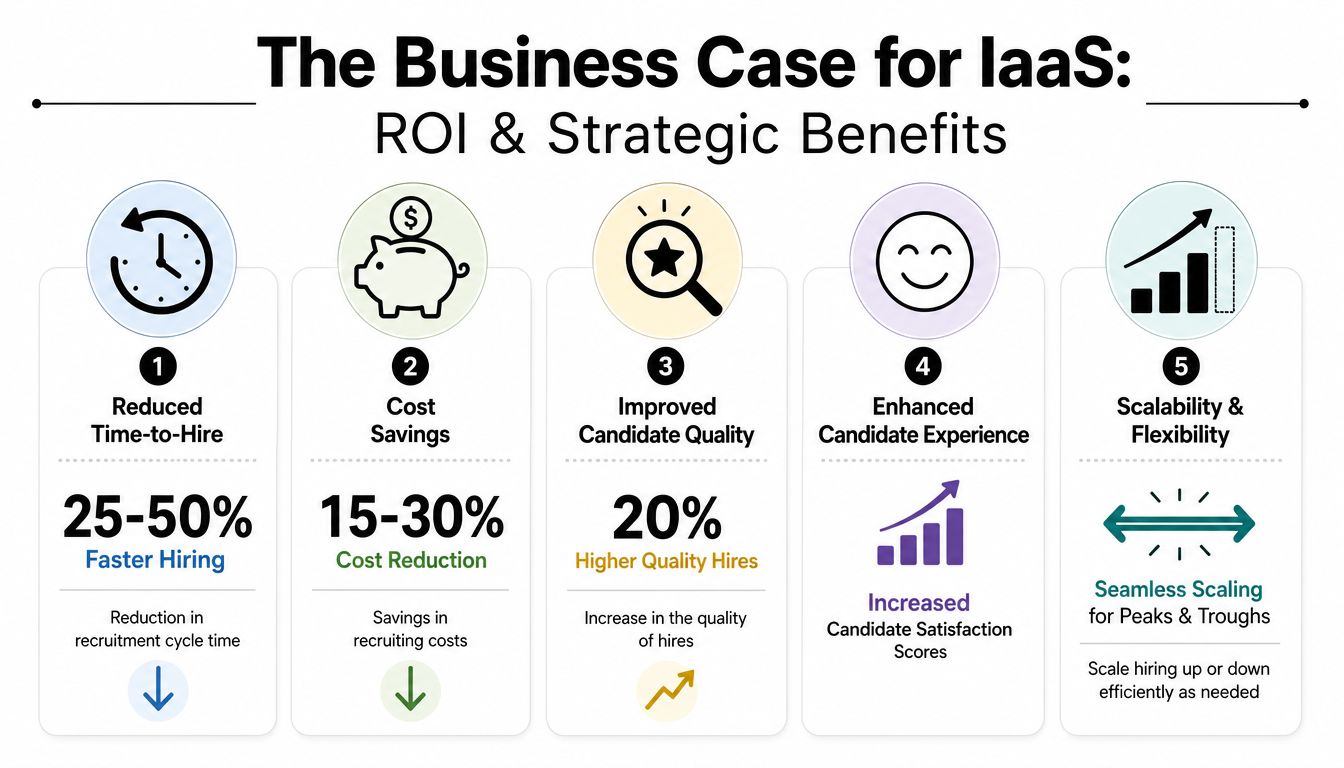
A CHRO approves an aggressive hiring plan, the talent team cuts time-to-screen, and dashboards look better within weeks. Three months later, quality concerns surface in one region, hiring managers complain about weak shortlists, and early attrition starts creeping up. That is the business case for interview as a service. It is not just about hiring faster. It is about deciding whether speed, consistency, and capacity gains outweigh the risk of poor screening design, local bias, and weaker retention.
The ROI case starts with labor economics. Every unnecessary first-round interview consumes recruiter capacity, hiring manager attention, and scheduling effort that your team should spend on calibration, selection, and closing. IaaS pays off when it removes repeatable work from expensive internal talent and turns a variable bottleneck into a controlled operating layer.
In Asia Pacific, investment in digital hiring infrastructure continues to rise. The Applicant Tracking Systems market is in a period of rapid growth and is projected to expand at a CAGR of 11.6% through 2030, according to MarketsandMarkets on ATS market growth in Asia Pacific. The point is simple. Your competitors are building faster hiring systems. If your first-round process still depends on manual coordination and inconsistent screening, you are choosing higher cost and slower execution.
Where the return actually comes from
Do not ask whether IaaS reduces recruiting cost in general. Ask where your current process is wasting money.
The waste usually shows up in four areas:
- Recruiter capacity loss: Recruiters spend too much time on scheduling, routine screening, and status management.
- Hiring manager productivity loss: functional leaders sit in low-yield first rounds that do not require their judgment.
- Conversion loss: candidates disengage when the process is slow, unclear, or inconsistent.
- Spike-driven inefficiency: every hiring surge forces reactive interviewer allocation, which hurts both speed and quality.
That is where the financial return comes from. Lower coordination load. Fewer senior hours spent on weak-fit candidates. Better throughput without adding permanent recruiting headcount.
Why this is a strategic decision
The stronger argument for IaaS is not cost reduction. It is control.
A well-run IaaS model gives your talent function a standard for early-stage evaluation across business units, geographies, and hiring spikes. That matters in India and other high-volume, high-variance markets, where local language patterns, college-brand assumptions, accent bias, and city-based preferences can subtly shape screening outcomes. If your provider uses AI, you need to test for those localized biases instead of assuming automation makes the process fair.
Speed can also create a second-order problem. If accelerated screening pushes more marginal hires into the funnel and your final-stage calibration is weak, attrition shows up later. Faster hiring with worse retention is not efficiency. It is deferred cost.
The interview scheduling software market reflects the broader shift toward automated hiring operations. It is projected to grow from $2.295 billion in 2025 to $4.651 billion by 2035 at a CAGR of 7.32%, according to Market Research Future on interview scheduling software. Scheduling tools solve one part of the problem. IaaS goes further by standardizing how the first serious screening layer gets done.
If your recruiters still own every phone screen, your hiring model is absorbing cost in the wrong place.
The video below gives a useful high-level view of how these services fit into modern recruiting operations.
What good IaaS changes inside the talent function
You should expect operating improvements, not magic. Good IaaS usually improves five things:
- Screening consistency: candidates face the same questions, score criteria, and handoff standards.
- Capacity planning: hiring teams can handle surges without dragging senior employees into round-one volume.
- Role clarity: recruiters run process control, hiring managers step in where judgment matters, and escalation points become clearer.
- Data discipline: scorecards and rejection reasons become easier to audit across teams and locations.
- Candidate experience: the early process feels organized, which improves trust and response rates.
One example in this category is Career Central, which offers AI-driven phone screening, first-round interviews, and coding assessments for organisations. The right question is not whether a provider can move interviews faster. It is whether the provider can reduce operational drag, maintain quality thresholds, and avoid introducing new bias into your funnel.
If the answer is yes, the business case is strong. If the answer is speed alone, keep your wallet closed.
Understanding IaaS Models and Core Technology
Not all interview as a service models are the same. Some vendors are mostly workflow tools. Others provide managed screening. A few combine AI-led interactions, automated video rounds, and assessment workflows into one operating layer. If you don't understand the model, you'll buy the wrong thing.
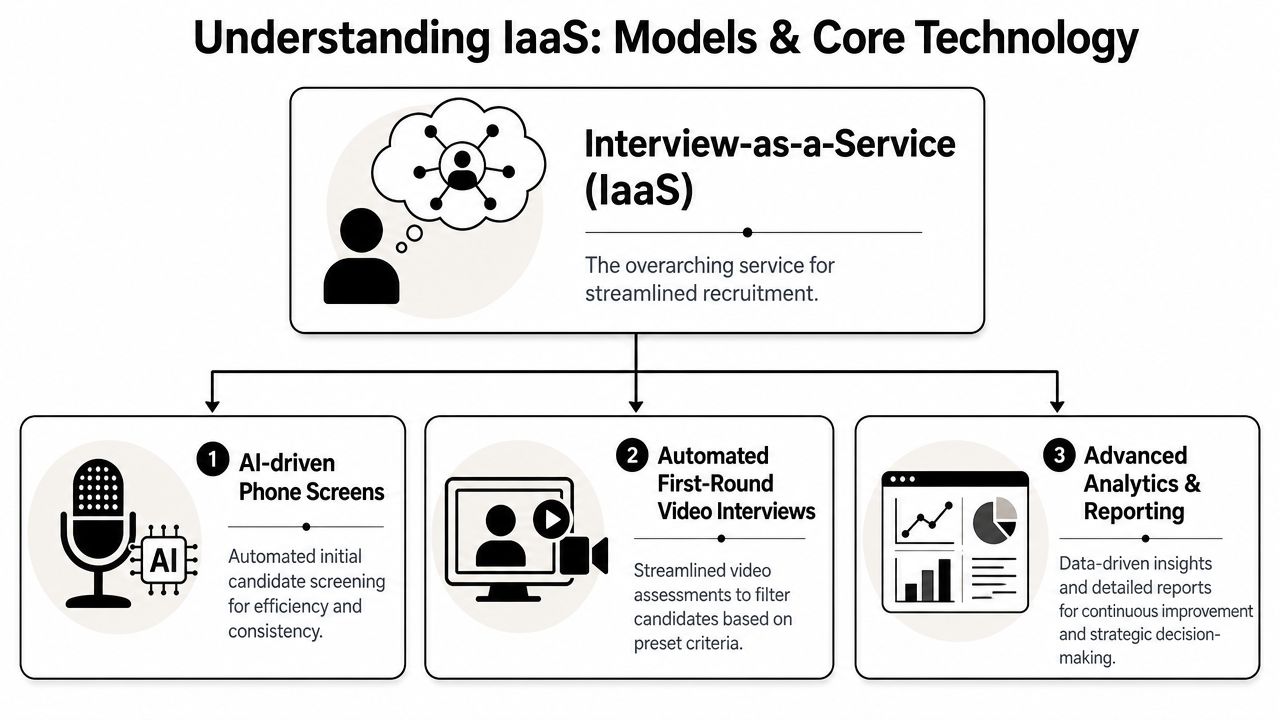
Use a simple lens. Every IaaS setup is trying to do one of three jobs: filter, evaluate, or prioritise.
AI-driven phone screens
This is the fastest way to clear top-of-funnel congestion. Candidates answer structured questions through automated phone or voice-enabled workflows. The system captures responses, checks for role-fit signals, and presents outcomes in a standardised format.
It's useful when your recruiters are drowning in early conversations that don't require senior judgment. For roles with clear baseline criteria, this model saves time and improves consistency.
The operational impact can be substantial. Outsourcing technical interview rounds via IaaS can reduce the average time-to-screen per candidate from 14 days to 4.2 days, while cutting interviewer coordination latency by 71%, according to FloCareer's explanation of Interview as a Service.
What problem does it solve? Queue management. It stops qualified candidates from sitting idle while recruiters chase calendars.
Automated first-round video interviews
These are structured video interviews, usually asynchronous or lightly moderated, where candidates respond to predefined prompts. The strength here is standardisation. Every candidate gets the same questions, in the same sequence, under the same baseline conditions.
This model works well when you need to compare communication, clarity, baseline role understanding, and motivation across a large pool. It's especially effective for distributed teams and roles where scheduling live first rounds creates unnecessary delay.
Use it carefully. Video can improve consistency, but only if your scorecard is disciplined. If your evaluation criteria are vague, all you've done is create a cleaner recording of a weak process.
Technical coding assessments
For engineering hiring, this is often where IaaS becomes most valuable. A structured technical screen or coding evaluation prevents senior developers from spending early-stage time on candidates who haven't met role thresholds.
Good technical assessment models usually include:
- Role-matched tasks: Exercises should reflect the actual work, not trivia.
- Proctoring and integrity controls: Basic safeguards reduce noise in results.
- Evaluation rubrics: Reviewers need to assess problem-solving quality, not just final output.
- Candidate feedback standards: Even rejected candidates should experience a fair process.
Analytics and reporting
This is the layer most buyers underweight. The core value of interview as a service isn't just automation. It's the visibility that comes from structured data.
A strong provider should show you patterns such as where candidates drop off, where interviewers disagree, which roles produce the most false positives, and where scorecards fail to predict later-stage success. Without that reporting layer, IaaS becomes outsourced activity instead of managed improvement.
Don't buy a platform because it uses AI. Buy it if it makes interviewer judgment more consistent, measurable, and auditable.
Matching the model to the hiring need
Different hiring problems need different IaaS components.
| Hiring situation | Best-fit IaaS component | Why it works |
|---|---|---|
| High-volume screening backlog | AI-driven phone screens | Clears early noise quickly |
| Distributed first-round hiring | Automated video interviews | Standardises candidate comparison |
| Engineering hiring pressure | Coding assessments | Protects technical team capacity |
| Poor process visibility | Analytics and reporting | Improves calibration and accountability |
If a vendor tries to sell the same workflow for every role family, walk away. Sales hiring, customer support hiring, and backend engineering hiring don't need the same screening architecture.
Your IaaS Implementation Roadmap
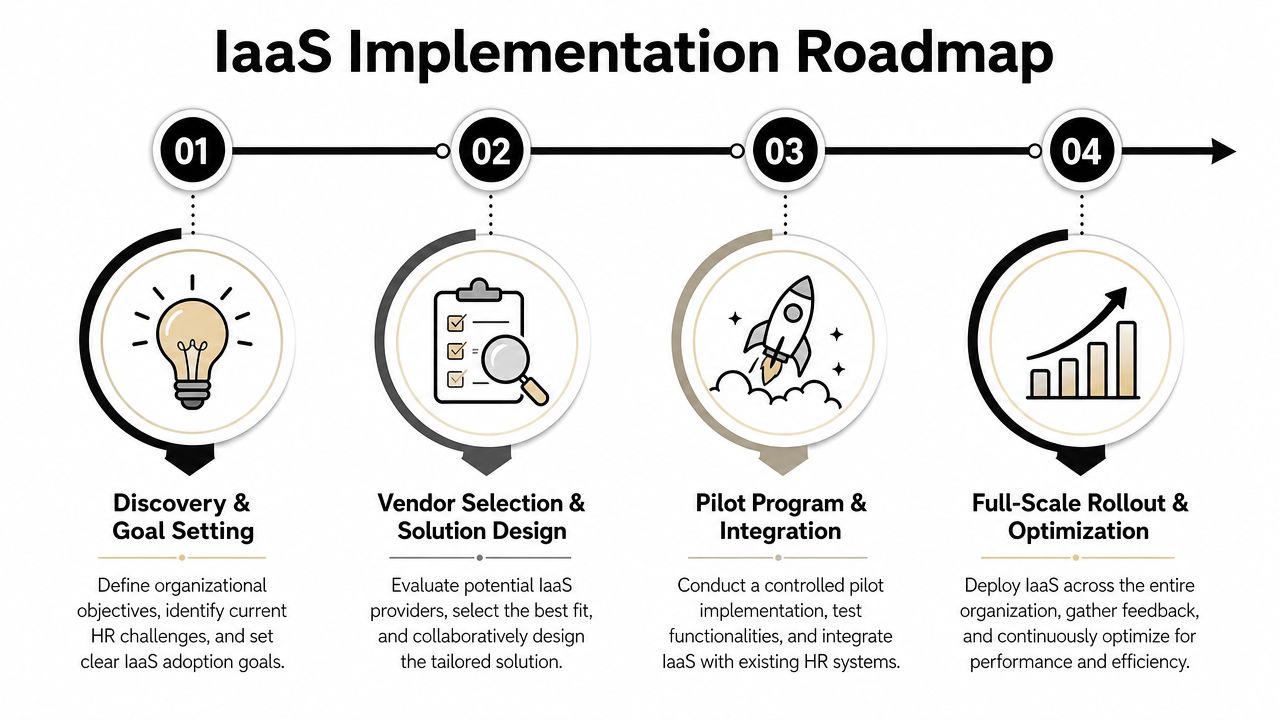
Most IaaS roll-outs fail for a boring reason. The technology works, but the organisation never decides what problem it's solving. A rushed rollout creates internal resistance, weak adoption, and noisy results. A disciplined rollout makes interview as a service look far more effective because the operating assumptions are clear from day one.
The market conditions support adoption. In India, the video interviewing software market is projected to grow from US$ 250.06 million in 2022 to US$ 891.86 million by 2030, according to The Insight Partners on India's video interviewing software market. That tells me the infrastructure and user behaviour around remote interviewing are already maturing. The implementation challenge is no longer technology acceptance. It's execution discipline.
Phase 1 Discovery and goal setting
Start with the business problem, not the platform demo. Be specific. Are you trying to shorten time-to-screen, reduce engineering interviewer load, improve scorecard consistency, or create a more structured candidate experience?
Focus on three actions:
- Map the current bottleneck: Identify exactly where interviews stall.
- Define success in operational terms: Choose a small set of outcomes tied to speed, quality, or recruiter capacity.
- Align hiring leaders early: If business stakeholders think IaaS is replacing judgment, they'll resist it.
A useful test question is this: what internal work do you want your recruiters and hiring managers to stop doing?
Phase 2 Vendor integration and solution design
Many teams over-focus on integration mechanics and ignore workflow design. Yes, your ATS, scheduling stack, and reporting environment matter. But interview architecture matters more.
Build the model around role families, not around software defaults.
- Set scorecards first: Interview criteria need to exist before automation is layered in.
- Define escalation rules: Decide when a candidate moves from automated screening to human review.
- Establish privacy controls: Candidate data handling, retention, and access policies need legal and security oversight.
Board-level concern: If you can't explain how a candidate was screened, scored, and advanced, you don't have a scalable hiring process. You have an outsourcing risk.
Phase 3 Pilot programme and feedback loop
Run a pilot with one role cluster, one geography, or one business unit. Don't launch across the enterprise because one vendor demo looked polished.
The pilot should test four things:
- Candidate experience: Is the process clear and respectful?
- Internal usability: Can recruiters and hiring managers interpret the results easily?
- Decision quality: Are shortlisted candidates stronger?
- Operational flow: Does the process reduce coordination pain in practice?
Collect qualitative feedback aggressively. Early friction usually appears in scorecard interpretation, manager confidence, and candidate communication.
Phase 4 Full-scale rollout and optimisation
Scale only after you've adjusted the process. Full rollout is less about deployment and more about governance.
Use a repeating review rhythm:
| Governance area | What to review |
|---|---|
| Role calibration | Whether scorecards still match actual hiring needs |
| Candidate experience | Whether automation feels clear, fair, and timely |
| Hiring manager adoption | Whether leaders trust and use the outputs |
| Process performance | Whether the original bottleneck is actually shrinking |
The companies that get value from IaaS treat it like a managed operating system. The ones that struggle treat it like a plug-in.
How to Choose the Right IaaS Partner
Choosing an IaaS provider is a buyer-discipline exercise. The wrong partner creates a polished mess: attractive interface, weak evaluation logic, poor transparency, and no accountability when hiring managers challenge results.
Don't start with feature lists. Start with failure modes. Ask what could go wrong if this provider handled thousands of candidate interactions on your behalf. That frame leads to better questions.
The criteria that actually matter
The first filter is workflow fit. Can the provider support different interview structures for different role families, or are they forcing every job into the same assessment mould? If the answer is one-size-fits-all, they'll create friction fast.
The second filter is transparency. You need to understand how screening decisions are made, what recruiters and managers can review, and where human override sits. If the provider can't explain scoring clearly, reject them.
Third, test implementation reality. Some vendors promise easy deployment but expect your team to do all the heavy lifting. You want a partner that can support configuration, calibration, and issue resolution without turning your TA team into unpaid systems integrators.
IaaS Vendor Evaluation Checklist
| Evaluation Criteria | What to Look For | Red Flags |
|---|---|---|
| ATS integration | Clean data flow, status sync, minimal manual duplication | Recruiters need to re-enter candidate data |
| Interview design flexibility | Different workflows by role family, region, and seniority | One fixed screening model for every role |
| Scoring transparency | Clear rubrics, reviewable outputs, human override options | Opaque scores with no explanation |
| Candidate experience | Branded communication, clear instructions, sensible escalation paths | Robotic interactions and confusing hand-offs |
| Security and privacy | Documented controls, access governance, retention policies | Vague answers on data handling |
| Support model | Named contacts, response commitments, implementation guidance | “Submit a ticket” as the primary support process |
| Reporting depth | Actionable dashboards tied to hiring decisions | Vanity metrics with little operational value |
| Localisation capability | Support for regional language, context, and hiring norms | Generic global model with poor local fit |
Questions to ask in the demo
Don't let the sales team steer the meeting. Push into uncomfortable territory.
- Show me a scored interview output: Not the dashboard overview. The actual evaluator view.
- Explain a false positive: How does the system catch candidates who look strong in screening but fail later?
- Show local adaptation: How is the model adjusted for Indian hiring contexts, accents, and educational backgrounds?
- Walk through an exception case: What happens when a hiring manager disagrees with the recommendation?
- Clarify ownership: Who updates workflows when roles change?
A serious vendor will answer hard questions directly. A weak vendor will hide behind product language and implementation promises.
What good partnership looks like
A strong IaaS partner behaves like an extension of talent operations, not just a software seller. They care about calibration, stakeholder adoption, and defensible process design. They don't just automate interviews. They help you operationalise hiring standards.
If you're comparing vendors and one team spends more time discussing workflow governance than glossy AI claims, that's usually the more mature partner.
Common IaaS Pitfalls and How to Avoid Them
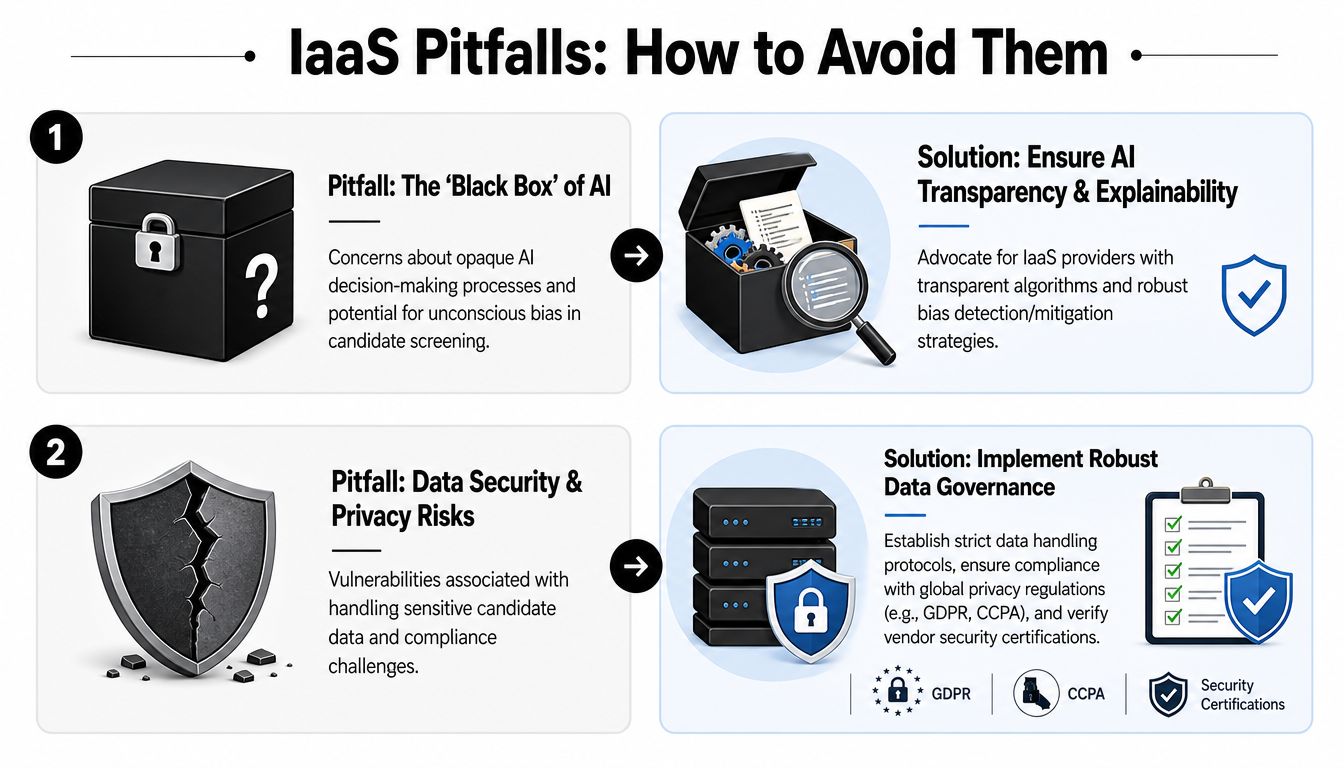
Most vendor content becomes useless by celebrating speed and standardisation while ignoring two risks that matter in real hiring environments. First, AI can create new bias even when it removes some human inconsistency. Second, faster hiring can backfire if your process gets shallow.
In India, those risks aren't theoretical. A 2024 ISB study found that 38% of AI recruitment tools in India showed bias against candidates from non-metro educational backgrounds, and a 2025 NASSCOM report found that early attrition within 6 months rose by 22% in Indian IT firms using IaaS, according to Docsie's summary of Interview as a Service risks and outcomes.
The black box problem in local hiring
A lot of IaaS rhetoric says AI reduces bias. That's only half true. Structured processes can reduce interviewer inconsistency. But if the model behind the screening process is poorly adapted to local context, it may automate a different bias.
That matters in India because local dialects, non-metro educational backgrounds, and regional communication styles can all be misread by generic evaluation systems. A candidate from a tier-2 or tier-3 city shouldn't be penalised because the model was built around a narrow profile of “professional polish”.
What to do instead:
- Demand explainability: Ask how candidate signals are weighted and reviewed.
- Insist on localisation evidence: The provider should show how the system handles Indian hiring context.
- Audit outcomes by candidate segment: Look for patterns that suggest adverse impact.
- Keep human review in edge cases: Automation should support judgment, not lock it out.
The speed trap
Reducing hiring timeline is useful. Chasing speed as the main outcome is reckless. If the screening model overweights technical readiness and underweights long-term fit, you'll fill seats faster and lose people sooner.
That's exactly why attrition data matters. If candidates clear a highly standardised process but leave within months, your hiring engine is producing throughput, not quality.
A better operating rule is this:
Fast hiring is only a win if the people you hire still look like good decisions six months later.
The governance gap
Many organisations implement IaaS without putting anyone in charge of ongoing fairness, calibration, and process review. That's a mistake. Once a system is live, it needs active governance.
Use this mitigation checklist:
| Pitfall | What causes it | What to do |
|---|---|---|
| Localised AI bias | Weak regional training or narrow candidate assumptions | Audit outcomes and require transparent review paths |
| Shallow hiring for speed | Over-optimised early screening focused on fast elimination | Add structured culture and role-context evaluation later in the process |
| Blind trust in automation | Teams assume system outputs are objective | Train managers to challenge and calibrate results |
| Candidate distrust | Process feels impersonal or opaque | Explain the process clearly and keep human contact points visible |
I'm not arguing against interview as a service. I'm arguing against naive adoption. The right model can improve hiring operations. The wrong model can scale bad decisions efficiently.
Frequently Asked Questions About IaaS
Is interview as a service only suitable for technical hiring
No. Technical hiring is often the first use case because interview load is high and specialist interviewer time is expensive. But IaaS also fits sales, support, operations, customer success, and other roles where structured early assessment improves consistency. The decision should come down to repeatability. If a role can be assessed against a clear scorecard in the first stages, IaaS can help.
How are IaaS services usually priced
Providers usually charge per interview, per assessment, or through a subscription or managed-service model. Focus on total hiring economics, not headline price. A lower per-interview fee means little if the process creates weak shortlists, poor candidate experience, or early attrition. Ask for full pricing detail on setup, integrations, interviewer calibration, reporting, support, and workflow changes before you compare vendors.
How do we keep the candidate experience human
Design it deliberately. Candidates should know why an external interview layer exists, what will be assessed, how long the process will take, and where human interaction happens. Keep recruiter contact visible, especially after automated screening or standardised first rounds. In markets like India, this matters even more because candidates often read silence or rigid automation as disinterest or disrespect.
Should we use IaaS for every role
Use IaaS selectively. It works best where early-stage evaluation is structured, repeatable, and operationally heavy. It is a weaker fit for executive hiring, confidential searches, niche leadership roles, and jobs where relationship judgment matters from the first conversation. Treat IaaS as a system for specific hiring bottlenecks, not as a default model across the whole organisation.
What's the best first step for a CHRO
Start with one business problem. Pick the role family where interviewer capacity is stretched, hiring quality is uneven, or time-to-slate is too slow. Then test one provider against clear success measures: shortlist quality, interviewer productivity, candidate completion rates, offer conversion, and retention after hire.
If your team is considering interview as a service, review Career Central as one possible provider and assess it with discipline. The decision should rest on three questions. Will it reduce hiring cost without weakening judgment. Will it improve consistency without introducing localised bias. Will faster screening produce hires who still look like strong decisions six months later. If you cannot answer all three with evidence, do not scale.
Prepared with Outrank