

You've just finished a 45-minute interview. The panel is discussing whether the candidate is “strong”, “not quite right”, or “a good cultural fit”, but nobody can point to the same evidence. One interviewer has detailed notes, another has a handful of impressions, and the hiring manager is trying to compare candidates who were assessed against different standards.
That's the failure an interview evaluation form should prevent. A useful form turns an interview into a documented assessment of job-relevant capability, not a memory test or a vote based on personal chemistry. It gives interviewers a common structure, preserves independent judgement, and helps HR teams explain how a decision was reached.
Purpose and Structure of an Interview Evaluation Form
An interview evaluation form has one central job: capture comparable evidence against criteria that were defined before candidates entered the process. It is not just an administrative record of who attended the interview. It should help an interviewer answer a narrower question, namely, what did this candidate demonstrate that is relevant to this role?
That distinction matters because unstructured conversations produce uneven evidence. One candidate may spend most of the session discussing previous experience, while another completes a practical exercise. If the panel then compares overall impressions, the form has failed before anyone enters a score.
A sound structure usually includes:
- Candidate and requisition details, including the role, band, hiring stage, interviewer, and date.
- Four to six role-critical criteria, rather than a long list of loosely related traits.
- Explicit weights, so the form reflects what matters most in the job.
- Anchored rating levels, which describe what weak, acceptable, and strong evidence looks like.
- Evidence fields, where interviewers record what the candidate said, did, or produced.
- A recommendation, linked to the criteria rather than to personality or instinct.
- Process records, including completion time, reviewer identity, and any required sign-off.
The structured and unstructured interview comparison is useful when deciding how much freedom interviewers should have. Structured interviews don't require robotic conversations. They require consistent questions, consistent criteria, and a clear distinction between follow-up probing and changing the assessment standard.
Finalise the scorecard before advertising
Write the scorecard while defining the job, not after the first interview. The hiring team should agree what success looks like, decide which criteria are essential, and assign weights before the job is posted. Changing the criteria mid-process makes candidate comparisons unreliable and creates an obvious fairness problem.
A practical form separates observation from interpretation. “Explained how they isolated the data issue, tested two possible causes, and documented the resolution” is evidence. “Seems sharp” is an impression. The first can be reviewed and calibrated. The second invites interviewer drift.
Practical rule: If another trained interviewer couldn't understand why a score was given from the written note alone, the form is asking for more evidence.
For high-volume hiring, the form also needs to be usable. A detailed template that nobody completes consistently creates less reliable data than a concise form with mandatory, well-designed fields. The objective is a defensible record that supports comparison without turning every interview into paperwork.
Categories of Candidate Assessment Criteria
A single list containing technical skill, communication, teamwork, and “culture fit” encourages the halo effect. A candidate who gives an impressive technical answer can receive an inflated communication score, even when the interviewer hasn't assessed clarity separately. Categorisation prevents one attractive trait from contaminating every other judgement.
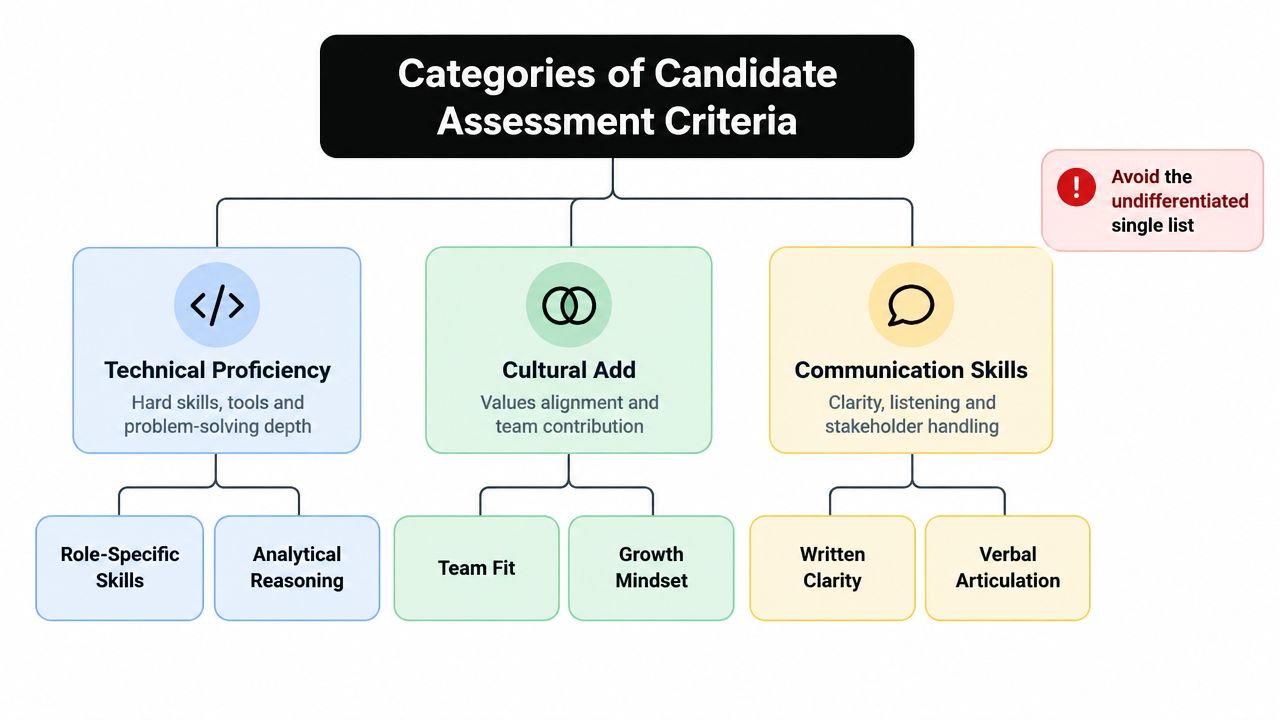
Use four to six criteria overall, then group them into distinct evidence areas. The exact mix should follow the role, not a universal template.
Technical proficiency
This category covers the capability required to perform the work. It might include software fluency, domain knowledge, coding quality, process knowledge, or the ability to apply a method under realistic constraints.
Separate role-specific skills from analytical reasoning where both matter. A candidate may know a tool but struggle to diagnose an unfamiliar problem. Another may lack exposure to the exact tool but demonstrate a sound approach to learning and solving new problems. Those are different signals and deserve different prompts.
Behavioural and team contribution
“Culture fit” is often too vague to score safely. Replace it with observable behaviours connected to the role, such as collaboration, ownership, adaptability, customer judgement, or respectful disagreement.
A criterion like team contribution should describe what interviewers can observe. For example, the rubric might look for how a candidate handled competing priorities, involved colleagues, or responded when a proposed solution failed. Avoid criteria based on being “like us”, shared interests, or an undefined sense of energy.
Communication and stakeholder handling
Communication isn't just confidence or fluency. Assess whether the candidate listens, answers the question, explains reasoning, adapts detail to the audience, and records information clearly where the role requires it.
Use separate prompts for verbal articulation, listening, and written clarity when those skills have different consequences in the job. A technical specialist may need to explain risk to non-technical stakeholders. A support candidate may need to write concise, accurate responses. Both require communication, but the evidence is not interchangeable.
| Category | Assess | Avoid |
|---|---|---|
| Technical proficiency | Applied skill, tools, reasoning, task quality | Credentials as a substitute for demonstration |
| Behavioural contribution | Observable collaboration, ownership, adaptability | “Would fit in here” |
| Communication | Clarity, listening, audience awareness, written output | Accent, style preference, charisma |
Keep criteria independent
Write one primary question and one or two permitted probes for each criterion. Interviewers should record evidence under the relevant heading immediately, rather than placing every note in a general comments box. This reduces cognitive overload and makes the later debrief more disciplined.
A well-designed form doesn't eliminate judgement. It makes judgement specific, role-related, and reviewable.
Detailed Field-by-Field Form Entries
The form should guide the interviewer from context to evidence to decision. If fields appear in the wrong order, interviewers tend to jump straight to an overall recommendation and fill in supporting comments afterwards.
Start with the administrative fields. Record candidate identity, requisition reference, role and band, hiring stage, interviewer, date, and interview format. These details allow HR to trace the assessment and identify whether a concern belongs to a particular stage or reviewer.
Then show only the criteria assessed in that round. A technical interviewer shouldn't be required to score motivation if the session wasn't designed to test it. The form should name the criterion, display its weight, show the anchored scale, and provide a space for evidence.
The evidence field is the control point
Ask interviewers to write notes in a simple pattern:
- Prompt or task, what the candidate was asked to do.
- Response or output, what the candidate said, built, calculated, or demonstrated.
- Relevance, why the evidence supports or weakens the criterion.
- Unresolved point, what needs verification later.
“Good answer” isn't evidence. “Identified the customer impact first, proposed a staged fix, and described how they would monitor the result” is much more useful. The note should describe observable content, not a judgement about character.
The form can include a numeric rating beside each criterion, but the rating must remain tied to the evidence. A practical sequence is to record notes during the interview, select the score independently, and write the concise rationale before the panel debrief begins. This prevents group discussion from rewriting an interviewer's first-hand assessment.
Keep completion realistic
For India-focused hiring workflows, published template guidance recommends a form that can be completed in about 10 minutes, with identity, requisition, stage, criteria, ratings, evidence, and recommendation fields included in the workflow. See the interview evaluation form template guidance for the operational sequence and debrief controls.
Finish with:
- Strengths demonstrated, limited to role-relevant evidence.
- Material gaps or risks, with the question or task that exposed them.
- Development assumptions, clearly separated from essential requirements.
- Final recommendation, such as advance, hold for calibration, assess further, or do not advance.
- Confidence level, explaining whether the evidence was direct, partial, or inconclusive.
- Follow-up requirement, if another stage must test a specific unresolved criterion.
Completed forms should be collected before the debrief starts. The chair can then compare evidence criterion by criterion, rather than allowing the strongest voice in the room to establish the group's conclusion.
Scoring Rubrics and Anchored Rating Examples
A rating scale only works when interviewers can distinguish one level from another. “Three means average” tells a panel very little. Behaviourally anchored ratings define the evidence required, which makes a score more portable across interviewers and hiring stages.
The table below uses a problem-solving criterion. Adapt the wording to the role, but keep the anchor observable.
Anchored Rating Scale Example for Problem Solving
| Score | Rating Label | Required Evidence and Behavioural Anchors |
|---|---|---|
| 1 | Insufficient evidence | Doesn't clarify the problem, jumps to an unsupported solution, misses important constraints, or can't explain the reasoning. |
| 3 | Meets the role requirement | Defines the problem, identifies relevant information, proposes a workable approach, and explains the main trade-offs. The solution addresses the stated task but may need prompting or refinement. |
| 4 | Strong evidence | Clarifies ambiguity independently, tests assumptions, considers alternative approaches, explains trade-offs clearly, and identifies how success or failure would be monitored. |
The scale doesn't need to use every available number. A form can use a broader range, but the anchors must explain what each selected level means. If the panel uses a five-point scale, define the intermediate points as well, rather than leaving interviewers to invent their own meanings.
Compare vague labels with evidence rules
| Vague label | Why it fails | Anchored alternative |
|---|---|---|
| “Good communication” | Rewards style and personal preference | Answers directly, listens to the full question, explains reasoning in a logical sequence, and adapts detail to the audience |
| “Strong technical fit” | Can conceal credential bias | Completes the task accurately, uses appropriate tools, explains decisions, and identifies limitations |
| “Great culture fit” | Encourages affinity bias | Demonstrates a specific behaviour required by the team, such as constructive disagreement or reliable ownership |
For behavioural criteria, anchors should describe actions rather than personality. “Confident” is difficult to assess consistently. “Explained a disagreement, stated the evidence used, listened to the other person's concern, and agreed a next step” gives the interviewer something concrete to record.
Use the situational interview question framework to connect each prompt to its intended criterion. The question, evidence field, and rubric should form one chain. If a question cannot produce evidence for a criterion, remove it or move it to another stage.
Calibration works best when interviewers score the same sample response, explain their evidence, and revise the anchor wording before live interviews begin.
Don't let the final score replace judgement. A weighted result can flag a pattern, but a mandatory criterion may justify a decision even when the overall average looks acceptable. Record that rule on the form so the panel knows how to handle essential failures, conflicting evidence, or an incomplete assessment.
Transitioning from Credentials to Capability Proof
Academic qualifications and previous job titles can provide context, but they don't prove that a candidate can perform the work. This is especially important in entry-level hiring, where applicants may have limited employment history but can still demonstrate practical ability, software fluency, or learning agility.
Evidence from India points to a clear design challenge. A Willis Towers Watson survey reported by India Today found that formal psychometric assessment was used across several management levels, while many organisations had not explored it. The practical lesson isn't to add tests indiscriminately. It is to decide which assessment method produces the most relevant evidence for each criterion.
Reweight the form around work outputs
For an entry-level analyst, the form might assess:
- Task execution, whether the candidate can clean, interpret, or present information from a realistic exercise.
- Tool fluency, how accurately they use the software required for the role.
- Reasoning, whether they explain assumptions and recognise limitations.
- Learning agility, how they respond to unfamiliar instructions or feedback.
- Communication, whether they can explain a conclusion to the intended audience.
Academic history can remain a background field, but it shouldn't silently dominate the scorecard unless the role genuinely requires a qualification. The same principle applies to prestigious employers and job titles. They may guide questions, but the form should record what the candidate demonstrated.
Use evidence from practical tasks
A capability-focused form should include a dedicated field for the task or assessment. Record the instructions given, the candidate's output, any constraints, the support provided, and the reviewer's judgement against the rubric. This makes the assessment more transparent than a general note saying the candidate “seemed capable”.
India-specific hiring evidence also highlights the measurement problem. A SHRM India and MeritTrac study reported by Economic Times Education reported that only 45% of organisations measured assessment-tool impact through data, while 30% relied on gut feeling and 25% didn't measure impact at all. Those figures describe an evidence gap, not a reason to trust a score automatically. Track whether the criterion tested is connected to later performance, and review the form when it produces ambiguous or repetitive evidence.
The strongest transition is gradual. Keep credential information available to the process owner, but make interviewer scoring depend on job-related demonstration wherever possible.
Operationalising Bias Control and Compliance
A fairness statement at the bottom of a form doesn't control bias. The controls need to appear in the workflow, where interviewers choose evidence, assign ratings, and influence the debrief.
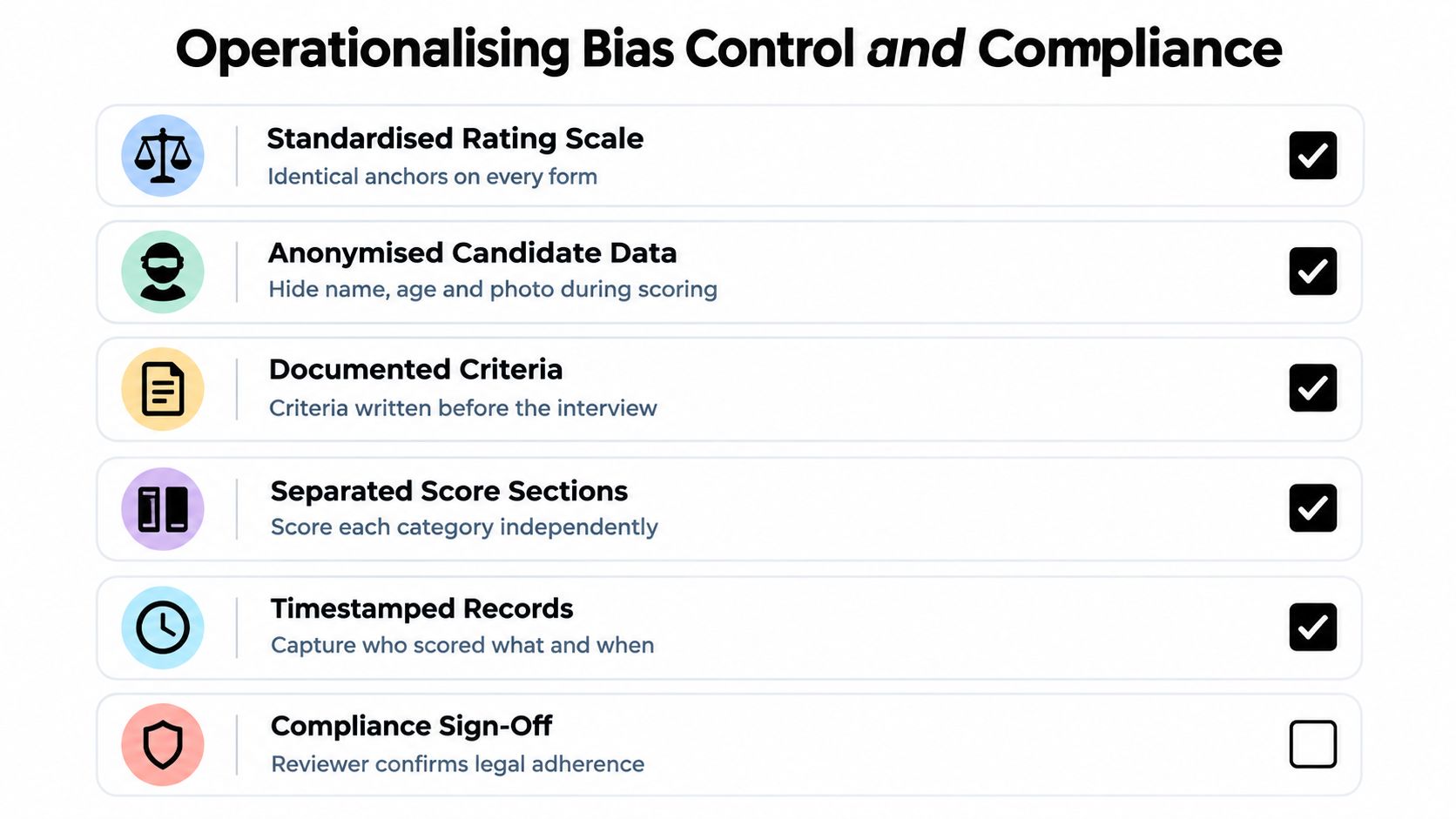
Start by removing information that isn't needed for the assessment. Interview cards should exclude age, religion, and marital status, and demographic information should not appear in the interviewer's scoring view. Candidate names, photographs, and other personal details should be restricted where the workflow permits, while HR retains whatever information is necessary for lawful administration.
Build controls into the form
- Predefined criteria: Write the criteria and anchors before interviews begin. Don't add a new requirement because one candidate exposed a concern.
- Independent scoring: Require each interviewer to submit ratings and evidence before the panel debrief.
- Separated sections: Score technical, behavioural, and communication evidence independently.
- Observable notes: Reject comments about likeability, polish, background, or “energy” unless translated into a job-related behaviour.
- Audit records: Preserve who scored each criterion, when the form was completed, what version was used, and whether a reviewer changed a score.
- Escalation path: Give HR a process for challenging inconsistent ratings or criteria that may create indirect disadvantage.
India-focused guidance identifies structured behavioural interviewing and clear rubrics as practical ways to reduce bias. The form should therefore show the question, the relevant competency, the anchor, and the evidence box together. That layout makes it harder to score a candidate on an unrelated personal impression.
Treat AI as part of the decision trail
AI-assisted screening can increase consistency, but it also creates a need for stronger governance. The Deloitte India campus hiring report reported that 86% of employers in campus hiring use AI in recruitment, and noted that gender diversity remains an explicit shortlisting filter. That makes human oversight and documentation essential, not optional.
If an AI tool produces a score or risk flag, store the assessment dimension, input stage, reviewer action, and reason for overriding or accepting the output. Career Central provides AI-driven phone screening, first-round interviews, and coding assessments with structured candidate scoring, which can be incorporated as one stage in a wider evaluation architecture. The hiring organisation still needs to define the criteria, review the evidence, and maintain responsibility for the decision.
The candidate assessment tools guide can help teams compare assessment approaches, but compliance depends on the complete process, not the software label.
Cross-Referencing Forms Across Hiring Stages
A candidate should not have to answer the same question at every stage merely because each interviewer uses a separate form. The forms should pass forward evidence gaps, not repeat conversations.
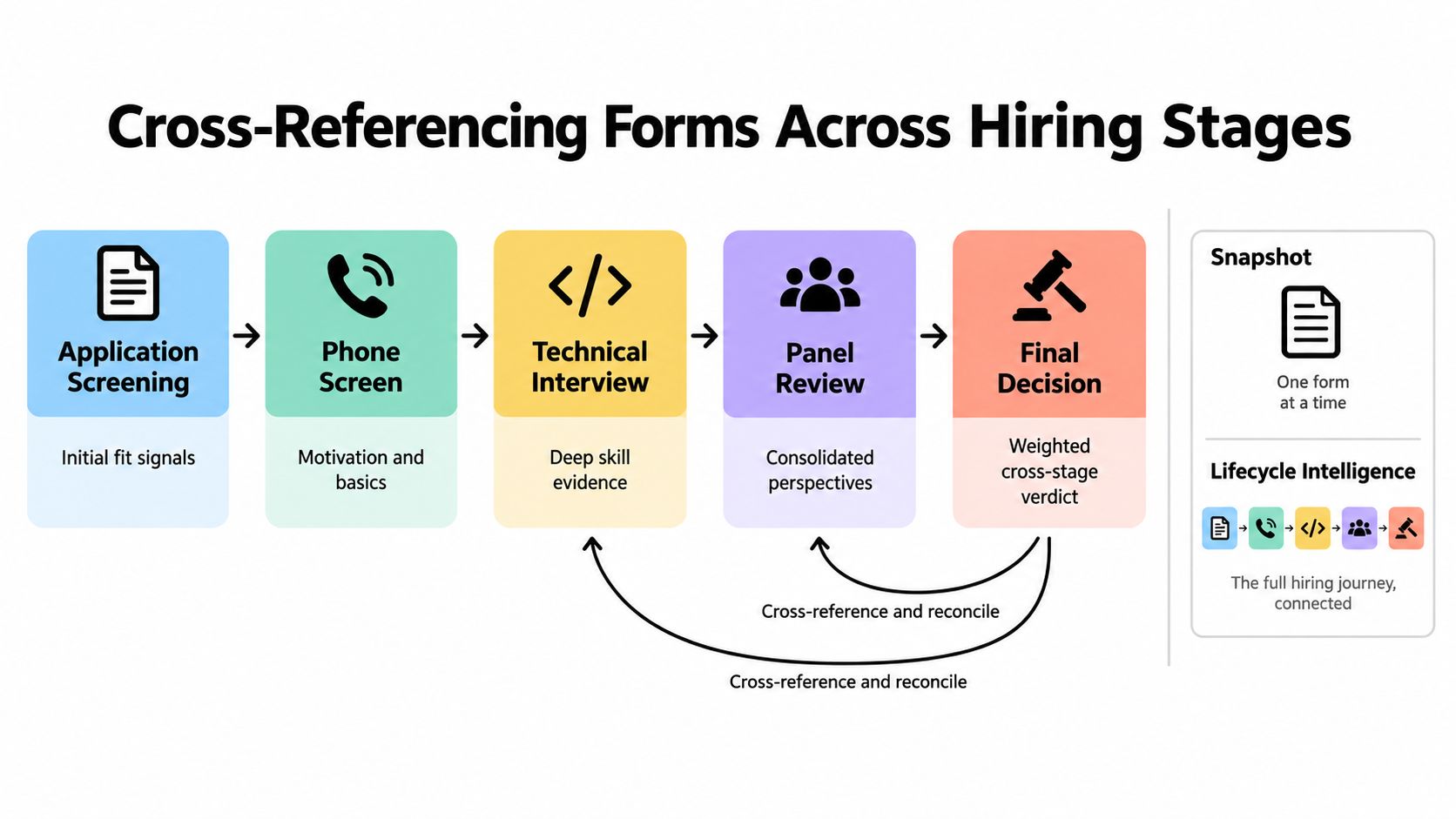
Consider a high-volume customer operations role. The application screen checks basic eligibility and records the source of the signal. The phone screen then assesses motivation, availability, role understanding, and communication basics. Instead of asking the technical interviewer to repeat those questions, the handover should identify the criteria still needing direct evidence.
Design each stage for a different signal
Application screening should capture eligibility and any stated experience relevant to the role. It should not make a final judgement about capability when the application contains no direct demonstration.
Phone screening can test motivation, role alignment, communication clarity, and potential risk flags through consistent prompts. The interviewer should record the candidate's evidence and mark assumptions that require verification.
Technical or practical assessment should focus on task performance. The form should reference the earlier gap, such as software fluency or reasoning, then capture the output against its own rubric.
Panel review should consolidate perspectives without averaging away an important concern. The chair can compare each criterion, identify where interviewers saw different evidence, and ask for clarification rather than asking everyone to defend a general preference.
Final decision should record the weighted cross-stage verdict, essential criteria, unresolved risks, and the rationale for the chosen next step.
“Pass forward the question that remains unanswered, not the opinion that someone formed.”
The handover record should be short. Include the criterion, existing evidence, confidence in that evidence, and the next probe. Don't copy every note from the previous stage into the next form. Excessive context can create anchoring, where a later interviewer unconsciously searches for confirmation of an earlier view.
A shared criterion library helps keep names and definitions consistent across stages, while stage-specific forms preserve focus. HR should also retain version history, especially when an AI system or external assessment contributes to the candidate profile. That record lets the organisation distinguish a direct observation from an automated signal and a final human decision.
Quick-Reference Guide for Interviewers
Interviewers don't need to memorise a policy before every conversation. They need a short routine that protects evidence quality when the schedule is busy.
Before the interview
- Read the role criteria: Know which competencies this stage assesses and which it doesn't.
- Review the anchors: Check what the form defines as insufficient, acceptable, and strong evidence.
- Prepare the prompts: Use the agreed questions and only the permitted probes.
- Check the record: Understand what has already been assessed so you don't repeat an earlier stage.
- Remove irrelevant information: Don't use age, religion, marital status, photographs, or personal background as scoring inputs.
- Plan the evidence: Leave space for task outputs, quoted candidate examples, reasoning, and unresolved questions.
During the interview
Take notes while the candidate answers, but don't turn the conversation into a transcription exercise. Capture the prompt, the key response, the action taken, the result or reasoning, and the relevance to the criterion.
Use follow-up questions to clarify evidence, not to help one candidate reach a better answer than another. If you give additional information or extra time, record it because the support provided may affect how the output should be interpreted.
Watch for familiar traps:
- Halo effect: One impressive answer inflates unrelated scores.
- Similarity bias: Shared background becomes a substitute for evidence.
- Recency bias: The final answer outweighs the full interview.
- Credential substitution: A qualification replaces a practical demonstration.
- Vague concern: “Not a fit” appears without a job-related example.
- Score chasing: Interviewers adjust ratings to match the panel's preferred candidate.
After the interview
Complete the form before joining the debrief. Select ratings independently, then write a concise evidence-based rationale. A recommendation should state the decision and its basis, for example, “advance because the candidate demonstrated the required workflow under the stated constraints”, or “assess further because tool proficiency remains untested”.
During the debrief, discuss one criterion at a time. Resolve disagreement by comparing notes, not by counting votes. If the evidence is incomplete, record that limitation rather than manufacturing confidence.
Finally, check that the form is complete, signed or submitted as required, and linked to the correct requisition. A clean record supports consistent decisions, candidate feedback, later calibration, and responsible process improvement.
A reliable interview evaluation form isn't the longest document your hiring team can tolerate. It's the smallest structured record that captures the right evidence, separates independent criteria, controls avoidable bias, and makes the final decision explainable.
Career Central provides AI-driven phone screening, first-round interviews, and coding assessments with structured candidate scoring for organisations building evidence-based hiring workflows. Use Career Central to explore how its interview layer could fit alongside your evaluation forms and panel process.