
Your hiring panel has two candidates for the same role. Both deliver polished STAR answers. Both describe a difficult stakeholder, a tight deadline, and a measurable result. One candidate explains how they clarified risk, involved the right decision-maker, and changed course when new information appeared. The other repeats a rehearsed story with impressive activity but little evidence of sound judgement.
That difference is where situational interview questions earn their place. They aren't a storytelling contest. Used well, they test how a candidate would interpret ambiguity, prioritise competing demands, communicate under pressure, and protect business outcomes. For HR managers and talent leaders hiring at scale in India, the quality of the scenario and the scoring method matters more than the size of the question bank.
Table of Contents
- Why Situational Interview Questions Predict On The Job Judgment
- How to Design High Signal Situational Questions From Scratch
- Building a Scoring Rubric That Separates Polish From Performance
- Role Specific Situational Interview Questions With Sample Answers
- Common Mistakes That Weaken Situational Interviews and How to Fix Them
- Integrating Situational Questions Into AI Driven Screening Workflows
Why Situational Interview Questions Predict On The Job Judgment
A candidate is asked what they would do after discovering a production issue shortly before release. One answer jumps to a fix and a client update. Another checks user impact, confirms rollback safety, assigns communication ownership, and records the decision path. Both sound responsible. Only one exposes how the person would control risk before acting.
That distinction explains the value of situational interview questions. Behavioural questions ask candidates to recall past actions. Situational questions ask them to reason through incomplete facts, conflicting stakeholders, and consequences that are not yet clear. The format gives interviewers evidence of decision quality, rather than relying only on memory, presentation skill, or a polished success story.
Indian interview guidance often groups situational prompts with behavioural questions and expects a specific work example organised around circumstance, action, and outcome. The familiar STAR method, Situation, Task, Action, Result, gives candidates a clear structure, while hiring teams commonly look for an outcome that demonstrates impact and judgement. Indeed India's behavioural interview guidance reflects how structured questioning now shapes interview preparation.
Standardised question banks create a practical trade-off. Hiring teams may use HR-round banks with 47 questions, India-focused guides with 50 questions, and broader collections of 120+ questions. These sets make interviews easier to organise, but repeated prompts also make coaching easier. Once candidates expect questions about conflict, failure, deadlines, or leadership, a fluent STAR response may reveal little about how they would choose under pressure.
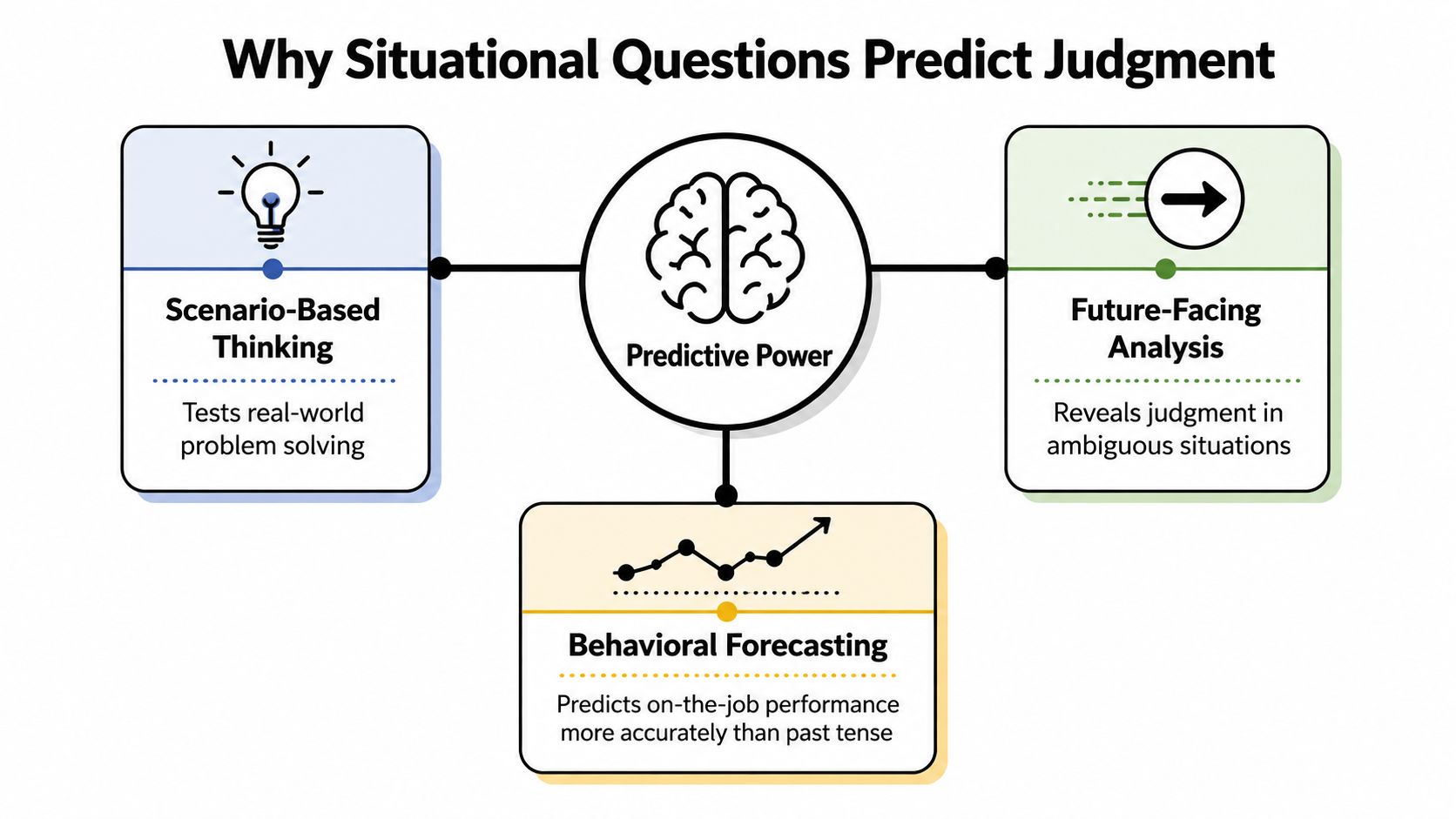
The signal sits inside the reasoning
Score what the candidate notices first, which information they identify as missing, how they weigh risk, and who they involve before committing resources. Listen for a clear trade-off, not phrases such as “I took ownership” or “I collaborated with the team” without supporting detail.
In a production incident, Candidate A says they would fix the issue immediately, update the client, and hold a retrospective. Candidate B first establishes user impact, checks whether rollback is safe, assigns one person to communication, and preserves the decision path for review. Both answers sound responsible. Candidate B gives stronger evidence of sequencing, containment, and stakeholder awareness.
Practical rule: Score the candidate's reasoning before you score the result they claim.
Situational questions add the most value when a role includes uncertainty, cross-functional dependency, or changing priorities. India-focused guidance includes prompts about unclear requirements, disputes over credit, ethical pressure, production incidents, and leading demoralised teams. Workro's India interview guide presents STAR as a structure that allocates about 10% to Situation, 10% to Task, 60% to Action, and 20% to Result, with the result ideally quantified.
That allocation helps candidates prepare, but it should not become the employer's scoring system. A neat STAR narrative can still overlook the central risk in a hypothetical case. Interviewers should introduce a realistic decision point, then examine how the candidate tests assumptions, sets priorities, escalates concerns, and chooses an action when no option is obviously safe.
How to Design High Signal Situational Questions From Scratch
Start with the role's real dilemmas, not a list of popular interview prompts. Ask the hiring manager where a capable employee could make a costly decision with incomplete information. The answer might involve unclear product requirements, a customer demanding an exception, a data-quality concern, a safety issue, an underperforming team member, or a senior stakeholder pushing for speed over control.
Build around a decision, not a personality trait
A weak prompt asks, “How do you handle pressure?” It gives the candidate room to offer a generic value statement. A stronger version presents a choice:
“You're supporting a release that has a committed delivery date. During final checks, you find an issue affecting a subset of users, but the product owner believes the team can monitor it after launch. What would you do before recommending whether to proceed?”
The second prompt has a defined tension. It invites the candidate to discuss evidence, risk, escalation, communication, and an explicit recommendation. It doesn't tell them which option is correct, so the answer can reveal judgement.
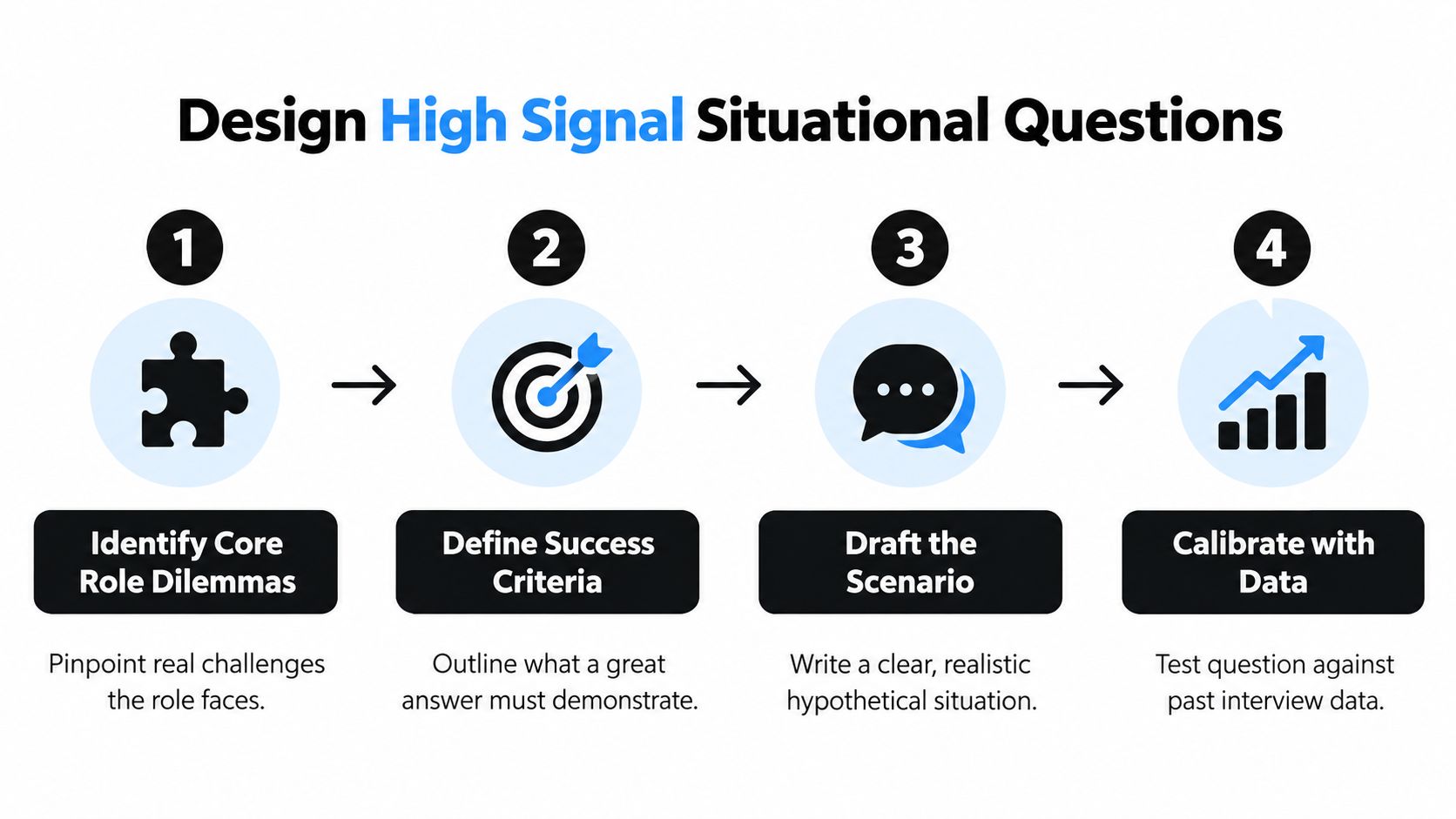
Use this construction sequence:
Identify the role dilemma. Ask what regularly creates competing priorities for this position. Avoid hypothetical drama that the job won't involve.
Define observable success. Decide what a strong answer should demonstrate. For a software engineer, that may include impact assessment, rollback thinking, and transparent escalation. For a sales role, it may include qualification discipline and honest expectation-setting.
Write the scenario plainly. Include enough context to make the situation realistic, but leave room for the candidate to ask clarifying questions. Ambiguity should reflect the job, not poor question writing.
Name the decision point. Ask what the candidate would do first, what information they would seek, and how they would communicate the recommendation. “What would you do?” alone is too broad to score consistently.
Add a controlled follow-up. Probe the answer with a new fact. For example, ask how the plan changes if the stakeholder rejects the recommendation or if the impact becomes larger than expected.
Align questions to competencies
Map each prompt to a small number of competencies, such as prioritisation, ethical judgement, customer communication, analytical thinking, or people leadership. Career Central's competency mapping guide can help hiring teams connect role expectations to observable interview evidence.
Before adding a question to a bank, ask the hiring manager:
- Does this situation occur in the role?
- Is the decision difficult for a reason the candidate can understand?
- Can two interviewers distinguish a strong answer from a merely fluent one?
- Does the question avoid assuming a preferred personality or communication style?
- Can the answer be scored without requiring insider knowledge?
- What follow-up would expose shallow reasoning?
A practical bank usually needs only a focused set of custom scenarios for each role. Relevance beats volume. If a question doesn't lead to a meaningful decision, remove it, even if candidates find it engaging.
Building a Scoring Rubric That Separates Polish From Performance
A rubric should make the interviewer ask, “What did the candidate notice, decide, and prioritise?” rather than, “Did the answer sound confident?” STAR remains useful because it organises the response, but it shouldn't become the score. Action quality and judgement deserve more attention than narrative smoothness or the presence of a tidy metric.
Use four performance levels for each competency:
- Level 1, unclear: The candidate jumps to a solution, ignores key constraints, or gives a generic response.
- Level 2, partial: The candidate identifies part of the problem but misses stakeholders, dependencies, risks, or verification.
- Level 3, sound: The candidate gathers relevant information, chooses a defensible action, communicates appropriately, and explains how they would review the outcome.
- Level 4, strong: The candidate weighs competing outcomes, adapts when conditions change, protects trust, and connects the decision to business or customer impact.
The level isn't a reward for speaking at length. A concise answer can reach the highest level if it contains clear assumptions, sequencing, ownership, escalation logic, and a way to test whether the decision worked.
Score evidence, not confidence
For each question, record the evidence under four dimensions. Decision quality asks whether the candidate selected a sensible path. Stakeholder awareness examines whether they recognised who could be affected. Communication clarity tests whether they explained the recommendation and escalation route. Business impact considers whether they connected the action to customer, operational, financial, quality, or team consequences.
| Evaluation Dimension | Weak Response Signals | Strong Response Signals |
|---|---|---|
| Decision quality | Acts immediately without clarifying facts or risk | States assumptions, gathers critical information, and sequences the response |
| Stakeholder awareness | Treats the issue as an individual task | Identifies affected parties and assigns communication or ownership |
| Communication clarity | Uses broad phrases such as “I'd align everyone” | Explains what would be communicated, to whom, and when |
| Business impact | Focuses on completing the task only | Weighs customer, operational, ethical, and delivery consequences |
Use the same rubric across interviewers, but don't force identical wording. A recruiter may assess the structure and relevance of the response, while a technical interviewer may assess risk management within the role scenario. The guide to structured and unstructured interviews is useful when deciding how much freedom interviewers should have while keeping the assessment comparable.
Calibrate before the interview loop
Calibration works best with sample responses. Give the panel a polished but shallow answer, a cautious answer with no decision, and a response that identifies risk and proposes a sequence. Discuss why each answer earns its score. This exposes hidden preferences, such as rewarding assertiveness, accent, speed, or familiarity with a particular corporate vocabulary.
For AI-assisted screening, convert each dimension into observable indicators. The system may flag whether the candidate addressed the affected stakeholder, stated a decision criterion, proposed an escalation, or explained how they would validate the outcome. Those flags should support review, not replace it. A human should examine ambiguous answers, unusual but reasonable approaches, and any response where language fluency may be distorting perceived competence.
Role Specific Situational Interview Questions With Sample Answers
The same scenario shouldn't be copied across every job family. A customer success manager, an engineer, and an operations lead may all face pressure, but the evidence of good judgement differs. The examples below are designed as starting points for screens, not scripts candidates should memorise.

Software engineering
Prompt: A release is ready, but monitoring shows a defect affecting a limited group of users. The product owner wants to launch and investigate later. What would you do?
A weak STAR-shaped answer says, “I'd take ownership, fix the bug quickly, inform the team, and make sure it doesn't happen again.” It contains action verbs but no assessment of severity, rollback safety, user impact, or release criteria.
A stronger answer explains how the candidate would reproduce the defect, estimate impact, check whether a feature flag or rollback is available, and present options to the product owner. The result should be a clear go or no-go recommendation, with monitoring and communication responsibilities assigned.
Follow-up: What changes if the defect affects a regulated workflow or customer data?
Sales
Prompt: A prospect wants a commitment your product team hasn't approved, and the deal is important to your pipeline. How would you respond?
A weak answer promises to “build a strong relationship” and says they would ask the product team to prioritise the request. It doesn't protect the customer from an unsupported commitment.
A stronger answer separates the prospect's underlying need from the requested feature, confirms what the product can deliver, documents the limitation, and offers a credible alternative. The candidate should explain how they would update the opportunity record and set expectations without sacrificing trust for short-term progress.
Follow-up: What would you say if the prospect insists on a written commitment before continuing?
Customer success
Prompt: A strategic customer reports a recurring issue and threatens to leave, but engineering has no immediate fix. What would you do?
The weak version moves straight to escalation and promises frequent updates. That may sound responsive, but it doesn't show how the candidate would establish impact, contain the problem, or avoid overpromising.
A stronger answer confirms the customer's business consequence, reviews available workarounds, creates a clear internal owner, and agrees a communication cadence. The result should include a documented recovery plan and a truthful explanation of what the team can and can't commit to.
Operations and leadership
For operations, ask: “A supplier delay threatens a committed delivery, and the fastest alternative costs more and has less proven reliability. How would you decide?” A strong answer compares service impact, cost, quality, and contingency options instead of choosing speed automatically.
For leadership, ask: “Your team is demoralised after a missed target, while senior management wants an immediate recovery plan. What would you do first?” A weak response launches a motivational meeting and assigns new targets. A stronger response diagnoses causes, listens to the team, protects accountability, and presents leadership with a recovery plan grounded in evidence.
These prompts work because they force role-specific trade-offs. The candidate still has room to use STAR, but the interviewer scores the decision path, not the polish of the story.
Common Mistakes That Weaken Situational Interviews and How to Fix Them
A candidate delivers a polished STAR response about resolving conflict. The story includes a clear action and an impressive result, yet a follow-up question reveals no method for checking assumptions or handling a changed constraint. That gap is the risk. India-focused interview material for HR teams illustrates how standardised preparation can make rehearsed responses easier to present.
STAR remains useful for organising evidence. It should not determine the score. Design scenarios that expose priorities, trade-offs, verification, and decision changes, then use AI-assisted screening to flag missing evidence for human review.
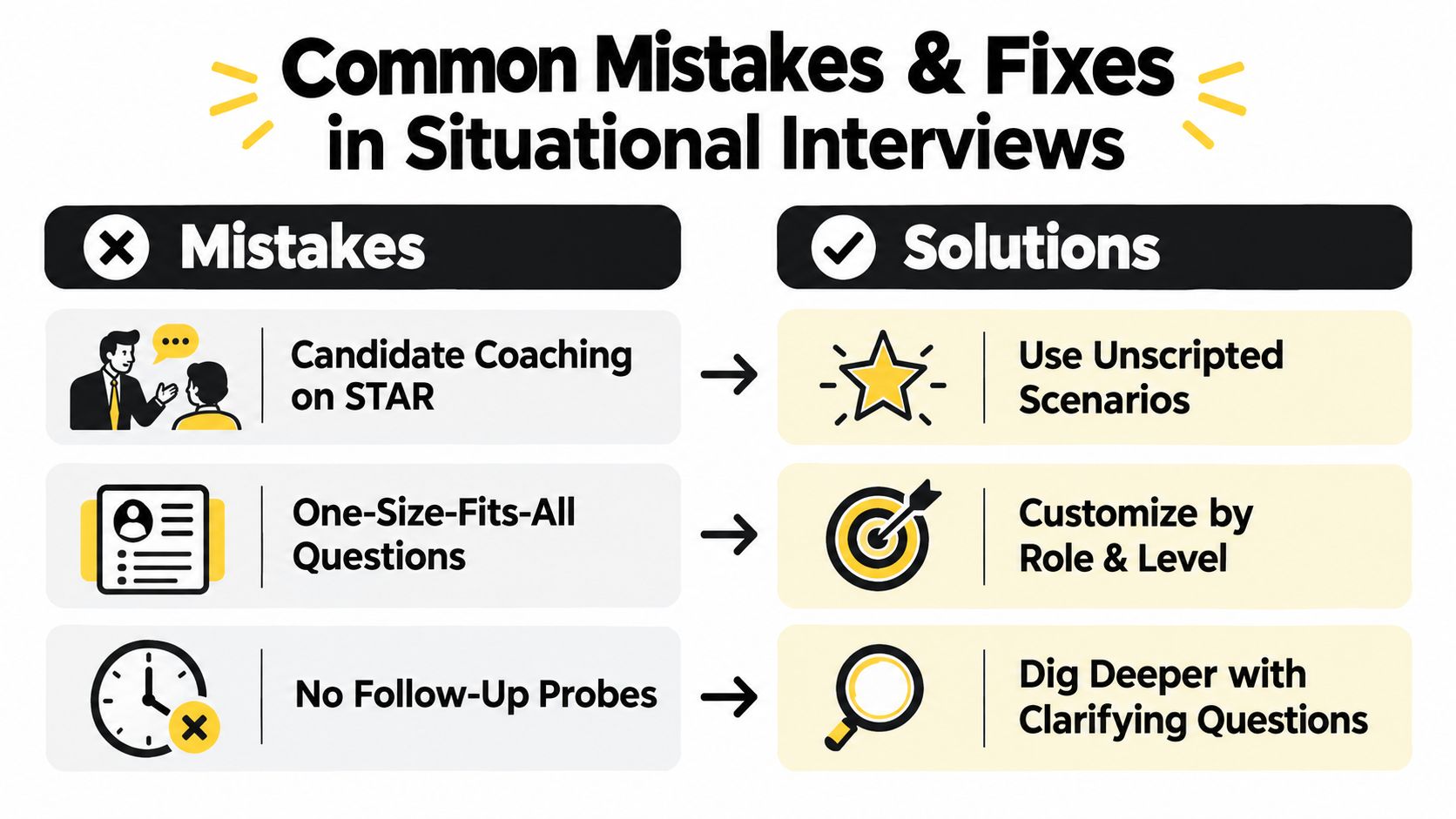
Mistake one, relying on generic prompts
“Tell me how you handle conflict” mainly tests preparation. Replace it with a scenario that names the conflict, competing objectives, and decision required.
Before: “How would you deal with a difficult colleague?”
After: “A colleague owns information you need for a customer commitment but says your request isn't a priority. The customer is waiting, and escalating may damage the working relationship. What would you do first, and when would you escalate?”
The revised prompt creates a realistic constraint without signalling the preferred answer. Score how the candidate establishes urgency, chooses a first action, and sets an escalation threshold.
Mistake two, rewarding confidence over evidence
Fast speech, assertive wording, and polished vocabulary can sound capable without demonstrating sound judgement. Listen for assumptions, verification, stakeholder mapping, and a credible definition of success. A pause to clarify the situation can be stronger evidence than an immediate, confident solution.
Mistake three, asking no follow-up questions
Prepared candidates often know how to complete STAR. They may not be ready when the facts change. Ask, “What would make you change your decision?” Then introduce a new constraint involving timing, risk, customer impact, or limited resources. Score whether the candidate updates the plan rather than defending the first answer.
Mistake four, treating a measurable result as proof
A quantified result strengthens an answer, but it does not establish causation or sound judgement. Ask which baseline the candidate used, what they directly influenced, and what they would do if the result moved in the opposite direction. This separates ownership from polished reporting.
Mistake five, skipping panel calibration
One interviewer may reward caution while another rewards decisiveness. Review anonymised responses, agree what each score means, and test whether the rubric measures role competence rather than communication style. For high-volume India hiring, calibration also helps teams check that automated flags reflect evidence, not accent, fluency, or response speed.
Hiring demand is uneven across the market. Naukri reported 3% year-on-year white-collar hiring growth in January 2026, driven by non-IT sectors and fresher hiring. That variation makes consistent scoring more important. Polished answers deserve examination against the rubric, not automatic credit. The interviewer still owns the judgement call, while structured prompts and AI-assisted review make weak evidence easier to spot.
Integrating Situational Questions Into AI Driven Screening Workflows
AI-assisted screening works best when it handles repeatable administration while hiring professionals retain control over judgement. Start with a short phone screen that asks a role-specific scenario, captures the candidate's response, and uses consistent follow-up logic. Avoid letting the system score accent, speed, or confidence as substitutes for competence.
A practical workflow looks like this:
Present the scenario consistently. Use the same core wording and permitted clarifications for candidates in the same hiring stream.
Capture structured evidence. Tag references to risk, stakeholders, prioritisation, escalation, customer impact, and validation.
Apply the rubric. Produce dimension-level indicators rather than one opaque recommendation. A high-level score should show why the answer received it.
Route uncertain answers to a human. Send incomplete, contradictory, unusually creative, or context-dependent responses for review.
Hand off the record. Store the question, transcript, evidence tags, reviewer decision, and ATS outcome together so the team can audit the process.
The screening interview questions guidance from Career Central provides a useful basis for combining standard screening with workplace-problem scenarios. Career Central offers AI-driven phone screening, first-round interviews, and coding assessments as an interview-as-a-service option, so teams can place situational prompts within a broader high-volume workflow rather than treating them as a separate exercise.
For fresher and high-volume hiring, begin with one role and a small set of dilemmas. Have recruiters and hiring managers score the same sample responses, then compare AI flags with human decisions. Review which prompts produce useful differentiation, which trigger shallow memorised answers, and which create avoidable bias. Update the question or rubric only after identifying the failure mode.
The implementation target isn't a fully automated hiring decision. It's a consistent first layer that surfaces evidence, reduces interviewer repetition, and gives human reviewers a clearer basis for discussion. Visit Career Central to evaluate AI-driven phone screening, first-round interviews, and coding assessments for a situational screening workflow built around your roles and scoring criteria. Start with one hiring stream, define the evidence you need, and pilot the process before expanding it across your organisation.