Competency mapping is a structured way to link each role to the specific knowledge, skills, and behaviours needed to perform it well. In India, that approach has reached national scale, with the Capacity Building Commission mapping competencies across a civil service system that includes about 30,000 Group A officers and roughly 3.1 million people across Groups A, B, and C according to the CBC's account of the programme.
A CHRO can see the problem in a familiar hiring meeting. Two managers review the same candidate for a sales leadership role. One praises confidence and relationship-building. The other wants analytical discipline, forecast accuracy, and evidence of coaching. The recruiter leaves with several opinions, but no agreed definition of success.
That's where competency mapping earns its place. It turns an attractive but vague idea such as “strong leader” into a role-specific set of capabilities, proficiency expectations, observable behaviours, and evidence. It also creates the structure that modern screening and interview technology needs, while making clear where human judgement must remain involved.
Table of Contents
- Why Competency Mapping Has Become a Core HR Priority
- A Clear Definition and the Thinking Behind It
- The Core Components Every Competency Map Needs
- Step-by-Step Process for Building a Competency Map
- Connecting Competency Maps to AI-Driven Screening and Interviews
- Measuring Whether Your Competency Map Actually Works
- Common Pitfalls and How to Avoid Them
- Quick-Start Checklist for HR Leaders
Why Competency Mapping Has Become a Core HR Priority
The sales candidate has passed an initial screen, but the hiring team can't agree on the scorecard. The sales director values commercial judgement. The regional manager focuses on stakeholder trust. A senior interviewer sees potential because the candidate speaks confidently under pressure. Each view may be reasonable, yet the organisation is evaluating a different job in every interview.
Competency mapping gives those people a common reference point before candidate conversations begin. It identifies what the role must deliver, what capabilities support that delivery, and what evidence should count. The framework then supports recruitment, onboarding, performance management, learning, succession, and internal mobility through a shared language.
Practical rule: Define what good performance looks like before asking an interviewer to decide whether a candidate has it.
The need is sharper in roles that change quickly. A job description can describe current responsibilities, but it often fails to show how the role will evolve, which capabilities are essential, and which can be developed after appointment. A map helps leaders distinguish between a genuine requirement and a preference inherited from the last person in the role.
A safeguard for technology-led hiring
AI screening doesn't remove ambiguity. It processes the instructions a team gives it. If the organisation hasn't defined the competencies and evidence for a role, an automated workflow may reproduce inconsistent human preferences at greater scale.
A well-designed map allows a team to create consistent prompts, structured interview questions, and scoring criteria. It can also expose disagreement early. If business leaders can't agree whether a capability is essential, trainable, or merely desirable, the issue belongs in role design, not in an opaque candidate score.
India's public-sector work illustrates how far this idea can extend. The CBC says it is conducting an HR audit across 93 ministries, aligning mandates, roles, and performance with required competencies, while tracking competency growth annually in its description of the national capacity-building programme. That makes competency mapping more than an appraisal tool. It becomes part of workforce-capacity planning and public administration reform.
A Clear Definition and the Thinking Behind It
Competency mapping identifies the knowledge, skills, abilities, and behaviours required for effective performance in a specific role, then connects those requirements to proficiency levels and evidence. The emphasis on “specific role” matters. A competency isn't useful because it sounds desirable. It's useful when the organisation can explain how the capability appears in the work.
The process begins with job analysis. HR and business leaders examine role outputs, speak with managers and experienced role-holders, observe important tasks, and consider future demands. They then organise the findings in a competency dictionary, which provides common definitions and behavioural language. Finally, they apply the dictionary to a role or job family.
From the work to the dictionary
India's formal civil-service framework describes this sequence clearly. The DoPT Competency Dictionary explains that teams should identify distinct roles, map their accountabilities, and assign the proficiency level required for each competency. The CBC's Karmayogi Competency Model adds a standardised structure with two major domains, 13 behavioural competency categories, and 21 functional competencies.
The same logic works in a commercial organisation. Start with a nurse's role, for example. The map may include clinical knowledge, patient communication, judgement, record accuracy, and teamwork. A charge nurse needs many of the same foundations, but also requires coordination and escalation capability. A nursing director needs the clinical standard plus system-level planning, resource decisions, and leadership.
Think of the map as the nervous system of talent management. The organisation's objectives sit at the centre, role accountabilities provide the pathways, and observable competencies connect those objectives to daily work. The map doesn't reduce a person to a number. It makes expectations explicit enough to discuss, assess, and improve.
What makes a competency observable
“Communicates effectively” is too broad to guide a fair assessment. A stronger indicator might be, “Summarises a complex decision in a concise written brief, identifies the decision owner, and confirms next steps.” The second description gives interviewers and managers something they can observe.
A role profile can then show the required competency, the proficiency level, and the evidence that would demonstrate it. That matrix can feed a job description, interview guide, development plan, succession conversation, or performance review without changing the underlying expectation.
The Core Components Every Competency Map Needs
A useful map has layers because roles demand different kinds of capability. Treating every requirement as one undifferentiated list creates confusion. Behavioural competencies describe how work gets done, functional competencies describe what the person must do within a function, and technical competencies capture specialist knowledge, tools, methods, or credentials.
Behavioural competencies
Collaboration, adaptability, judgement, accountability, and communication often appear across many roles. They matter for culture and leadership, but labels alone aren't enough. “Shows confidence” may reflect a culturally narrow preference, while “presents a recommendation, responds to challenge with relevant evidence, and records agreed actions” describes behaviour that can be examined more consistently.
Behavioural competencies should include positive indicators and, where useful, counter-indicators. The latter help an interviewer distinguish a real gap from a nervous interview performance. They also reduce the temptation to treat personality style as proof of capability.
Functional and technical capability
A sales manager may need territory planning, pipeline review, coaching, negotiation, and commercial analysis. A software engineer may need programming knowledge, system design, testing, and secure development practices. A finance manager may need financial modelling, control awareness, and the ability to explain risk to non-specialists.
Each entry should contain:
- A stable identifier: This supports version control and reporting across systems.
- A plain definition: The reader should understand it without specialist interpretation.
- Behavioural indicators: These show how the competency appears in real work.
- Proficiency descriptions: Each level should represent a meaningful change in autonomy, complexity, or scope.
- Evidence examples: These may include work products, structured answers, simulations, references, or observed performance.
- Assessment rules: The profile should identify what is essential, trainable, or relevant only to certain role variants.
A matrix, not a checklist
Consider commercial judgement. At an early level, a person might prepare a guided analysis using customer, revenue, and cost information. At an advanced level, a person might challenge assumptions, weigh trade-offs, and connect a recommendation to longer-term business consequences.
The difference isn't "basic" versus "excellent." It is a change in the complexity of decisions and the independence expected. The CBC's Karmayogi framework reinforces this distinction by separating behavioural and functional competency domains, giving HR teams a taxonomy for identifying capability gaps rather than relying on generic job descriptions.
Job families should share common standards, but individual profiles must preserve meaningful differences. A people manager and an individual contributor may both need collaboration, yet their evidence and proficiency expectations won't be identical.
Step-by-Step Process for Building a Competency Map
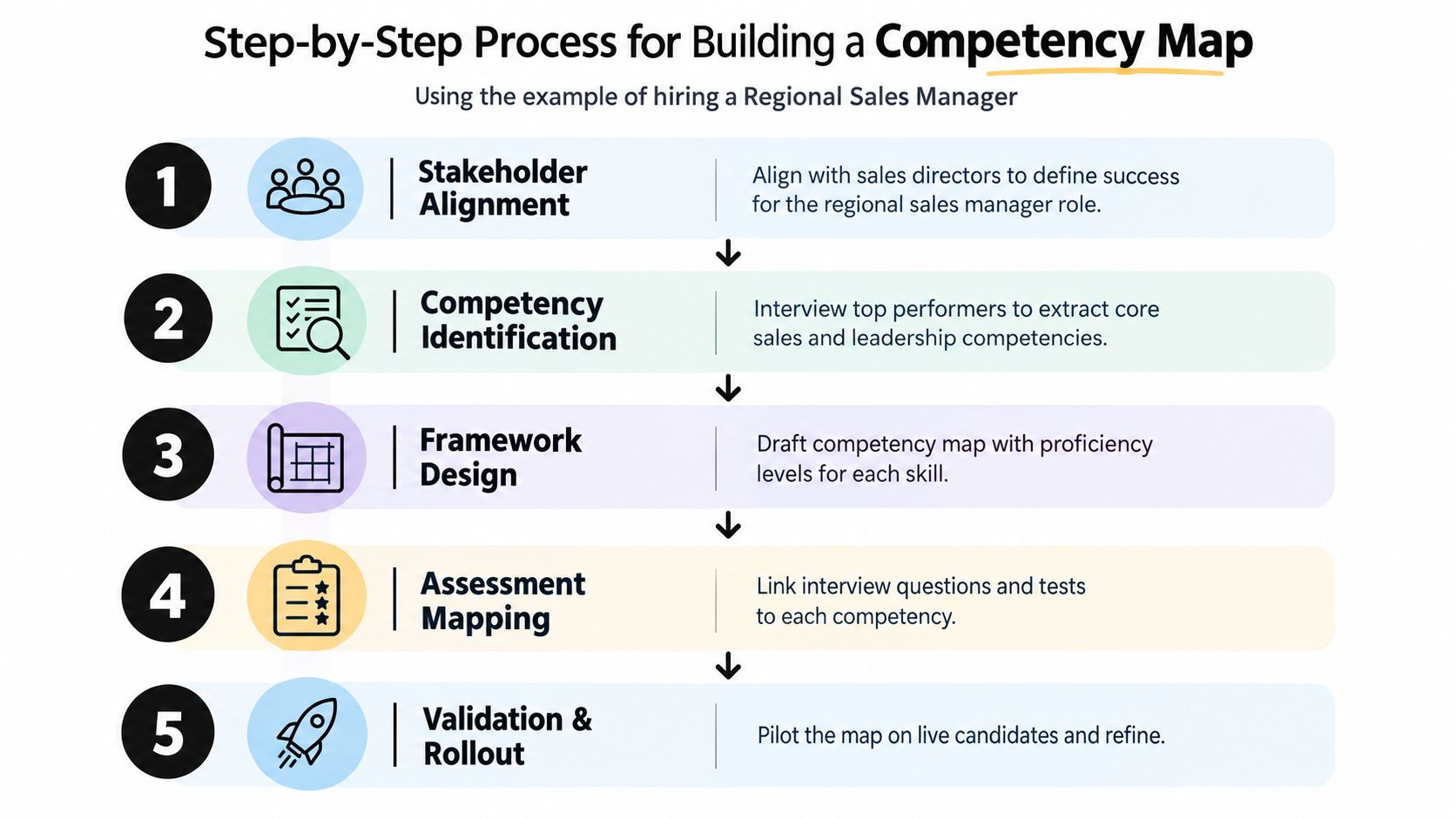
Use one role to keep the exercise practical. Suppose the organisation is hiring a regional sales manager. The role owns a market, leads sales activity, develops people, and makes decisions using commercial information. The map should reflect those accountabilities rather than copy a generic leadership framework.
1. Align stakeholders and analyse the work
Bring together the sales director, HR, a recruiter, experienced regional managers, and relevant partners such as finance or customer success. Ask what outcomes define success, which decisions the manager makes, where new hires commonly struggle, and what high performers do differently.
Review work outputs, customer responsibilities, pipeline routines, coaching expectations, and the role's likely future demands. Separate the work from the personality of the current incumbent. A successful manager may be naturally outgoing, but sociability isn't automatically a requirement.
2. Identify role-specific competencies
Translate the evidence into a shortlist. The regional sales manager may require territory planning, forecasting, coaching, negotiation, stakeholder management, commercial judgement, and adaptability. Define each term in language that describes actions and decisions.
A structured interview format can later test those behaviours consistently, but the interview shouldn't determine the map. The business requirements come first.
3. Set proficiency levels
Decide what the role needs on entry and what can develop after appointment. A new regional manager may need independent pipeline analysis immediately, while the organisation may support development in a more advanced strategic planning capability.
Write proficiency levels around complexity, scope, and autonomy. Avoid rating someone “advanced” because they have spent a long time in sales. Experience is evidence to investigate, not a substitute for demonstrated capability.
4. Validate the draft
Ask incumbents and hiring managers to challenge the draft. Do the indicators describe real work? Are any competencies duplicates? Is a requirement genuinely essential, or is it a preference? The role-to-competency assignment should be reviewed by divisional heads and key stakeholders, as the Indian civil-service approach also specifies in its competency-mapping method.
Pilot the map against recent examples where possible. If interviewers can't identify evidence or apply the proficiency descriptions, revise the wording before rollout.
5. Embed and govern it
Put the approved competencies into the job description, application screen, interview scorecard, onboarding plan, and performance conversation. Assign an owner in HR and a business owner in sales. Record the version, approval date, and reason for every material change.
Review the profile when the territory model, sales process, technology, or leadership expectations change. A quarterly governance conversation needn't rewrite the entire dictionary. It should ask whether the role still demands the same capabilities and whether the assessment evidence remains valid.
Connecting Competency Maps to AI-Driven Screening and Interviews
A completed map becomes useful to AI hiring software only after the organisation converts its language into structured inputs. Each competency needs a definition, a proficiency description, an assessment method, and a scoring rule. The system can then ask relevant questions, capture evidence, and apply the same rubric across candidates.
The tool should match the competency. A phone screen bot can explore verbal communication and motivation signals, but it shouldn't be treated as proof of technical depth. A structured video interview can present a situational judgement prompt. A coding assessment can test technical performance directly where the role requires code.
Competency-to-Tool Matching Matrix
| Competency Type | Example for a Sales Manager | AI Tool | Human Oversight Required |
|---|---|---|---|
| Behavioural | Coaching and stakeholder communication | AI phone screen or structured video interview | Review cultural nuance, context, and evidence quality |
| Functional | Territory planning and commercial judgement | Structured scenario interview with a scoring rubric | Confirm that the scenario reflects the organisation's market |
| Technical | CRM analysis and forecast interpretation | Data exercise or role-specific assessment | Check accessibility, relevance, and the candidate's reasoning |
AI can add value through consistency, scale, and evidence capture. It can ask every candidate the same core questions, record responses for review where policy allows, and flag which competency indicators appeared in an answer. It can also help recruiters separate a candidate's narrative from the rubric instead of relying on memory.
Human judgement remains essential for ethical review, reasonable adjustments, unusual career histories, and contextual interpretation. An automated score isn't a hiring decision. It is an input that must be governed.
A worked sales example
Take commercial judgement. The map might define it as using customer, revenue, and cost information to make a defensible recommendation. A screening workflow could ask: “Tell us about a time you changed a regional sales plan after reviewing performance information. What did you examine, what decision did you make, and what risks did you consider?”
The rubric should look for evidence of analysis, trade-off reasoning, and decision ownership. It shouldn't award points merely because the candidate sounds polished. HR teams evaluating candidate assessment tools should therefore ask whether the product supports structured criteria, auditability, human review, and role-specific configuration.
Measuring Whether Your Competency Map Actually Works
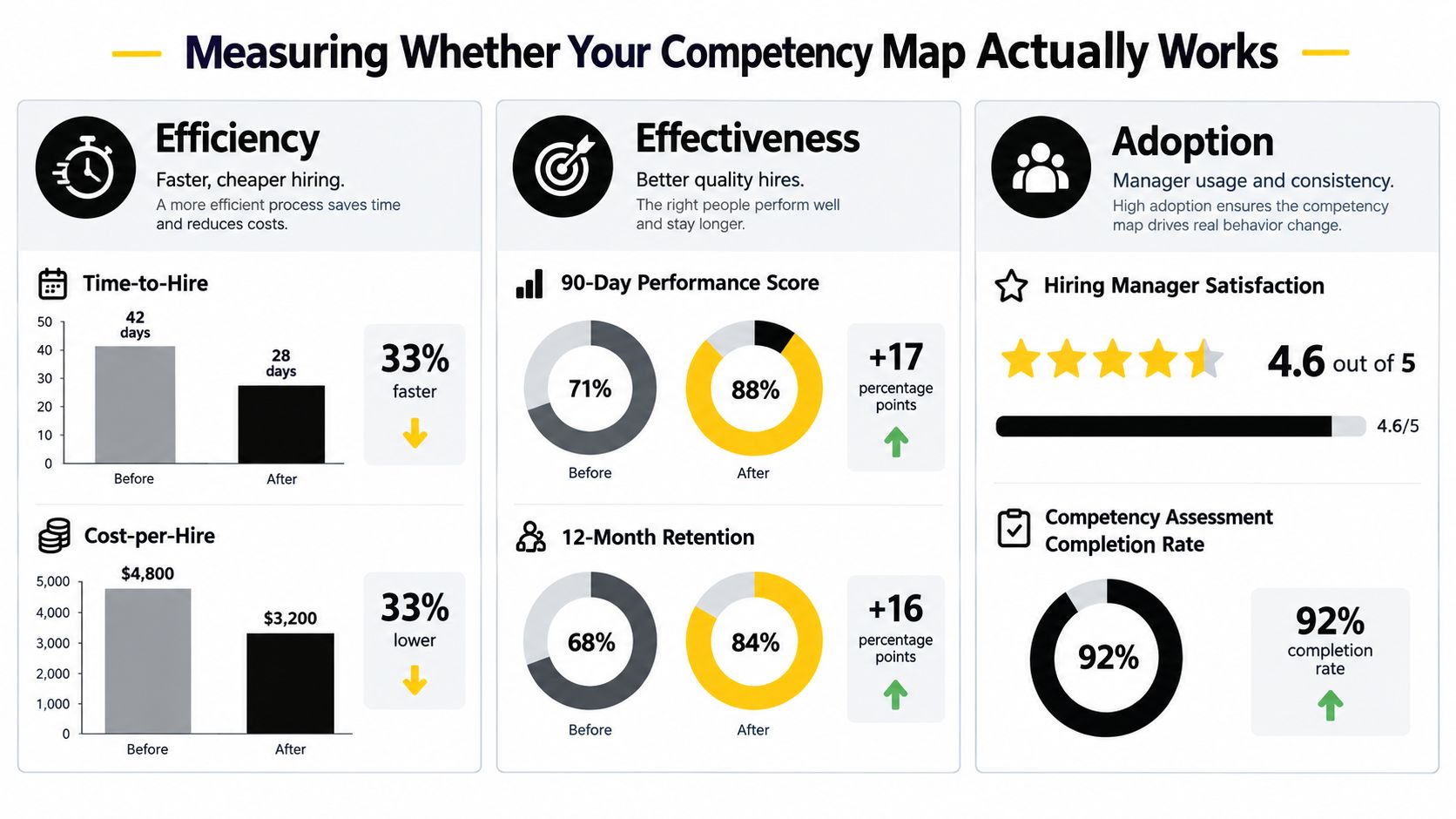
A competency map is a decision system, not a library document. HR leaders should test whether it improves the process, helps identify suitable capability, and produces consistent assessments. The measures should cover efficiency, quality, and consistency, while avoiding the assumption that every result is caused by the map alone.
Efficiency measures include time-to-hire, cost-per-hire, and the interview-to-offer ratio. If a map reduces unnecessary interviews or clarifies which assessment belongs at each stage, the hiring process may become easier to manage. Those measures matter, but speed alone can reward premature decisions.
Test prediction, not just adoption
Quality measures should examine whether competency scores at hiring relate to later performance. Compare structured competency results with performance evidence at agreed review points, such as six and twelve months. Add quality-of-hire assessments, manager feedback, and regrettable attrition where the organisation already tracks those outcomes.
A simple validation study can begin with a defined cohort. Record each candidate's competency scores at hire, then compare them with first-year performance ratings and role outcomes. The analysis should look for a meaningful relationship, not a predetermined result. There is no universal correlation threshold that can be responsibly applied to every role, workforce, or sample. HR should set an internal decision rule with its analytics, legal, and business partners, then recheck it as more evidence becomes available.
A competency is valuable because it predicts or explains relevant work behaviour, not because it appears in a polished framework.
Check consistency and fairness
Inter-rater reliability shows whether trained interviewers interpret the same rubric similarly. Scorecard completion rates indicate whether the framework fits the workflow. Adverse-impact monitoring helps identify whether a screening rule or competency indicator disadvantages a demographic group.
The map should be revalidated periodically, especially when the work changes. India's government framework links competency growth to annual tracking as described by the CBC. For private employers, the practical lesson is similar: review the relationship between mapped capability and actual performance instead of launching the framework and forgetting it.
Common Pitfalls and How to Avoid Them
Competency mapping usually fails. The framework remains available, the language sounds professional, and managers continue making decisions through personal preference. The warning signs become visible when the map no longer describes the job, produces inconsistent scores, or appears only during annual appraisals.
| Pitfall | What Goes Wrong | Practical Fix |
|---|---|---|
| Static dictionary | Definitions stop reflecting changing work | Assign an owner, record versions, and review role profiles on a set cadence |
| Generic behavioural list | Imported labels don't match local work or culture | Write role-specific indicators using evidence from managers and incumbents |
| Hidden bias | Terms such as “confidence” reward a narrow communication style | Replace style-based language with observable actions and run structured bias checks |
| Single-use framework | HR uses the map for hiring, while learning and succession ignore it | Connect the same role profile to development, performance, and mobility decisions |
| No validation rhythm | The organisation doesn't know whether competencies predict success | Review assessment consistency and outcome relationships with business and analytics leaders |
Bias can hide inside ordinary language
Return to the regional sales manager. “Projects confidence in executive meetings” might favour candidates who use a particular accent, interaction style, or cultural form of self-presentation. A more defensible indicator would be, “Presents a recommendation clearly, answers challenge with relevant evidence, and distinguishes known facts from assumptions.”
That replacement doesn't eliminate judgement. It makes the judgement more specific and reviewable. Multiple assessors should use the same question and rubric, while the organisation should monitor whether particular indicators create unequal outcomes.
The diagnostic question for leaders
Ask in the next talent review: Which competency in our framework has changed least on paper but most in the actual job? If nobody can answer, ownership and review discipline are probably weak. If several leaders give different answers, the organisation may have a governance problem before it has a technology problem.
A mapping project also needs restraint. Indian research points towards multi-dimensional frameworks that combine technical, cognitive, behavioural, functional, ethical, learning, and industry-application dimensions rather than relying on single-skill checklists as outlined in this employability-focused research resource. That doesn't mean every role should carry every competency. It means the selected capabilities should reflect the role's real performance demands.
Quick-Start Checklist for HR Leaders
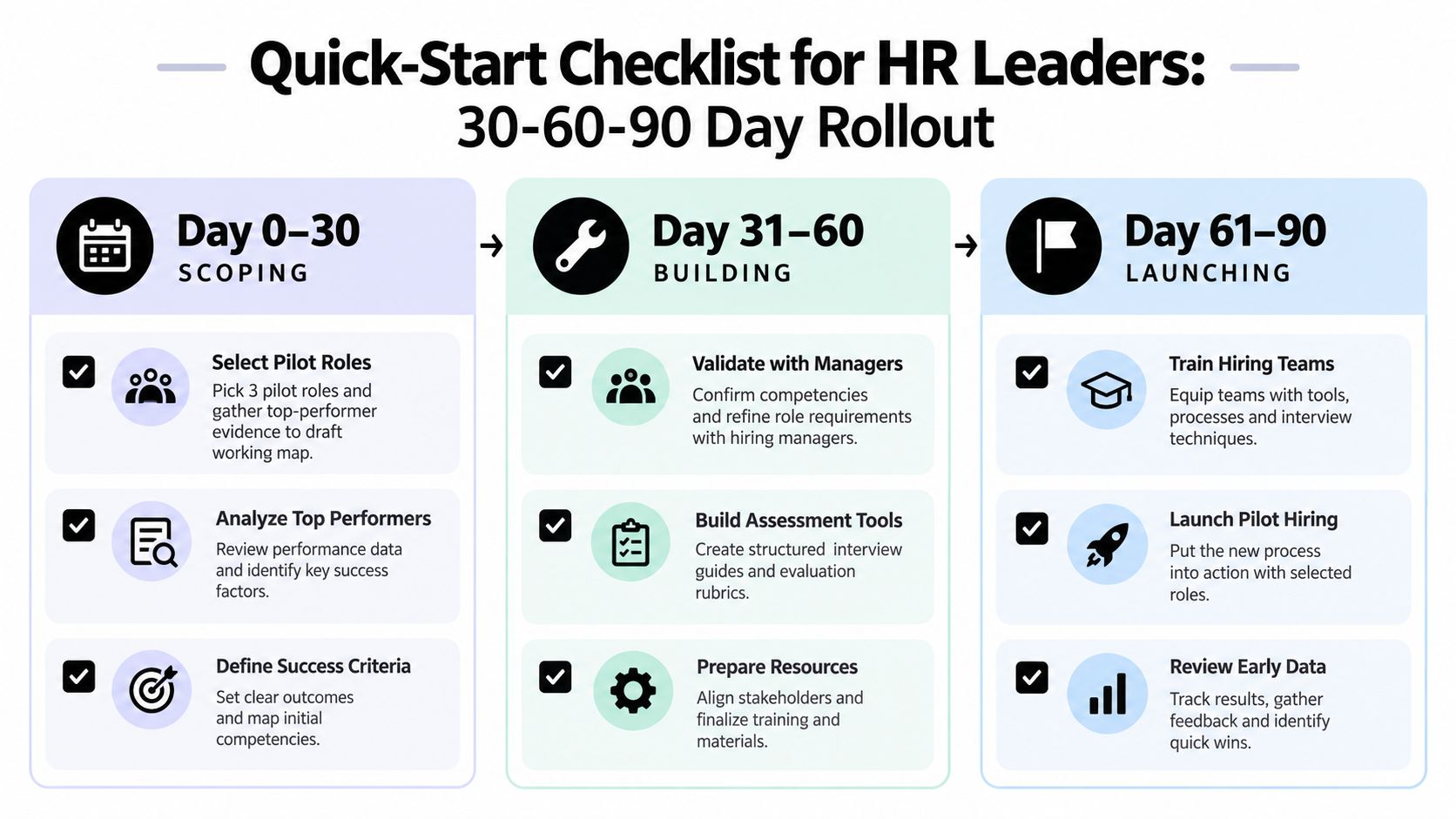
A CHRO doesn't need to map every job before learning whether the approach works. Start with a small set of strategically important roles, use real evidence, and treat the first rollout as a controlled operating exercise rather than a branding project.
Days 0 to 30, scope the work
- Select pilot roles: Choose three roles with visible hiring, development, or succession needs.
- Name owners: Assign one HR programme owner and one accountable business leader for each role.
- Gather evidence: Review outputs, interview managers and high performers, and identify decisions that distinguish strong performance.
- Draft the map: Create definitions, observable indicators, proficiency expectations, and evidence examples.
- Record assumptions: Mark which competencies are essential at entry, trainable after joining, or relevant only to certain role variants.
The deliverable is a working role profile, not a perfect enterprise dictionary.
Days 31 to 60, validate the design
- Run structured pilots: Use the draft in live hiring or realistic assessment exercises.
- Compare assessors: Review how different interviewers apply the same indicators and where their scores diverge.
- Collect usability feedback: Ask managers whether the questions, evidence rules, and proficiency levels help them make decisions.
- Test for bias: Examine whether language such as “confidence,” “executive presence,” or “culture fit” can be replaced with observable work behaviour.
- Revise the profile: Remove duplicates, clarify ambiguous terms, and document every change.
The success signal is usable evidence and more consistent discussion, not a high number of completed forms.
Days 61 to 90, operationalise the map
- Connect the workflow: Link competencies to job descriptions, AI screening rubrics, structured interview scorecards, and onboarding milestones.
- Train assessors: Show interviewers how to ask the question, listen for evidence, record notes, and avoid inferring personality from style.
- Set governance: Schedule the first quarterly review and define the trigger events that require an earlier update.
- Plan validation: Agree which later performance evidence will be compared with hiring assessments.
- Communicate limits: Tell leaders that the map supports decisions, but it won't replace role expertise, ethical review, or a fair assessment process.
The CBC's competency framework demonstrates how a structured taxonomy can support role design and capability-building. Private employers can apply the same discipline at a smaller scale, provided they keep the framework current and test whether it reflects real work.
Career Central provides AI-driven phone screening, first-round interviews, and coding assessments that can be configured around structured hiring criteria. Visit Career Central to explore how a competency map can become a more consistent, reviewable part of your recruitment workflow.