A hiring team can ask two interviewers to assess the same candidate and still receive opposite recommendations. That isn't a minor process flaw. It means the organisation may be comparing interviewer impressions rather than comparable evidence.
The evidence behind the structured and unstructured interview debate is stronger than most hiring discussions suggest. A widely cited hiring evidence base places the predictive validity of unstructured interviews at around 0.14, compared with around 0.51 for structured interviews and around 0.54 for work-sample tests, as summarised in an India-focused hiring analysis published for the 2026 market (Strategic Hiring in India). The figures shouldn't be treated as a guarantee of hiring success, but they do reframe the decision: structure is a measurement design, not merely an administrative preference.
The practical question for Indian HR leaders, therefore, isn't which interview format is better. It is where standardisation protects decision quality, where flexibility creates useful signal, and how much interviewer discretion a role requires.
Table of Contents
- Why Interview Structure Decides Hiring Quality
- What Structured and Unstructured Interviews Really Mean
- Structured Versus Unstructured Interviews Head to Head
- Question Banks and Scoring Rubrics That Make Structure Work
- When to Use Each Format Across Hiring Stages
- Implementing Structured Interviews Without Slowing Hiring
- Integrating AI Phone Screens and Coding Assessments Wisely
Why Interview Structure Decides Hiring Quality
Consider a familiar hiring meeting. One interviewer recommends a candidate because the person gave a clear example of managing a difficult stakeholder. Another rejects the same candidate because the conversation felt too rehearsed. Neither interviewer asked precisely the same questions, followed the same sequence, or recorded evidence against a common rubric.
The team now has a debate, but not a clean comparison. The candidate may have demonstrated a relevant competency to one interviewer while never receiving the opportunity to demonstrate it to the other. Indian research-methods teaching materials describe this difference in practical terms: structured interviews support standardisation and comparability, while unstructured interviews encourage exploration and open-ended discussion (Indian research-methods material).
That distinction affects more than interview etiquette. It affects the quality of evidence available for a hiring decision. If every candidate answers a common set of job-relevant questions, the hiring panel can compare responses more directly. If each conversation develops differently, the panel may gain richer context, but it also increases the role of interviewer judgement.
The operational cost of inconsistency
In high-volume recruitment, inconsistent interviews create predictable operational problems:
- Unequal assessment: Candidates aren't given the same opportunity to demonstrate the same capabilities.
- Unclear feedback: Notes reflect impressions rather than observable behaviour or evidence.
- Difficult calibration: Interviewers disagree because they used different standards, not necessarily because the candidate's performance was ambiguous.
- Weak auditability: The organisation may struggle to explain why one candidate progressed and another did not.
A structured format won't remove bias or guarantee a good hire. It can, however, make the decision process more visible and easier to inspect. A hiring manager can ask which competency was tested, what evidence the candidate provided, and how that evidence matched the rating scale.
Decision principle: If the organisation needs comparable evidence across candidates, structure should be the default. Flexibility should be added deliberately, not allowed to determine the assessment by accident.
This guide uses that lens. The aim is to help CHROs, talent acquisition leaders and hiring managers choose the right level of structure for each stage, especially where Indian employers are combining high-volume screening, AI-assisted interviews and human assessment.
What Structured and Unstructured Interviews Really Mean
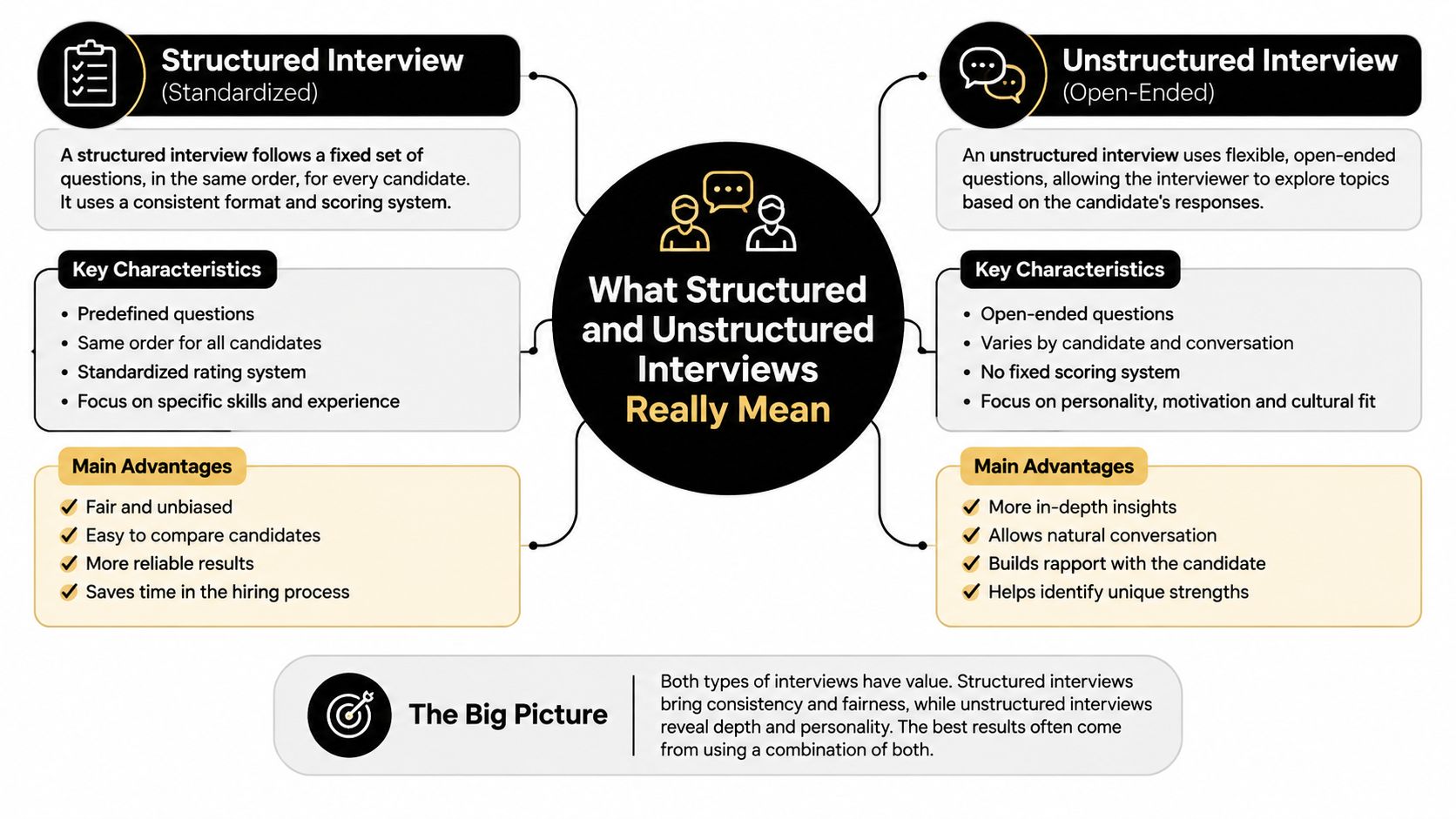
The difference between the two formats is simple to state, but hiring teams often apply it too loosely. A structured interview isn't just an interview with a printed list of questions. An unstructured interview isn't automatically a thoughtful conversation. The distinction rests on standardisation, comparability and scoring discipline.
Structured interviews
A structured interview normally defines the following elements before the interview begins:
- Questions: Every candidate receives the same core questions.
- Wording: Interviewers use consistent wording so the assessment doesn't change from one conversation to another.
- Sequence: Questions follow a predetermined order.
- Evidence capture: Interviewers record responses using a standardised format.
- Scoring: Assessors apply predetermined criteria or a competency rubric.
Indian academic material describes structured interviews as more standardised and suitable for descriptive work, economical data collection and a safer basis for generalisation. In hiring, the equivalent benefit is a more consistent comparison between candidates.
A structured interview can still sound natural. The interviewer may introduce the organisation, explain the process, allow reasonable clarification and maintain rapport. The discipline applies to the assessment questions and scoring, not to every human interaction.
Unstructured interviews
An unstructured interview allows the interviewer to decide how the conversation develops. Questions may change according to the candidate's answers, follow-up probing can go deeper into an unexpected topic, and the order of discussion may vary.
That flexibility can surface context that a fixed sequence misses. A senior candidate discussing a product failure, for example, may reveal how they handled ambiguity, conflicting priorities or a board-level disagreement. An interviewer can explore those details immediately instead of moving mechanically to the next question.
The trade-off is variance. The Indian university lecture material on interview standardisation notes that predetermined questions and fixed order reduce interviewer discretion and improve comparability, while flexible questioning increases variation in how candidates are probed and scored.
The concept map is therefore:
- Structured format: common questions, common sequence, comparable evidence.
- Unstructured format: adaptive questions, richer context, greater discretion.
- Hybrid format: structured competency assessment, controlled flexibility for relevant probing.
That last model is usually the most useful for complex hiring, provided the organisation defines where probing is allowed and how the resulting evidence will be judged.
Structured Versus Unstructured Interviews Head to Head
Interview structure affects decision quality through three mechanisms: the relevance of evidence collected, consistency between assessors, and the amount of discretion left to individual interviewers. A comfortable conversation can produce weak evidence, while a statistically stronger format can fail if its questions and scoring rules do not match the role.
| Evaluation Criteria | Structured Interview | Unstructured Interview |
|---|---|---|
| Decision accuracy | Supports comparable job-related evidence and more consistent judgments | Accuracy depends heavily on interviewer skill and conversation quality |
| Reliability | Common questions, fixed order and standardised recording support comparison | Flexible questioning creates greater variation between candidates |
| Bias control | Limits opportunities for irrelevant interviewer discretion | Leaves more room for personal impressions and inconsistent probing |
| Candidate experience | Predictable and transparent, but may feel formal if poorly delivered | Conversational and adaptable, but candidates may receive unequal assessment |
| Scalability | Suited to repeatable, high-volume hiring | Difficult to scale consistently across many interviewers |
| Best use | Common competencies, high-volume screening and evidence-based selection | Exploratory discussion, senior judgement and context discovery |
Decision accuracy depends on the selection context
Validity coefficients should not be read as a direct probability that a hiring decision will be correct. Their practical value depends on the quality of the applicant pool, the selection ratio, the performance standard, and whether interview evidence is combined with other assessments. A structured interview can improve ranking among candidates, but it cannot compensate for a weak competency model or a poorly defined job.
Selection ratio matters particularly in Indian high-volume hiring. If a process must distinguish a small group of hires from a much larger applicant pool, comparable questions and anchored ratings help reduce noise before later-stage assessment. If the shortlist is already small and highly qualified, a controlled conversation may add context without needing the same level of standardisation at every stage. The design question is therefore how much structure the decision requires, not which format wins in every situation.
Reliability and score consistency
Reliability asks whether different assessors would reach similar conclusions from the same evidence. Structured formats give interviewers a shared question set and rating framework, making calibration possible. Unstructured formats can produce useful observations, but the organisation has less control over what each interviewer tested or how evidence was weighted.
India-focused hiring guidance recommends treating interviewer-score correlation above 0.7 as a practical quality benchmark for structured interviews, while associating unstructured formats with weaker score consistency (India employer hiring guidance). The benchmark shifts attention from whether interviewers liked the format to whether assessors apply it consistently.
Bias, flexibility and governance
Structure reduces unequal treatment, but it does not make an interview automatically fair. Questions can remain irrelevant, rubrics can reflect poor assumptions, and assessors can apply ratings inconsistently. Governance requires job-related criteria, documented evidence, interviewer calibration, and periodic review of outcomes.
Unstructured interviews provide useful flexibility for senior roles, unconventional career paths, and complex decisions that do not fit a standard answer. That flexibility should be bounded. A hybrid design can keep core competency questions and scoring consistent, then allow documented probing where the candidate provides relevant evidence that needs clarification.
For AI phone screens, the same principle applies. Use a structured script and defined escalation rules for repeatable screening, while reserving human review for ambiguity, accommodation needs, unusual experience, or evidence the automated stage cannot assess. Structured interviews remain easier to audit and scale, while controlled flexibility preserves context. The trade-off is controlled evidence versus uncontrolled discretion, not rigid procedure versus human judgement.
Question Banks and Scoring Rubrics That Make Structure Work
A structured interview begins with the role, not with a collection of popular interview questions. The hiring team should identify the competencies that distinguish effective performance, then design questions that give every candidate a comparable opportunity to demonstrate them.
A competency question bank might include:
- Prioritisation: “Describe a time when you had competing urgent priorities. How did you decide what to do first, and what happened?”
- Stakeholder management: “Tell me about a disagreement with a stakeholder over an important decision. What action did you take?”
- Learning agility: “Give an example of when you had to learn an unfamiliar tool or process quickly. How did you approach it?”
- Technical problem-solving: “Walk us through a difficult technical problem you solved, including the alternatives you considered.”
- People leadership: “Describe a time when a team member's performance affected delivery. How did you respond?”
The precise wording should reflect the role. A customer operations position and a senior engineering position may both require problem-solving, but the evidence that matters won't be identical.
For practical guidance on defining the capability being assessed, teams can use this competency assessment resource.
Build the rubric before the interview
A rubric should explain what strong, acceptable and weak evidence looks like. Avoid relying on labels such as “good communication” without behavioural anchors. A useful scorecard can contain:
| Rubric element | What to define |
|---|---|
| Competency | The job-relevant capability being assessed |
| Evidence prompt | The question or task used to elicit evidence |
| Strong evidence | Observable actions, reasoning and relevant outcomes |
| Limited evidence | General claims, unclear ownership or weak reasoning |
| Follow-up rule | Permitted probes that clarify the same competency |
| Final rating | The score and written rationale |
The interviewer shouldn't award a high rating because the candidate sounds confident. The notes should identify what the candidate personally did, how they made decisions and what evidence supports the judgement.
Standardise the probe, not every word
A rigid script can make an interview feel artificial. A better approach distinguishes between core questions and permitted probes. For example, every candidate might receive the same stakeholder-management question, followed by one of these standard prompts:
- “What was your specific responsibility?”
- “What alternatives did you consider?”
- “What was the result?”
- “What would you change now?”
These prompts preserve comparability while allowing the interviewer to clarify incomplete answers. Interviewers shouldn't invent a new competency test because one answer sparked personal curiosity.
A structured interview also needs standardised recording. Notes should separate the candidate's evidence from the interviewer's interpretation. “Candidate explained how they renegotiated delivery priorities with the finance team” is more useful than “candidate seems collaborative”.
The resulting design is structured at the point where fairness matters, and flexible only where additional context improves interpretation.
When to Use Each Format Across Hiring Stages
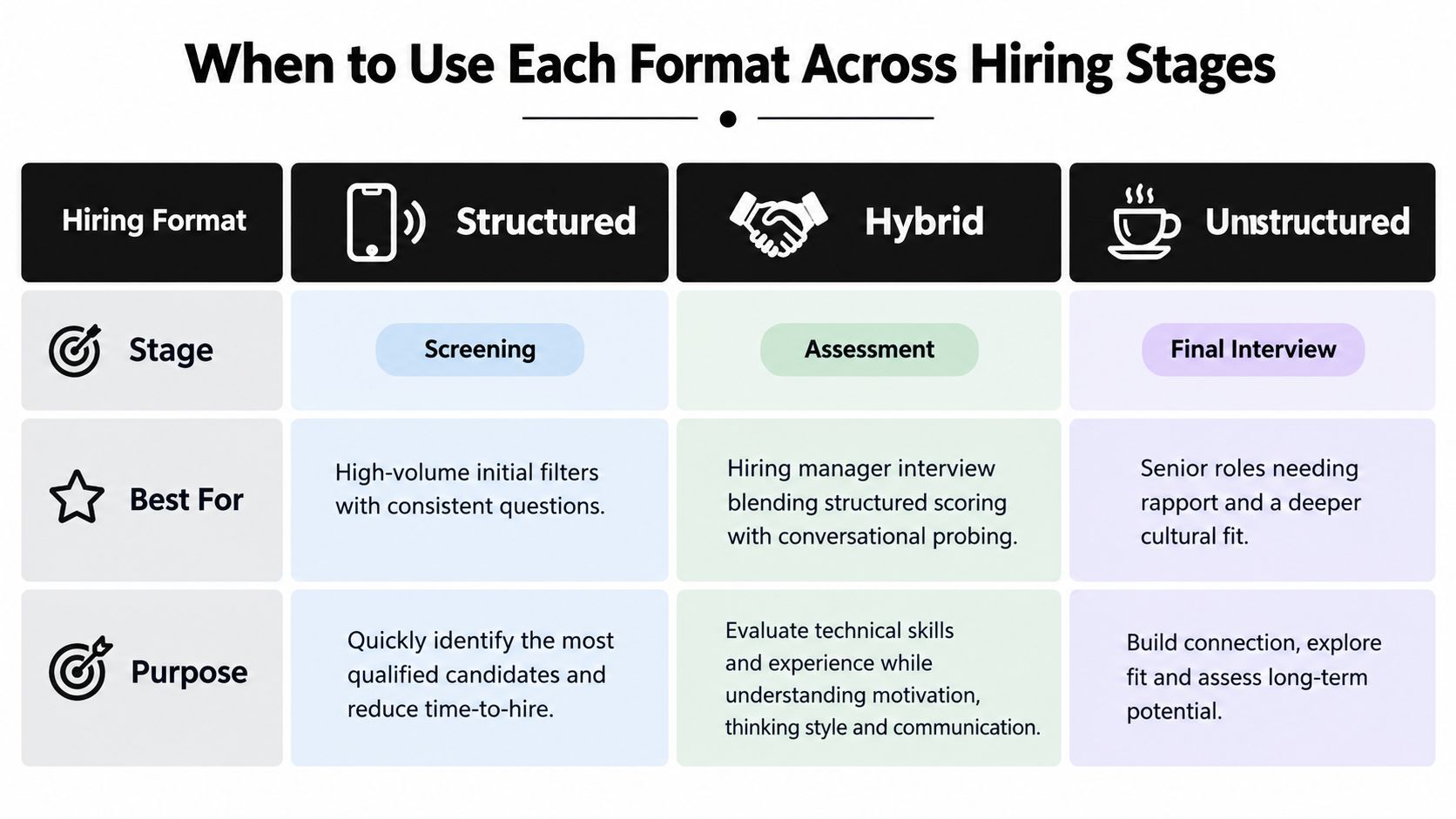
The right format depends on the stage's decision purpose. A phone screen asks whether a candidate should proceed. A hiring manager interview asks whether the candidate can perform the work. A senior leadership conversation may need to examine judgement, influence and ambiguity in greater depth.
Screening and AI phone interviews
High-volume initial screening benefits from maximum structure. Candidates should encounter consistent eligibility and competency questions, and the organisation should define what evidence moves someone forward. Standardisation protects throughput and gives recruitment teams a defensible basis for comparison.
An AI phone screen can administer the same prompts consistently, but governance still matters. The employer must define which signals are job-related, how responses are documented and when a human reviews an ambiguous result.
First-round and hiring manager interviews
The first human interview usually works best as a hybrid. Keep the competency questions, order and scoring criteria consistent, then allow controlled probing when the candidate provides relevant detail that needs clarification.
For a sales role, the interviewer might assess discovery, objection handling and prioritisation through standard questions. A follow-up can explore the candidate's reasoning, but it shouldn't become an unrelated conversation about shared interests or personal background.
Senior and complex roles
A senior leadership assessment may require more conversational space because the organisation is evaluating judgement under ambiguity, stakeholder management and strategic trade-offs. Even here, “unstructured” shouldn't mean undocumented or entirely impressionistic.
The panel can use a structured competency framework with open-ended prompts. Each interviewer should still own defined competencies, record evidence and score independently before discussion. The conversation becomes flexible in how it uncovers context, not arbitrary in how the organisation decides.
Use structure to control the decision, not to eliminate the conversation.
The most defensible model for Indian employers is usually a graduated design: high structure at early volume stages, a hybrid assessment for functional evaluation, and carefully governed flexibility for complex final decisions.
Implementing Structured Interviews Without Slowing Hiring
Implementation works when structure is treated as workflow design, not paperwork. The objective is a process that makes sound assessment easier to run, record and review without adding duplicated conversations.
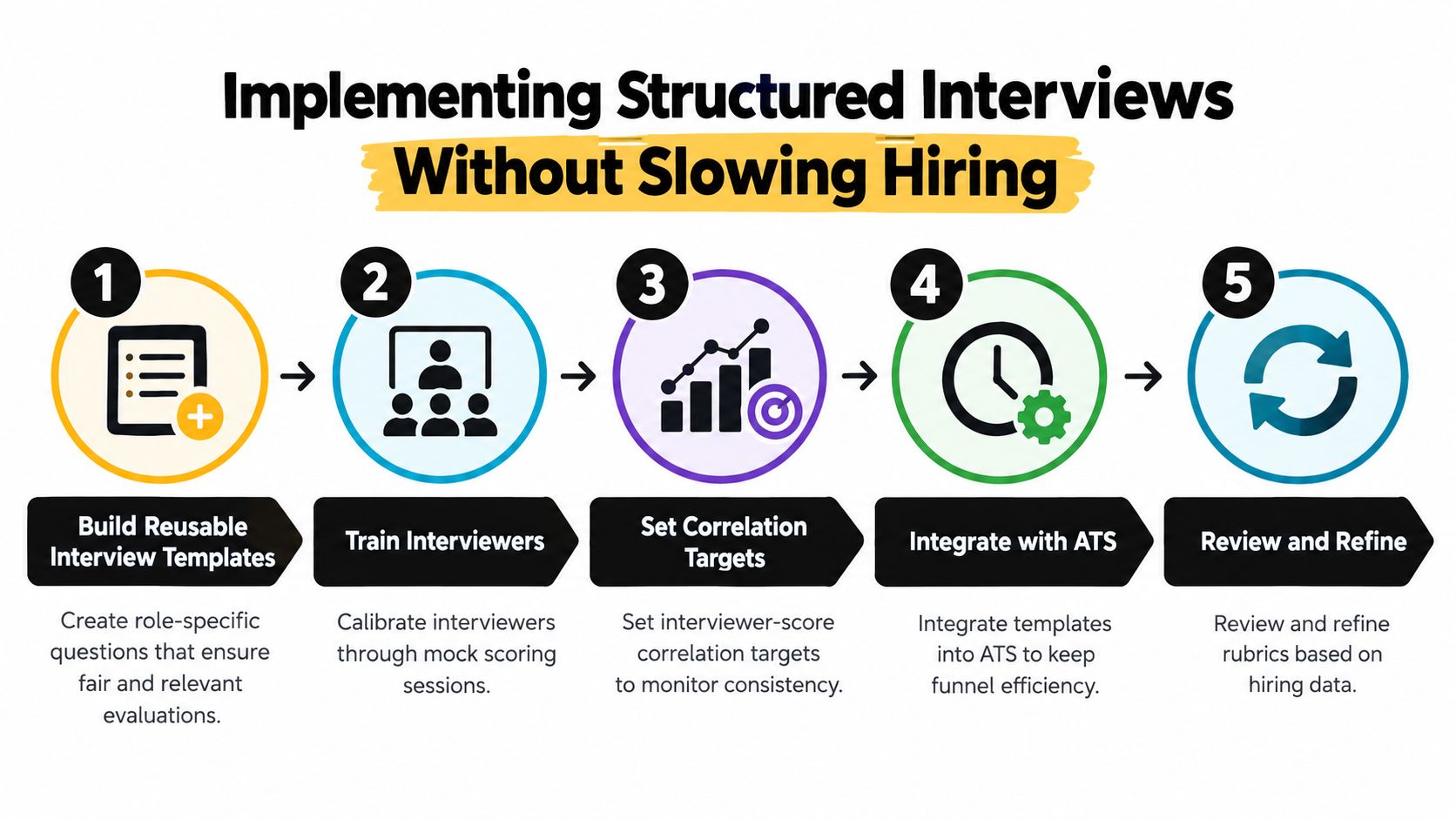
Start with role-specific templates. Each should define the competencies being assessed, core questions, permitted probes, rating anchors and evidence fields. Reusable templates reduce preparation for recurring roles, but require review when responsibilities change.
A practical rollout sequence
- Map the role: Separate capabilities required for performance from desirable background signals. Remove traits that have no clear connection to the work.
- Write the assessment: Create common questions and define strong evidence before interviewing candidates. This gives assessors a shared standard rather than a personal interpretation of quality.
- Calibrate assessors: Provide sample responses. Have interviewers score independently, then discuss why ratings differ and clarify the rubric.
- Embed the workflow: Put questions, scorecards and evidence fields in the ATS or interview platform. This reduces reliance on personal notes and makes missing feedback visible.
- Review outcomes: Examine score consistency, candidate progression, hiring manager feedback and later quality-of-hire indicators.
Teams reviewing digital workflows can compare candidate assessment tools with their existing ATS and interview documentation process.
Protect speed through design
Adding interview stages without redesigning the funnel creates delay and candidate attrition. India-focused employer guidance reports that each additional interview round can increase candidate drop-off by 15–20% (employer hiring playbook). Structure should therefore help the organisation reach a decision with fewer repeated conversations, rather than create another approval layer.
Assign each stage a distinct purpose. If the phone screen tests basic role requirements, the next interview should examine deeper competencies instead of repeating the same questions. Give every interviewer a defined remit and a deadline for submitting evidence. A short, consistent scorecard is usually faster to review than unstructured notes.
Governance and measurement
Documentation supports accountability, but access to sensitive candidate information should be restricted according to the organisation's legal and privacy requirements. A scorecard should explain the hiring decision through job-related evidence, without recording irrelevant personal details.
Review whether interviewers apply the rubric consistently. Track candidate drop-off, time between stages, feedback completion and disagreement patterns across assessors. Agreement is not the objective. The useful question is whether disagreement reflects genuine ambiguity in the candidate's evidence or inconsistent assessment practice. That distinction indicates whether to refine the rubric, retrain interviewers or preserve flexibility for a complex role.
Integrating AI Phone Screens and Coding Assessments Wisely
AI can standardise early interactions, but it shouldn't become an unexamined decision-maker. An effective architecture assigns technology the work that benefits from repeatability and assigns humans the work that requires contextual judgement.
Career Central describes an AI-driven interview service that includes phone screening, first-round interviews and coding assessments, making it relevant to organisations designing a structured early-stage funnel. Used responsibly, such a layer can present consistent prompts, capture responses and organise assessment evidence before a human reviewer evaluates progression.
The governance model should include clear checkpoints:
- Before launch: Validate that questions measure job-related competencies rather than accent, familiarity with interview conventions or background signals.
- During screening: Create a human review path for unclear, incomplete or unusual responses.
- At assessment: Combine coding evidence or structured responses with role-specific human evaluation instead of treating one signal as sufficient.
- After hiring: Compare assessment evidence with later performance indicators and review whether the process excludes unconventional but capable candidates.
This is why AI should support, not replace, human judgement in interview design (AI and interview quality guidance). The same principle applies to psychometrics. India-focused research reports that 60 percent of organisations use psychometrics at recruitment to assess quality of hire, while 58 percent use it to assess job or culture fit, with usage falling later in the employee lifecycle (India psychometrics research). These figures indicate strong employer interest in standardised hiring evidence, but they don't justify removing human review.
The strongest hybrid process is transparent about what each tool measures, keeps a route for human reconsideration and evaluates candidate acceptance alongside efficiency. That is how organisations gain the consistency of structure without turning hiring into a black box.
Career Central provides AI-driven phone screening, first-round interviews and coding assessments that can support a consistent, documented hiring workflow. Visit Career Central to evaluate how its interview layer could fit into your structured and hybrid assessment process.