Competency assessment is the evaluation of knowledge, skills and abilities against specific job competencies and demonstrable application, not recall. In India, this approach sits within the NEP 2020 reform agenda and is increasingly relevant to both education and hiring.
Two candidates arrive for the same role. Their CVs show similar qualifications, and both give polished answers in the interview. One can prioritise a customer issue, explain the decision clearly and use the relevant system under pressure. The other can describe the right process but struggles to apply it when the situation changes. A conventional hiring process may treat them as equals. A well-designed competency assessment looks for the difference that matters at work.

Table of Contents
- Introduction Why Competency Assessment Matters Now
- What Competency Assessment Really Means
- How Competency Assessment Differs From Other Evaluations
- Types of Competencies With Real Workplace Examples
- Why Organisations Are Shifting to Competency Based Hiring
- How to Design and Implement Competency Assessments That Work
- Measuring Results and Integrating With AI Screening and Coding Tests
- Frequently Asked Questions on Competency Assessment
Introduction Why Competency Assessment Matters Now
A new hire joins with the right qualification, confident communication and a strong interview. Within weeks, the manager discovers that the person needs extensive support with judgement, collaboration or role-specific execution. The hiring team may have followed a careful process, yet measured information about the candidate more closely than evidence of performance.
That gap gives competency assessment meaning for talent leaders. It links a job requirement to an observable behaviour, then gathers evidence that a candidate can perform it to the required standard. The method can support a phone screen, work sample, coding task or interviewer evaluation. It remains more than a structured conversation because the evidence must connect to work.
India's education reforms make this shift timely. The Ministry of Education describes competency-based assessment through knowledge, skills and abilities related to defined competencies or job requirements. NEP 2020 gives greater weight to application, reasoning and problem-solving than memorisation. Its assessment agenda includes PARAKH, a standard-setting body intended to support assessment across recognised school boards. The Ministry of Education's PARAKH overview records that PARAKH was established as an independent unit in NCERT on 8 February 2024.
The same principle applies in hiring. A funnel can lose candidates when early screens, interviews and later tasks test different things. A definition alone cannot prevent that drop-off. Talent teams need a clear competency model, validated tasks, consistent scoring and AI that assists review without turning an automated score into unquestionable evidence.
Practical rule: If a competency cannot be described as an observable behaviour, it is not ready to assess.
The guide develops the idea from definition to implementation, including distinctions from skills tests and certifications, assessment design, method selection and responsible AI-assisted screening.
What Competency Assessment Really Means
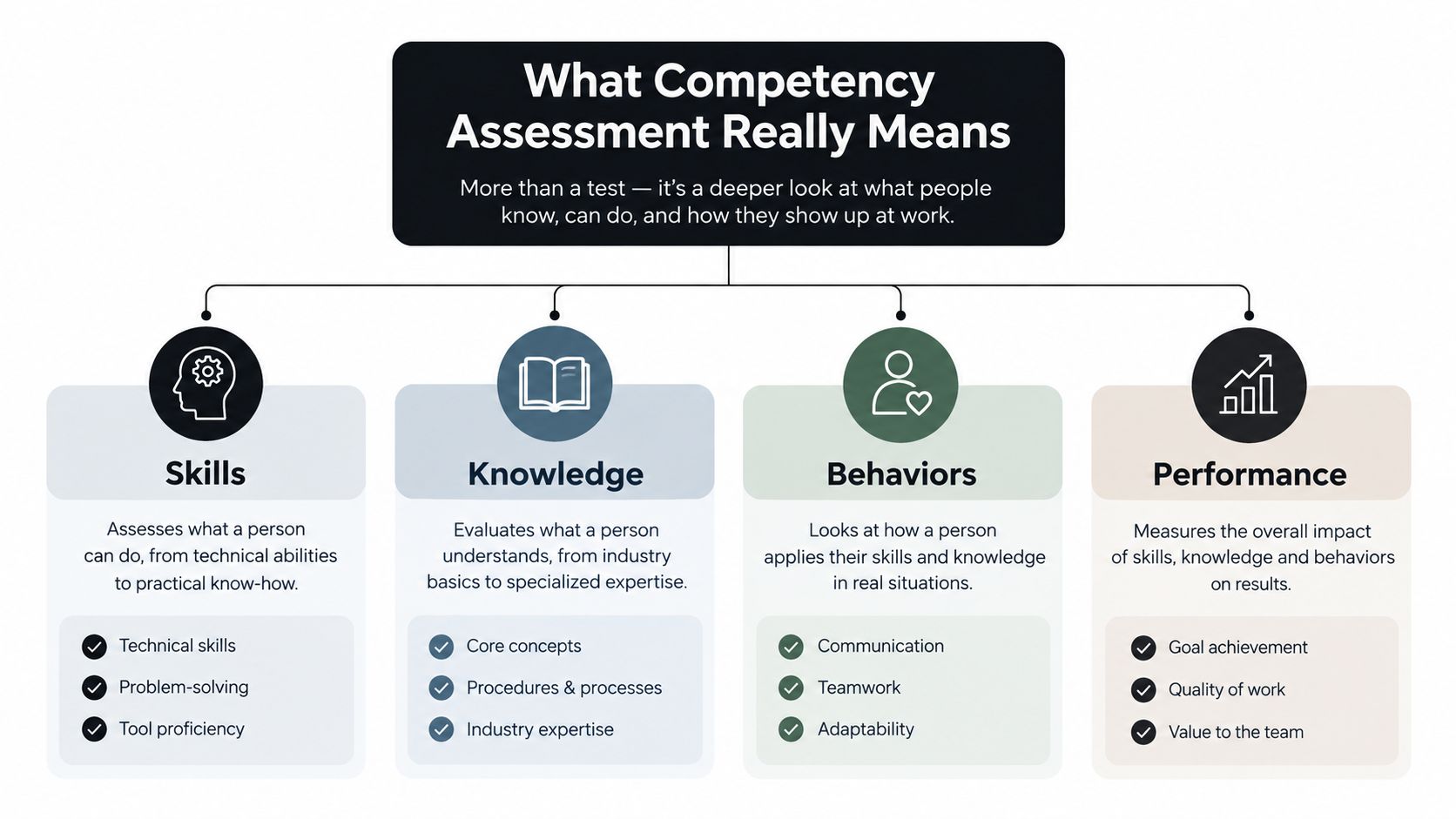
A candidate may explain how an engine works, recognise road signs and pass a written driving test. Safe driving requires more: handling traffic, responding to an unexpected hazard and repeating the performance reliably. The same distinction applies at work. Competency is demonstrated capability, shown when a person applies what they know in a defined situation.
A useful definition has four connected parts:
- Knowledge is the concepts, rules and information required for the role.
- Skills are the practical actions that use that knowledge, such as writing code, analysing data or operating a process.
- Abilities are broader capacities, including reasoning, communication and problem-solving.
- Standards and behaviour show whether the person performs reliably in the context and manner the role requires.
These parts work like the components of a driving test. Knowing the rules matters, but the assessment must also show how the candidate acts, makes decisions and maintains the expected standard. A correct answer can provide evidence of knowledge. A realistic task, scenario or structured response gives stronger evidence of application.
From policy language to usable evidence
India's NEP 2020 and PARAKH reforms, discussed in the Introduction, reinforce the move from memorisation toward applied knowledge, reasoning and problem-solving, a useful parallel for workplace assessment.
For an HR team, the definition becomes useful only after it is translated into observable evidence. “Customer focus” is too broad to score consistently. A clearer competency statement might require a service representative to identify the customer's underlying issue, explain available options, record the interaction accurately and follow the role's process.
That wording gives assessors specific behaviours to observe and gives candidates a clearer picture of what the organisation values. It also helps hiring teams connect an early screen, work sample and interview to the same capability, rather than letting each stage measure a different idea of fit. The design still needs validation and consistent scoring, particularly when AI supports screening or review.
Repeatability matters
Competency is not a strong result on one fortunate attempt. The British Council's India-focused skills assessment report describes it as the ability to carry out responsibilities to a recognised standard on a regular basis. Its framework includes validity, reliability, transparency, flexibility, practicality and an evidence base.
In practical terms, the assessment should measure the intended capability, produce dependable results, make the criteria understandable, fit the hiring context and retain enough evidence for a decision. That standard separates competency assessment from an ordinary test with a more appealing label.
How Competency Assessment Differs From Other Evaluations
HR teams often use the term competency assessment for several different activities. A multiple-choice test, a structured interview and a professional certification can all provide valuable evidence, but they answer different questions. The key is to match the method to the competency and to avoid claiming that one method measures everything.
| Evaluation Type | What It Measures | Best Use Case | Limitation |
|---|---|---|---|
| Competency assessment | Application of knowledge, skills, abilities and behaviours against defined standards | Evaluating whether a candidate can perform important job responsibilities | Requires careful design, scoring and validation |
| Skills test | A specific capability, such as numerical reasoning, language or technical knowledge | Checking a focused skill early in the funnel | May not show how the skill transfers to a complete work task |
| Interview scorecard | Evidence from structured questions and interviewer judgement | Exploring decisions, communication and past behaviour | Quality depends on question design and assessor consistency |
| Certification exam | Achievement against the requirements of a recognised course or credential | Confirming formal learning or professional eligibility | Doesn't automatically prove performance in your specific workplace |
India's policy framing is useful here because it treats competency as evidence of knowledge, skills and values in a specific domain, while NEP-aligned materials place weight on core concepts and real-world application rather than memorised responses. That means a certificate can be relevant without being conclusive, and an interview can contribute evidence without becoming the entire assessment.
Choose by evidence, not by format
A phone screen may be suitable for communication, motivation and basic role alignment. It isn't usually enough to establish whether a developer can produce maintainable code or whether an analyst can interpret a complex dataset. A coding task can provide direct technical evidence, but it may say little about stakeholder management.
For general aptitude design, HR teams can also distinguish focused reasoning exercises from broader competency evaluation using this guide to types of aptitude tests. The important decision isn't whether a method looks modern. It's whether the method creates observable evidence for the competency in question.
A structured interview becomes a competency assessment only when the organisation has defined the behaviour, asks comparable questions, applies explicit criteria and records evidence against those criteria. Adding a scorecard to an informal conversation doesn't create validity. The label must follow the design, not replace it.
Types of Competencies With Real Workplace Examples
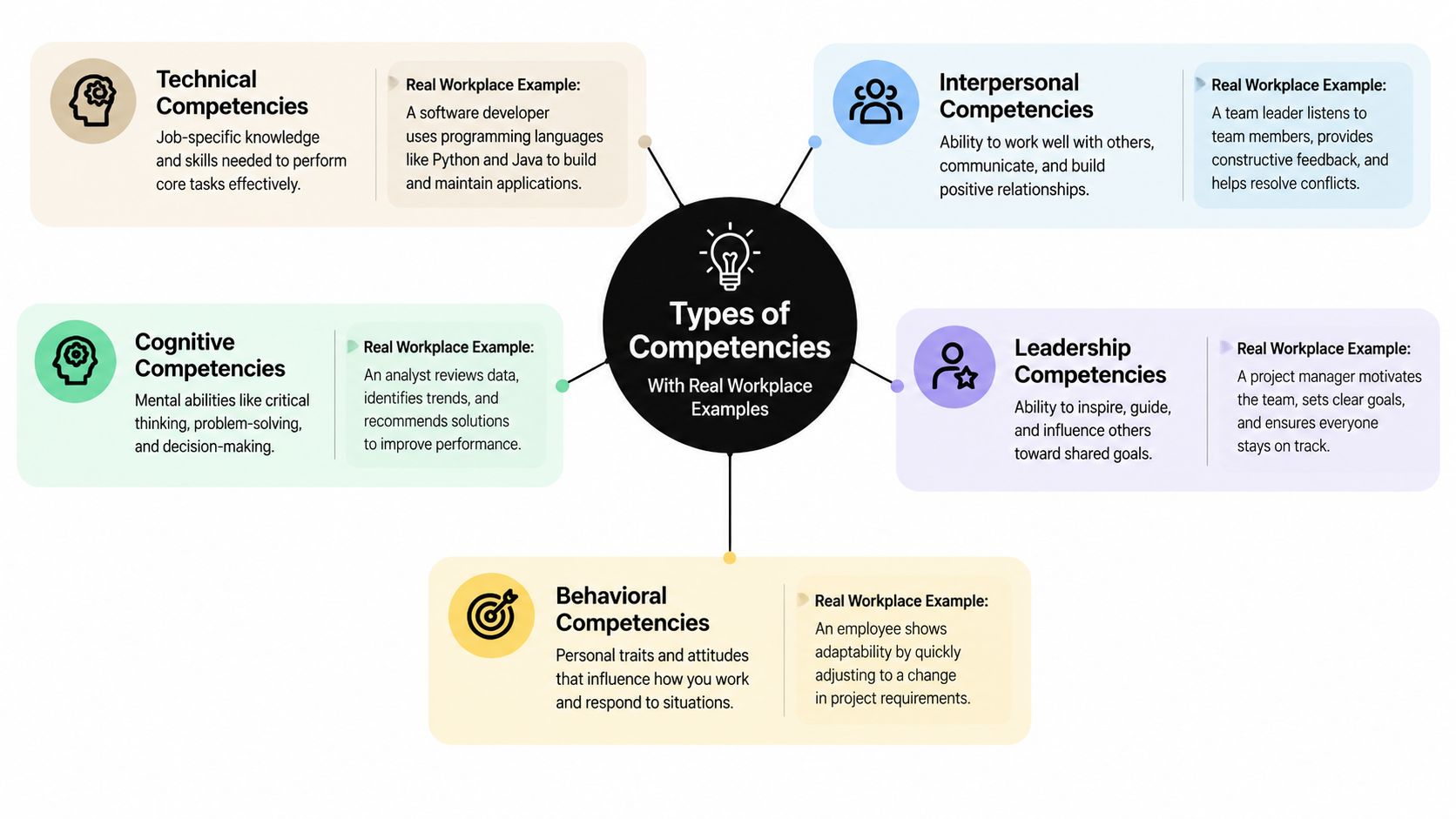
A useful competency dictionary helps assessors recognise evidence in action. It works like a role map: each position draws on several domains, but the balance changes with the work. A technical specialist may need deep domain knowledge and careful reasoning. A people manager may need stronger evidence of coaching, judgement and conflict handling.
Technical and cognitive competencies
Technical competencies cover the tools, methods and domain knowledge required for a role. For software work, evidence might include writing a functioning solution, explaining trade-offs and testing edge cases. In finance, it could involve interpreting a reconciliation issue and documenting the correct treatment.
Cognitive competencies show how a person analyses information and makes decisions. A planning candidate might receive incomplete information, identify priorities, state assumptions and explain risks. A good assessment examines the quality of the reasoning, rather than rewarding a memorised framework that the candidate cannot apply.
Interpersonal and behavioural competencies
Interpersonal competency appears in how someone exchanges information and works with others. A sales candidate could clarify an ambiguous customer requirement, respond to an objection and summarise the next action. A communication skills assessment test can support this evaluation when its criteria focus on observable behaviours, including clarity, listening and adaptation to the audience.
Behavioural competencies describe recurring patterns in action. They include prioritisation, ownership, adaptability and attention to detail. A scenario can show how a candidate responds when deadlines conflict. A work sample can reveal whether the person checks assumptions before submitting an output.
Values-based competencies
Values-based competencies turn organisational principles into choices an assessor can observe. “Integrity” is too broad to score directly. A clearer indicator is whether a candidate identifies a reporting error, explains its impact and escalates it through the appropriate channel, even when that creates inconvenience.
Across all five categories, assessment quality depends on the same design principles: recognised standards, observable indicators and a method that captures relevant evidence. A competency dictionary should therefore specify what acceptable performance looks like and which task, question or simulation can reveal it. This keeps the model useful for hiring, development and validation, rather than turning it into a list of attractive terms.
Why Organisations Are Shifting to Competency Based Hiring
A hiring panel faces a familiar problem: two candidates hold similar qualifications, yet only one can apply knowledge when the situation changes. Competency-based hiring addresses that gap by examining how people use what they know, not only what they have studied.
India's education reforms point in the same direction. The CBSE Competency Based Education Project, launched in March 2021, was designed to replace rote learning with a competency-based framework over 2–3 years, according to the Ministry of Education's CBSE competency-based education document. Its approach, alongside NEP 2020, places greater weight on application, reasoning and problem-solving. PARAKH adds a standards and coordination role, helping connect assessment with demonstrated capability.
The workforce case
The Skills for the Future report cited by the Comptroller and Auditor General reports that 88% of India's workforce is in low-competency occupations, while 10–12% are in high-competency roles. For employers, this points to a capability challenge. Filtering applicants by educational background alone cannot show who can perform the work or develop into a stronger contributor.
A competency model gives recruiters and hiring managers a shared vocabulary. It also gives candidates a clearer target and creates evidence for development or internal mobility discussions. Applied carefully, it can widen access by giving job-relevant performance more weight than pedigree.
A competency label has value only when a candidate's behaviour connects to a defined work outcome.
The risk of superficial adoption
A structured interview becomes a competency assessment only when its questions, evidence and scoring criteria are tied to the role. An automated score has the same limitation. Vague competencies, inconsistent questions or rubrics that reward polished language can produce confidence without reliable evidence.
The strongest organisations treat competency hiring as an operating design problem. They define successful performance, choose evidence that can reveal it, train assessors and review results after launch. India's reform agenda supplies momentum, but employers must still translate broad ideas such as problem-solving into observable, role-specific evidence. Without that translation, a competency framework remains a list of labels rather than a dependable hiring tool.
How to Design and Implement Competency Assessments That Work
A capable applicant can still fail an assessment because the task is unclear, the device is unsuitable or the scoring rewards polished language instead of job performance. Design therefore starts with the role, not the platform. Ask the hiring manager which decisions, tasks and risks define success. Then translate broad requirements into observable behaviour, such as diagnosing a root cause before recommending a solution or explaining technical constraints in language a non-specialist can use.
A practical design process includes these choices:
- Prioritise the competencies: Separate capabilities required for the work from useful preferences. Assessing too many areas slows hiring and weakens the signal.
- Define performance indicators: Describe weak, acceptable and strong evidence through actions and outputs, rather than personality labels.
- Match the method: Use a phone screen for communication or initial motivation, a coding assessment for programming evidence, a case or work sample for applied reasoning, and a structured interview for judgement and past behaviour.
- Build a scoring rubric: Give assessors anchored descriptions and space to record evidence. A score without an explanation is difficult to review and easy to overinterpret.
- Calibrate assessors: Review sample responses together before live hiring begins. Discuss differences and agree on how the rubric should be applied.
- Protect fairness: Check whether language, accessibility, location, device access or cultural assumptions affect performance.
- Pilot before scaling: Compare assessment evidence with later job-related outcomes and candidate feedback. Revise tasks that confuse capable candidates or fail to distinguish performance.
Quality has several dimensions. Validity asks whether the assessment measures the intended competency. Reliability asks whether results remain dependable across assessors and comparable candidates. Transparency, flexibility and practicality also matter because candidates and hiring teams need to understand the task and use it consistently. The earlier India skills assessment research offers a useful reference for examining these dimensions without treating them as abstract labels.
Keep human judgement accountable
AI can standardise parts of an early hiring stage, but it does not transfer accountability to the software. A tool may organise responses, apply a consistent rubric or surface evidence for review. The hiring team still defines the competency, checks the scoring logic and provides a route for human reconsideration.
Career Central provides AI-driven phone screening, first-round interviews and coding assessments, with structured candidate scoring and feedback that can support this workflow. Evaluate it as one component of the wider system, alongside the candidate assessment tools an organisation already uses. Each method should have a clear purpose, competency mapping and explanation of what its score can and cannot show.
India's NEP 2020 and PARAKH reforms reinforce the value of clearer, more consistent evidence of capability. Employers still need to convert that direction into role-specific design. Assessments should identify current performance and trainable potential, while distinguishing a genuine capability gap from a poorly designed or inaccessible process. A disciplined pilot, documented rubric and human review make that distinction easier to defend.
Measuring Results and Integrating With AI Screening and Coding Tests
A hiring funnel can look healthy while losing evidence at each step. Track candidate movement through screening, work samples, interviews and decisions, then ask what each stage measures. A high pass rate may reflect strong applicants, an easy assessment or a standard that is too broad. A low pass rate may point to a capability gap, unclear instructions or a task unrelated to the job.
PMKVY illustrates why funnel data needs careful reading. Reporting cited in 2025 showed that, out of every 100 enrolled candidates, 78 were trained, 52 assessed and 47 certified, as reported by Careers360's coverage of the PMKVY data. The fall between stages does not identify its own cause. It does show why HR leaders should review enrolment, completion, assessment and certification separately before judging the whole pipeline.
Build one evidence view
Treat the assessment system like a case file, not a single verdict. It can bring together AI phone screening, a coding task, structured interviewer observations and relevant work samples, while preserving each method's competency mapping, score meaning and confidence limits. Combining unrelated results into one number can conceal weaknesses unless the weighting has a clear, defensible rationale.
Review assessor differences, candidate appeals, completion patterns and performance after hiring. For AI-assisted assessments, test whether the tool reflects role requirements and gives candidates with different language backgrounds, regions, accessibility needs or educational routes a comparable chance to demonstrate competence. Human review should remain available when evidence is unclear or a candidate challenges the result.
NEP 2020 and PARAKH reinforce the need for clearer evidence of capability. For HR teams, that direction becomes useful only when assessment design, validation and AI integration connect to the same competency framework.
Measurement principle: A dashboard should show where evidence was gathered and where uncertainty remains, rather than hide both inside one neat score.
Frequently Asked Questions on Competency Assessment
How do we stop competency becoming a vague label?
Define each competency through observable behaviour, context and a recognised performance standard. If assessors can't point to evidence, remove or rewrite the competency.
Which method suits each stage?
Use phone screening for communication and basic alignment, coding tests for programming execution, work samples for applied tasks and structured interviews for judgement or behavioural evidence.
What do pass and fail rates tell us?
They show movement through a process, not automatically hiring quality. Review item difficulty, completion, assessor variance and later job-relevant outcomes.
Can calibration reduce bias?
It can improve consistency by aligning assessors to the same evidence standards. Also review language, accessibility and regional effects rather than assuming calibration solves every fairness issue.
How should we validate AI assistance?
Test it against defined competencies, compare its outputs with trained human reviewers and monitor errors after launch. Keep human oversight for uncertain or disputed decisions.
Career Central provides AI-driven phone screening, first-round interviews and coding assessments that can help HR teams gather structured evidence across the hiring funnel. Visit Career Central to explore how its assessment services could support a competency-based hiring process with clearer scoring and human-led review.