The real hiring risk rarely shows up in the interview. It shows up after the offer is signed, when a polished candidate starts the job and the cracks become obvious. They misread basic data, miss patterns in everyday problems, or make poor calls the moment the work gets messy.
That is exactly what aptitude testing is designed to catch earlier. It gives hiring teams a clearer, more objective view of how someone thinks, not just how confidently they talk. In India, numerical and verbal reasoning tests are already a major part of that process, with over 78% of large employers using these cognitive tests in pre-employment screening. The logic is simple. When you need to compare large applicant pools quickly, interviews alone do not give you enough signal.
The real question is not whether to use aptitude tests. It is which ones to use, when to use them, and how to fit them into a hiring workflow that stays fast and fair. That matters even more in tech-enabled recruitment, where TA teams need to screen at scale without sacrificing relevance or consistency.
This guide breaks down the main types of aptitude test used in hiring and shows where each one adds value. More importantly, it looks at assessment as a connected system, so you can combine cognitive screening, behavioural insight, and role-specific evaluation inside a modern AI-powered workflow.
Table of Contents
- 1. Verbal Reasoning & Communication Assessment
- 2. Numerical Reasoning & Quantitative Analysis
- 3. Logical Reasoning & Abstract Thinking
- 4. Technical & Coding Aptitude Assessment
- 5. Personality & Behavioral Fit Assessment
- 6. Spatial Reasoning & Visualization Aptitude
- 7. Speed & Accuracy (Clerical & Perceptual) Assessment
- 8. Mechanical Reasoning & Problem-Solving
- 9. Leadership & Management Aptitude Assessment
- 10. Situational Judgment & Business Acumen Assessment
- 10 Types of Aptitude Tests Compared
- Building Your Integrated Assessment Strategy
1. Verbal Reasoning & Communication Assessment
For many roles, weak communication doesn't show up as poor grammar. It shows up as missed meaning. A candidate reads a client brief, policy note, support ticket, or contract summary and pulls the wrong conclusion from it. That's why verbal reasoning deserves a place far beyond obvious writing-heavy jobs.
This test type works best when the passages look like the documents people will handle at work. For a customer support hire, use policy excerpts and complaint threads. For HR, use handbook language, manager emails, and compliance summaries. For sales, test how candidates interpret product notes and prospect objections.

What it reveals in practice
A strong verbal reasoning assessment tells you whether a candidate can process written information under modest time pressure and separate fact from inference. That matters in consulting, customer success, operations, and people roles, where poor reading discipline creates rework.
The trade-off is fairness and context. Generic passages often reward test familiarity more than job readiness. The concern is especially relevant in India, where regional discussions around contextualised cognitive assessments point to language bias and cultural framing issues in standard test designs. If your hiring pool includes candidates from non-English primary education backgrounds, dense corporate English can produce false negatives.
Practical rule: Test comprehension, not accent, polish, or Western idiom familiarity.
A simple build that works well:
- Use role language: Include vocabulary from the actual function, but avoid jargon only insiders would know.
- Keep the scoring clean: Reward correct interpretation, not writing style, unless writing is part of the role.
- Pair it with a phone screen: An AI-led first-round conversation can validate whether strong text comprehension carries over into spoken communication.
2. Numerical Reasoning & Quantitative Analysis
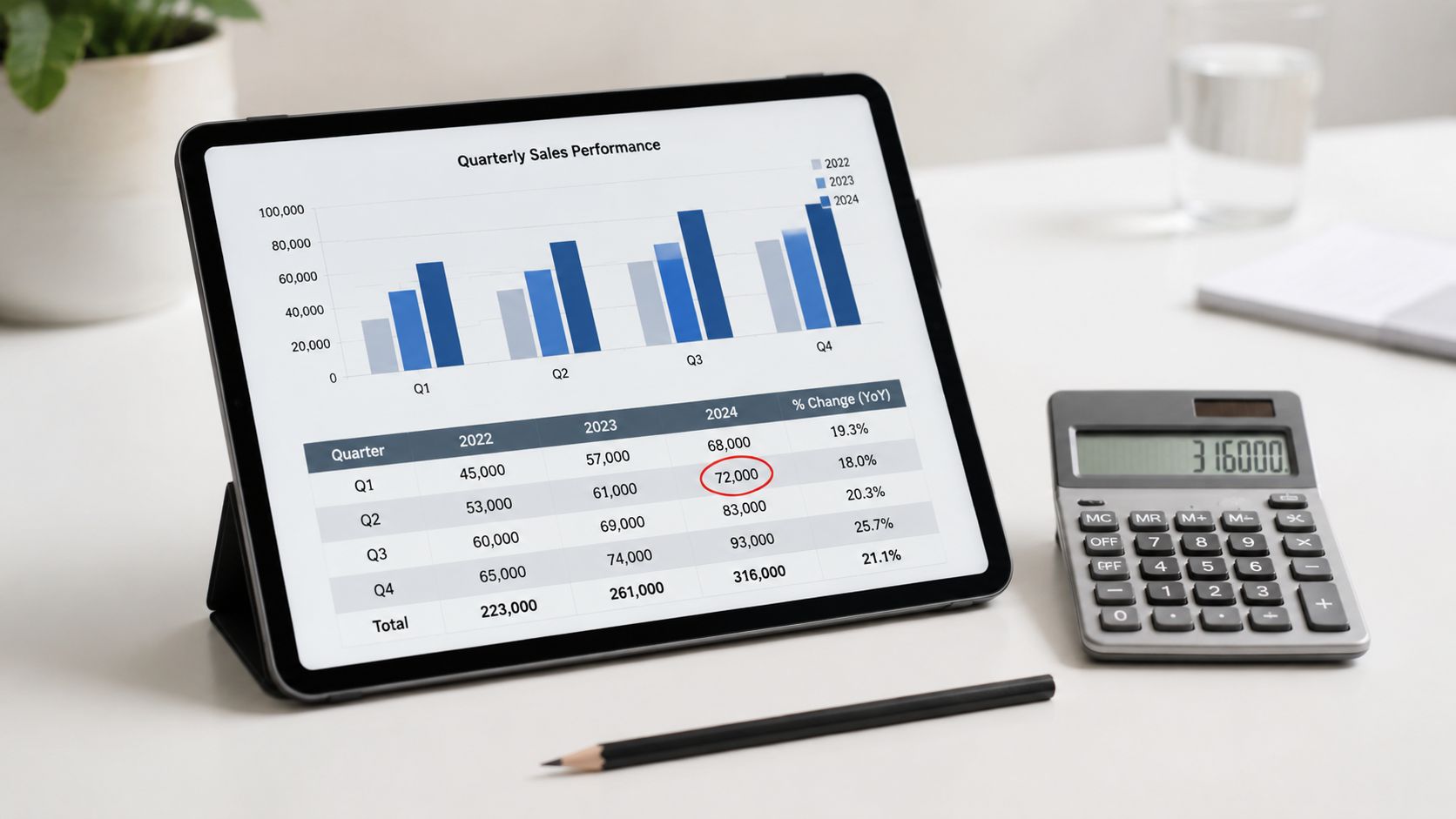
A hiring team reviews 600 applications for an analyst role, interviews a polished shortlist, and still misses the one question that matters. Can this person read a messy table, spot the underlying issue, and make a sound call with incomplete numbers? Numerical reasoning earns its place early because it answers that question faster than CV screening ever will.
It is especially useful for roles tied to forecasting, pricing, reporting, margin control, demand planning, and operational decision-making. In many teams, weak quantitative judgment does not show up until after hire, when dashboards are misread, assumptions go unchallenged, and avoidable mistakes reach customers or senior stakeholders.
How to make it job-relevant
The strongest numerical assessments mirror the decisions the role requires. A finance candidate might compare gross margin shifts across product lines. An operations hire might choose between staffing options under demand variability. A growth analyst might review funnel data, identify the constraint, and explain which metric deserves attention first.
That distinction matters. Hiring managers often ask for "numerical aptitude" and receive a generic maths test heavy on percentages, ratios, and speed drills. That format is easy to buy and easy to score, but it often selects for test familiarity rather than business judgment.
A better design tests three things:
- Interpretation: Can the candidate read tables, charts, and basic model outputs correctly?
- Decision quality: Can they choose the right action from imperfect data?
- Working pace: Can they do both under realistic time pressure?
Calculator policy is a practical example of the trade-off. If the job allows spreadsheets, BI tools, or calculators, the assessment should too. Speed still matters, but the pressure should sit on prioritisation and interpretation, not mental arithmetic.
Standardised aptitude packs are widely used, which is exactly why many hiring teams overuse them. Off-the-shelf tests help with scale, especially at the top of the funnel. They also flatten role differences if you stop there. A revenue operations hire, commercial finance analyst, and supply planner all use numbers, but they do not use them in the same way.
The best process combines efficiency with validation. Start with a short numerical screen in your ATS or assessment layer to reduce volume fairly. Then route qualified candidates into a role-specific step such as a spreadsheet case, dashboard review, or scenario-based exercise. Platforms like Career Central make that easier to run at scale by automating invitations, scoring workflows, shortlist movement, and recruiter follow-up inside one AI-enabled screening process.
Use numerical reasoning to answer an early screening question. Then use a work sample to confirm the candidate can apply that reasoning in your operating context. That combination is usually stronger than either method on its own.
3. Logical Reasoning & Abstract Thinking
Logical reasoning is often the cleanest early-stage filter when you're hiring for potential, not just proven experience. It helps you spot candidates who can infer rules, recognise patterns, and work through unfamiliar problems without needing a lot of hand-holding.
That makes it useful in graduate hiring, product roles, consulting tracks, software roles, and internal mobility decisions. A candidate may not know your tools yet, but if they can structure ambiguity well, they'll usually ramp faster than someone with a better CV and weaker reasoning habits.
Where it adds the most value
This test type earns its keep when the role changes quickly. Product analysts, implementation specialists, strategy associates, and early-career software hires often face novel problems every week. Logical reasoning helps identify who can stay coherent when there's no obvious template.
The trade-off is that abstract tasks can feel detached from reality. Shape matrices and sequence puzzles can be useful, but they lose hiring-manager trust when they look like exam tricks. The fix is straightforward. Use logical reasoning as a broad screen, then validate it through a real work sample.
A strong sequence looks like this:
- Stage one: Short logical reasoning test to reduce volume fairly.
- Stage two: Function-specific task, such as a product prioritisation prompt or debugging exercise.
- Stage three: Structured interview focused on how the candidate approached the problem.
Don't expect logical reasoning alone to predict job success. Expect it to improve the quality of the shortlist.
If you're using an AI-enabled workflow, this is a good place for automation. A platform can invite candidates, score consistently, and route only strong performers into the next layer without manual coordination from recruiters.
4. Technical & Coding Aptitude Assessment
A resume says someone has worked with Python, React, or AWS. A technical aptitude assessment shows whether they can use that knowledge under realistic constraints.
For hiring managers, that distinction matters most when the cost of a weak technical hire is high. A candidate can pass a generic coding quiz and still struggle to debug production issues, explain trade-offs, or write code another engineer can maintain six months later. The strongest assessments test applied judgement, not recall.

Assess for the work the role actually requires
Good technical testing starts with task design. Backend roles should face API logic, data handling, error cases, and system behaviour under failure. Frontend roles should deal with component structure, state management, accessibility, and usability trade-offs. DevOps and platform candidates should work through automation, incident response, reliability, and operational judgement.
That is why syntax traps and language trivia produce weak signal. They reward memorisation and punish otherwise capable candidates who rely on documentation the same way your team does on the job.
The practical trade-off is speed versus realism. Short coding tests are easier to administer at volume, but they often miss how candidates structure a solution. Long take-home projects produce richer evidence, but they create drop-off, frustrate experienced applicants, and can disadvantage people with limited free time. In most hiring funnels, the best middle ground is a focused task that takes under an hour, followed by a brief review conversation.
A useful scoring rubric usually covers:
- Correctness: Does the solution work for the main use case?
- Edge-case handling: Did the candidate spot failure paths and ambiguous inputs?
- Code quality: Is the structure readable, maintainable, and sensible for the level?
- Technical judgement: Were trade-offs reasonable for the problem and time available?
- Communication: Can the candidate explain decisions clearly?
For junior hiring, weight reasoning and core problem-solving more heavily than polish. For mid-level and senior roles, increase the bar for architecture choices, readability, testing instincts, and maintainability. If collaboration is central to the role, add a short debrief where the candidate talks through their approach with an interviewer or records an explanation asynchronously.
This test type becomes far more useful when it is combined with earlier screening rather than run in isolation. A common sequence is simple. Use broad aptitude or role-fit screening first to reduce volume, then send technical assessments only to viable candidates, then validate the strongest submissions in a structured interview. That setup protects engineering time and gives recruiters a process they can run consistently.
Technology helps here, but only if the workflow stays role-specific. Assessment platforms can automate invites, standardise scoring, flag completion issues, and route strong candidates into the next stage without manual chasing. Used well, that creates a tighter hiring system, especially for teams hiring across multiple technical roles at once.
5. Personality & Behavioral Fit Assessment
Personality assessment can be useful, but it's also the easiest area to misuse. Teams often run a behavioural fit test because they want to reduce attrition or preserve culture. Then they turn a nuanced input into a hidden veto and reject people who don't match a narrow model of how the team already behaves.
Used well, personality assessment helps you understand work style. Does the candidate prefer autonomy or frequent collaboration? Do they bring structure to ambiguous work? Are they likely to thrive in a high-contact client role or a solitary specialist role? Those are useful questions when interpreted carefully.
Use it to guide interviews, not replace them
Personality results should create better interview probes, not final decisions on their own. If a profile suggests someone may avoid conflict, ask how they've handled stakeholder tension. If it suggests high drive with low patience, ask how they work in process-heavy environments. The point is to test reality, not trust the profile blindly.
Behavioural assessment is especially useful after cognitive screening. Once candidates have demonstrated baseline capability, personality data helps hiring managers think about manager fit, team dynamics, and coaching needs.
What usually doesn't work:
- Using culture fit as similarity hiring: You end up cloning the current team.
- Scoring every trait as good or bad: Most traits help in one context and hurt in another.
- Ignoring legal and ethical review: Behavioural tools need careful use and clear purpose.
For sales, support, leadership-track, and customer success roles, behavioural signal can add real value. Just keep it anchored to role demands, not personal preference.
6. Spatial Reasoning & Visualization Aptitude
A candidate gets through screening for a design engineer role, interviews well, and explains past projects with confidence. Then they hit the first week of work and struggle to read assembly views, rotate parts mentally, or spot how one layout change affects the full system. That hiring miss is expensive, and interviews rarely catch it early enough.
Spatial reasoning tests are built for that gap. They measure how well someone can interpret shapes, orientation, movement, layout, and 2D-to-3D relationships. For engineering, architecture, CAD, manufacturing, logistics planning, field installation, and some technical support roles, that signal can be more useful than another general cognitive score.
The key decision is whether you want abstract ability or job-relevant performance. Generic cube rotations can work as a broad indicator, especially early in high-volume screening. For shortlist decisions, role-shaped tasks usually give better evidence. A mechanical engineer should work through assembly drawings or tolerance-based visuals. A warehouse layout planner should interpret space constraints and flow paths. A UX candidate should make sense of hierarchy, screen structure, and component placement rather than solve pure geometry puzzles.
That trade-off matters.
Highly abstract items are easier to standardise and benchmark across candidates. Contextual tasks are usually more predictive, but they take more effort to design, calibrate, and score. In practice, the best setup is often a two-step model. Use a short standardised visual reasoning screen to reduce volume, then route qualified candidates into role-specific exercises inside your assessment workflow.
A strong spatial assessment setup usually includes:
- Visual tasks that match the job: drawings, layouts, part orientation, maps, or interface structures
- Minimal reading load: the goal is visual reasoning, not verbal endurance
- Interactive formats where possible: drag, rotate, reorder, or inspect views instead of relying only on static images
- Accessibility checks: poor colour contrast, cluttered screens, or tiny labels can distort results
- Clear scoring rules: separate spatial accuracy from speed if the role values precision over pace
This category works best as a selective tool, not a default test for every vacancy. In a modern hiring stack, it fits well after an initial screen and before interviews or work samples. Platforms such as Career Central make that easier to operationalise. Recruiters can auto-trigger a spatial test for the right job families, score it consistently, and combine the result with technical, cognitive, and behavioural data in one workflow.
Used that way, spatial reasoning becomes more than a niche assessment. It helps hiring teams identify candidates who can handle visual complexity on the job, and it does it at a stage where the process can still scale.
7. Speed & Accuracy (Clerical & Perceptual) Assessment
Many teams underuse speed and accuracy tests because they sound old-fashioned. That's a mistake. For operations, compliance support, records processing, QA, admin, and data maintenance roles, this is often one of the most predictive assessments in the stack.
These jobs rarely fail because people lack ambition. They fail because people miss details, transpose values, overlook exceptions, or rush through repetitive work without a stable checking routine. Interviews don't expose that well. A timed perceptual assessment does.
Separate speed from quality
The biggest design flaw here is combining speed and accuracy into one vague score. A candidate who works quickly and makes avoidable mistakes isn't the same as a candidate who works slightly slower with excellent consistency. Those are different hiring profiles and should be interpreted differently.
Build the task around familiar work. Data matching, record verification, invoice checks, claim review, proofreading, and form comparison all work better than abstract symbol hunts. If the role involves software, show screen-like interfaces rather than paper-style forms.
A practical scoring view:
- Track error rate separately: You need to know whether mistakes are random or systematic.
- Use realistic time pressure: The aim is job simulation, not candidate panic.
- Plan accommodations: Some strong candidates need format adjustments to show true capability.
This type of assessment fits well after an initial resume screen and before interviews. It can save hiring managers from spending live interview time on candidates who cannot sustain detail-heavy work accurately.
8. Mechanical Reasoning & Problem-Solving
Mechanical reasoning is essential when the role involves equipment, tools, moving systems, physical cause and effect, or machine-based troubleshooting. Maintenance technicians, manufacturing operators, service engineers, and automotive roles all benefit from it.
The strongest candidates in these jobs don't just know terminology. They understand what happens when force changes, motion transfers, friction increases, or a component fails. A mechanical reasoning test gives you a controlled way to check that before you place someone near expensive equipment or critical operations.
Best use cases in industrial hiring
Use realistic diagrams from the actual environment whenever possible. Gears, pulleys, valves, conveyors, pressure systems, and maintenance scenarios all provide stronger evidence than textbook physics sketches.
In India, hiring teams are also shifting towards more specialised testing for role alignment. Earlier noted evidence on contextualised engineering assessments supports this approach, especially where employers need objective signal beyond interviews.
Before the video, one point matters. Entry-level hiring shouldn't confuse trainability with prior exposure. If the role can be taught, calibrate the test for baseline reasoning, not expert familiarity.
Give candidates the kind of diagrams they'll see on the job. That's where mechanical reasoning becomes useful hiring evidence, not just a test score.
For industrial hiring workflows, this assessment often works best after eligibility screening and before site interviews or practical simulations.
9. Leadership & Management Aptitude Assessment
A candidate handles a panel interview with confidence, speaks clearly about strategy, and projects authority. Then the challenges begin. A team misses deadlines, two high performers clash, and a senior stakeholder demands an answer by 5 p.m. Leadership aptitude assessment helps you test for judgement in that environment, before you hand over people responsibility.
This category is most useful for team lead promotions, manager hiring, succession planning, and high-potential identification. It gives hiring managers a more reliable signal than interview presence alone, especially when different interviewers use different definitions of leadership.
What to assess beyond confidence
Strong leadership assessments focus on how candidates allocate work, set priorities, coach underperformance, handle conflict, and balance short-term delivery with long-term team stability. Scenario-based formats usually produce better evidence than self-ratings because they force choices under constraint.
As noted earlier, employers are increasingly using more contextual managerial assessments for mid-to-senior hiring. The practical implication is simple. General cognitive ability can tell you whether someone can process complexity. It does not tell you whether they can run a team well.
A useful leadership assessment stack often includes:
- Managerial scenarios: Missed targets, resourcing gaps, performance issues, stakeholder escalation, change resistance.
- Follow-up rationale: Ask candidates to explain why they chose a course of action, what risk they accepted, and what they would monitor next.
- Structured scoring: Rate judgement, consistency, people management logic, and escalation discipline against clear rubrics.
In a modern hiring process, this test type works best in combination with other signals. Pair it with cognitive screening earlier in the funnel and a situational or business judgement exercise later. That sequence helps TA teams filter for capability first, then examine how that capability shows up in real management decisions.
AI can help here if you use it carefully. Platforms such as Career Central can automate first-round scenario delivery, scoring workflows, and assessor coordination at scale. Human review should still decide the outcome, because good management often involves choosing between two imperfect options, not selecting a textbook answer.
10. Situational Judgment & Business Acumen Assessment
A candidate clears cognitive screening, interviews well, and has the right technical background. Then the job starts. A customer escalation lands at 6 p.m., two teams disagree on ownership, a deadline is slipping, and there is no clean option. Situational judgment and business acumen assessments test performance in that kind of environment.
Used well, these assessments show how candidates prioritize, balance risk, and make decisions under pressure. That makes them useful for roles where judgment affects customers, revenue, delivery, compliance, or team performance. Customer service, HR, operations, project management, consulting, and commercial leadership teams often get more value from this format than from another generic aptitude screen.
Timing matters. Situational judgment tests usually work best after you have evidence of baseline capability from earlier-stage screening. At that point, the goal is not to ask whether someone can do the job in theory. The goal is to see how they handle ambiguity, trade-offs, and imperfect information in practice. In an AI-enabled process, that sequencing also improves efficiency. Tools such as Career Central can automate scenario delivery, collect written or video rationales, and route edge cases to human reviewers instead of forcing recruiters to manually manage every response.
Strong design matters more than test length. Weak SJTs are easy to game because they reward polished, socially acceptable answers. Strong ones are built from real incidents and scored against the judgment standards that matter in the role.
A practical design checklist:
- Use real operating scenarios: Customer escalations, policy conflicts, budget pressure, delivery delays, stakeholder disagreement, or quality issues.
- Force trade-offs: Ask candidates to choose between speed and accuracy, customer retention and margin protection, autonomy and escalation, or short-term fixes and long-term process discipline.
- Require rationale: The explanation often reveals more than the selected answer, especially for mid-level and senior hiring.
- Score with a rubric: Define what good judgment looks like before launch. Include risk awareness, prioritization logic, stakeholder handling, and commercial sense.
- Refresh the item bank: Repeated scenarios become coachable and lose value.
Business acumen assessment should go a step further than workplace behavior. It should test whether a candidate understands the consequences of a decision. If they approve a refund, what happens to margin? If they push a release early, what risk shifts to support or customer success? If they protect team capacity, what slips and who needs to know? Those questions separate candidates who pick plausible answers from candidates who understand how work runs.
For hiring teams, the best use case is combination, not isolation. Pair situational judgment with earlier cognitive or technical screening, then use structured interviews to probe the reasoning behind the candidate's choices. That stack gives TA leaders a cleaner signal. You screen for capability first, then test how that capability holds up in real operating conditions.
10 Types of Aptitude Tests Compared
| Assessment | Implementation complexity 🔄 | Resource requirements ⚡ | Expected outcomes 📊 | Ideal use cases 💡 | Key advantages ⭐ |
|---|---|---|---|---|---|
| Verbal Reasoning & Communication Assessment | Low–Medium, simple item writing and automated scoring | Low, item bank and basic validation, AI scoring possible | Better screening for communication skills; quick early-stage filter | Phone screening, customer service, sales, client-facing roles | Predicts communication performance, scalable, fast to administer |
| Numerical Reasoning & Quantitative Analysis | Medium, requires careful item calibration and timed formats | Moderate, data sets, psychometric validation, calculators allowed | Objective measure of quantitative ability; strong predictor for analytical roles | Finance, analytics, operations, forecasting roles | High objectivity and predictive validity for numerical tasks |
| Logical Reasoning & Abstract Thinking | Medium, non‑verbal item design and progressive difficulty | Moderate, psychometric design, visual assets, practice examples | Predicts learning capacity and problem‑solving flexibility | Consulting, engineering, product management, strategy | Culture‑fair, low language dependency, good for high‑potential identification |
| Technical & Coding Aptitude Assessment | High, coding environment, test security, automated evaluation | High, platforms, reviewers, language‑specific tasks, time for candidates | Direct measure of job‑critical technical skills and code quality | Software engineering, DevOps, backend/full‑stack developer roles | Job‑relevant, objective code output evaluation, predicts onboarding success |
| Personality & Behavioral Fit Assessment | Medium–High, validated instruments and legal review needed | Moderate, licensed tools, trained interpreters, integration with interviews | Insights into cultural fit, retention risk, team dynamics | Team leads, manager hiring, culture fit assessments, coaching | Predicts retention and team fit; supports development and hiring decisions |
| Spatial Reasoning & Visualization Aptitude | Medium, interactive visuals and accessible design required | Moderate, 3D/visual assets, computer‑based testing platform | Strong predictor for roles needing spatial skills; objective scoring | Engineering, architecture, UX/UI, manufacturing design roles | Language‑independent, identifies visual strengths relevant to design/engineering |
| Speed & Accuracy (Clerical & Perceptual) Assessment | Low, straightforward timed tasks with automated scoring | Low, simple platform, short administration time | Predicts productivity and quality in detail‑oriented roles | Data entry, QA, administrative and clerical positions | Fast, cost‑effective, high correlation with clerical job performance |
| Mechanical Reasoning & Problem‑Solving | Medium, domain‑specific scenarios and realistic diagrams | Moderate, SME input, interactive diagrams or simulations | Predicts practical mechanical aptitude and reduces training need | Maintenance technicians, manufacturing operators, automotive roles | Directly job‑relevant, clear performance benchmarks for mechanical tasks |
| Leadership & Management Aptitude Assessment | High, complex scenario design and validity testing | High, expert design, 360° data, trained interpreters | Identifies leadership potential, improves promotion and development outcomes | Mid‑to‑senior manager selection, succession planning, executive assessment | Predicts management success, provides coaching insights, reduces failed hires |
| Situational Judgment & Business Acumen Assessment | Medium–High, careful scenario crafting and rubric development | Moderate, SME input, role customization, scoring guidelines | Measures practical decision‑making and organizational alignment | Customer service, project management, HR, sales management | Realistic, customizable, lower adverse impact; predicts interpersonal and judgment skills |
Building Your Integrated Assessment Strategy
A common hiring failure looks like this. A candidate clears a generic aptitude test, interviews well, gets hired, and then struggles in the actual work because the process measured broad ability but missed role-specific fit, judgment, or execution under pressure. The problem is rarely the test itself. The problem is using one assessment to answer every hiring question.
Strong assessment strategy starts with sequence. Hiring teams should decide what they need to learn at each stage, then assign the right test type to that stage. Broad cognitive assessments work well early because they help reduce volume and create a consistent baseline. They should not carry the whole decision.
The next layer should add job relevance. A software role may need logical reasoning plus a coding exercise. An analyst role may need numerical reasoning plus a case-based judgment screen. A frontline operations role may need speed and accuracy testing, then a structured check on reliability and communication. Each assessment should earn its place by measuring something distinct.
A practical setup often follows this order:
- Front-end screening: AI phone screening or automated first-round screening to confirm communication, motivation, and basic alignment with the role.
- Core aptitude stage: Verbal, numerical, or logical reasoning based on the demands of the job family.
- Role-specific stage: Coding, mechanical, spatial, or clerical accuracy testing tied to real tasks.
- Decision-quality stage: Situational judgment, leadership, or behavioral assessment for shortlisted candidates.
- Interview stage: Structured interviews that test the gaps, risks, or strengths surfaced earlier.
At this stage, many teams either gain efficiency or lose it. If recruiters send separate test links manually, chase completions by email, compare scores across different dashboards, and brief hiring managers from scattered notes, quality drops fast. Good assessment design cannot compensate for a fragmented process.
An integrated workflow solves that operational problem. Platforms such as Career Central let teams run AI phone screening, early interviews, and coding assessment in one hiring flow, which reduces admin load and keeps decision points consistent. That matters most in high-volume hiring, multi-role recruiting, and distributed teams where handoff mistakes are expensive.
There is also a fairness benefit. Teams that define the purpose of each assessment are less likely to overread a single score or reject strong candidates for the wrong reason. A low numerical score means something different from weak business judgment. A strong reasoning score paired with low experience signals a trainable candidate, not necessarily a poor one.
The strategic goal is simple. Use fewer guesses and better layers of evidence. When assessment types are combined with clear intent and managed in one system, hiring becomes faster, easier to defend, and more predictive than resume screening and unstructured interviews alone.
Crafted with the Outrank app