A hiring manager says a candidate has “excellent communication skills” because the interview felt easy. The written exercise was polished, the candidate spoke confidently, and everyone in the debrief agreed they seemed clear. A few weeks later, the same hire sends vague project updates, misses the actual question in stakeholder meetings, and escalates a tense customer exchange.
That gap is why a communication skills assessment test must be designed as an engineering problem. You're not measuring whether someone creates a pleasant impression. You're testing how they encode, transmit, receive, and adapt information in situations the role will create.
Table of Contents
- Why a Communication Skills Assessment Test Matters in Hiring
- Choosing the Right Test Format for Each Role
- Sample Items You Can Adapt Today
- Building a Scoring Rubric That Actually Works
- Validating Reliability and Benchmarking Scores
- Integrating AI Driven Screening Without Losing Trust
- Running the Test Inside Your Hiring Workflow
Why a Communication Skills Assessment Test Matters in Hiring
Communication becomes a hiring constraint when employers need the skill but can't reliably identify it. A 2025 India-focused employer analysis found that 38% of employers reported difficulty hiring candidates with communication skills, placing communication among the most commonly cited capability gaps in fresh talent, alongside learning agility, problem framing, time management, and digital fluency. The same employer analysis on communication competence ranked communication among the leading soft skills expected from freshers.
That figure changes the design question. If employers are struggling to source the capability, an informal interview impression isn't enough. A structured assessment gives recruiters observable evidence before a candidate reaches the final decision stage.
A useful test measures four connected competency families:
- Clarity of expression: Can the candidate communicate the main point without ambiguity, unnecessary detail, or confusing structure?
- Active listening: Do they identify what the other person asked, retain relevant information, and respond to it rather than to an assumption?
- Stakeholder adaptation: Can they change vocabulary, detail, tone, and channel for a customer, peer, engineer, executive, or new starter?
- Conflict-aware articulation: Can they communicate a difficult message without becoming evasive, defensive, aggressive, or misleading?
Define the failure before writing the item
Start with the role, not with a test library. Write down the communication moments that can cause operational damage, such as an unclear customer reply, a missed escalation, a poorly framed technical update, or an unproductive disagreement with a colleague.
Then answer three questions:
- What does failure look like in this role?
- Which communication channel exposes that failure, written, verbal, situational, or several?
- What interview question should the result inform?
For example, a low score on audience adaptation should lead to a follow-up question about explaining a complex issue to a non-technical stakeholder. That connection keeps the assessment role-anchored instead of turning it into a generic writing sample.
Practical rule: Don't write an item until you can name the workplace decision the response will support.
India-based research also shows why standardisation matters. A study involving residents and healthcare staff used established communication instruments and reported mean scores of 85.95 on the Communication Skills Attitude Scale and 100.81 on the Interpersonal Communication Competence Scale, with significant differences across professional groups in most categories, as reported in the India-based communication assessment study. The lesson for hiring teams is straightforward: communication can be scored, compared, and calibrated. It shouldn't remain a vague impression.
Choosing the Right Test Format for Each Role
The format determines the behaviour you can observe. A written response shows how a candidate organises information on the page, but it won't show whether they listen well in a live exchange. A recorded explanation reveals articulation and pacing, but it may say little about how they handle competing stakeholder needs.
Written, verbal, and situational formats
Written tasks work well when the job depends on email, documentation, ticket handling, briefs, or status updates. Ask candidates to rewrite an unclear customer message, summarise an incident, or explain a decision to a defined audience. These tasks are relatively easy to administer and compare, though they can over-index on editing skill, keyboard fluency, or access to familiar writing conventions.
Verbal tasks expose articulation, pacing, explanation quality, responsiveness, and listening. A recorded explain-back scales better than a live panel, while role-play gives richer evidence about adaptation and tension. Verbal formats can disadvantage non-native speakers, introverts, candidates with speech differences, or people who need accessibility adjustments, so score job-relevant clarity rather than accent, eye contact, or performance style.
Situational tasks place the candidate inside a workplace dilemma. They can reveal prioritisation, stakeholder judgement, tone control, and conflict handling more directly than a question asking someone to describe their communication style. Their weakness is design complexity. Poorly written scenarios test the candidate's guess about the “correct” corporate answer rather than genuine judgement.
The different aptitude test formats provide useful context for thinking about format selection, but communication testing still needs to mirror the actual role.
| Format | Core Competency | Admin Time | Main Bias Risk | Best-Fit Roles |
|---|---|---|---|---|
| Written work sample | Clarity, structure, tone control | Low to moderate | Overweights editing and language familiarity | Engineering, administration, technical writing |
| Recorded verbal response | Articulation, pacing, explanation | Moderate | Accent, speech difference, introversion | Sales, consulting, customer support |
| Live role-play | Listening, adaptation, conflict handling | High | Rater style and interviewer prompting | Leadership, support, account management |
| Situational judgement item | Prioritisation, stakeholder adaptation | Low to moderate | Ambiguous “ideal” answers | Project management, operations, HR |
| Panel question and answer | Responsive explanation and persuasion | High | Charisma and interviewer consistency | Consulting, leadership, client-facing roles |
For roles where communication is among the top hiring risks, pair one written item, one verbal item, and one situational item. The combination creates a more defensible signal than any single format.
Sample Items You Can Adapt Today
A test becomes useful when candidates must produce the kind of communication the job requires. The following prompts are deliberately practical. Adapt the names, systems, and terminology, but preserve the audience and decision pressure.
Written items
Item 1, customer email rewrite
Prompt: “Rewrite the following email for a customer who has reported a delayed order. Preserve the facts, acknowledge the inconvenience, state the next action, and avoid promising a resolution you can't confirm. You have 90 seconds.”
Targets: Clarity, tone control, ownership, and concise structure.
Strong response: It opens with acknowledgement, explains the known position in plain language, gives a specific next step, and avoids blame or empty reassurance. Weak response: It repeats the customer's complaint, uses defensive language, buries the action, or makes an unsupported promise.
Human review: Required for tone, accountability, and whether the response would reduce follow-up. An automated tool can flag length, missing action language, or unclear sentence structure, but it shouldn't decide whether the message is appropriate.
Item 2, engineering incident summary
Prompt: “Write a 150-word incident summary for an engineering audience. Include what happened, the observed impact, what is known, what remains uncertain, and the next investigation step.”
Targets: Information hierarchy, precision, audience awareness, and separation of fact from assumption.
Strong response: It uses headings or a clean sequence, distinguishes evidence from hypothesis, and gives readers enough context to act. Weak response: It produces a chronology without a conclusion, hides uncertainty, uses unexplained jargon, or omits the next step.
Verbal items
Item 3, technical explain-back
Prompt: “Record a 60-second explanation of a technical process for a non-technical stakeholder who needs to understand the business impact, not the underlying implementation.”
Targets: Simplification, pacing, audience adaptation, and outcome-focused explanation.
Strong response: It starts with the practical consequence, uses a clear analogy or plain-language sequence, and checks what the stakeholder needs to know. Weak response: It starts with internal terminology, delivers disconnected details, or sounds fluent without answering the business question.
AI can help transcribe and pre-tag clarity indicators, but a human rater must judge whether the explanation is understandable to the intended audience.
Item 4, frustrated peer role-play
Prompt: “A colleague says you caused a delay by failing to provide information. You believe the request was incomplete. Respond in a live role-play, ask one clarifying question, acknowledge the impact, and agree the next action.”
Targets: Active listening, conflict-aware articulation, accountability, and next-step discipline.
Time limit: Keep the opening response within a short, controlled exchange rather than allowing an unlimited conversation.
Strong response: It doesn't rush to defend itself. It reflects the concern, asks for the missing detail, separates intent from impact, and proposes a workable action. Weak response: It interrupts, assigns blame, over-explains, or agrees vaguely without resolving ownership.
Situational items
Item 5, delayed deliverable
Prompt: “A deliverable will be late. The customer wants certainty, the engineering lead wants technical detail, and the finance stakeholder needs an updated forecast. Choose the order in which you'll communicate, select the channel for each stakeholder, and draft the opening message to the first person you contact.”
Targets: Prioritisation, stakeholder adaptation, transparency, and message sequencing.
A strong response explains why the order matters and changes the message for each audience. A weak response sends the same generic update to everyone or delays communication until every detail is known. AI can group response patterns, but human reviewers must assess whether the choices are operationally sensible.
Item 6, ranking manager messages
Prompt: “Rank these four messages from most effective to least effective when a team member misses a critical handoff. Explain your top choice in two sentences.”
Create options that vary in directness, empathy, specificity, and accountability. The strongest answer should address the event, impact, and next step without humiliating the employee.
Use AI to pre-rank or identify unusual responses, not to make the hiring decision. A human should review any response that could be penalised because of a different but valid communication style.
Building a Scoring Rubric That Actually Works
A total score hides the reason behind a candidate's performance. One person may write with excellent structure but struggle to adapt verbally, while another may handle conflict well but produce unclear documentation. Score the dimensions separately, then use the pattern to guide the interview.
Use four bands from 1 to 4. Four bands force a decision without creating false precision. Binary scoring collapses useful differences, while a five-point Likert scale often encourages raters to place candidates in a comfortable middle category without a clear behavioural anchor.
Four observable dimensions
- Clarity: Is the message understandable and appropriately precise?
- Structure: Does the candidate lead with the point and organise supporting information?
- Audience awareness: Does the response reflect the recipient's knowledge, needs, and emotional context?
- Persuasion: Does the candidate move the conversation towards understanding, agreement, or action without manipulation?
| Band | Clarity | Structure | Audience Awareness | Persuasion | Red Flags |
|---|---|---|---|---|---|
| 4, strong | Direct, precise, easy to understand | Logical sequence with a clear priority | Adjusts detail, tone, and language naturally | Builds agreement with evidence and relevant framing | No material concern |
| 3, effective | Mostly clear, with minor ambiguity | Understandable sequence, occasional excess detail | Recognises the audience and adjusts adequately | Gives a credible rationale and next step | Small omissions to probe |
| 2, inconsistent | Main point is recoverable but unclear in places | Ideas are uneven or repetitive | Uses a mostly generic message | States a position without enough support | Jargon dumping, weak listening |
| 1, weak | Recipient must interpret or guess | No usable order or conclusion | Ignores audience needs or emotional context | Avoids the decision or escalates tension | Evasive answers, blame, misleading certainty |
Run a 30-minute rater alignment session before launch. Give raters the same sample responses, ask them to score independently, compare differences, and discuss only the behavioural evidence. Update the anchors when disagreement reveals ambiguous wording.
Don't deduct points for a strong accent, nervousness, or a communication style that differs from the rater's preference. Deduct only when the behaviour prevents the candidate from completing a job-relevant communication task. Red flags should trigger a follow-up interview wherever possible, not an automatic rejection. The purpose is to investigate the behaviour, not turn one imperfect response into a permanent label.
Rater discipline: Score what the candidate communicated, not how closely they resemble the person you expected to hire.
Validating Reliability and Benchmarking Scores
A professionally designed rubric still needs evidence. Check whether raters apply it consistently, candidates receive reasonably stable results, and scores connect to work the role requires. Treat each check as an engineering test for a specific failure point.
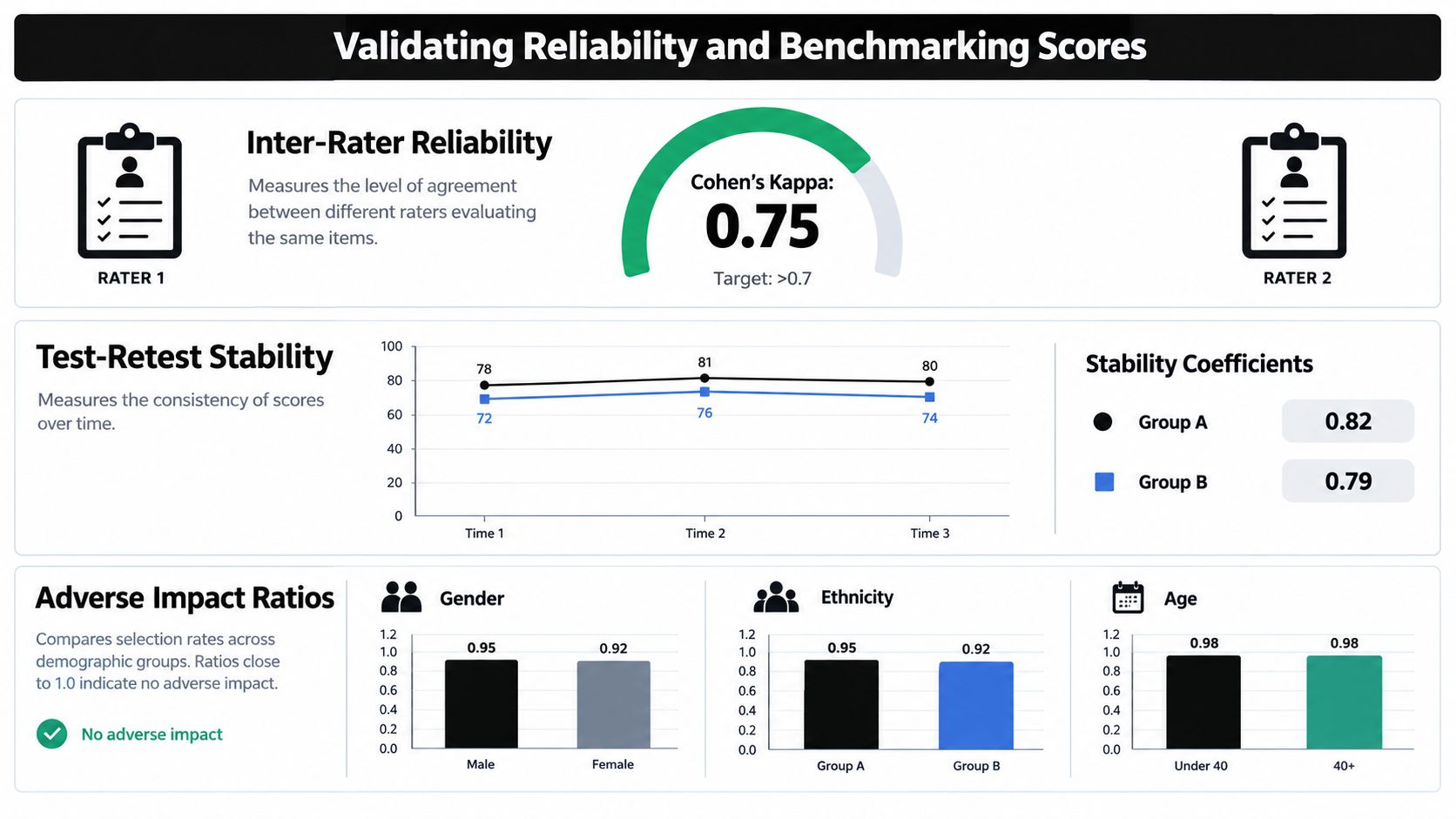
For rater consistency, calculate Cohen's kappa for categorical or banded ratings. The assessment plan sets an operating target above 0.7. If agreement falls below that level, inspect the item wording and scoring anchors before attributing the problem to the raters. Ambiguous prompts, inconsistent probing, and vague definitions of “professional” communication often create the variance.
Use a holdout sample for test-retest checks. Have candidates or employees complete an equivalent form later, then compare results. Large shifts can point to unstable items, excessive familiarity, inconsistent administration, or a construct the test has not defined clearly.
Use benchmarks as evidence, not decoration
An India-based e-assessment involving 65 participants reported a broad spread: 9 scored above 90, 10 scored 81–90, 13 scored 61–80, 14 scored 40–60, and 19 scored below 40, according to the published communication performance study. The distribution shows why one average can conceal meaningful performance bands.
Set cut scores from role evidence and normative bands instead of choosing an arbitrary pass mark. Check whether high performers separate from low performers on each item. An item with nearly identical answers may be too easy. An item that strong candidates miss for reasons unrelated to the job needs revision or removal.
Quarterly audits should answer practical questions:
- Review disagreement by item and interviewer to locate rater drift.
- Check which items distinguish stronger and weaker performers.
- Examine adverse impact ratios across relevant demographic groups.
- Compare assessment dimensions with structured interview results and early job evidence.
- Ask candidates about unclear instructions, accessibility barriers, and technical friction.
Keep a version record for every rubric, prompt, scoring change, and approval. For wider assessment workflow design, teams can review this guide to an online logical reasoning test, while keeping communication-specific validity evidence separate.
Integrating AI Driven Screening Without Losing Trust
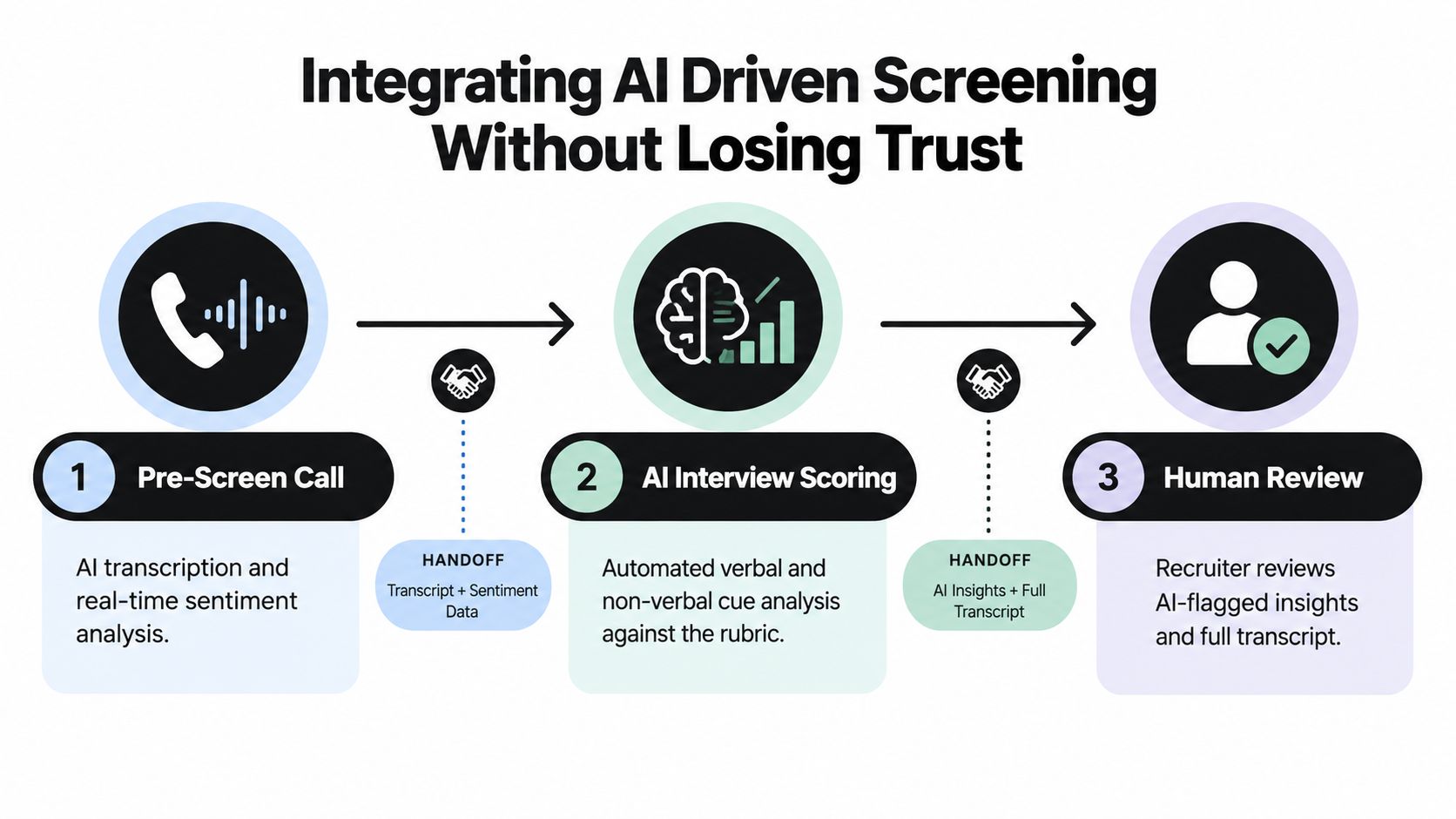
AI fits best where it reduces repetitive handling, not where it replaces judgement. In a communication skills assessment test, that usually means three handoff points: transcription, rubric pre-fill, and summary creation.
At the pre-screen call, an AI phone screener can transcribe the conversation and organise evidence against the rubric. It may flag whether the candidate answered the question, introduced relevant information, or used language that needs human review. Sentiment analysis can provide a prompt for investigation, but it shouldn't be treated as a reliable verdict on empathy or professionalism.
At the interview scoring stage, the system can pre-fill rubric fields from the transcript and identify moments for the interviewer to inspect. The interviewer must edit, reject, or confirm those suggestions. A model's label is not evidence until a trained human can trace it to an actual response.
At the debrief stage, AI can generate a candidate summary that separates observed behaviour from interpretation. The panel should have access to the full transcript or response, not just the generated summary.
Keep these controls non-negotiable
- Disclose the process: Tell candidates that an automated system may transcribe or analyse responses, explain the purpose, and obtain the required consent.
- Offer a route for support: Provide accessibility options and a human contact for technical or process concerns.
- Audit the model: Test outputs across accents, dialects, speech patterns, language registers, and relevant candidate groups.
- Keep a human gate: Never allow a sentiment score, accent classification, or opaque confidence label to become an automatic rejection.
- Start in shadow mode: Run AI scoring alongside human scoring for one hiring cycle. Compare disagreements, false flags, and missing evidence before using the system as a decision input.
- Store evidence responsibly: Limit access to transcripts, define retention rules, and document who can challenge a result.
A model trained on one accent or one professional register can mistake difference for deficiency. The safest design treats AI as an assistant that finds evidence faster, while trained assessors remain accountable for the decision.
Running the Test Inside Your Hiring Workflow
Consider a candidate called Alex Chen moving through a structured process. After the application screen, the ATS sends a clear invitation explaining why communication is assessed, what formats Alex will complete, how responses are reviewed, and where to request an adjustment.
The timed written test arrives through the ATS. It includes a customer rewrite, an incident summary, and a situational item. The recruiter owns the initial written triage, but only against the pre-approved rubric. They shouldn't reinterpret the standard because one candidate's background or writing style feels unfamiliar.
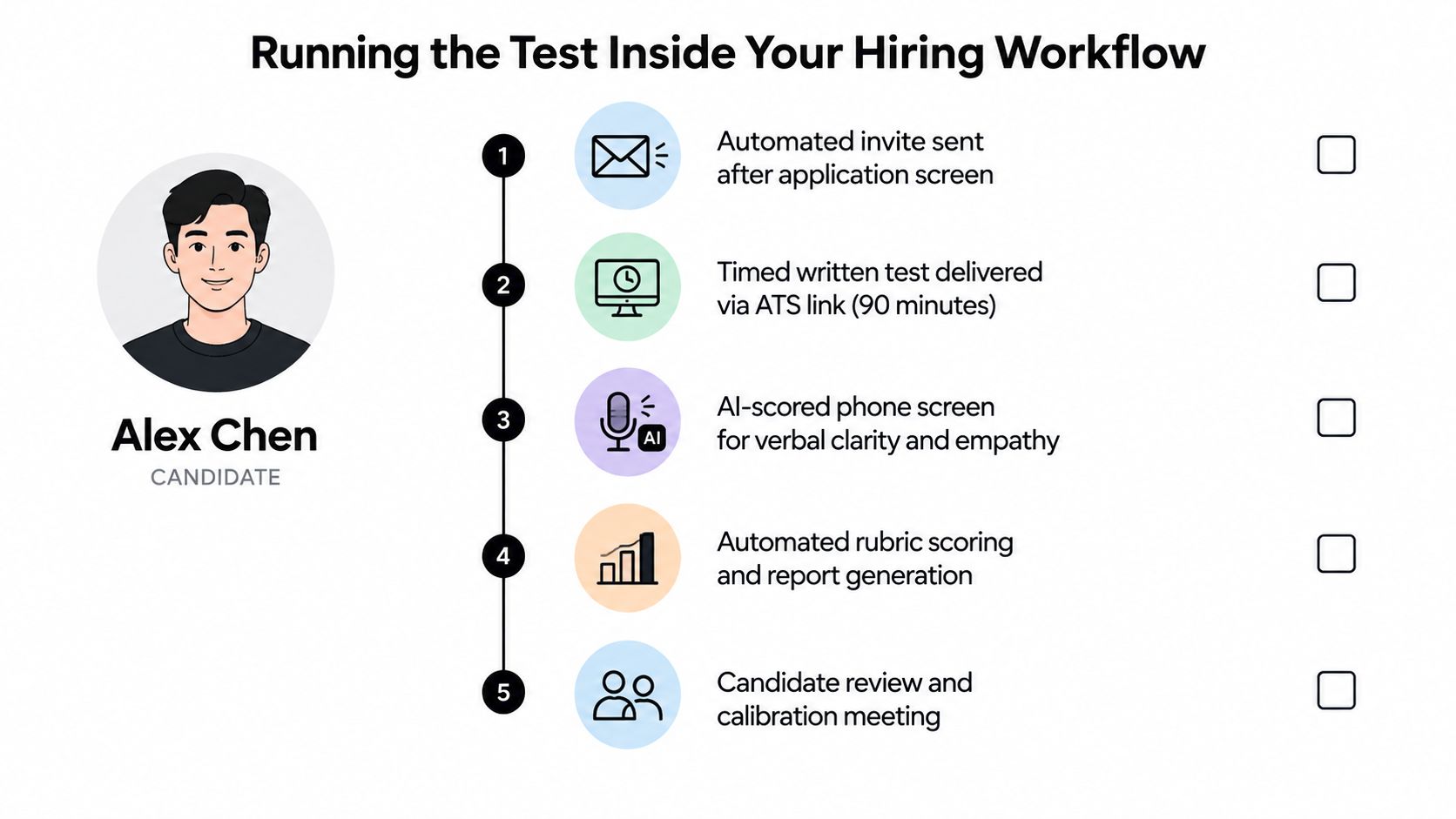
Alex then completes an AI-assisted phone screen for verbal clarity and listening signals. The system creates a transcript and preliminary rubric view. The first-round panel owns the final verbal rating, using the transcript as supporting evidence rather than as a substitute for listening to the response.
The hiring manager owns the situational discussion. If Alex ranked stakeholder messages well but gave a weak explanation, the manager can ask a targeted follow-up instead of repeating generic questions. The debrief should show dimension scores, observed examples, AI flags, human corrections, and unresolved questions in one ATS record.
Assign ownership and protect the candidate experience
Keep the written assessment before the interview so the panel can use results without improvising the entire conversation. Score written responses within 48 hours, as an operating recommendation, so candidates aren't left waiting while the evidence loses relevance.
Give candidates plain instructions, reasonable time limits, accessible response options, and a contact for technical issues. If a retest is allowed, define the trigger and approval path before launch. Don't create an informal exception process that favours candidates who know which recruiter to ask.
A practical pre-launch checklist should confirm:
- Invite copy: The purpose, format, time limit, consent language, and support route are clear.
- ATS mapping: Each item, dimension, rater, and decision field maps to the correct requisition.
- Score storage: Raw responses, rubric scores, AI suggestions, human edits, and final decisions are retained appropriately.
- Retest policy: The organisation has a documented rule for technical failure, accessibility need, or suspected irregularity.
- Candidate templates: Invitations, reminders, delay notices, and outcome messages are ready.
- Rater calibration: Interviewers have scored sample answers and discussed edge cases.
- Audit plan: Someone owns the review of reliability, group outcomes, item performance, and candidate feedback.
Teams evaluating broader candidate assessment tools should apply the same standard: select the tool only after defining the job behaviour, scoring evidence, human ownership, and audit trail.
Career Central provides AI-driven phone screening, first-round interviews, and coding assessments that can support a structured communication evaluation workflow without removing human review. Visit Career Central to see how its assessment services can fit your ATS, rubric, and hiring process.