Your hiring team has a familiar problem. A role attracts hundreds of applications, CVs reveal qualifications but not how candidates handle unfamiliar problems, and interviews can't provide a consistent first comparison. An online logical reasoning test appears to offer a practical answer: give every applicant structured questions, apply the same time limit, and identify people who can analyse information before investing interview time.
That promise is useful, but only when the test is treated as a role-specific signal, not a generic intelligence filter. A high score can reflect strong pattern recognition while saying little about customer judgement, communication, coding ability, or execution in a particular job. A low score can also reflect unfamiliarity with timed computer testing, poor connectivity, or an assessment that measures the wrong reasoning style.
India's selection ecosystem has deep roots in standardised testing. A 2026 academic chapter traces the development of this tradition through the NCERT National Science Talent Search and admissions testing at IIM Ahmedabad, showing how assessments were used to make latent ability visible as standardised data for decision-making. The modern online format extends that tradition into high-volume hiring, but digital delivery also introduces new questions about validity, access, and interpretation. The academic discussion of India's testing history and modern assessment lineage provides useful context.
Table of Contents
- Introduction to Online Logical Reasoning Tests for Hiring
- What an Online Logical Reasoning Test Really Measures
- Comparing Inductive Deductive and Abstract Reasoning Types
- Understanding Validity Reliability and Fairness in Reasoning Tests
- How to Select Administer and Score Tests Effectively
- Integrating Reasoning Tests with AI Phone Screens and ATS Workflows
- Putting It All Together for Smarter Hiring Decisions
Introduction to Online Logical Reasoning Tests for Hiring
A recruitment manager hiring for an operations role may receive applications from candidates with similar degrees, familiar software names, and polished CV language. The screening team still needs to distinguish between someone who can identify a process bottleneck, someone who follows a rule accurately, and someone who presents well on paper. An online logical reasoning test can create an early, structured comparison without asking every applicant to attend a live interview.
That's why these assessments have become common in Indian hiring and admissions. Current India-focused formats package reasoning into timed sections, with defined topic coverage and quantifiable results. One assessment framework describes a 90-minute online test with three sections, including 18 aptitude questions in a 30-minute section, while a recruitment configuration describes 20 questions in 30 minutes with English India language support. The India-specific assessment instructions and format examples show how tightly these tests are designed around speed, scale, and comparison.
The practical benefit is consistency. Candidates receive comparable instructions, question formats, and scoring rules, while recruiters can apply an initial threshold before scheduling human conversations. Yet consistency isn't the same as accuracy. A test can be administered identically to every candidate and still measure a skill that has little connection with the job.
Practical rule: Use reasoning results to decide what to investigate next, not to make the entire hiring decision.
This guide focuses on the decisions that matter to HR leaders. You'll learn what different reasoning types measure, how to match them to job families, how to examine validity and fairness, and how to administer scores responsibly. You'll also see where an AI phone screen and ATS workflow add context that a single score can't provide.
The central question is simple: Does this assessment help you predict performance in this role, for this candidate population, under these testing conditions? If the answer isn't clear, the correct response isn't to buy a longer test. It's to define the role signal more carefully.
What an Online Logical Reasoning Test Really Measures
A customer-support applicant receives a sequence of unfamiliar cases and must decide what follows from each one. The task does not ask whether the candidate remembers your product manual. It examines how they identify relationships, apply conditions, compare alternatives, and reach a defensible conclusion from limited information.
That distinction matters for hiring. An online logical reasoning test is not a generic intelligence label. It is a role-specific signal, similar to a short simulation: useful only when the situations, timing, and interpretation match the work the person will perform.
Three mental operations behind the questions
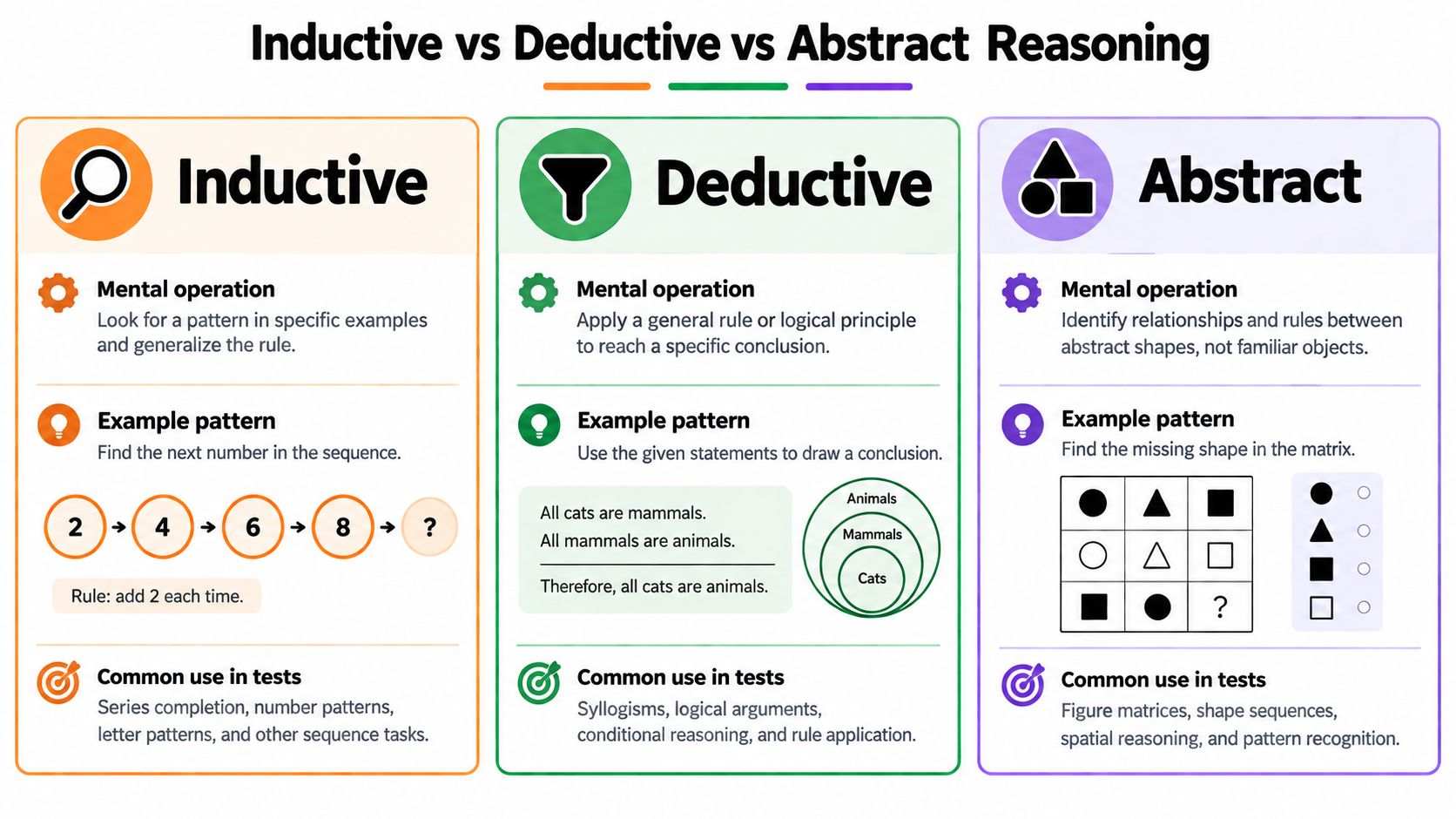
Inductive reasoning moves from observations towards a likely rule. A series such as 2, 4, 6, 8 asks the candidate to detect a pattern and extend it. In a quality-monitoring role, the same mental operation might involve spotting a recurring error across records. The answer depends on recognising a relationship, not recalling a fact.
Deductive reasoning starts with stated rules and applies them to a specific situation. A syllogism may provide several premises and ask which conclusion follows necessarily. In compliance or process work, the equivalent task is checking whether a case satisfies every stated condition. The candidate must separate what the information supports from what merely sounds plausible.
Abstract reasoning uses shapes, matrices, symbols, or visual transformations. The candidate may track rotation, position, quantity, or alternation across a sequence. This can indicate how they handle unfamiliar information, although it should not be treated as a direct forecast of communication, judgement, or job knowledge.
Online delivery adds another measurement layer. The platform controls item presentation, records responses, applies timing rules, and converts answers into a score or comparison. That consistency helps HR teams review high-volume Indian hiring pipelines, but it does not remove measurement error. A small screen, unstable connection, unfamiliar interface, or severe time pressure can affect results independently of reasoning ability.
What the score can and cannot tell you
A score can indicate how a candidate handles structured information under the test's conditions. It may help create a shortlist or give interviewers a focused question to investigate. It cannot establish that the person will collaborate, communicate with customers, write production-quality code, manage ambiguity, or make sound ethical decisions. A broad score should therefore remain one signal among several.
The practical test is role fit. A pattern-heavy assessment may be relevant to quality review, while a rule-based assessment may better reflect policy operations. Separate subscale results can show which signal is driving the overall result, whereas one combined number can hide an important mismatch.
Indian selection testing has long treated reasoning as a distinct component alongside verbal and quantitative abilities. Earlier standardised batteries included 14 logical-reasoning questions within a 55-question assessment, illustrating that reasoning can be measured separately rather than folded into one undifferentiated aptitude result. The source on India's standardised selection testing tradition
For HR managers, the interpretation should remain practical: validate the assessment against role outcomes, review performance under its timing conditions, and combine the result with structured interview evidence. An AI phone screen can then test whether the candidate explains decisions clearly and handles role-relevant scenarios, while the ATS preserves the evidence and prevents a generic score from becoming the whole decision.
Comparing Inductive Deductive and Abstract Reasoning Types
The label “logical reasoning” covers several different activities. A candidate who performs well on a number series may not perform equally well on a syllogism or a visual matrix. Indian higher-education syllabi cover a wide range of content, including syllogisms, coding-decoding, spatial items, and pattern-based questions. The IISc syllabus showing the breadth of logical reasoning content illustrates why one overall score can conceal different subskills.
The three types side by side
| Reasoning Type | What It Measures | Example Item | Best Fit Roles |
|---|---|---|---|
| Inductive | Detecting a rule from examples and applying it to a new case | Complete a sequence such as 2, 4, 6, 8 | Operations analysis, quality monitoring, forecasting support |
| Deductive | Applying stated conditions to reach a logically supported conclusion | Decide which conclusion follows from a set of premises | Compliance, policy operations, audit support, process management |
| Abstract | Identifying relationships among unfamiliar visual or symbolic information | Complete a shape matrix by tracking movement or transformation | Technical screening, engineering support, analytical problem-solving |
Inductive items are useful when a role requires people to notice regularities in data or workflows. For example, an operations analyst may need to recognise that delays follow a recurring pattern across locations or process stages. The test doesn't reproduce the job, but it can sample the underlying habit of looking for relationships.
Deductive items fit work governed by explicit rules. A compliance associate, claims reviewer, or process specialist may need to determine whether a case satisfies a defined set of conditions. The hiring team should still test actual policy application separately, because a clean syllogism is narrower than a real case involving incomplete information.
Abstract items can be helpful for roles where candidates must manipulate unfamiliar structures. They may be relevant to technical, engineering, or analytical work, but recruiters should be careful not to treat visual pattern skill as a universal proxy for technical competence. A candidate may understand systems thoroughly and still be disadvantaged by a poorly designed visual interface.
A practical selection matrix
Before choosing a test, map the role's actual decisions:
- If the role follows defined rules, give greater weight to deductive content and add a work-sample exercise using realistic policy scenarios.
- If the role detects trends or exceptions, include inductive items and check whether the assessment uses data formats similar to the job.
- If the role handles visual or spatial systems, consider abstract content, but confirm that candidates have equal access to the required screen and interface.
- If the role combines all three, use a balanced battery and report the subscale results, rather than hiding them inside one total score.
A generic reasoning test may be suitable for an early exploratory screen, especially when the role family is broad. It becomes risky when the same score is used unchanged for campus hiring, experienced lateral hiring, customer support, finance operations, and software engineering.
For a broader view of how reasoning fits alongside other assessment categories, HR teams can review this guide to types of aptitude tests. The important decision isn't how many questions a vendor offers. It's whether the questions represent the decisions and information patterns that matter in the job.
Understanding Validity Reliability and Fairness in Reasoning Tests
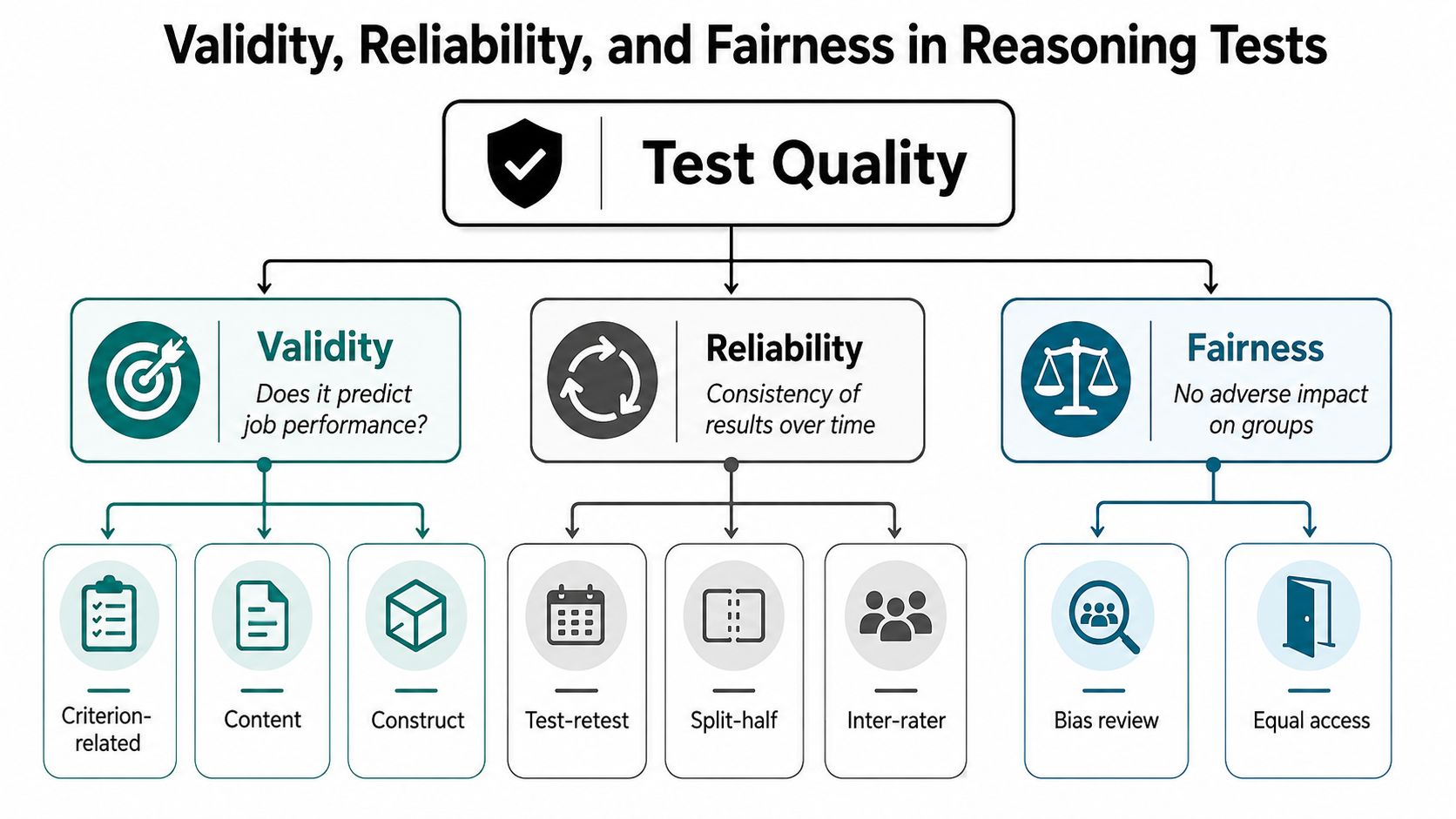
A hiring team may receive stable scores and still make weak decisions. For example, a high-volume Indian hiring process can rank thousands of applicants efficiently, yet a generic puzzle score may say little about performance in customer support, finance operations, or software engineering. Validity, reliability, and fairness answer different questions: does the test reflect the work, does it measure consistently, and does each candidate have a fair chance to show the intended ability?
Validity means job relevance
Validity asks whether test performance connects with an outcome the employer cares about. That outcome could be training performance, accuracy, productivity, structured quality ratings, or success on a defined job task. A vendor should explain the supporting evidence, the candidate population studied, the role context, and the limits of the claim.
Ask for a content map. It should identify the reasoning skill assessed by each item and explain its connection to the job. A role that requires applying rules needs different evidence from one that requires spotting trends or interpreting unfamiliar visual information. The score should therefore be treated as a role-specific signal, not a universal measure of talent.
Check whether separate norms exist for campus and experienced candidates. A result calibrated for one group may not transfer cleanly to another. The same caution applies when a test moves between job families or is used with different language, education, and technology conditions.
Reliability means dependable measurement
Reliability concerns consistency. Under comparable conditions, would a candidate receive a broadly similar result, or could the score change because of a particular item set, device, connection problem, or brief distraction? The provider should describe its item reviews, technical interruption process, and methods for identifying unusual response patterns.
Validity can also have a time window. The Indian assessment benchmark discussion reports one-year aptitude score validity for CoCubes and two-year eLitmus score validity, along with percentile examples. Use such information as a prompt for verification, not as a substitute for checking the current provider documentation and the relevance of the score to your role.
Ask the provider: “What evidence connects this score to performance in our role, and under what conditions does that evidence stop applying?”
Fairness includes access
Fairness extends beyond biased wording. Device quality, screen size, connection stability, accessibility features, language support, and familiarity with remote testing can all affect performance. Timed assessments may amplify small technology differences when candidates complete them from home.
A fair process provides clear instructions, a practice item, technical support, and a documented response to interruptions. If AI proctoring is used, explain what it monitors, how human review works, and how the organisation handles false flags. More surveillance may improve rule compliance while also increasing anxiety or excluding candidates with legitimate environmental constraints.
Interpret score bands alongside job evidence. Review completion, technical incident, and progression patterns across relevant candidate groups. Investigate meaningful differences before expanding the assessment, and validate the final score against later performance rather than treating a cut-off as a natural law.
How to Select Administer and Score Tests Effectively
Selection starts before a vendor demonstration. Write down the job decisions you want to predict, the candidate population, and the point in the funnel where the assessment will appear. A campus screen, an experienced specialist role, and a high-volume service role may need different content, timing, language support, and decision rules.
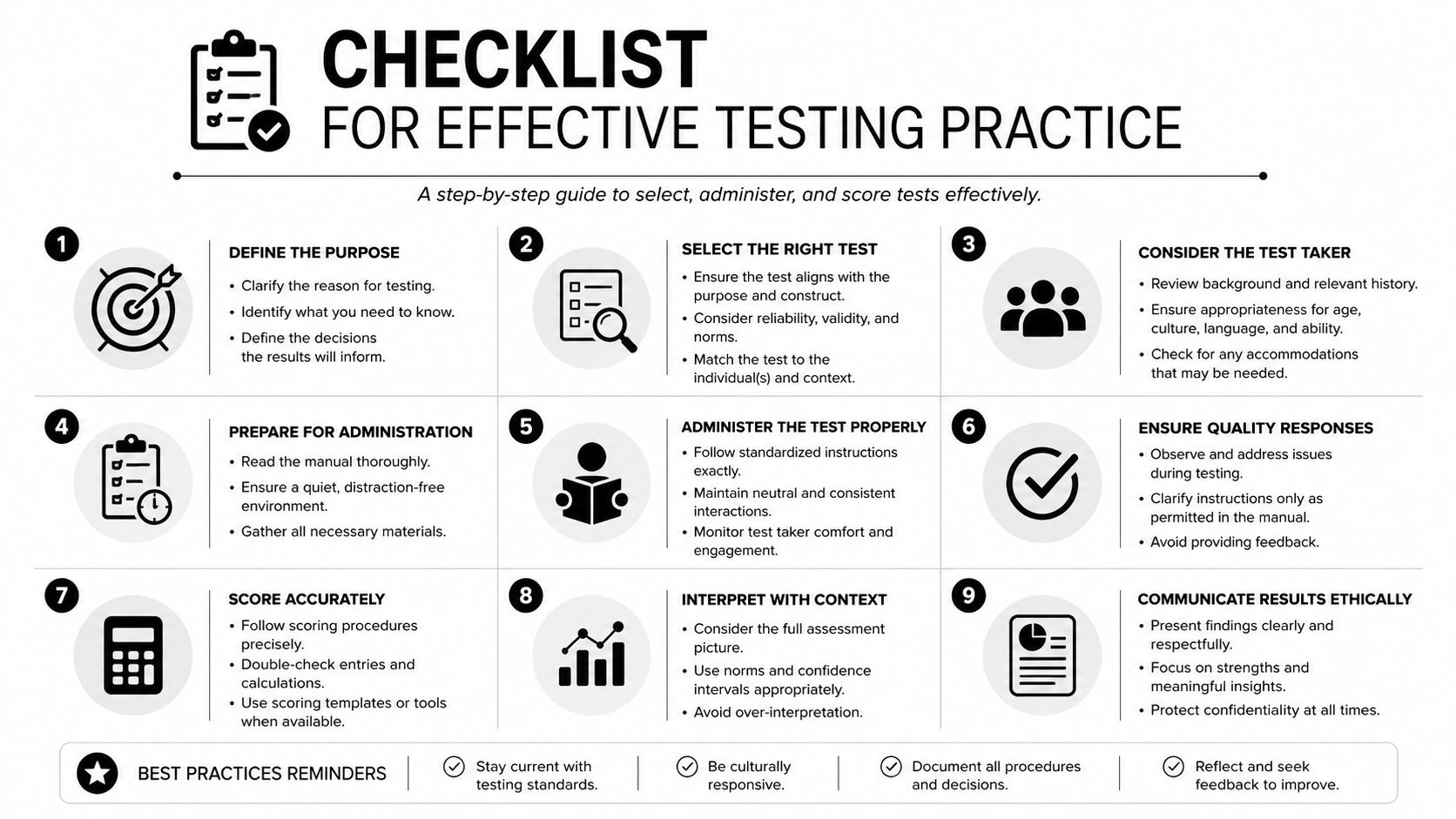
A five-part operating workflow
1. Define the hiring signal. Convert broad requirements such as “analytical thinking” into observable behaviours. Does the employee compare cases, detect exceptions, apply policy, or solve unfamiliar problems? Each answer points towards a different item mix.
2. Examine the item design. Ask to see sample formats, difficulty logic, accessibility options, language coverage, and subscale reporting. Confirm that the test isn't merely a collection of popular puzzle types with no documented connection to the job.
3. Configure the candidate experience. India's current assessment patterns commonly use short, timed modules. One India-focused framework includes ranking, directions, coding-decoding, data arrangements, blood relations, and puzzles, with 18 aptitude questions in 30 minutes; another recruitment format describes 20 questions in 30 minutes and English India support. The India assessment-format reference shows the range of configurations employers may encounter.
Give candidates instructions in plain language and include a practice item that demonstrates navigation, not the answer to a live question. Test the assessment on the devices and networks your applicants are likely to use.
4. Standardise administration. Keep invitation messages, access windows, support routes, and accommodation rules consistent. Record technical interruptions separately from performance outcomes. Proctoring should be proportionate to the hiring risk, transparent to candidates, and reviewed for false positives.
5. Set and review decision rules. Use a cut score only when you can explain what it means for the role. A percentile can help with comparative ranking, but it doesn't prove mastery. Combine the result with structured interview evidence, work samples, or an AI phone screen that tests communication and job-related scenarios.
Administration checks for Indian hiring
Use a short pilot before a full rollout. Include candidates from the actual hiring channels, not only internal employees who already understand the company's systems. Review whether candidates abandon the test, request support, encounter device problems, or perform differently across locations.
Keep an audit record containing the version used, instructions shown, time limits, score interpretation, overrides, and final hiring outcome. That record helps the team investigate disputes and improve the process without relying on memory.
HR teams comparing broader assessment options can use this overview of candidate assessment tools. The platform choice matters, but governance matters more. A technically polished assessment still needs a clear role rationale, consistent administration, and human review.
Integrating Reasoning Tests with AI Phone Screens and ATS Workflows
A reasoning score becomes more useful when it answers one narrow question and an adjacent assessment answers another. The ATS can trigger the test after an application meets basic eligibility criteria, store the result against the requisition, and route candidates according to documented rules. An AI phone screen can then test communication, motivation, availability, and responses to structured job scenarios.
A workable sequence looks like this:
- Application and eligibility review: The ATS checks required qualifications and removes duplicate or incomplete records.
- Reasoning assessment: Candidates complete the role-aligned online test under consistent instructions.
- AI phone screen: The system asks structured, job-related questions and captures responses for consistent review.
- Human decision gate: A recruiter examines the reasoning subscales, phone-screen evidence, CV, and any work sample.
- Interview handoff: Interviewers receive a focused brief showing what to probe, not an automated hiring verdict.
This sequence prevents a common error. A candidate may score strongly on deductive questions but struggle to explain a decision clearly to a customer. Another may show moderate abstract reasoning and excellent process judgement in a phone scenario. The combined evidence gives the recruiter a more complete basis for deciding whether to advance the person.
India-facing assessment pages describe a move towards AI-proctored, remote, and online aptitude batteries. They also describe TCS NQT as being marketed to 1600+ corporate recruiters with a dedicated reasoning section, while raising concerns about device and connectivity bias in at-home assessment. The discussion of Indian online assessment adoption and access risks is relevant when designing a remote workflow.
Build a measurement dashboard
Track process and quality measures together:
- Completion rate: Identify whether candidates can access and finish the assessment.
- Technical incident rate: Separate platform or connectivity problems from candidate performance.
- Time to shortlist: Check whether automation reduces recruiter workload.
- Progression by score band: See how reasoning results relate to phone screens and interviews.
- Fairness indicators: Review whether access, completion, and progression patterns differ across relevant groups.
- Outcome alignment: Compare assessment signals with later structured performance evidence.
Career Central offers an AI-driven interview layer for phone screening, first-round interviews, and coding assessments, which can be considered when an organisation wants to connect structured candidate conversations with assessment workflows. Its AI-driven first interview service is one possible component in that broader stack.
Keep the handoff explainable. Recruiters should know why a candidate advanced, which evidence came from the reasoning test, which came from the phone screen, and where human judgement changed the automated recommendation.
Putting It All Together for Smarter Hiring Decisions
An online logical reasoning test earns a place in the hiring funnel when it measures a capability the role requires. Start with the work, not the vendor catalogue. Identify whether employees need to infer patterns, apply rules, manipulate unfamiliar information, or combine those abilities under realistic conditions.
Then apply four decisions:
- Use the test when the reasoning construct is job-relevant, the administration is accessible, and the provider can explain its evidence.
- Customise the test when different roles require different reasoning types or when campus and lateral candidates need separate interpretation.
- Pair the test with a structured AI phone screen, work sample, or interview when communication and judgement also drive performance.
- Skip or redesign it when the score has no clear relationship to job outcomes or when remote conditions create avoidable access problems.
Pilot the assessment before making it a default filter. Review subscale results, completion patterns, technical incidents, interview outcomes, and later performance evidence. If the score doesn't add useful information beyond the CV and structured conversation, changing the workflow is more responsible than defending the test.
The strongest hiring systems combine standardised evidence with human accountability. A reasoning test can make early screening faster and more comparable, while an AI phone screen can add structured conversational evidence and an ATS can preserve the audit trail. None of these tools should replace role analysis, fair access, or a recruiter's responsibility to interpret evidence carefully.
Career Central provides AI-driven phone screening, first-round interviews, and coding assessments that can complement a role-aligned online logical reasoning test. Visit Career Central to explore how a structured AI interview layer can fit into your assessment and recruitment workflow.