

A CHRO opens the hiring dashboard after a demanding recruitment cycle. Applications are high, recruiters have filled interview calendars, and sourcing channels appear active. Yet accepted offers and confirmed joiners remain far below expectations. The dashboard reports activity, but it doesn't explain the loss between interest and employment.
That gap is where the recruitment yield pyramid earns its place. It treats each hiring stage as a decision point, then asks whether the transition to the next stage is producing the right volume and quality. The result isn't a universal scorecard. It's a diagnostic instrument that helps Talent Acquisition leaders identify whether the problem sits in sourcing, qualification, assessment, offer design, or closing.
The Hiring Funnel That Never Lines Up
The hiring leader in this situation usually starts by asking whether the team needs more sourcing. That response is understandable, but it may be wrong. A large applicant population can coexist with weak screening quality, slow assessments, inconsistent interviews, or offers that fail to convert into joiners.
The first useful move is to stop treating applications as the headline outcome. Recruitment processes contain several distinct populations: people reached, people who apply, people who meet eligibility criteria, people who complete an assessment, people who interview, people who receive offers, and people who join. A practical explanation of these transitions appears in the steps in the selection process, but the analytical principle is simple: every layer narrows the population for a different reason.
In India, this distinction matters particularly in graduate recruitment. Approximately 70–80% of graduate recruitment is conducted through campus recruitment, according to the Indian analysis of campus recruitment parameters. Campus channels can therefore create substantial reach and applicant volume, while later assessment, interview, offer, and joining stages reduce the pool progressively.
Read the loss, not just the volume
A yield pyramid doesn't ask whether a funnel is narrow or wide in isolation. It asks whether the narrowing is expected for that role, market, channel, and assessment design.
A sharp drop after sourcing may indicate weak targeting or a scarce talent market. A sharp drop after screening may indicate a job description that attracts unsuitable applicants, an eligibility rule that is too restrictive, or an inconsistent review process. A sharp drop after interviews may point to calibration problems. A fall between offers and joiners may expose compensation, notice-period, location, trust, or candidate-experience issues.
Analyst's rule: Every stage hides a decision. The pyramid makes that decision visible enough to test.
The dashboard becomes useful only when leaders connect each ratio to an operational question. More applications aren't automatically better. More interviews aren't automatically evidence of a healthy process. The final objective is a dependable flow of qualified people into roles, with enough speed and fairness to sustain hiring at scale.
Anatomy of the Recruitment Yield Pyramid
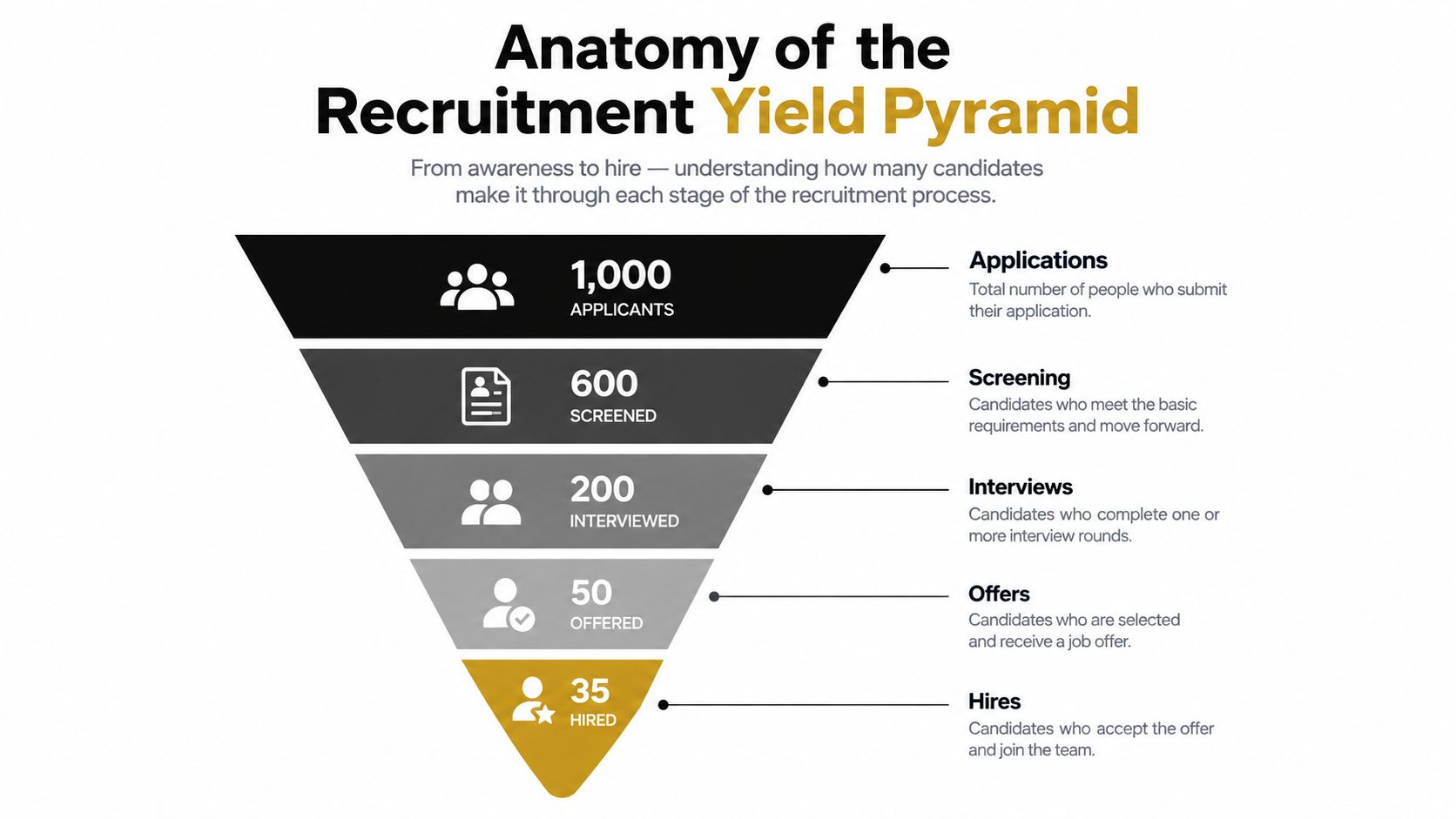
The pyramid begins with the widest available population and narrows towards people who enter employment. The labels can vary by organisation, but the logic remains consistent.
Start with reach and applications
The widest layer may contain sourcing impressions, campaign responses, talent-pool records, referrals, or applications. Its reach metric describes whether the employer is visible to a relevant market. Its application metric describes whether that visibility produces candidate action during a defined hiring period.
This layer informs decisions about channel mix, employer messaging, campus participation, job-board presence, referral activity, and the clarity of the role. It shouldn't be interpreted as proof of candidate quality. A channel can create broad awareness while producing little qualified supply.
Move through qualification and assessment
The next layer is the screen. Measure the proportion of applicants who meet defined requirements, and record the time between application and screening decision. This stage tests qualification accuracy. A low yield may mean targeting is weak, or it may reflect a deliberately demanding brief for a specialist role.
Assessment adds another decision. Track invitations, completions, pass rates, and time in stage. These metrics show whether candidates understand the task, can access it, and are being evaluated against job-relevant criteria. A high assessment dropout rate can reflect poor instructions or excessive friction rather than a lack of talent.
Examine interviews, offers, and joiners
Interview metrics should cover selection into interview, attendance, panel outcomes, feedback consistency, and time between stages. The operational question is whether the interview method distinguishes relevant capability from confidence, familiarity with the format, or assessor preference.
Offers form a separate layer because an employer can assess candidates effectively and still lose them. Track offers issued, accepted, declined, withdrawn, and converted to joining. The offer-to-join ratio informs closing effectiveness, while the overall yield shows how the complete process turns market activity into workforce capacity.
The value of the pyramid lies in the transitions. A stage isn't good because it is large. It is useful when the movement into and out of it makes sense for the role and produces downstream quality.
Conversion Rates That Actually Mean Something
A conversion ratio is a relationship between two adjacent populations. It becomes useful only when the organisation knows what decision produced the change. Consider a clearly labelled illustration: 1,000 applications, 120 screens, 35 interviews, 8 offers, and 5 joiners. These figures are a teaching example, not a universal benchmark.
The implied transitions are 12% application-to-screen, approximately 29% screen-to-interview, approximately 23% interview-to-offer, and 63% offer-to-join. The overall application-to-join movement is 0.5%. Each ratio asks a different question, so combining them into one funnel score would hide the diagnosis.
| Funnel Stage | Campus Hiring | Engineering Hiring | Diagnostic Question |
|---|---|---|---|
| Applications to screens | Role-specific, not a universal benchmark | Role-specific, not a universal benchmark | Are sourcing and eligibility rules producing a usable pool? |
| Screens to interviews | Depends on assessment design | Depends on technical-screen difficulty | Does screening identify candidates who can progress? |
| Interviews to offers | Depends on panel calibration | Depends on technical and role requirements | Are assessors applying the standard consistently? |
| Offers to joiners | Depends on candidate priorities and offer design | Depends on competition and closing execution | Can the employer convert assessed talent? |
What India-specific evidence tells leaders
The engineering hiring funnel analysis for India describes a market with nearly 5 million software engineers, while an individual technology vacancy commonly receives 300 to more than 1,000 applications. It also reports that 75% of resumes are never read by a human and that the average software-engineer interview process takes 23.3 days in India.
Those figures don't create targets for every engineering role. They show where scale creates pressure. A large applicant layer can conceal a severe application-to-human-review bottleneck, while a lengthy process can leave qualified candidates waiting as employers compete for them. The appropriate response is to inspect the transition, not to demand more applications.
Why the ratios compound
If an organisation weakens two early transitions, the loss multiplies before the offer stage. A modest improvement in sourcing quality may have little visible effect if screening remains poorly calibrated. Conversely, a better screen can increase interview efficiency without solving offer acceptance.
Practical reading: A ratio is a signal about a decision. It isn't a performance target detached from role requirements.
Leaders should compare stage ratios with quality outcomes, time in stage, and joining results. A narrow funnel can be healthy when the role is specialised and the assessment is job-relevant. A broad funnel can be wasteful when recruiters spend time processing applicants who were never plausible candidates.
Why One Funnel Ratio Is Never Enough
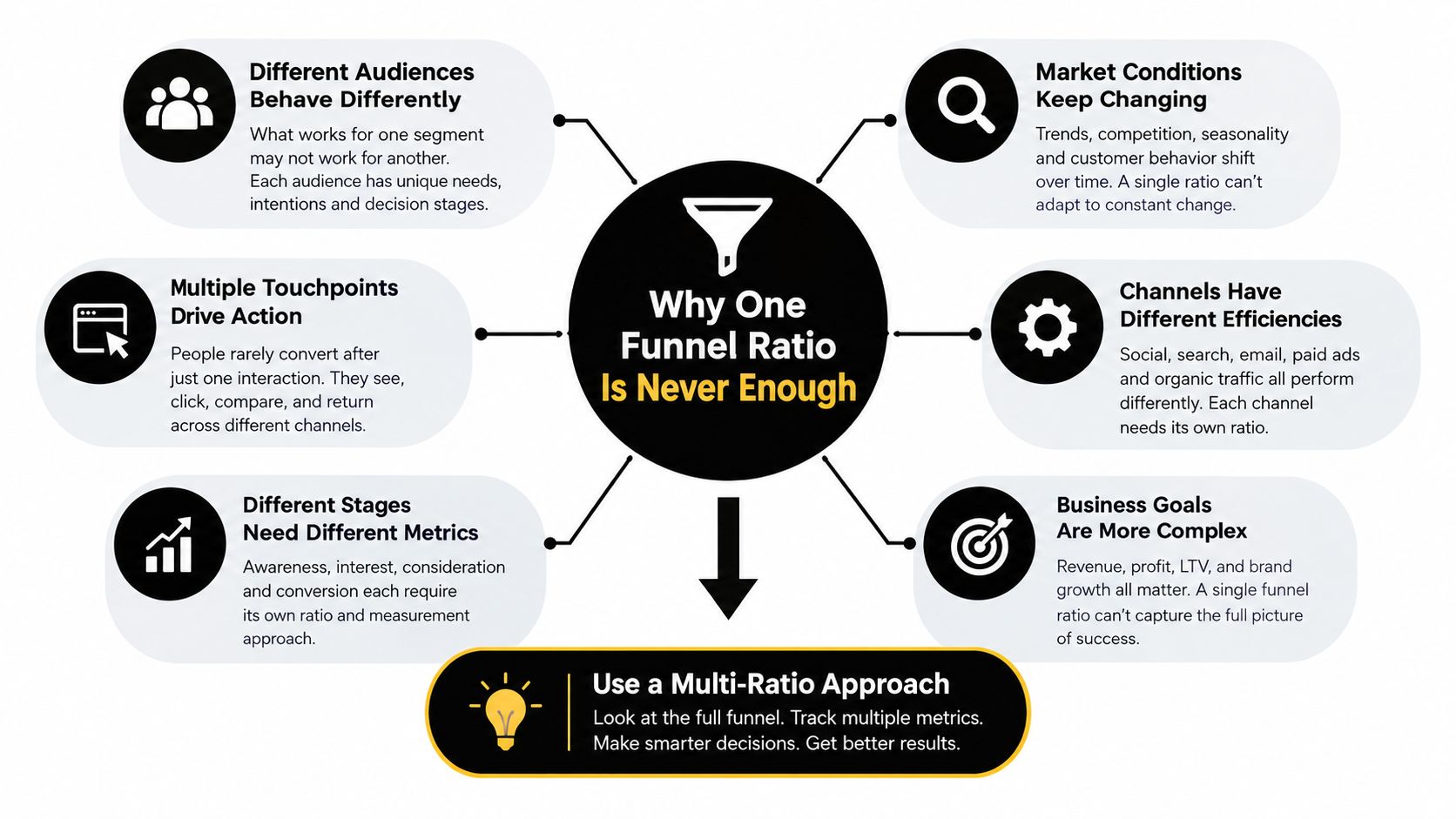
A single offer-acceptance rate can look reassuring while the organisation loses candidates earlier. A single screen-to-interview rate can look efficient while the screen excludes capable people. Aggregation turns different hiring problems into one average and removes the information needed to act.
The same application-to-offer result could describe very different realities. For an engineering role with a demanding technical assessment, a small offer population may reflect accurate filtering. For a sales role with a broad, transferable capability profile, the same result might indicate an unclear brief or overly narrow screening criteria. An operations role may need yet another interpretation because availability, location, shift expectations, and practical experience can shape progression differently.
Segment before you benchmark
At minimum, segment the pyramid across four dimensions:
- Role family: Compare graduate, sales, operations, engineering, security, and AI roles separately.
- Experience band: Separate fresher, mid-career, senior, and leadership pipelines.
- Sourcing channel: Distinguish campus, referral, direct sourcing, agency, job board, and internal movement.
- Assessment difficulty: Record whether candidates face a basic eligibility review, a work sample, a coding task, or a multi-stage technical evaluation.
Geography and candidate segment can add further diagnostic value. A channel may perform strongly in one city and weakly in another. An assessment may work for experienced applicants but create unnecessary friction for people with adjacent skills.
A narrower funnel can be the healthy one
The common assumption is that every drop deserves correction. That isn't analytically sound. If a specialist role attracts people without the required capability, a lower screen-to-interview ratio may show that qualification has improved. If a generalist role produces almost no interview-ready candidates, the same ratio may expose an overly restrictive brief.
India's current skills market makes this distinction more important. Foundit's 2025 India hiring tracker reports approximately 290,000 AI job postings in India during 2025, with AI hiring projected to rise 32% to nearly 382,000 roles in 2026. It also reports 58% year-over-year growth in generative AI and large-language-model skills. These figures indicate concentrated demand, not a universal conversion standard.
The right question is therefore not, “How do we make the funnel wider?” It is, “Which candidates should progress, and does each stage identify them reliably?”
Recalibrating the Pyramid by Role Family
A recruitment yield pyramid should be calibrated to the role family, talent market, and hiring risk. Comparing every requisition with one corporate average can make a healthy filter look inefficient or conceal a process that excludes qualified candidates. The pyramid is most useful as a diagnostic instrument, tracking both volume efficiency and whether progression remains consistent across relevant candidate groups.
| Role Family | Biggest Drop-off Stage | Leading Indicator |
|---|---|---|
| Campus and fresher | Assessment completion and assessment pass-through | Eligible applicants progressing through a structured, accessible assessment |
| Mid-career generalist | Application-to-screen or screen-to-interview | Qualified screens from each sourcing channel |
| Niche technical | Sourcing and initial qualification | Relevant technical talent entering the pipeline |
| Emerging AI and machine learning | Skills assessment and offer conversion | Evidence-based technical progression and accepted offers |
Campus and fresher hiring
Graduate hiring often creates concentrated seasonal demand and large applicant pools. The operating risk is whether eligibility rules, assessment capacity, communications, and decision timing handle that concentration consistently. Because campus cycles gather applications into limited windows, stage-level measures are more useful than a single applicant total.
The campus recruitment study supports separating campus attendance, applications, eligibility, assessment completion, interviews, offers, acceptance, and joining. Analysts can then identify whether losses reflect weak reach, inaccessible assessment design, limited interviewer capacity, or offer friction. Completion and timely decision rates are stronger leading indicators than raw campus participation.
Mid-career generalist roles
For a mid-career generalist, the constraint may appear at sourcing or initial screening. Job titles can attract applicants with similar career histories even when the role requires a specific combination of communication, ownership, domain knowledge, and operating context.
Qualified-screen yield by channel therefore matters more than response volume. A narrow funnel may reflect precise sourcing and a well-defined brief. A wider funnel can signal unclear requirements or weak channel targeting if few applicants meet the operating criteria.
Niche technical roles
Security, embedded systems, and other specialised roles require a different allocation of recruiter time. When relevant talent is scarce, adding generic sourcing volume increases workload without improving the pipeline. Review the entry layer, the precision of technical outreach, and the assessment's connection to the capabilities the role requires.
Equity checks also need role context. A sourcing channel that produces lower volume may still reach qualified candidates who are underrepresented in the broader applicant pool. Compare progression and representation by stage before labelling that channel inefficient.
Emerging AI and machine learning roles
AI and machine-learning hiring depends on skills-based evidence because titles and credentials can be weak proxies for current capability. The leading indicator is progression through a credible technical assessment, followed by offer acceptance and joining.
A narrow funnel may indicate appropriate standards and accurate qualification. A weak offer layer may show that the organisation can identify scarce talent but cannot close it. In that case, increasing applications addresses the wrong problem. The intervention belongs in assessment credibility, role proposition, or offer execution.
AI Screening and the Equity Layer of the Pyramid
A recruiter sees the shortlist arrive faster, yet fewer candidates from nontraditional backgrounds reach assessment. For a fuller view of where automation fits across the hiring workflow, see this guide to recruitment process automation. Faster screening improves the funnel only when it preserves access to candidates who can perform the work.
The central governance question is whether an AI system expands access to relevant candidates or rejects conventional profiles more quickly. The India Skills Report 2025 identifies initial interviews as the recruitment activity with the highest demand for AI-tool adoption. AI evaluation therefore sits near the pyramid's upper stages, where design choices can shape who reaches every later decision.
Add a second dimension to every stage
An equity layer should run alongside the efficiency layer. For each candidate segment the organisation can lawfully and responsibly monitor, report:
- Pass-through by stage: Compare representation at application, screening, assessment, interview, offer, and joining.
- Assessment completion: Check whether language, device access, timing, or connectivity creates avoidable dropout.
- False-negative review: Sample rejected candidates and examine whether the model or rubric excluded people who showed relevant capability elsewhere.
- Offer and joining parity: Separate interview throughput from the ability to convert candidates across segments.
A model can reduce recruiter hours and improve time-to-shortlist while lowering representation from Tier-2 cities, nontraditional degree paths, career-gap candidates, or adjacent-skill backgrounds. That result combines operational efficiency with reduced access to talent.
Treat fairness as an operating metric
Review equity before final hiring outcomes. A segment that disappears during screening cannot reappear at interview. Pair stage-level conversion, assessment completion, and regional representation with productivity measures, then investigate the transition where the disparity begins.
Career Central offers job publishing, talent sourcing, coding assessments, AI-driven first interviews, and candidate scoring across successive recruitment-funnel stages. Organisations evaluating such tools should connect their outputs to efficiency and equity reporting, with human governance over model and rubric decisions.
A faster rejection process is not a successful funnel if it removes relevant candidates before a human can evaluate their capability.
Auditing Your Pyramid and Acting on the Data
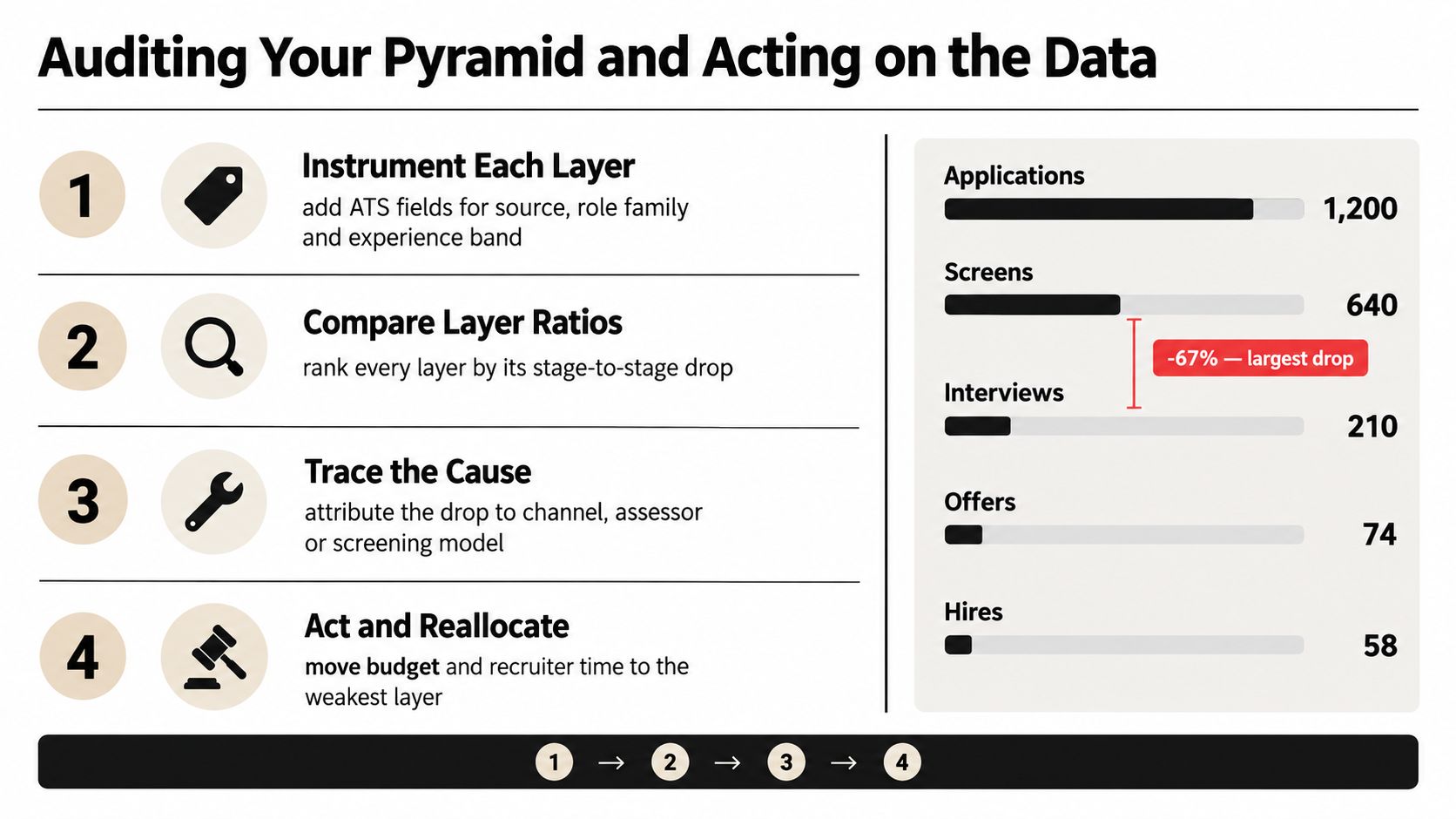
A useful audit converts ratios into ownership. It starts with instrumentation, continues through diagnosis, and ends with a resourcing decision that someone must review.
Instrument the layers
Configure the ATS to capture source, role family, experience band, assessment type, assessor, stage dates, rejection reason, offer status, and joining outcome. Without these fields, leaders can report movement but can't explain it. The first task is data discipline, not dashboard design.
Compare segmented transitions
Calculate stage-to-stage conversion for comparable role groups and hiring periods. Don't compare a graduate campaign with a specialist technical search, and don't use one annual average to judge a funnel that changes with market conditions.
The HR analytics guide provides useful context for turning recruitment records into management information. In practice, the audit should rank each stage by its drop-off and then test whether the pattern is concentrated by channel, role, assessor, location, or candidate segment.
Trace the cause before reallocating resources
A weak transition can result from volume, quality, friction, or capacity. Review assessor notes, candidate feedback, time in stage, assessment completion, interview attendance, and rejection reasons. If candidates abandon an assessment, the issue may be access or instructions. If assessors disagree repeatedly, the issue may be rubric design. If strong candidates wait too long, interviewer capacity may be the constraint.
A practical audit sequence looks like this:
- Tag the population: Preserve source, role family, experience band, assessor, and stage dates.
- Rank the transitions: Identify where candidates leave the funnel, then segment the result.
- Test competing explanations: Compare quality evidence, candidate experience, and time-in-stage data.
- Assign an intervention: Change sourcing, rewrite the brief, redesign the rubric, add structured interviews, or rebalance interviewer load.
- Name an owner: Give the action to a recruiter, hiring manager, assessment lead, or operations owner.
- Set a review point: Recheck the same segmented transition after the next meaningful hiring cycle.
Don't treat a weak ratio as proof that a team is underperforming. Treat it as a prompt to investigate the decision architecture. The output of an audit should be a specific change, a responsible owner, and evidence that the change altered the relevant stage without damaging downstream quality.
Turning Yield Insights into Hiring Strategy
A CHRO can defend a hiring plan to the board when each resourcing decision connects to a measurable funnel signal. Reach can inform employer-brand investment. Screen-to-interview movement can inform recruiter targeting and assessor capacity. Offer-to-join performance can reveal whether closing capability, role design, or candidate communication needs attention.
| Pyramid Stage | Primary KPI | Diagnostic Signal | Resourcing Lever |
|---|---|---|---|
| Reach and applications | Relevant applicant yield | Strong activity but weak qualification | Reallocate sourcing and improve role messaging |
| Screening | Qualified-screen conversion | Many applicants leave before credible review | Improve targeting, eligibility logic, or recruiter capacity |
| Assessment | Completion and pass-through | Dropout or inconsistent results | Redesign instructions, rubric, or access model |
| Interviews | Interview-to-offer movement | Low progression or assessor disagreement | Train panels and introduce structured evaluation |
| Offers and joiners | Offer acceptance and joining | Candidates exit after selection | Improve closing, communication, and offer design |
| Overall funnel | Qualified hires from source | Volume fails to produce workforce capacity | Fund the weakest layer, not the loudest channel |
Strategy should remain role-segmented. A low join rate may be acceptable for a scarce AI role if the organisation is reaching the right specialists and maintaining strong assessment quality. The same result may signal waste in a graduate intake if the employer has already invested heavily in a broad campus pipeline.
Three operating commitments make the model sustainable:
- Instrument equity metrics at every stage, not only at the final hire.
- Review segmented baselines monthly rather than annually, so leaders can detect changes while they can still act.
- Report yield ratios beside time-to-fill, giving decision-makers a view of throughput, quality, speed, and access together.
The recruitment yield pyramid is most valuable when it changes where people spend time and money. Use it to fund the stage that constrains qualified hiring, preserve narrow funnels when they reflect sound selection, and challenge any automation that improves speed by shrinking access.
Career Central provides AI-driven phone screening, first-round interviews, and coding assessments that can support successive recruitment-funnel stages. Visit Career Central to explore how structured evaluation and candidate scoring can help your team measure conversion and hiring quality together.