
A recruiter opens the day with a familiar problem: a high-volume role has attracted a large applicant pool, hiring managers want interviews immediately, and the team is still arranging calendars, reviewing CVs, chasing feedback, and repeating the same opening questions. By the time recruiters reach the candidates who need genuine persuasion, much of the day has already gone into administration.
Recruitment process automation changes where that effort sits. The strongest programmes don't attempt to remove human judgement from hiring. They use software and AI to handle repeatable screening, first-round interviews, psychometric assessments, coding evaluations, scheduling, and structured reporting, so recruiters can spend more time assessing motivation, building relationships, and closing offers.
The practical question for HR leaders isn't whether automation sounds impressive. It's which part of the workflow creates the greatest bottleneck, whether the data moves cleanly between stages, and where human judgement must remain visible.
Table of Contents
- Redefining the Modern Hiring Workflow
- The Business Case for Automated Talent Acquisition
- Core Components of an AI-Driven Hiring Engine
- Avoiding the Partial Automation Trap
- Strategic Implementation and Change Management
- Evaluating Vendors and Assessment Platforms
- Future-Proofing Your Talent Acquisition Strategy
Redefining the Modern Hiring Workflow
A traditional hiring workflow often looks efficient on paper. A candidate applies, a recruiter reviews the CV, someone arranges a call, an interviewer takes notes, the panel submits feedback, and the recruiter decides whether the candidate should progress. In practice, every handoff creates waiting time and re-entry work.
Consider a recruiter managing a large intake for an IT services or BPO role. The recruiter may spend the morning sorting applications, the afternoon conducting nearly identical first-round conversations, and the evening updating the applicant tracking system. Candidates who could have progressed quickly remain in a queue, while recruiters have less time for the conversations that influence acceptance.
A modern workflow treats early-stage hiring as a managed pipeline, not a sequence of isolated tasks. The system can screen applications against agreed criteria, route suitable candidates to an asynchronous first-round interview, collect structured responses, and send the resulting evidence to a recruiter for review. The recruiter still decides who advances, but doesn't need to personally perform every initial filter.
Practical rule: Automate the repeatable evidence-gathering work, not the accountability for the hiring decision.
That distinction matters. AI can ask consistent questions, assess responses against a defined rubric, and organise candidate information. It can't replace a hiring manager's understanding of team dynamics, a recruiter's ability to build trust, or the judgement required when a candidate has an unconventional career path.
The workflow also needs to respect the candidate's experience. Clear instructions, a realistic completion deadline, accessible interview links, and timely status updates make automation feel organised rather than impersonal. Recruiters should map every stage, from application to offer, using a practical guide to the steps in the selection process, then identify where candidates and recruiters currently wait.
The result is a role shift. Recruiters move from being administrative gatekeepers to pipeline managers and talent advisers. They review evidence, investigate exceptions, speak with promising candidates, support hiring managers, and close the people who are most likely to succeed.
The Business Case for Automated Talent Acquisition
The case for automation is strongest where an organisation hires at volume and every delay multiplies across the pipeline. In India, adoption has moved beyond isolated experiments among large enterprises. A 2026 India-focused industry report says 62% of large Indian enterprises with 1,000 or more employees use at least one AI-powered recruitment tool, compared with 34% in 2024. The same report estimates Indian HR technology spending at ₹1,800 crore in 2026, while AI-driven hiring tools are growing at 41% year over year. These figures come from the State of AI Recruitment in India 2026 report.
Those figures don't prove that every implementation is well designed. They do show that large employers are investing across screening, sourcing, candidate communication, and workflow coordination. For CHROs, the relevant signal is the speed of operational adoption. Recruitment process automation is becoming part of the infrastructure used to manage large hiring programmes, rather than a side project owned by an innovation team.
Where time compression creates value
High-volume recruitment produces value when candidates move through stages without unnecessary waiting. An India-focused report cited in industry coverage says AI-assisted screening can reduce time-to-hire by 40% to 55% in large-scale environments such as BPO, IT services, and manufacturing. It also reports that AI phone screening can reduce hiring cycles to about 48 hours for high-volume roles, compared with a traditional 18 to 22 days. These figures are reported in Indeed India's analysis of the AI hiring paradox.
Candidate throughput matters alongside speed. The same coverage reports AI phone-screening completion rates of 74% to 82% for frontline and blue-collar roles, compared with 28% to 35% for email-based screening. A faster workflow that candidates don't complete won't improve hiring. The useful combination is quick routing, a low-friction assessment, and a clear next step for people who meet the requirements.
The financial case should therefore include more than licence cost. Measure recruiter time released, candidate completion, time between stages, quality of shortlisted candidates, hiring-manager responsiveness, and the number of qualified people reaching a human conversation. If the tool makes screening faster but sends poorly matched candidates to interview, the organisation has automated activity, not improved hiring.
Core Components of an AI-Driven Hiring Engine
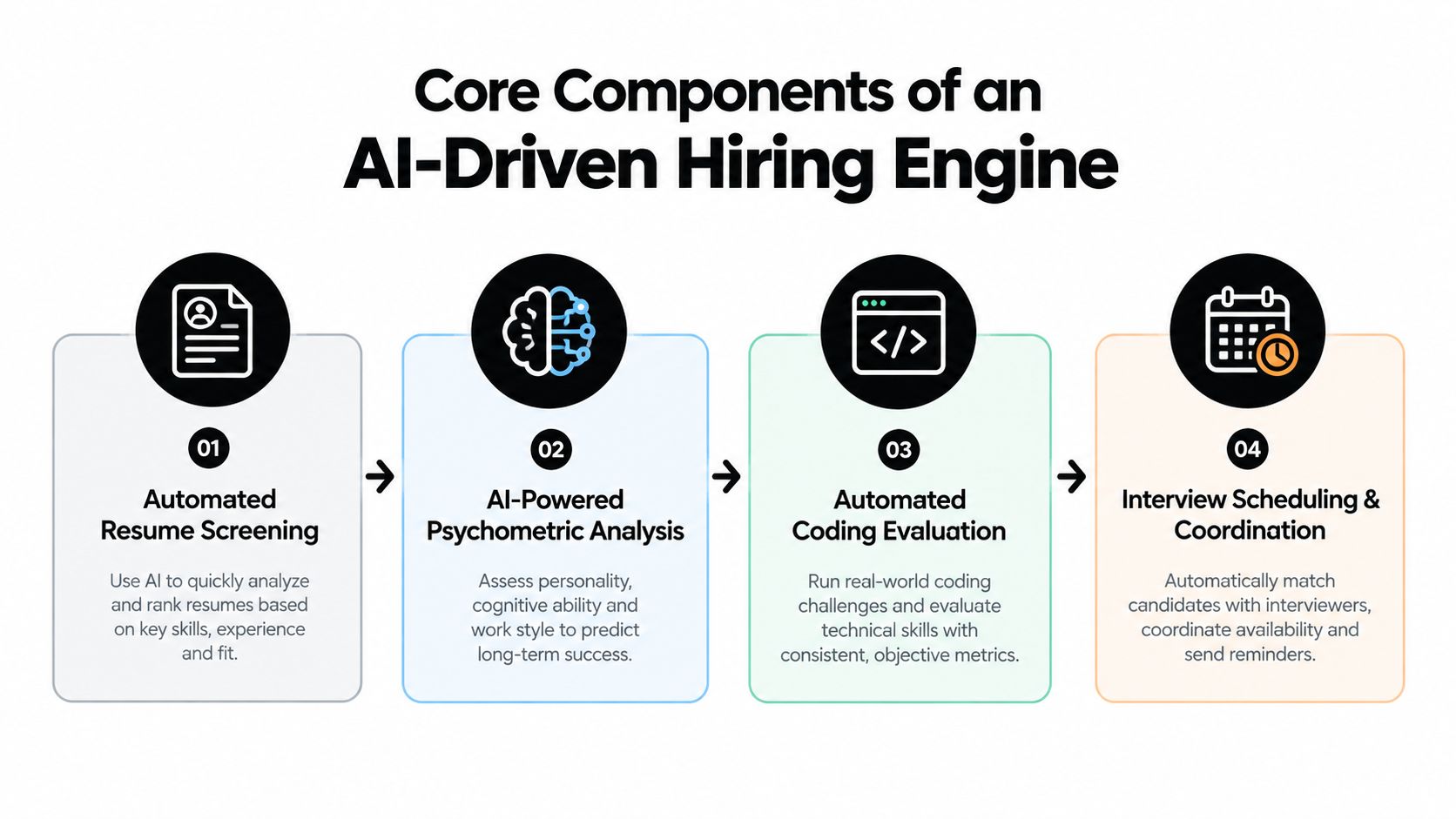
The highest-bottleneck phases are often first-round interviews, psychometric assessments, and coding assessments. These stages require consistency, but they also consume recruiter and interviewer capacity when every applicant must be handled manually.
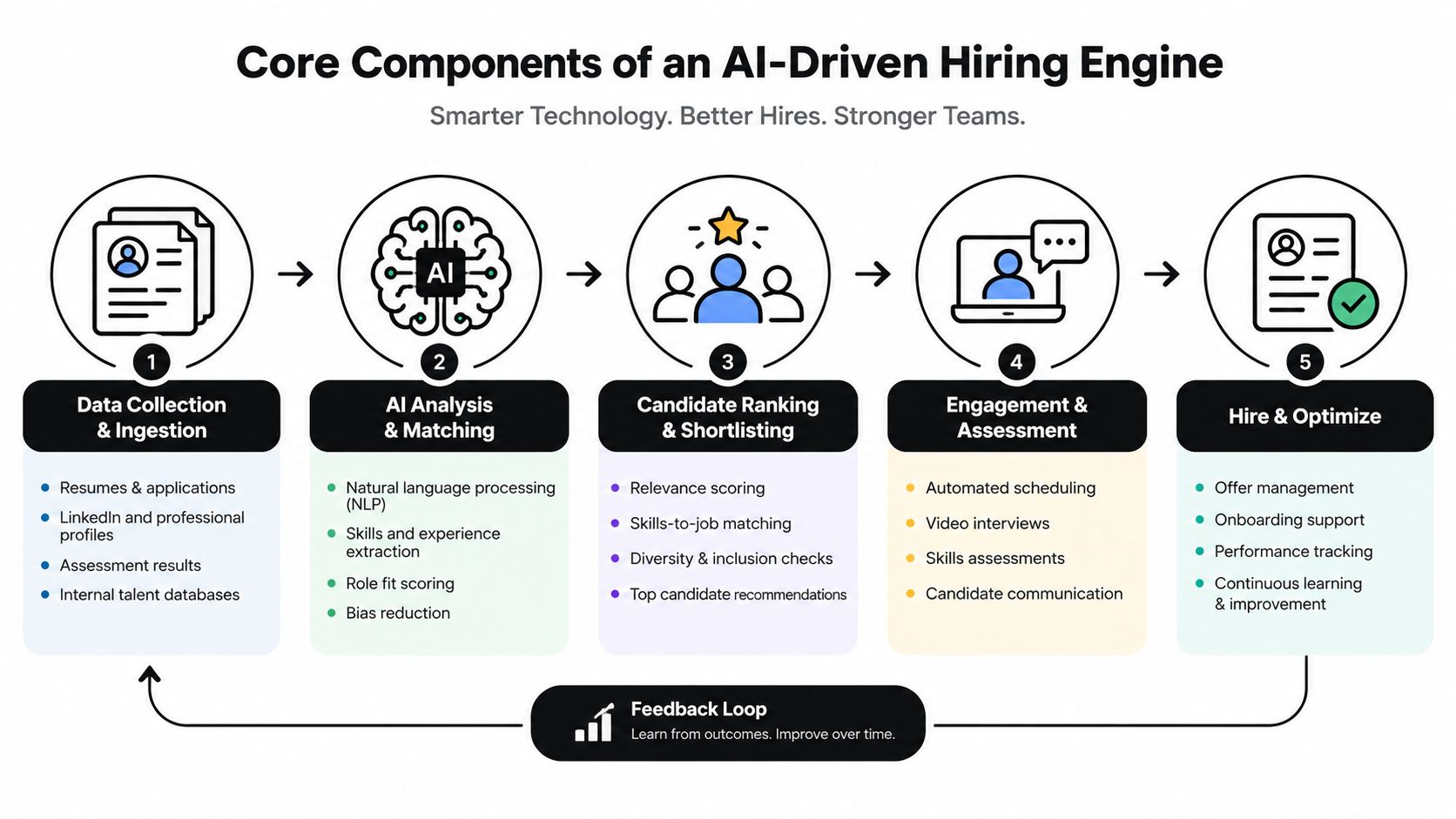
A workable workflow can follow five practical movements.
Collect and qualify the application. The ATS receives the application and applies role-specific criteria agreed during intake. The criteria should distinguish essential requirements from preferences, because an automated filter can't rescue an unclear brief. A structured approach to what parsing a CV means helps teams understand how applicant information enters the workflow.
Route the candidate to the right first step. Candidates who meet the initial requirements receive a unique interview link or assessment invitation. The invitation should explain the format, deadline, expected preparation, and how the organisation will use the results. Routing rules can send technical candidates to a coding assessment, operational candidates to a phone screen, and early-career applicants to a consistent first-round interview.
Run the asynchronous interview. The candidate completes an AI-powered interview at a convenient time before the deadline. The platform asks defined questions, captures responses, and evaluates them against a structured rubric. This creates a common evidence base for early screening without requiring every recruiter to conduct the same conversation repeatedly.
Add role-relevant assessment. Psychometric testing can examine mental capabilities, stress handling, and alignment with organisational culture. A study of IT companies in Hyderabad examined the cost-effectiveness of psychometric testing in recruitment and selection, supporting its relevance to an automated assessment stage through the published study on psychometric assessments. Coding assessments can test practical technical ability before a senior engineer invests time in a live interview.
Return structured evidence to the recruiter. The system should produce scores, recordings where appropriate, an evaluation report, and a hiring recommendation. Recruiters then review the evidence, inspect borderline cases, and decide who moves forward. One Indian platform describes a workflow based on unique interview links, candidate-completed AI interviews, structured reports, and recommendations, while another reports that its AI conducts 500+ screening interviews a day and returns ranked candidates with recordings and recommendations. These workflows are described by Zire's AI candidate screening platform.
The recruiter shouldn't receive an unexplained score and be expected to trust it. Each recommendation needs traceable evidence, a visible rubric, and an escalation route for candidates whose experience doesn't fit the standard pattern. Automation works best as a scalable filter with human review, particularly at the first-round stage.
Avoiding the Partial Automation Trap
A recruiter can stop reading every CV and still spend hours on administration. That happens when an organisation automates screening but leaves first-round AI interviews, psychometric testing, coding assessments, scheduling, feedback, and candidate follow-up in separate tools.
The result is activity automation without workflow automation. Recruiters download interview and assessment reports, reconcile candidate IDs, copy scores into the ATS, chase interviewer feedback, and explain inconsistent recommendations to hiring managers. Time shifts from screening to exception handling instead of closing the strongest candidates.
Deloitte India reports that 86% of organisations say AI or Agentic AI is transforming recruitment, while resume screening remains the dominant use case at 72%. Assessments account for 48%, and candidate engagement for 37%. These figures appear in Deloitte India's announcement on AI adoption in campus hiring. The pattern points to selective automation rather than a redesigned hiring workflow.
Audit the handoffs before buying more software
Start with the process map, not the vendor demo. For every stage, ask:
- Who owns the next action? A completed AI interview, psychometric test, or coding assessment must create a clear recruiter or hiring-manager task.
- Where does the data go? Responses, scores, recordings, notes, and decisions should flow into the ATS or another approved system of record.
- What happens when the candidate is unusual? Career changes, accessibility requests, incomplete data, and technical failures need defined exception routes.
- Which decision remains human? Recruiters and hiring managers should know when to challenge a recommendation or request a second review.
- What does the candidate see? Instructions and next steps should be clear, without confusing internal labels or unexplained outcomes.
An integrated stack is more useful than several point tools. A 2026 study of an Indian IT firm examined automation across requisition approval, job posting, sourcing, screening, scheduling, offer management, and onboarding. It linked the workflow to ATS platforms, chatbots, online job portals, and collaborative tools, with effectiveness improving when data moved continuously between stages. The findings are available in the SN Business & Economics study of talent acquisition automation.
The test is simple: If the recruiter has to re-enter the output, the workflow isn't finished.
Use the same test for each bottleneck. First-round AI interviews should produce structured evidence for recruiter review. Psychometric testing should connect results to the role rubric, rather than sit in a separate portal. Coding assessments should identify technical evidence before an engineer joins the process. Candidates who meet the threshold can progress, while recruiters spend their time reviewing borderline cases, calibrating quality, and closing the shortlist.
Partial automation is a design warning. It signals that the organisation has automated tasks without assigning ownership for what happens next.
Strategic Implementation and Change Management
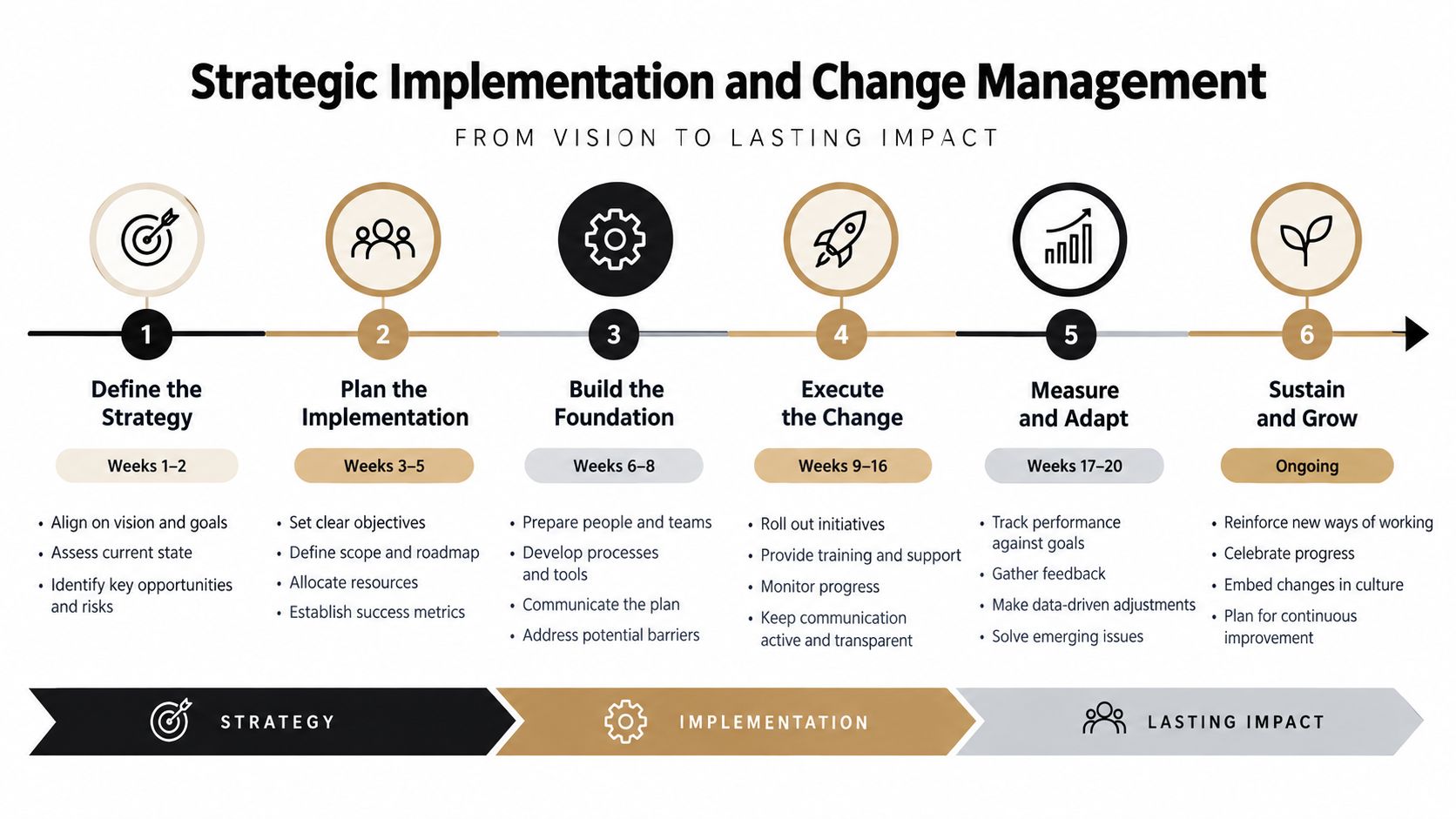
Successful deployment starts with a contained operational problem. Don't begin by promising an organisation-wide replacement of recruitment. Choose one role family where applicant volume is high, first-round interviews are repetitive, and the hiring team can agree on what good evidence looks like.
Build the pilot around a real bottleneck
Begin with an intake session involving the recruiter, hiring manager, interviewers, HR operations, IT, and the relevant data or compliance owner. Define the competencies, disqualifying requirements, assessment format, candidate communications, review responsibilities, and escalation rules before configuring the tool.
A practical rollout can follow this sequence:
- Set the operating objective. Decide whether the pilot is intended to improve first-round capacity, candidate completion, recruiter workload, technical screening, or decision consistency. Choose a primary objective and supporting measures.
- Document the current workflow. Record each handoff, delay, duplicate entry, and manual follow-up. Without this baseline, the team can't distinguish genuine improvement from a new interface.
- Configure the assessment rubric. Write behavioural, technical, and role-specific criteria in observable terms. Avoid vague measures such as “good culture fit” unless the organisation can define the behaviours it means.
- Run a controlled pilot. Use the selected role family while keeping a human review process active. Review recommendations, candidate feedback, completion issues, and edge cases frequently during the launch.
- Train recruiters to interpret evidence. Training should cover score meaning, recording review, override decisions, candidate communication, and system failure. Recruiters need permission to challenge the tool without being treated as resistant to change.
- Scale only after process repair. Extend the workflow to similar roles once the team has fixed routing, reporting, ATS integration, and exception handling.
Govern quality, not only speed
A dashboard that measures completed interviews but ignores candidate quality will encourage the wrong behaviour. Track the relationship between assessment output and later hiring decisions, hiring-manager confidence, candidate drop-off, technical performance, and the reasons recruiters override recommendations.
The change-management challenge is cultural as much as technical. Recruiters may worry that automation devalues their expertise, while hiring managers may assume that an AI score is objective because it is numerical. Leaders should state the opposite clearly: the system standardises early evidence, but humans remain accountable for interpretation and selection.
Evaluating Vendors and Assessment Platforms
Assessment platforms differ less by their marketing language than by the work they remove from the recruiter. A volume screening tool may be effective for an initial phone screen but unsuitable for a supervised coding evaluation. An enterprise assessment platform may offer stronger controls, yet be excessive for a simple early-stage workflow.
India-focused coverage of AI interview platforms reports two broad pricing bands. Volume screening tools are priced around ₹500 to ₹1,500 per assessment, while enterprise or proctored tools cost around ₹1,650 to ₹4,150 per interview, as described in The Hire Hub's overview of AI interview platforms in India. Use those ranges as a starting point for comparing use cases, not as a substitute for a full commercial evaluation.
AI Assessment Pricing and Use Case Matrix
| Assessment Tier | Price Range (INR) | Ideal Use Case | Key Features |
|---|---|---|---|
| Volume screening | ₹500 to ₹1,500 per assessment | High-volume early-stage hiring | Asynchronous first-round interviews, structured scoring, candidate routing, basic reports |
| Enterprise or proctored assessment | ₹1,650 to ₹4,150 per interview | Controlled assessment environments and sensitive hiring workflows | Proctoring, stronger assessment controls, detailed evaluation, enterprise administration |
The right platform should support the assessment types your workflow needs. For first-round interviews, check whether candidates receive unique links, whether they can complete the interview asynchronously, whether the system records responses appropriately, and whether recruiters receive evidence rather than an opaque pass or fail.
For psychometric testing, ask how the assessment maps to the role and whether the output is suitable for decision support rather than presented as a definitive judgement about personality. For coding assessments, examine the languages and task formats supported, the quality of plagiarism or integrity controls, the report provided to engineers, and the ease of moving a candidate into a live technical conversation.
Questions for procurement and talent leaders
- Integration: Does the platform write results back to the ATS, or will recruiters export and re-enter them?
- Workflow control: Can different role families use different questions, rubrics, deadlines, and routing rules?
- Candidate access: Does the process work across the devices and connectivity conditions common to the target workforce?
- Human review: Can recruiters inspect recordings, answers, evidence, and overrides in one place?
- Governance: Are permissions, retention, audit trails, and escalation procedures clear?
- Commercial fit: Are charges based on invitations, completed assessments, interviews, seats, or a broader platform licence?
Career Central is one option for organisations seeking an AI interview layer that supports AI-driven phone screening, first-round interviews, and coding assessments. Buyers comparing it with other tools can use a broader candidate assessment tools guide to evaluate functional coverage before speaking with vendors.
A vendor should earn trust through a realistic pilot. Give the platform representative a genuine role brief, review the candidate journey end to end, inspect the report a recruiter receives, and test what happens when a candidate needs human assistance. The most valuable demonstration is not a polished dashboard. It's the complete transition from application to recruiter decision.
Future-Proofing Your Talent Acquisition Strategy
Recruitment process automation becomes strategic when it changes the allocation of human attention. Early-stage interviews, psychometric assessments, and coding evaluations can create a repeatable evidence layer for large applicant pools. Recruiters then have more capacity for the work software can't perform well, including understanding motivation, resolving uncertainty, advising hiring managers, and closing candidates.
That shift requires discipline. An automated interview isn't automatically a fair interview, and a structured score isn't automatically a good decision. The organisation still needs job-relevant criteria, consistent questions, accessible candidate journeys, clear data controls, and a human route for exceptions.
Keep the workflow connected
A durable hiring engine has a continuous path from requisition approval through onboarding. The 2026 Indian IT-firm study described earlier is useful because it treats automation as a lifecycle rather than a single screening feature. That perspective changes the buying question from “Which tool can review CVs?” to “How will evidence travel from application to decision, and who acts on it?”
Recruitment leaders should review the workflow regularly. Candidate behaviour changes, roles change, interviewers drift from the rubric, and a model that worked for one job family may not suit another. Governance should include:
- Rubric reviews: Confirm that assessment criteria still reflect the role and aren't rewarding superficial patterns.
- Exception analysis: Review candidates who required manual intervention and identify whether the process needs redesign.
- Decision audits: Compare automated recommendations with recruiter and hiring-manager outcomes without treating either as infallible.
- Candidate feedback: Look for confusion, accessibility barriers, technical problems, and perceptions of impersonality.
- Integration checks: Confirm that records remain complete, searchable, and available to the people responsible for the next stage.
Reuters reported that AI hiring in India's IT sector rose 16% year over year in June 2026, while overall IT jobs fell 3%, a contrast included in the Deloitte India coverage cited earlier. The signal is not that every hiring decision should be automated. It is that organisations are concentrating technology investment where skills demand and screening complexity require faster, more structured workflows.
The future-proof approach is therefore selective rather than indiscriminate. Automate the first filter where volume makes manual handling unsustainable. Keep humans close to interpretation and candidate relationships. Connect the outputs to the ATS and operating rhythm. Then improve the system using evidence from real hiring outcomes.
Career Central provides AI-driven phone screening, first-round interviews, and coding assessments for organisations that need a structured early-stage hiring workflow. Visit Career Central to see how an AI interview layer could help your team scale screening while keeping recruiters focused on evaluation and closing offers.