Resume parsing means using software to convert an unstructured CV into structured, searchable data inside an ATS. In India, that matters because the market crossed over 150 million job applications annually by 2024, and 78% of Indian HR managers are estimated to rely on ATS platforms with parsing built in for screening candidates.
If you're leading talent acquisition today, you've probably felt the pressure from both sides. Application volumes keep climbing, recruiters don't have more hours, and hiring managers still expect fast, accurate shortlists. The temptation is to treat parsing as a back-office feature. That's a mistake.
For a CHRO or Head of Talent Acquisition, parse resume meaning isn't just “the system reads PDFs”. It's the point where your hiring operation turns messy documents into operational data. Done well, it helps recruiters move faster and compare candidates more consistently. Done badly, it hides strong candidates, misreads Indian career contexts, and embeds bias deeper into the funnel.
Table of Contents
- The Real Meaning of Parsing a Resume
- How AI and Parsers Extract Meaning from CVs
- The Tangible Benefits for Talent Acquisition Teams
- Common Resume Parsing Challenges in India
- The Ethical Minefield of Algorithmic Bias
- Implementing and Optimising Your Parsing Strategy
- The Future of Recruitment Is Parsed and Understood
The Real Meaning of Parsing a Resume
Resume parsing is the step that turns a CV from a document into usable hiring data inside your ATS. Names, phone numbers, employers, job titles, qualifications, skills, dates, and locations are pulled out of uneven formats and mapped into standard fields. For a CHRO, that matters because hiring speed and hiring control both depend on whether candidate information is searchable, comparable, and reportable.
In India, that definition needs a tighter lens. A parser is not working on a clean, uniform stream of resumes. It is reading CVs with mixed formatting, non-standard job titles, regional education references, varied address structures, and experience descriptions that switch between local shorthand and global terminology. If the parser misses that context, the problem is larger than a messy record. It can distort screening, weaken shortlist quality, and hide strong candidates from recruiters.
Why parsing matters at a strategic level
The core value is not extraction. The core value is downstream decision quality.
When resumes sit as attachments, recruiters spend time opening files, scanning for basics, and making judgement calls from inconsistent layouts. When the same information is captured in fields, teams can search by skill cluster, location, industry background, tenure, notice period, or degree type. That changes recruitment operations from manual document review to structured talent retrieval.
I usually advise HR leaders to test their current setup with one simple question: can a recruiter identify all candidates with the right SAP module experience, team size handled, and willingness to relocate, without opening 200 attachments? If the answer is no, parsing is being treated as a storage feature instead of an intelligence layer.
What parsing does, and where its limits begin
Resume parsing has a specific job. It organises candidate information so systems and recruiters can work with it faster and more consistently.
It does not decide fit on its own.
A useful way to separate the workflow is this:
- Parsing structures information. It converts unstructured CV content into fields the ATS can read and index.
- Screening applies rules. Recruiters or software use those fields to rank, filter, or route candidates.
- Selection requires judgement. Final decisions still depend on context, calibration, interviews, and business needs.
That distinction matters in the Indian market because parsing errors often look small at first. A generic parser may read “BE” as a verb instead of a Bachelor of Engineering degree. It may flatten “articleship” into generic internship experience. It may misread location signals across Tier 1 and Tier 2 city formats, or fail to interpret employer brands that are well known locally but not globally. Those are not cosmetic misses. They shape who appears in search results and who gets ignored.
What this means for HR leaders
The strategic meaning of parsing a resume is straightforward. It is the process that makes candidate data usable at scale, but only if it reflects local hiring reality accurately enough to support fair decisions.
That is why vendor evaluation should go beyond one question about extraction accuracy. CHROs should ask whether the parser handles Indian resume conventions, whether output quality is audited by role and region, and whether the system reduces bias or hardens it. A parser that saves recruiter time but systematically misclassifies candidates from certain colleges, cities, or career paths creates operational risk along with efficiency.
Used well, parsing improves throughput and visibility. Used carelessly, it automates bad judgement.
How AI and Parsers Extract Meaning from CVs
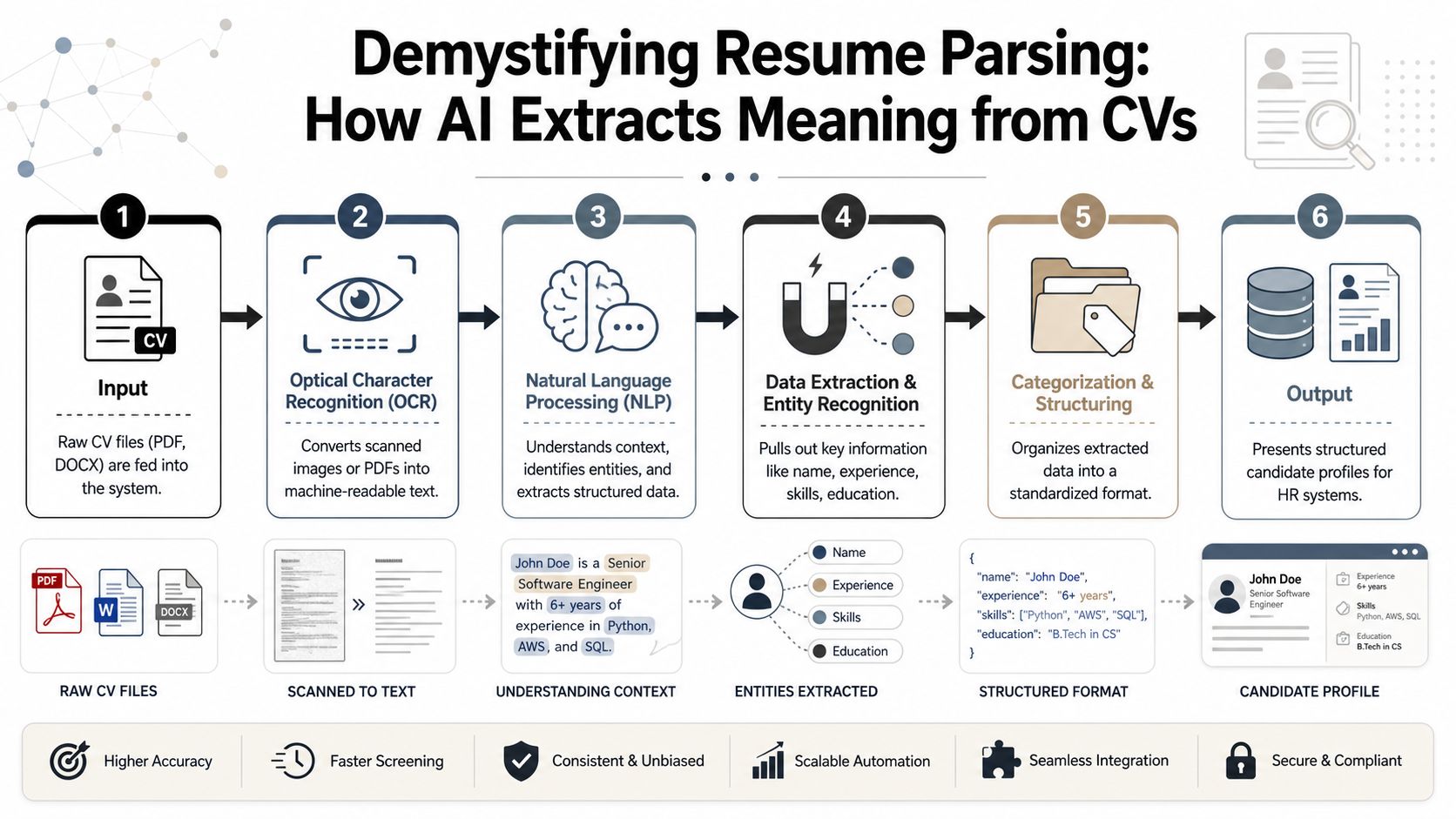
A modern parser doesn't “understand” a CV the way a recruiter does. It moves through layers. Each layer handles a different problem, and each one affects what your ATS finally stores.
Resume parsing in India typically relies on a three-layer architecture: document conversion, pattern recognition, and semantic understanding through NLP or AI. That stack is used to infer meaning such as reading “led 12 engineers” as management experience rather than a random phrase, with 85% to 95% accuracy in structured field extraction, according to Yena AI's overview of resume parsing architecture.
What the machine does first
The first layer is document conversion. If a candidate uploads a PDF, DOCX, or scanned file, the system has to make the text machine-readable. This is the OCR stage. If the parser fails here, everything downstream gets weaker.
The second layer is pattern recognition. In this stage, the parser identifies predictable formats such as:
- Contact details like email addresses and phone numbers
- Dates used for employment periods or education timelines
- Standard labels such as degree names, company names, or locations
This stage is powerful but narrow. It works best when the information follows recognisable patterns.
Where meaning enters the process
The third layer is where things get interesting. Semantic understanding tries to interpret context, not just text strings. A recruiter can see the difference between “Java” listed as a hobby project and “Java” used in a production engineering role. A stronger parser tries to make that distinction too.
That's also where the output starts becoming useful for recruiters. Instead of a raw attachment, the ATS can display a candidate profile with structured fields such as current title, years of experience, education, skills, employers, and inferred management scope.
A parser is most valuable when it helps a recruiter review a candidate profile without reopening the original CV for every basic fact.
Still, limitations begin to present themselves. Semantic interpretation requires context, and Indian resumes often contain mixed language, informal labels, unusual sequencing, and role descriptions that don't fit neat taxonomies.
A practical way to judge parser quality is to inspect the ATS output, not the vendor demo. Ask your team to review whether the parser consistently handles:
| Parsed field | What good output looks like | What weak output looks like |
|---|---|---|
| Work experience | Roles mapped in order with employer and tenure | Dates split incorrectly or overlapping roles |
| Skills | Relevant skills grouped cleanly | Keyword dumping with duplicates |
| Education | Institution, qualification, and year separated | Entire education block pasted into one field |
| Seniority | Leadership signals inferred from context | Only title captured, no scope understood |
If recruiters trust the structured profile, adoption rises. If they keep double-checking every field, the parser is adding a layer, not removing work.
The Tangible Benefits for Talent Acquisition Teams
A recruiter in a large Indian TA team can lose half a day to one repetitive task. Open CV. Scan for title. Check tenure. Re-enter education. Repeat across hundreds of applicants. Parsing changes that operating model by converting resumes into searchable candidate records early in the funnel.
The gain is speed, but the more important gain is control. Recruiters spend less time on clerical intake and more time on shortlist quality, hiring manager alignment, and candidate follow-up. For CHROs, that matters because hiring delays rarely come from one interview panel. They build up at the top of the funnel, where application volume is high and recruiter attention is thin.
In practice, talent acquisition teams usually see value in three areas:
- Higher screening throughput. Recruiters can review larger applicant pools without turning the ATS into a backlog queue.
- Cleaner hiring data. Structured records make it easier to search by skill, compare profiles, and report on funnel trends across roles and locations.
- More consistent first-pass review. Teams assess common fields instead of relying on each recruiter to interpret a different resume format.
That consistency has a practical impact in India, where one employer may receive applications from multiple states, education systems, and job-title conventions for the same role. A parser does not remove that complexity, but it gives the team a standard starting point for review.
Why operations leaders care
The operational case is straightforward. Manual screening does not scale well once hiring volumes rise across business units, cities, or seasonal demand spikes. Parsing shifts the repetitive extraction work to software, which helps TA leaders redeploy recruiter time toward activities that affect hiring outcomes more directly.
That change also improves process discipline.
When candidate information enters the ATS in a structured format, teams can build tighter workflows around screening, assessment, and handoff. It becomes easier to route candidates to specialist recruiters, apply common knockout criteria, and pass shortlisted profiles into downstream services such as Interview as a Service for first-round evaluation when consistency matters across locations.
Manual screening vs automated parsing
The difference is easiest to see at the workflow level:
| Metric | Manual Screening | With Resume Parsing |
|---|---|---|
| Intake process | Recruiter reads and re-enters key details | Candidate data is extracted into ATS fields automatically |
| Screening speed | Slower and dependent on individual capacity | Faster first-pass review across large applicant volumes |
| Data consistency | Varies by recruiter and resume format | Standardised fields across the database |
| Searchability | Limited to notes, tags, and memory | Structured filters for skills, tenure, title, and education |
| Recruiter effort | Heavy administrative load | More time for evaluation and stakeholder management |
The strategic upside is often missed. Once recruiters stop spending hours retyping and reformatting CV data, they can focus on decisions that require human judgement: whether a sales manager from Coimbatore should be mapped against a national role, whether a plant operations profile reflects real team leadership, or whether a candidate's career path fits the business context.
Parsing still has limits. It improves intake efficiency. It does not guarantee better hiring decisions, and in India it can create false confidence if the parser standardises a profile incorrectly. TA teams get the best results when they treat parsing as the first layer of screening infrastructure, then audit outputs regularly for regional title mismatches, education misreads, and hidden bias in shortlist patterns.
Common Resume Parsing Challenges in India
The hardest parsing problems in India aren't about reading text. They're about reading context.
AI parsers may report 85% to 95% accuracy for extracting fields like emails and titles, but that accuracy drops significantly when semantic understanding is needed to interpret achievements in unstructured Indian CVs. As Workable's discussion of how ATS systems read resumes notes, parsers often fail at the semantic layer, including recognising that “led 12 engineers” implies management rather than just matching isolated words.
Where Indian resumes break generic parsers
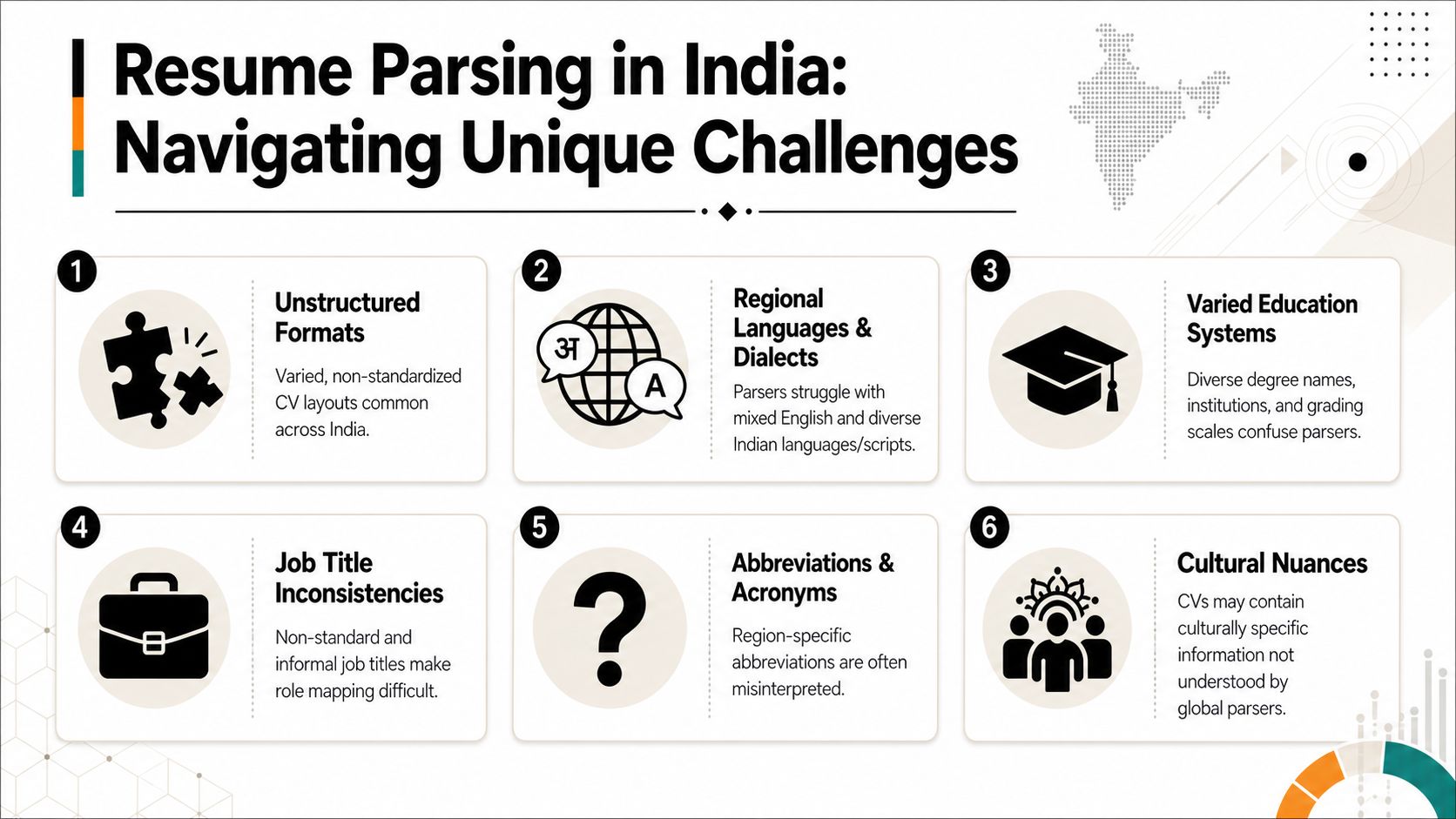
Many global parsing models are built around standardised CV patterns. Indian resumes often aren't standardised in that way.
A parser can struggle when it encounters:
- Regional job titles such as “Branch In-charge”, “Centre Head”, or “Office Boy”, where the literal phrase doesn't fully describe the actual level of responsibility
- Mixed language usage where English is blended with regional terms or abbreviations
- Education variations including state board naming conventions, non-standard degree labels, and institution names that don't map cleanly to global datasets
- Unconventional structure such as profile summaries, achievements, and career history presented in a non-chronological format
These are not edge cases in India. They're normal hiring data.
Why semantic errors matter more than field errors
If a parser misses a phone number, the problem is visible and easy to correct. If it misreads the meaning of a role, the error is subtler and more dangerous.
A candidate might have managed a field team, owned a branch P&L, or led implementation across districts. If the parser reduces that to a generic admin label, the profile may never surface in a search for managerial talent. The ATS record looks complete, but the meaning is wrong.
Recruiters should worry less about whether the parser captured every word and more about whether it captured the right interpretation.
That's why “simple layout” advice only goes so far. Clean formatting helps. It doesn't solve semantic mismatch.
A useful review process is to sample rejected or low-ranked profiles and inspect whether the parser mishandled context. Start with roles where Indian title diversity is common, then compare the original CV with the ATS fields. If the mismatch is frequent, the issue isn't candidate quality. It's parser training, taxonomy design, or ATS configuration.
The Ethical Minefield of Algorithmic Bias
Efficiency is the easiest part of the parsing story. Fairness is harder.
The verified data for this article states that AI parsing in India can inadvertently filter out candidates from tier-2 and tier-3 cities or from specific educational backgrounds because of biased training data. A 2025 to 2026 analysis also found that while parsing converts resumes into structured formats, it can reinforce historical bias when the extracted “meaning” favours metro-centric profiles, as described in Senseloaf's discussion of resume parsing and bias risk.

How bias enters a parsing workflow
Bias doesn't always appear as an explicit exclusion rule. More often, it enters through accumulated design choices.
If a parser is trained to treat certain institutions, employers, city names, or phrasing patterns as stronger signals, candidates from outside those patterns may be downgraded or surfaced less often. The system may never say “reject candidates from smaller cities”. But if the extracted meaning overweights metro experience, the outcome can look very similar.
For HR leaders, that creates a serious governance problem. A workflow designed for speed can become a silent filter against diversity goals.
Common risk points include:
- Historical training data that reflects old hiring preferences
- Search filters that overvalue pedigree signals
- Taxonomies that map local roles into lower-value categories
- Recruiter overreliance on parsed summaries instead of reviewing full context where needed
What CHROs should audit
A parser should never be treated as neutral just because it is automated. It needs auditing.
Start by comparing who gets surfaced versus who gets buried. Look across geography, institution type, and career path. Then inspect whether the parser or ATS scoring model is compressing candidate variety into narrow, metro-oriented patterns.
After that, bring your recruiters into the review loop. Ask them where parsed summaries underrepresent candidate capability. Those complaints are often the first signal that bias is entering through semantics rather than explicit exclusion.
A useful explainer on AI bias in hiring is below.
If your diversity strategy depends on reaching overlooked talent pools, you can't accept a parser that only recognises familiar profiles.
The practical goal isn't to abandon parsing. It's to stop confusing automation with fairness. High-performing TA teams use parsing for efficiency, then actively check whether the system is narrowing access to opportunity.
Implementing and Optimising Your Parsing Strategy
Adoption succeeds when HR leaders treat parsing as an operating system decision, not just a software feature.
That matters in India because the vendor market is already broad. The verified data notes that India has over 120 localised resume parsing vendors, and a 2025 study by the Indian Institute of Management Bangalore documented 92% accuracy for Indian resumes, compared with a global average of 85%, particularly for non-chronological formats or regional job title variations, as cited in Indeed's hiring resource on resume parsing.
How to choose well in a crowded vendor market
Vendor selection should start with your hiring reality, not with feature checklists.
If your organisation hires across regions, functions, and language patterns, test the parser on your own resume library. Include mixed-format CVs, regional titles, lateral career paths, and multilingual profiles. Generic demos often perform well because the sample resumes are unusually clean.
Shortlist vendors based on criteria such as:
- Indian resume fit rather than only global accuracy claims
- Taxonomy flexibility so your team can map local roles correctly
- Reviewer controls that let recruiters correct parsed fields easily
- Integration quality with the ATS and downstream systems you already use
- Feedback loops that let the model improve from recruiter corrections
A broader hiring stack also matters. Once you've cleaned the intake layer, it becomes easier to connect parsing with structured evaluation tools such as candidate assessment tools for later-stage screening.
A practical operating model
The strongest setup is human in the loop. That means the parser handles extraction, while recruiters review exceptions, ambiguous profiles, and roles where title interpretation matters.
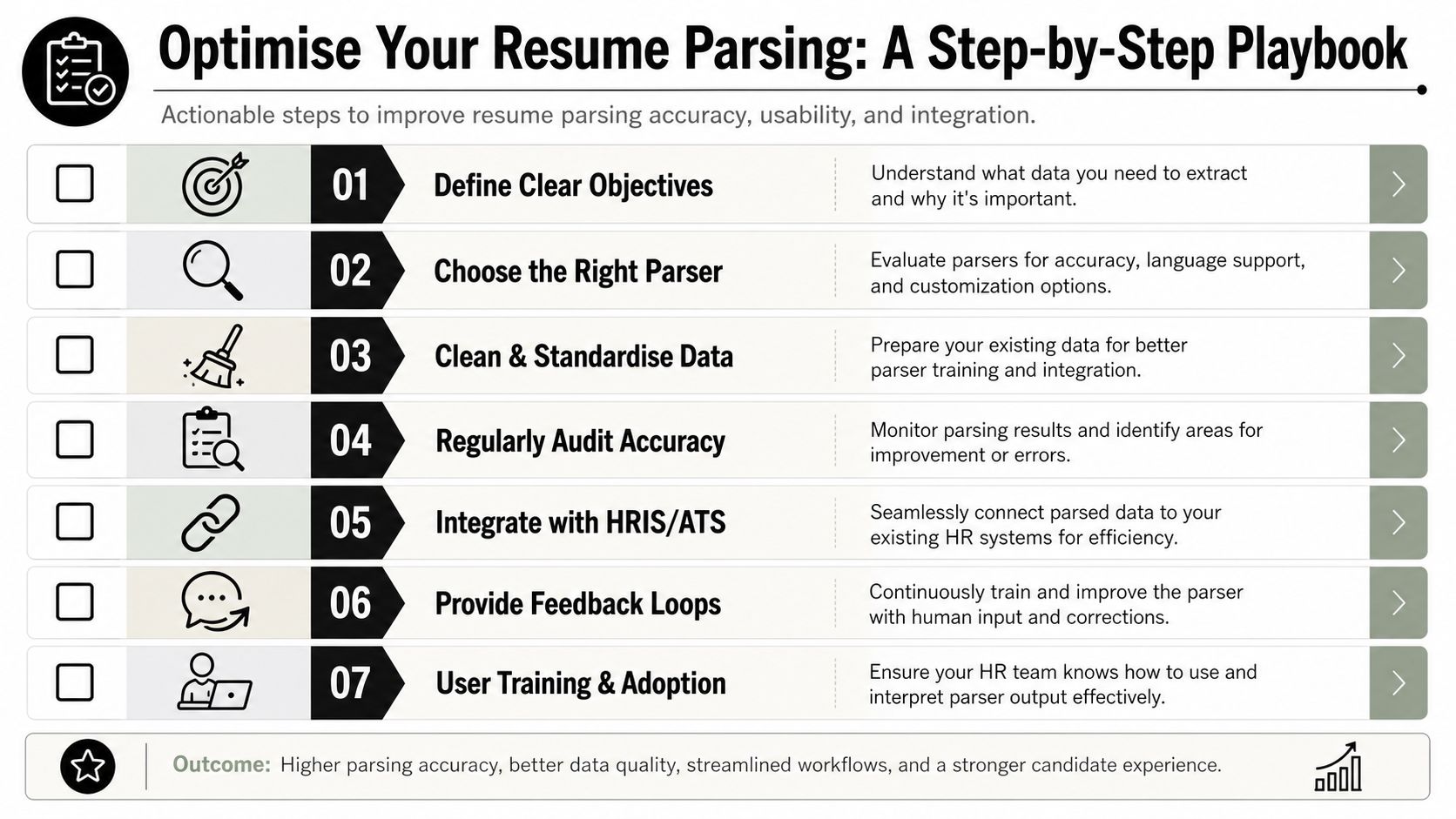
Use an operating rhythm like this:
- Define the fields that matter most. Don't parse everything just because you can.
- Set confidence thresholds. Low-confidence parses should trigger review, not silent acceptance.
- Audit error patterns regularly. Look for recurring issues in titles, education labels, and career progression.
- Train recruiters on parser limits. They should know when to trust the profile and when to open the original CV.
- Feed corrections back into the system. A parser improves only when your process captures and uses those corrections.
What doesn't work is blind trust. When recruiters assume the ATS profile is always right, small semantic errors become structural hiring errors. When they ignore the parser entirely, you lose the efficiency benefit. The middle path is the right one. Automation for scale, human review for judgement.
The Future of Recruitment Is Parsed and Understood
Resume parsing is no longer a niche HR tech feature. It's part of the basic infrastructure of modern recruitment, especially in high-volume markets such as India. The primary opportunity isn't only to read CVs faster. It's to build a hiring system where candidate information becomes searchable, comparable, and operationally useful.
But speed on its own isn't enough. The strongest teams understand the trade-off. Parsing creates efficiency, yet it can also flatten context, mishandle Indian role nuance, and amplify old hiring patterns if nobody audits the output. That's why mature talent functions don't ask whether to use parsing. They ask how to govern it.
The practical future is a blended model. AI handles document conversion, field extraction, and early organisation of candidate data. Recruiters and hiring leaders handle interpretation, fairness checks, and final judgement. That combination is what turns parsing from an admin shortcut into a strategic advantage.
For CHROs, the question behind parse resume meaning is simple. Do you want your ATS to be a document warehouse, or a decision-ready talent system? The organisations that answer that well will hire faster, operate with better visibility, and widen access to strong candidates instead of narrowing it.
If you're ready to improve hiring beyond resume intake, Career Central helps organisations run AI-driven phone screening, first-round interviews, and coding assessments so recruiters can move from parsing CVs to evaluating real candidate capability with more consistency and less manual effort.
Created with Outrank tool