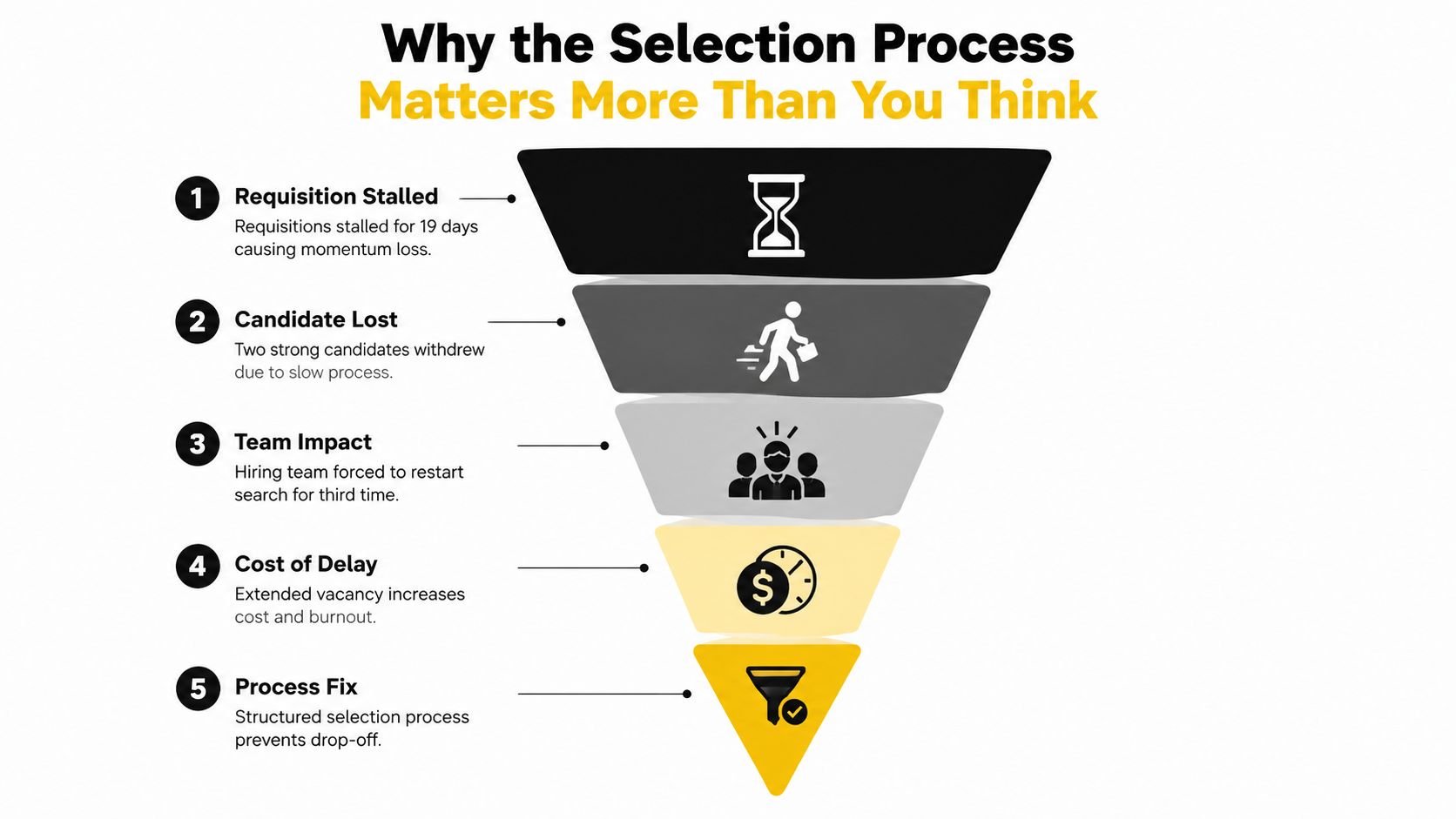
A hiring manager has just lost two strong candidates because the requisition sat stalled for 19 days. The team is preparing to start a third search, while interviewers debate whether the problem was sourcing, screening, scheduling, or the offer. Nobody has a reliable answer because the company treats hiring as one activity called “the process”.
That approach is expensive and difficult to improve. The steps in the selection process are separate decisions, each with an owner, a measurable output, a failure mode, and an opportunity for sensible automation. This guide shows how to build that funnel so teams can identify where candidates drop, preserve human judgement where it matters, and use AI where repetition is the primary bottleneck.
Table of Contents
- Why the Selection Process Matters More Than You Think
- The Core Stages of the Selection Process
- Using AI Phone Screening to Strengthen Early Rounds
- Adding Coding and Skill Assessments That Actually Predict Performance
- KPIs and Metrics to Track at Each Step
- Common Pitfalls in the Selection Process and How to Fix Them
- A Practical Checklist for Your Next Hiring Cycle
Why the Selection Process Matters More Than You Think
Hiring teams often blame a weak outcome on a small candidate pool. In practice, the larger problem is usually a poorly instrumented funnel. Sourcing creates attention, screening tests basic eligibility, interviews gather behavioural evidence, assessments test job-relevant capability, and closing converts a decision into an accepted offer. When those activities blur together, the team can't tell whether it needs better reach, sharper criteria, faster feedback, or stronger closing.
The Indian context makes this especially important. A study of Indian employees found that 43.3% experienced three interview rounds, 23.3% experienced four rounds, and only 6.7% experienced a single round, according to the study of interview rounds and selection fairness in India. Multi-stage hiring is therefore not an unusual exception. Candidates experience it as a chain of checkpoints, and every checkpoint can either build confidence or create doubt.
Treat every stage as a decision
A useful funnel asks four questions at every stage:
- Who owns the decision? A recruiter, hiring manager, interviewer, assessor, or executive.
- What evidence is required? A must-have criterion, behavioural example, work sample, or reference signal.
- What can happen next? Advance, hold, reject, or request more information.
- Which KPI exposes failure? Conversion, time-in-stage, fairness, acceptance, or post-hire quality.
This discipline also protects candidate trust. The same Indian study reported that 72.5% of respondents were satisfied or very satisfied with process fairness, with an average satisfaction score of 3.74 out of 5.00. Those figures indicate that structure can support a fairer experience, but structure only works when interview quality and HR communication are consistent.
A stalled requisition doesn't merely delay a hire. It weakens the candidate relationship, consumes interviewer time, and forces the team to repeat work it should already have learned from. Teams should review selection funnels with the same seriousness they apply to sales funnels. If candidates disappear between stages, the business needs to know exactly where and why. That connection also matters for retention, which is why leaders should examine the relationship between hiring quality and attrition in HR rather than treating recruitment and retention as unrelated problems.
The Core Stages of the Selection Process
A strong selection process doesn't mean adding interviews indefinitely. It means giving each stage a specific job and refusing to advance a candidate without the evidence that stage is meant to produce. The recruiter and hiring manager should agree on the process before the role goes live.
Build the funnel in sequence
Intake and role scoping belongs to the hiring manager and recruiter. They define outcomes, must-have capabilities, realistic constraints, reporting lines, and the difference between essential and trainable skills. The output is a success profile and scorecard. Watch time from requisition approval to role launch.
Sourcing uses inbound applications, referrals, outbound outreach, existing talent pools, and specialist channels. The recruiter owns channel strategy and must produce a qualified candidate pool, not merely a large applicant count. Track source-to-qualified-candidate conversion.
Resume screening tests applications against explicit must-have criteria. A recruiter or trained screener should record the reason for advancing or rejecting each application. The output is advance, hold, or reject. The primary KPI is screen pass rate by source.
Phone or AI screening checks motivation, communication, availability, location, work authorisation, compensation expectations, and baseline fit. The recruiter owns the rules, while the screening tool can handle repeatable questions. Track screen completion and pass-through rate.
First-round structured interviews test competencies through consistent questions and anchored scoring. The hiring manager or trained interviewer owns the stage. The output should be evidence against the scorecard, with interview-to-next-stage conversion as the core measure.
Role-specific assessments create a work sample, such as a coding task, writing exercise, analysis, presentation, or customer scenario. The functional owner evaluates the result against a published rubric. Track assessment completion and pass rate, while monitoring candidate drop-off separately.
Panel or onsite interviews test collaboration, depth, judgement, and role-specific behaviours. The recruiter controls coordination, and the panel members own distinct competencies. The stage should produce independent scores before discussion. Watch panel-to-offer conversion.
Reference and background checks validate relevant claims and explore working patterns, strengths, and development areas. The recruiter or HR team owns the process. The decision output is proceed, clarify, or stop. Track completion time and exception rate.
Debrief and decisioning converts evidence into a decision against the scorecard. The hiring manager makes the call, but the recruiter should enforce evidence standards and prevent unsupported “culture fit” conclusions. Measure decision time after final interview.
Offer and onboarding handoff covers compensation, start date, notice period, approvals, negotiation, and the transfer of context to onboarding. The recruiter owns the close, while the hiring manager reinforces the candidate's reason to join. Track offer acceptance rate and later review the quality signal from early retention.
| Stage | Owner | Decision Output | Primary Signal |
|---|---|---|---|
| Intake and scoping | Hiring manager and recruiter | Approved success profile | Role-launch time |
| Sourcing | Recruiter | Qualified pool | Source-to-qualified conversion |
| Screening | Recruiter or screener | Advance, hold, reject | Screen pass rate |
| Interviewing | Interview panel | Evidence-based scores | Stage conversion |
| Assessment | Functional assessor | Competency result | Completion and pass rate |
| Checks | Recruiter or HR | Proceed, clarify, stop | Exception rate |
| Decision and offer | Hiring manager and recruiter | Hire and accepted offer | Decision time and acceptance |
India-specific hiring research supports this practical design. At a Dixon facility, 38% of employees were selected based on multi-skills, 36% on previous experience, and 27% on qualification alone, while personal interviews accounted for 48% of selection methods, according to research on selection criteria and methods in India. The lesson is direct. Don't let a qualification filter carry the weight that practical evidence should carry.
Using AI Phone Screening to Strengthen Early Rounds
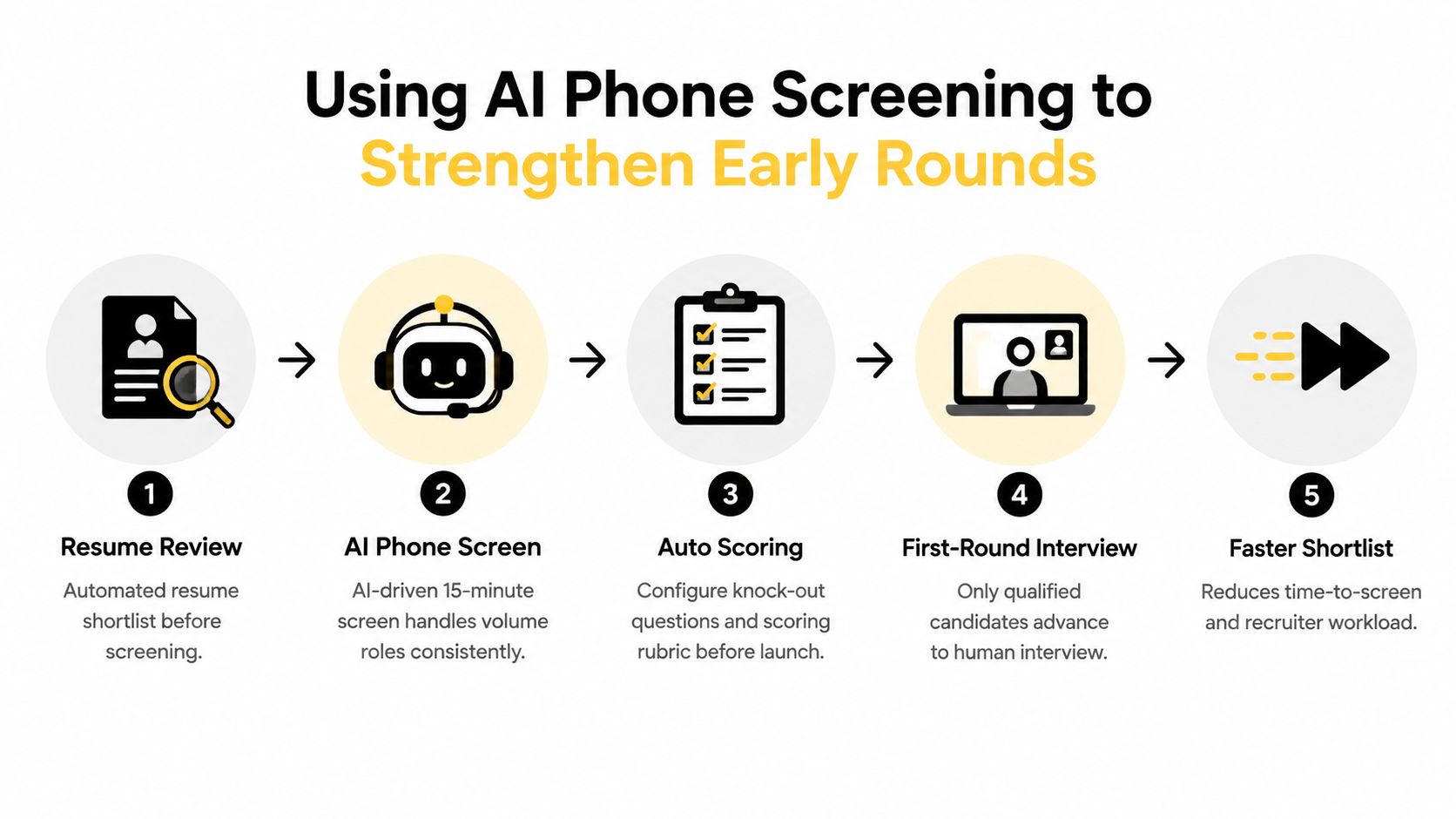
AI phone screening belongs after initial resume review and before the first human interview. It should remove repetitive qualification work, not make the hiring decision independently. A well-designed screen gives every candidate the same baseline questions, captures structured responses, and leaves the recruiter with better evidence for the next decision.
The configuration matters more than the novelty of the tool.
Configure the screen before launch
Start with a question set tied to the role. A customer support screen might test motivation for customer-facing work, handling of difficult conversations, availability, and communication clarity. A technical screen might establish relevant experience, project ownership, work environment, and expectations before a deeper assessment.
Separate knockout rules from scored competencies. Location, work authorisation, required availability, and compensation alignment may be eligibility checks. Motivation, communication, and problem-solving should be scored independently, because a candidate can communicate clearly without demonstrating strong motivation, or show motivation without enough role-relevant evidence.
Give candidates a clear choice. Explain that an AI system is conducting the call, provide a route to request a human interaction, and make it possible to opt out without being penalised. Candidates should also know how their responses will be used and who reviews the result.
The output should contain:
- A structured summary mapped to the scorecard.
- A confidence-rated recommendation, not an unexplained pass or fail.
- A transcript or audio link for recruiter review.
- Escalation triggers for unclear, contradictory, or sensitive responses.
Keep the recruiter accountable
Don't deploy an AI screen as a black box. Before launch, run known candidate profiles through the questions, inspect summaries for omissions, and compare recommendations with human review. Monitor whether certain accents, communication styles, disability-related speech patterns, or language backgrounds produce inconsistent outcomes. If the team can't explain why a candidate advanced or was rejected, the system isn't ready.
A managed service such as Career Central's candidate assessment tools can sit within this early selection layer by supporting AI-driven phone screening, first-round interviews, technical assessments, and structured scoring. The recruiter still needs to review the evidence and own the decision.
The right KPI is screen-to-human-interview conversion, paired with review time per completed screen and candidate completion. A faster screen that advances the wrong people only shifts the bottleneck to interviewers. AI should improve consistency and capacity while preserving a clear human handoff.
Adding Coding and Skill Assessments That Actually Predict Performance
An assessment earns its place only when it tests a skill the person will use in the job. Generic puzzles, excessive take-home work, and ambiguous scoring create friction without producing reliable evidence. Treat the assessment as its own selection stage, with a defined owner, timebox, rubric, and decision threshold.
Match the format to the work
Use a take-home assignment when the role requires thoughtful, independent output and the task can be evaluated without observing every step. Use a live coding or live work session when collaboration, explanation, and real-time problem-solving are central. Use an automated coding assessment when the role has a repeatable technical baseline and the team needs consistent initial filtering.
Keep the task proportionate. A practical timebox of 60 to 90 minutes is a useful design target for many technical exercises, but the hiring team should adjust it to the role and state the expected effort clearly. A candidate shouldn't need to produce a miniature production system to prove they can contribute to one.
Mirror the actual environment where possible. A backend engineer should work with relevant languages, frameworks, testing practices, and data structures. A data analyst should handle a realistic dataset and explain assumptions. A marketer might review a brief, identify an audience, and defend channel choices. The closer the task is to actual work, the more useful the evidence becomes.
Score the output consistently
Create the rubric before candidates submit work. A technical rubric might weight:
- Correctness, whether the solution works against stated requirements.
- Code quality, including readability, maintainability, and testing.
- Problem-solving, including assumptions and trade-offs.
- Communication, including explanation and response to feedback.
The exact weighting should reflect the role. Don't let an interviewer change the weighting because one submission is personally appealing. Brief assessors with examples of strong, acceptable, and weak evidence, then require written notes before the panel discusses the candidate.
AI proctoring can flag unusual behaviour or assist with similarity checks, but it can also create false confidence and candidate distrust. Use it as a review aid, not as proof of integrity or capability. A human should investigate exceptions and consider accessibility needs before making an adverse decision.
A competency-based framework gives hiring teams a better language for this work. The meaning of competency assessment is useful because it keeps the conversation focused on observable capability rather than vague impressions.
| Format | Time to Complete | Signal Quality | Candidate Experience | Best Fit |
|---|---|---|---|---|
| Take-home work sample | Agreed timebox | Strong for independent output | Flexible but can feel burdensome | Writing, analysis, design |
| Live coding or work session | Scheduled session | Strong for reasoning and collaboration | Immediate, but higher pressure | Engineering, problem-solving |
| Automated coding test | Short, controlled session | Useful for baseline filtering | Convenient, though impersonal | High-volume technical roles |
| Presentation exercise | Preparation plus delivery | Strong for communication and judgement | Visible and role-relevant | Sales, consulting, leadership |
KPIs and Metrics to Track at Each Step
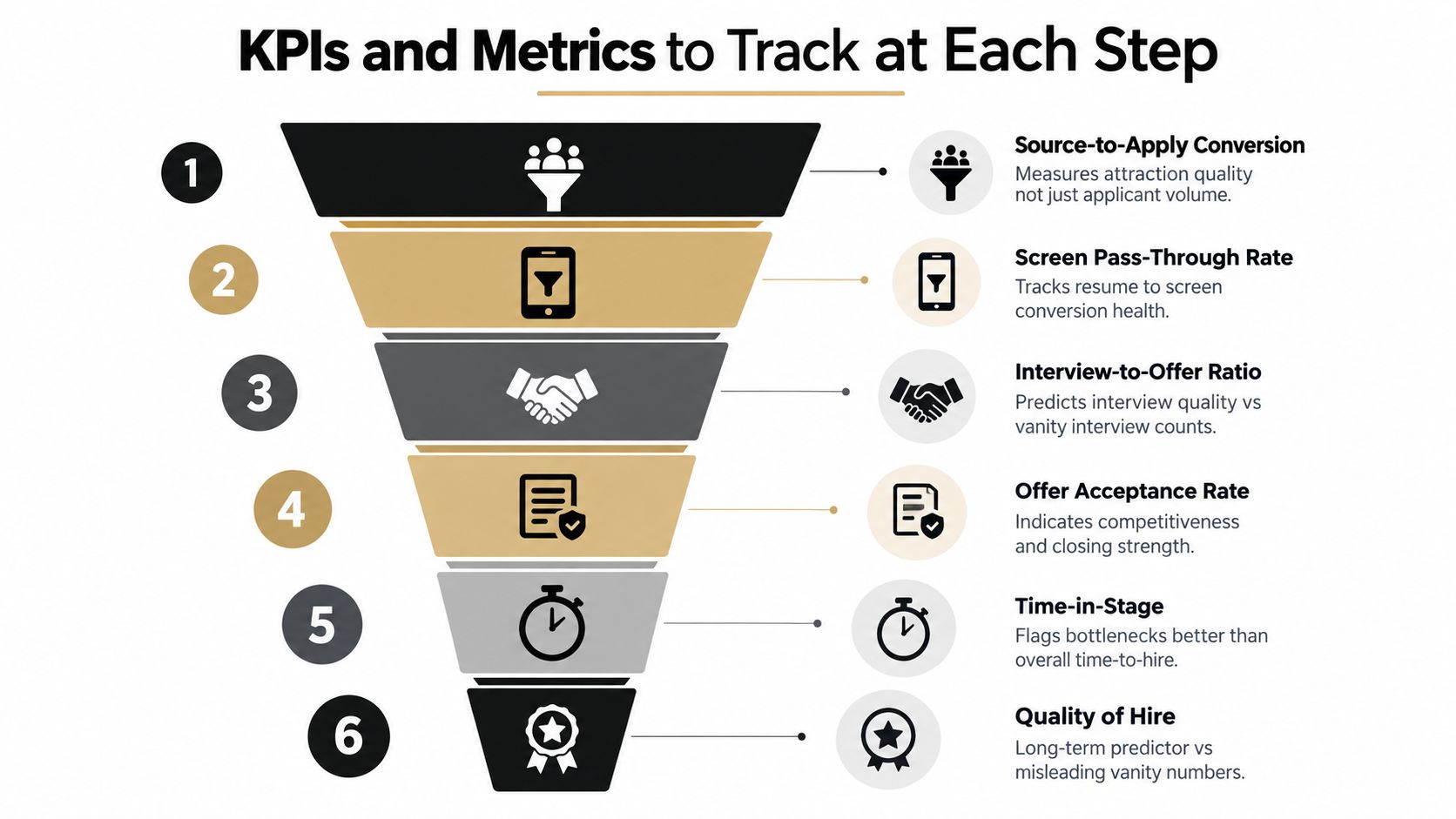
A hiring funnel can look healthy while producing weak hires. A large applicant count does not prove reach, and a high interview count does not prove selection quality. Give every stage one primary KPI, then track the failure mode behind it. The operating measures are conversion, speed, fairness, and downstream outcome.
Assign one primary KPI to every decision
At the top of the funnel, measure source-to-apply conversion and source-to-qualified conversion. These figures separate persuasive messaging from useful reach. A channel that attracts many applicants but few qualified people needs a different response from one that produces a smaller, stronger pool. Use AI to group sources and surface patterns, then have recruiters validate the evidence.
During screening, track screen pass rate, time-in-stage, and rejection reasons. Large differences between recruiters usually indicate inconsistent calibration, not meaningful judgement differences. Candidates sitting in review indicate unclear ownership. Set a review target, require a recorded reason for each decision, and inspect exceptions rather than hiding them in aggregate rates.
Interviews need interview-to-offer ratio, interviewer score distribution, and time from final interview to decision. A low offer yield can reflect weak screening, poor interview design, or an unrealistic role profile. Do not respond by adding another interview. Compare scores with later performance and remove questions that fail to distinguish qualified candidates.
At the offer stage, measure offer acceptance rate, decline reasons, and time from approval to offer. Internal delays can cost a candidate before the team has finished its process. AI can flag stalled approvals and identify recurring decline themes, but the hiring team must decide whether the problem is compensation, role scope, timing, or communication.
After hiring, use 90-day retention and hiring-manager satisfaction as practical quality-of-hire proxies. They are imperfect, but they connect selection decisions with what happens after joining. Recent India-focused reporting recommends measures such as shortlist-to-interview conversion, offer acceptance, and early retention instead of relying only on CV volume or interview counts, as described in India hiring intelligence research.
Add fairness and operational controls
Track adverse impact ratios by stage, comparing progression patterns across relevant groups while respecting privacy and applicable law. Review application, screening, assessment, interview, and offer stages separately. A fair overall result can conceal exclusion at one stage.
Set a baseline before changing the funnel. A stage is too leaky when it advances many candidates but produces little useful evidence, or rejects candidates who later perform well. It is too slow when candidates wait without a clear decision and withdraw as a result.
Configure the ATS so every movement records a timestamp, owner, source, decision reason, and communication status. Do not make recruiters maintain a parallel spreadsheet. The system should expose missing data and trigger reminders before a candidate disappears.
Applications per open role have grown by over 80% since 2022, while recruiters may spend 5 to 7 days sorting AI-polished applications, according to the India hiring intelligence report. Early-stage signal quality therefore deserves direct measurement. More applications do not repair a weak funnel. Better evidence does.
Common Pitfalls in the Selection Process and How to Fix Them
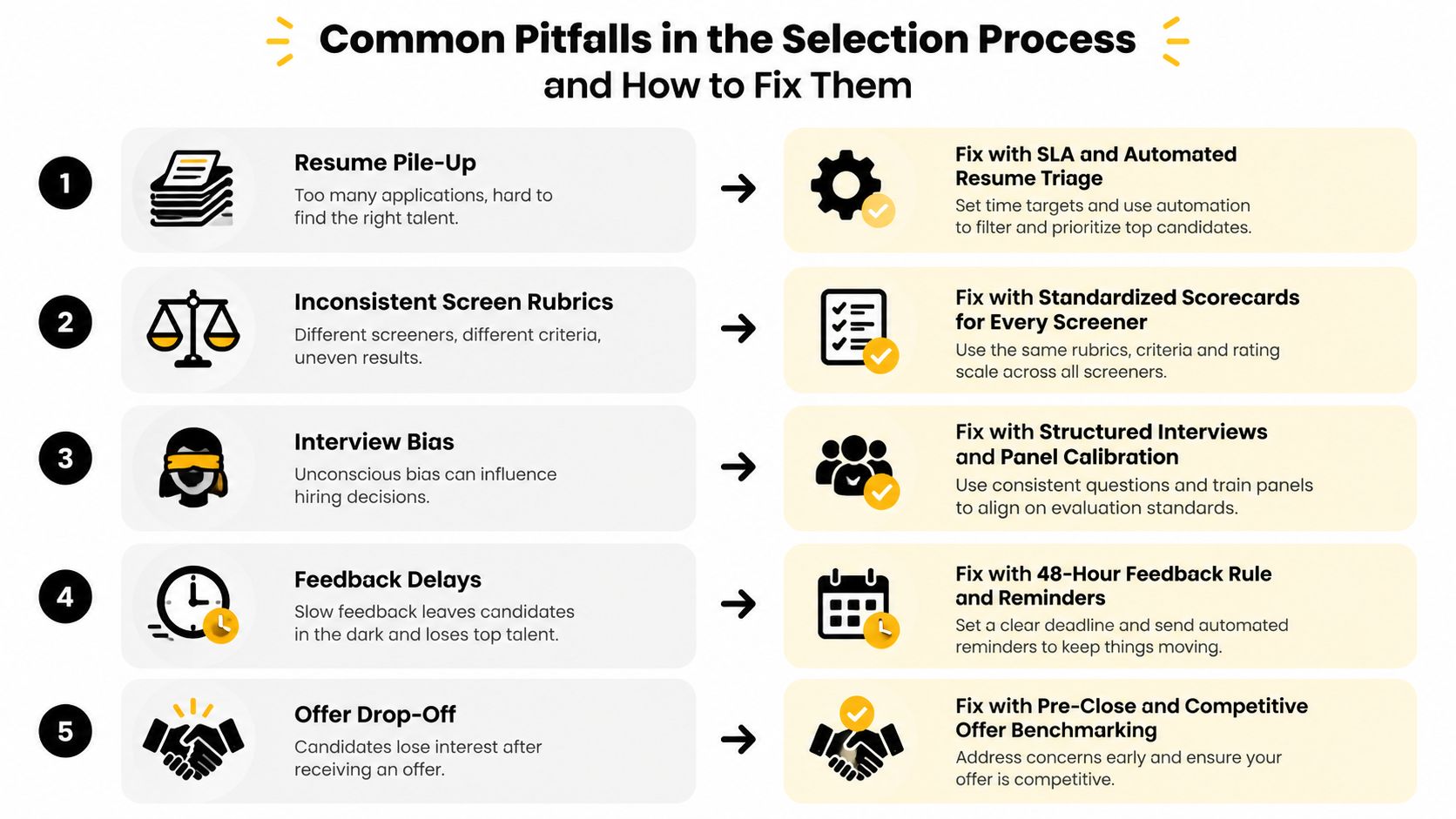
A hiring funnel can look busy while producing weak decisions. Applications accumulate, screening standards drift, interviews generate vague opinions, and approval delays drive qualified candidates away. Treat each defect as a measurable stage failure. Give it an owner, a KPI, and an AI-supported control where automation can improve speed without replacing judgment.
India-specific survey data shows how quickly these defects spread. Among 713 Indian hiring managers and recruiters, 62% admitted making hiring mistakes. 55% cited unclear job descriptions, 46% cited outdated screening methods, 40% cited ignoring cultural fit, and 78% spent less than five minutes reviewing a resume, according to reporting on hiring mistakes in India.
Fix the defects that leave visible signals
Resume pile-up. Track time to first review, queue age, and qualified-candidate conversion. A queue with no owner and candidates stuck in “new” status needs a review SLA, explicit must-have criteria, and automated triage that surfaces evidence for human review. Let AI prioritise applications. Do not let opaque rules reject them.
Inconsistent screening rubrics. Compare pass rates by screener for similar profiles. Wide variation usually means the rubric is too loose or reviewers interpret it differently. Give every screener the same scorecard, require a reason code, and calibrate against sample applications before the search starts. AI can flag scoring patterns that require review, but the hiring team must set the criteria.
Unstructured interviews. Track score variance, completion of required feedback, and the relationship between interview evidence and later performance. Comments such as “good fit” or “not senior enough” are conclusions, not evidence. Ask the same core questions, assign each interviewer specific competencies, and collect independent scores before discussion. Panel calibration keeps the loudest voice from becoming the decision.
Ghosting and feedback delays. Candidate communication is a funnel KPI, not a courtesy measure. Survey data reports that 29% of job seekers identify no response after applying as their biggest frustration, while 26% cite delays between interview stages and 20% want better interview feedback, according to candidate experience data from India. Set response expectations at application, after every interview, and during approval delays. Use automated reminders and send a short, honest update when the decision is not ready.
Reference checks treated as confirmation. Measure reference completion and the number of decision-relevant insights produced. A conversation that only verifies positive claims adds little evidence. Ask how the person worked, what support they needed, how they responded to feedback, and where the role could challenge them. Survey findings reported 70% considered reference checks important but only 58% conducted them, while 20% to 30% of candidates were reported to provide fake references. Use independent, relevant references and investigate inconsistencies rather than treating the check as a formality.
Offer-stage collapse leaves a clear trail: strong final scores followed by slow approvals, unclear compensation, or a manager who never pre-closed the candidate. Confirm motivation, notice period, competing processes, and decision criteria before approval. Then issue the offer quickly and connect the role's value to what the candidate has already said matters.
Practical rule: Every delay needs an owner, a next action, and a message to the candidate.
A Practical Checklist for Your Next Hiring Cycle
Before the requisition goes live, the recruiter and hiring manager should be able to answer the same questions without improvising. Use this checklist in the launch meeting.
Prepare the funnel
- Define success: Write the outcomes, must-have skills, trainable skills, and evidence for each competency.
- Choose channels: Select inbound, referral, outbound, and talent-pool routes based on the profile, then track source-to-qualified conversion.
- Set screening rules: Create a resume rubric and separate knockout criteria from scored capabilities.
- Configure AI screening: Approve role-specific questions, independent scoring categories, escalation triggers, human-review rules, and the candidate opt-out route.
- Design the assessment: Select the format, realistic task, timebox, accessibility support, and scoring matrix.
- Assign interview ownership: Map each interviewer to a competency, publish structured questions, and schedule the debrief before interviews begin.
- Prepare decisioning: Set the evidence threshold, reference prompts, approval path, and debrief script.
- Plan the close: Confirm compensation range, start-date flexibility, notice period, pre-close questions, and offer approval owner.
Protect candidate experience
- Set communication SLAs: Respond to applicants and provide status updates within the agreed window. The team can use a 48-hour response target as an operating rule, then measure time-in-stage against it.
- Explain the process: Tell candidates which steps apply, what each stage tests, who they will meet, and when they should expect an update.
- Make tasks proportionate: State the expected effort and provide a route for accessibility requests.
- Close every loop: Send clear rejection messages, preserve useful feedback where policy allows, and never leave candidates in an unexplained holding status.
- Review withdrawals: Record why candidates exit, whether the cause was delay, role clarity, compensation, scheduling, or another issue.
Run a final pre-launch review
The hiring manager, recruiter, and interview panel should confirm the role profile, scorecard, process sequence, assessment rubric, communication plan, and KPI dashboard together. After launch, review source conversion, screen pass-through, time-in-stage, interview-to-offer ratio, offer acceptance, fairness signals, and early retention. If a stage isn't producing evidence or a decision within its agreed window, change the stage rather than adding more activity.
The best selection process is not the longest one. It's the one that gives candidates clarity, gives interviewers usable evidence, and gives leaders enough data to fix the exact point where quality or trust is being lost.
Career Central provides an AI-driven interview layer for organisations, including phone screening, first-round interviews, coding assessments, and structured candidate scoring. Visit Career Central to see how its managed tools can support measurable early-stage selection.