A technical interview is a structured, role-specific evaluation of a candidate's hard skills, problem-solving approach, and ability to explain trade-offs under pressure. It's typically delivered across multiple stages, not as a single conversation.
That distinction matters to the HR leader staring at a Monday backlog of engineering requisitions while a VP asks for faster hiring without a quality drop. If the organisation treats the technical interview as a generic coding test, every interviewer creates a different version of the bar, candidates receive inconsistent experiences, and hiring decisions become difficult to defend.
In India, this process sits close to a wider employability challenge. The India Skills Report 2025 projects that nearly 55% of Indian graduates will be globally employable in 2025, compared with 51.2% in 2024. An alternative Mercer-Mettl-based view cited in Indian industry reporting places graduate employability at 42.6% in 2024. The gap between these measures reinforces one practical point: a degree or CV label can't substitute for validated, job-relevant capability.
Table of Contents
- What Technical Interview Meaning Really Covers for Hiring Teams
- The Anatomy of a Modern Technical Interview Loop
- Comparing the Main Technical Interview Formats
- Evaluation Criteria and Scorecards That Drive Better Hires
- Common Pitfalls and Biases in Technical Interviewing
- Integrating AI Screening and Assessments Into the Workflow
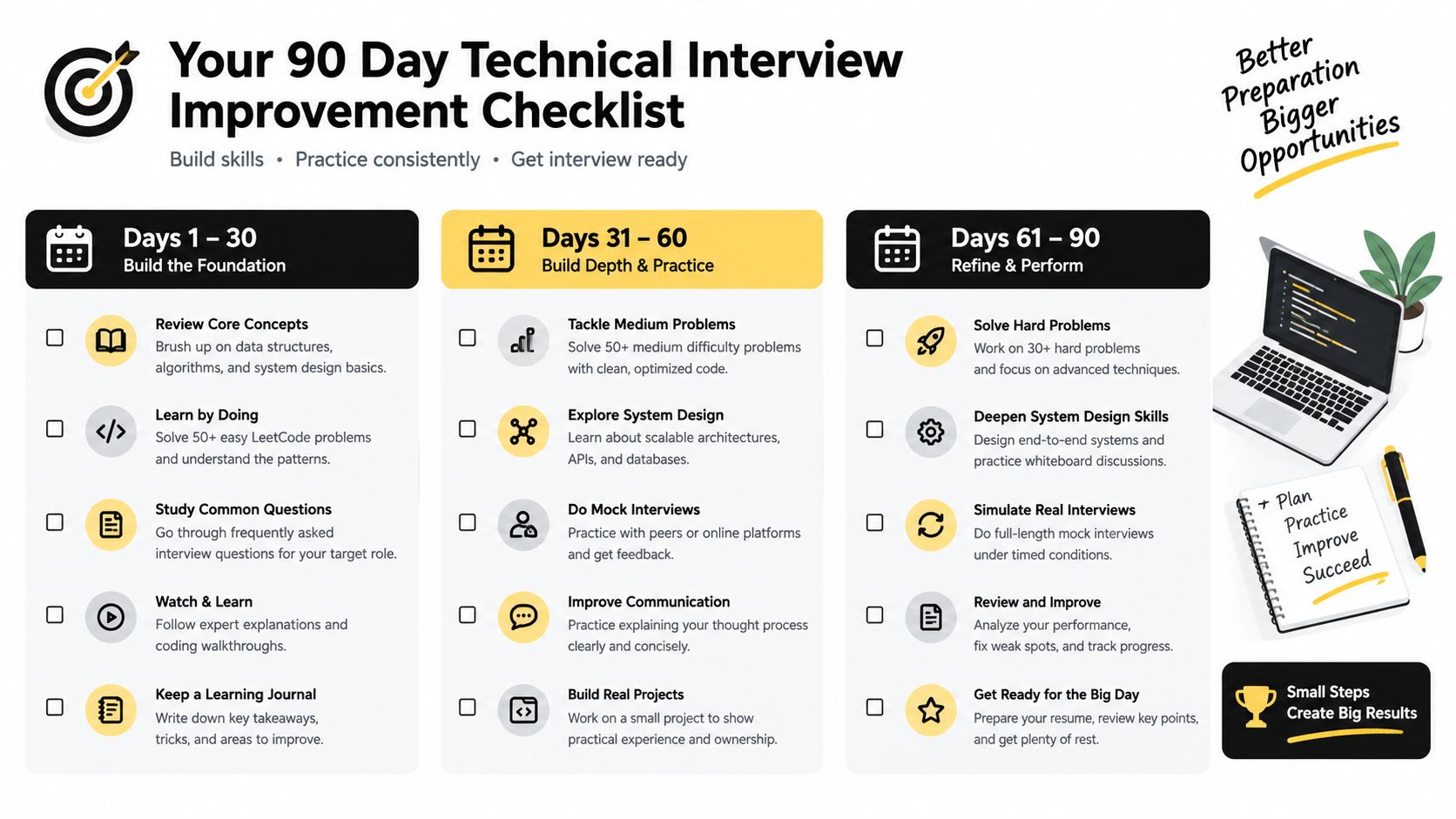
- Your 90 Day Technical Interview Improvement Checklist
What Technical Interview Meaning Really Covers for Hiring Teams
For hiring teams, “technical interview meaning” should answer a process design question, not a dictionary question. The working definition is simple: a structured, role-specific evaluation of hard skills, problem-solving, and trade-off reasoning under pressure, delivered through a deliberate sequence of assessments and conversations.
Indian hiring guidance commonly places programming fundamentals, data structures and algorithms, operating systems, DBMS, networking, SQL, and basic system design inside the technical evaluation. These areas may appear across four to six rounds over two to five weeks, depending on seniority and role design, as outlined in India-focused interview preparation guidance. HR shouldn't copy that pattern blindly. It should use it as a prompt to define which capabilities predict performance for each job family.
HR owns the definition of technical
A technical interview isn't the engineering team's private testing ground. HR and talent acquisition leaders should establish three boundaries before sourcing starts:
- Role scope: Define what “technical” means for a backend engineer, data analyst, security specialist, QA lead, or engineering manager. The relevant evidence won't be identical.
- Signal selection: Decide whether the role needs code quality, debugging, system thinking, SQL fluency, domain knowledge, written reasoning, or stakeholder communication.
- Decision standard: Set the minimum acceptable evidence before interviewers meet candidates. Otherwise, the strongest personality in the room will redefine the bar.
A technical interview differs from a take-home assignment, which tests independent execution over a longer window. It also differs from a portfolio review, which examines prior work, and from a behavioural or values interview, which focuses on collaboration, judgement, and working preferences. These components can complement one another, but they shouldn't be scored as interchangeable evidence.
Practical rule: If interviewers can't explain which job responsibility a question measures, remove the question.
The root problem behind inconsistent technical hiring is usually scope failure. One interviewer tests syntax, another tests architecture, and a third rewards familiarity with a particular technology stack. A defensible process links every question to a competency, every competency to a role requirement, and every rating to observable behaviour.
The Anatomy of a Modern Technical Interview Loop
A candidate's journey usually begins before anyone asks a coding question. The recruiter screen confirms motivation, compensation expectations, location or working arrangements, notice period, and basic eligibility. Its output should be a clear progression decision, not an informal impression about whether the candidate seems confident.
The next stage is a technical screen or online assessment. The interviewer may ask the candidate to solve a coding problem, troubleshoot a defect, explain a data structure, or reason through a practical scenario. The important signal isn't only whether the candidate reaches a correct answer. Interviewers should observe how the candidate clarifies the problem, selects an approach, tests assumptions, responds to hints, and communicates limitations.
India-focused guidance describes a typical loop with a recruiter screen, technical screen or online assessment, deeper technical rounds, system design for mid-level and senior candidates, and a hiring-manager or values round. Practical guidance on the technical round also frames it as an evaluation of hard skills, problem-solving, and the ability to explain trade-offs, rather than a definition quiz.
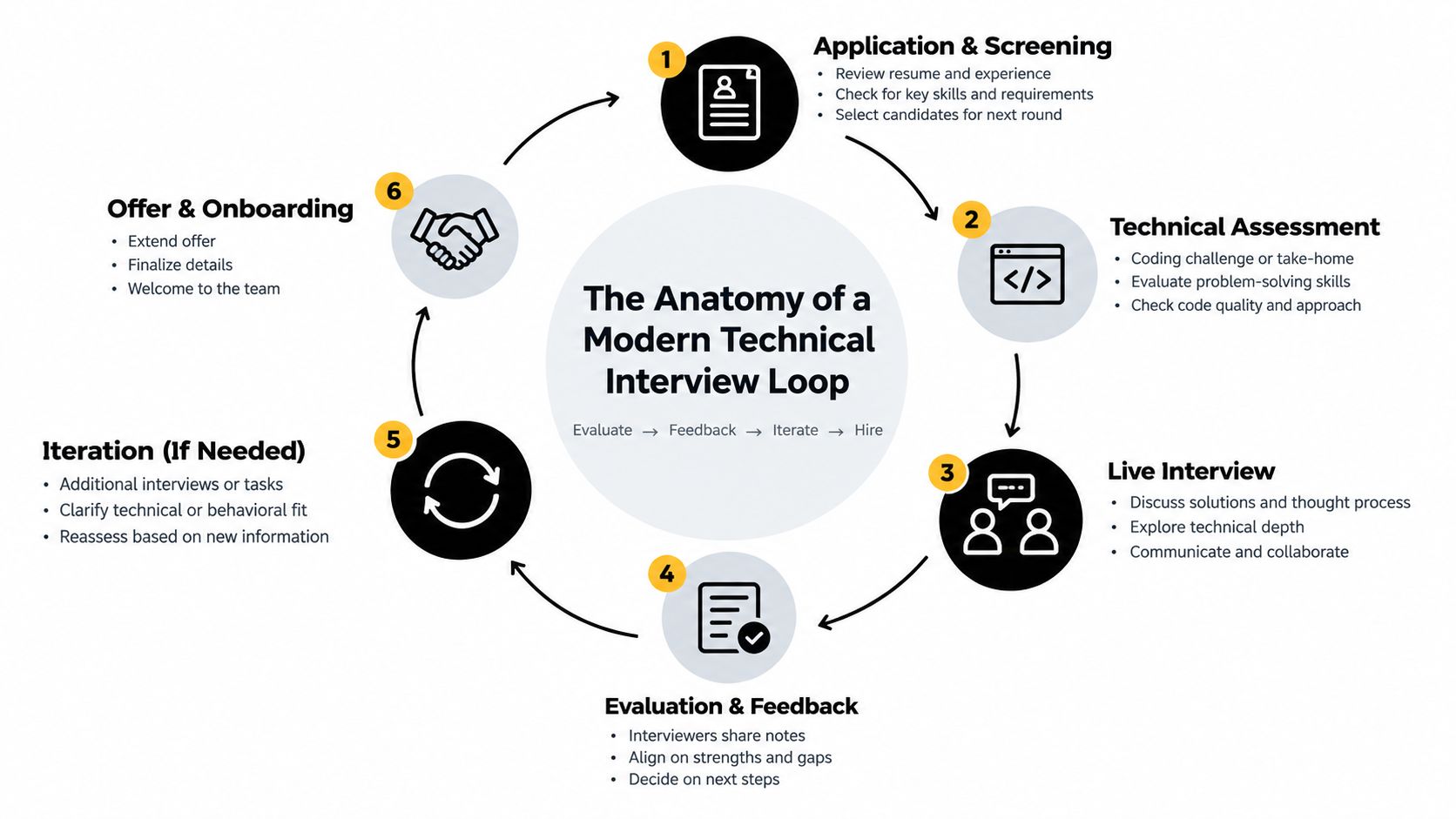
Each stage needs a distinct decision output
The virtual or onsite loop then tests the capabilities that earlier screens could only sample. A junior engineering candidate might complete coding and debugging exercises. A senior candidate may need to explain architecture choices, capacity assumptions, failure handling, observability, and operational trade-offs. A specialist may instead complete a domain-specific task.
The hiring manager close should not become another unstructured interview. It should clarify scope, expected outcomes, team context, constraints, and mutual fit. Candidates need enough information to assess the role, while the manager needs evidence that the candidate can operate at the required level.
Finally, interviewers submit scorecards and join a calibrated debrief. The decision should answer three questions:
- Which required competencies did the candidate demonstrate?
- Which risks remain untested or unresolved?
- Is the evidence strong enough for this level and role?
This sequence gives HR a practical operating model. Each stage has an owner, a time commitment, a candidate touchpoint, and a decision output. Without those elements, a “technical loop” is a collection of meetings.
Comparing the Main Technical Interview Formats
No single format produces enough signal for every technical role. HR should select formats based on the work the candidate will perform, the seniority of the role, the availability of trained interviewers, and the candidate experience the organisation can support.
| Format | Typical Duration | Primary Signal | Candidate Experience | Scalability | Best-Fit Level |
|---|---|---|---|---|---|
| Phone screen | Short conversation | Basic technical vocabulary, motivation, role alignment | Low preparation burden | High | All levels as an initial filter |
| Live coding interview | Time-boxed working session | Problem-solving, coding approach, testing, communication | Immediate and demanding | Moderate | Junior to mid-level engineering |
| System design interview | Extended design discussion | Architecture judgement, trade-offs, reliability thinking | High cognitive load, but relevant for experienced candidates | Lower | Mid-level, senior, and staff roles |
| Pair programming or take-home | Collaborative session or independent task | Code quality, practical execution, debugging, ownership | Pairing is interactive; take-homes offer flexibility but require personal time | Pairing is moderate; take-homes depend on grading capacity | Junior to senior, when the task mirrors the job |
A phone screen should filter for basic eligibility and motivation, not pretend to assess deep engineering ability. Live coding creates useful evidence when interviewers assess reasoning as well as output, but a whiteboard-only version can over-reward recall and familiarity with interview conventions. Pair programming provides a closer view of collaboration, while take-homes can give candidates more room to demonstrate practical execution, at the cost of a heavier review process.
For senior and staff roles, system design deserves a central place because architecture decisions often matter more than isolated algorithm performance. A candidate may write elegant code yet struggle to define boundaries, manage failure modes, or explain why one design is preferable to another.
Decision rule: Use two or three complementary formats per loop, and make each format test a different job-relevant signal.
The format also affects fairness. A process built entirely around fast, unfamiliar whiteboard exercises may exclude capable candidates whose strengths appear in debugging, written reasoning, or collaborative implementation. HR leaders should review the design through the lens of structured and unstructured interviews, then document why each chosen format belongs in the loop.
Evaluation Criteria and Scorecards That Drive Better Hires
A technical scorecard should convert impressions into evidence and give HR leaders a process they can audit. Define the criteria before interviews begin, then connect each criterion to a job-relevant behaviour. Four competency buckets cover most engineering evaluations: problem decomposition, technical depth, code quality, and communication. Adjust their weighting by role, but keep the definitions visible to every interviewer.
Problem decomposition covers clarifying questions, constraint identification, manageable work steps, and approach selection. Technical depth tests relevant concepts and whether the candidate can explain why a solution works. Code quality covers readability, correctness, testability, edge-case handling, and recovery after feedback. Communication shows whether the candidate makes reasoning clear to another engineer.
A practical scorecard model
Use behavioural anchors rather than personality judgements. A one-page scorecard can use this structure:
| Criterion | 1, Below Bar | 2, Mixed | 3, Solid | 4, Strong Hire |
|---|---|---|---|---|
| Problem decomposition | Starts coding without clarifying the task and loses track of constraints | Identifies part of the problem but needs repeated direction | Clarifies requirements and creates a workable approach | Structures ambiguity independently and explains trade-offs clearly |
| Technical depth | Relies on guesses or memorised terms without applying them | Applies familiar concepts with gaps in reasoning | Uses relevant concepts accurately for the role | Connects principles, constraints, and alternatives with depth |
| Code quality | Produces fragile or unreadable code and misses basic checks | Reaches partial correctness but needs substantial correction | Writes understandable, testable code and handles normal edge cases | Produces reliable, well-tested code, handles edge cases deliberately, and improves the design during review |
| Communication | Cannot explain decisions or respond to questions | Explains some steps but leaves major reasoning unclear | Communicates a coherent approach and responds to feedback | Makes complex trade-offs easy to follow and brings the interviewer into the reasoning |
Add an overall recommendation line and evidence fields for strengths, risks, and follow-up questions. A score without evidence is an opinion dressed as process. Require interviewers to record what the candidate did that supports each rating.
Calibration is a governance mechanism
Set a process standard that interviewers submit scorecards within 24 hours. Delayed write-ups increase memory distortion and give the most senior voice in the debrief too much influence over the record.
Do not hide disagreement inside an average. Require three concurring “strong hire” ratings for an unequivocal hire recommendation, with every dissent documented and resolved through evidence. This rule is stricter than averaging, but it reduces the risk of treating general enthusiasm as verified capability.
Use the competency assessment meaning guide to keep the distinction clear: competency is demonstrated through observable behaviour, not inferred from confidence, pedigree, or years of experience. For an AI-augmented hiring workflow, preserve the same standard. AI can organise evidence or flag missing fields, but interviewers must define the criteria, verify the observations, and own the decision.
Common Pitfalls and Biases in Technical Interviewing
Technical interviewing fails when interviewers confuse difficulty with relevance. A question can be hard, clever, and completely disconnected from the job. That creates noise while giving the team false confidence that it has tested rigour.
Seven failure modes deserve immediate scrutiny:
- Whiteboard-only formats: They favour speed under artificial conditions and may underrepresent practical engineering ability.
- Trivia questions: Bit manipulation puzzles, obscure syntax, and “regex golf” often measure recall rather than the work the role requires.
- Culture-fit drift: Interviewers can turn values discussions into judgements about personality, background, accent, or social similarity.
- Unstructured debriefs: The loudest opinion can replace the written evidence.
- Single-interviewer vetoes: One negative reaction shouldn't automatically outweigh several job-relevant observations.
- Recency bias in code review: A candidate's final answer can overshadow earlier reasoning, testing, and correction.
- Stack affinity bias: Interviewers may favour candidates who use the same tools they use, even when the underlying capability is transferable.
The assumption that years of experience predict performance also needs to go. Experience can indicate exposure, but it doesn't prove ownership, depth, judgement, or the ability to explain trade-offs. The scorecard should carry more weight than a neat chronology on a CV.
Make calibration evidence-led
Run calibration sessions where interviewers compare sample responses and justify ratings with scorecard evidence. For the first part of a code review, consider removing identifying information and delaying exposure to the candidate's employer, education, or technology brand. The purpose isn't to eliminate judgement. It's to prevent irrelevant information from shaping the first technical assessment.
The business cost of a poor senior hire can extend beyond the interview budget. A missed hire at senior level can cost 18+ months of ramp, as specified in the process brief. That figure should make calibration a leadership responsibility, not an optional interviewer-training exercise.
Integrating AI Screening and Assessments Into the Workflow
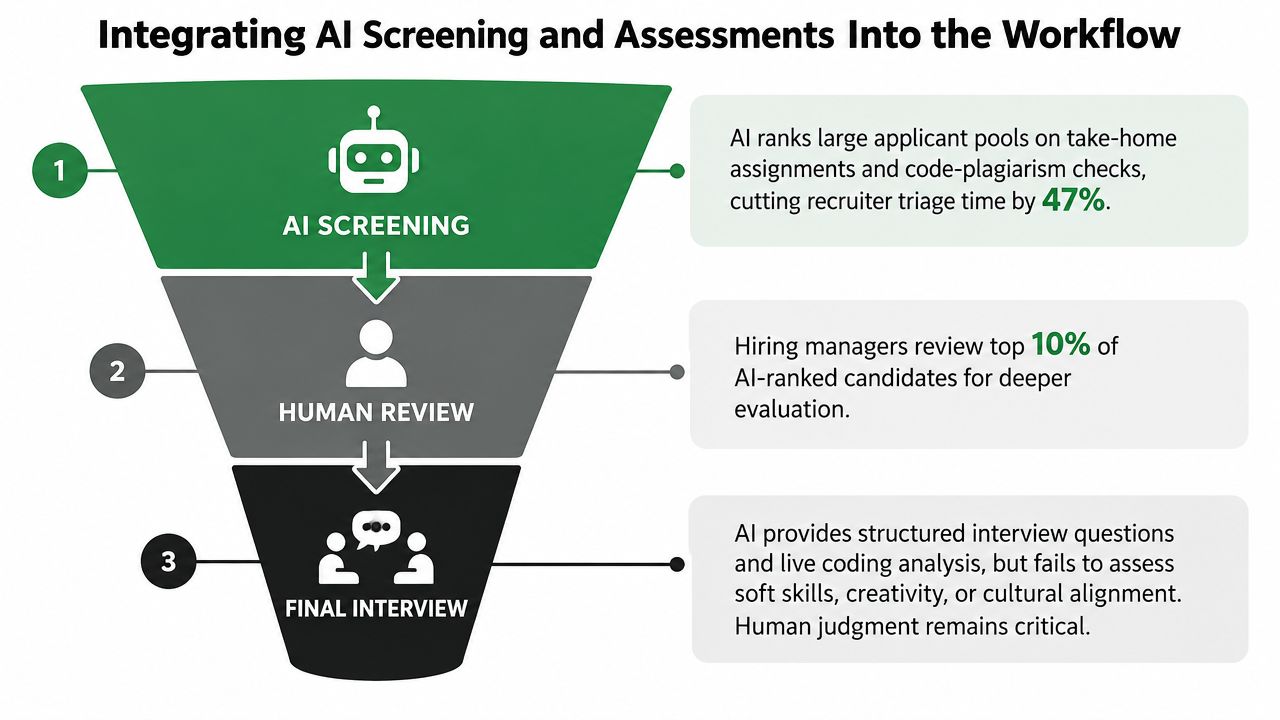
AI belongs at the front and middle of the technical funnel, but it shouldn't own the final hiring decision. Its value is strongest where the organisation needs consistency, repeatability, and support for high-volume review. Its weakness appears when the role depends on context, collaboration, creativity, or judgement under ambiguity.
At the pre-screen stage, AI can organise applicant information, administer structured coding assessments, identify potential plagiarism signals, and help recruiters prioritise review. At the mid-funnel stage, deterministic, time-boxed assessments can provide comparable evidence for junior roles. They are less complete for senior candidates, whose capability may depend on architecture decisions, influence, operational judgement, and the ability to handle competing constraints.
Put automation around the evidence, not above it
AI note-taking and transcription can help interviewers stay engaged with candidates instead of writing continuously. HR must disclose recording, obtain the required consent, and apply the organisation's privacy and retention rules in the relevant jurisdiction. The tool should support the record of the interview, not generate an unchallengeable verdict.
The workflow should connect with the systems recruiters already use, such as an applicant tracking system, structured assessment platform, or interview scheduling layer. Career Central provides AI-driven phone screening, first-round interviews, and coding assessments, including practice and assessment experiences covering coding, data structures, algorithms, and system design. It can sit alongside platforms such as Workday or Greenhouse, provided the organisation defines ownership of decisions and audit trails.
Keep humans accountable at the final stage
AI can surface patterns, standardise prompts, and make early assessments easier to administer. It can't fully assess how a candidate builds trust with peers, handles conflicting priorities, learns from failure, or operates within a particular team context. Those judgements need trained humans, clear questions, and documented evidence.
Candidate assessment tools should therefore be evaluated against the full workflow. Ask where the tool improves consistency, where it creates new risk, how candidates are informed, who reviews exceptions, and how a candidate can challenge an inaccurate or incomplete assessment.
A sound AI-augmented process has three controls:
- Human review: A qualified reviewer examines meaningful evidence before progression or rejection.
- Role alignment: The assessment measures capabilities required by the job, not generic technical cleverness.
- Auditability: HR can explain which stage produced the signal and how the final decision was reached.
Your 90 Day Technical Interview Improvement Checklist
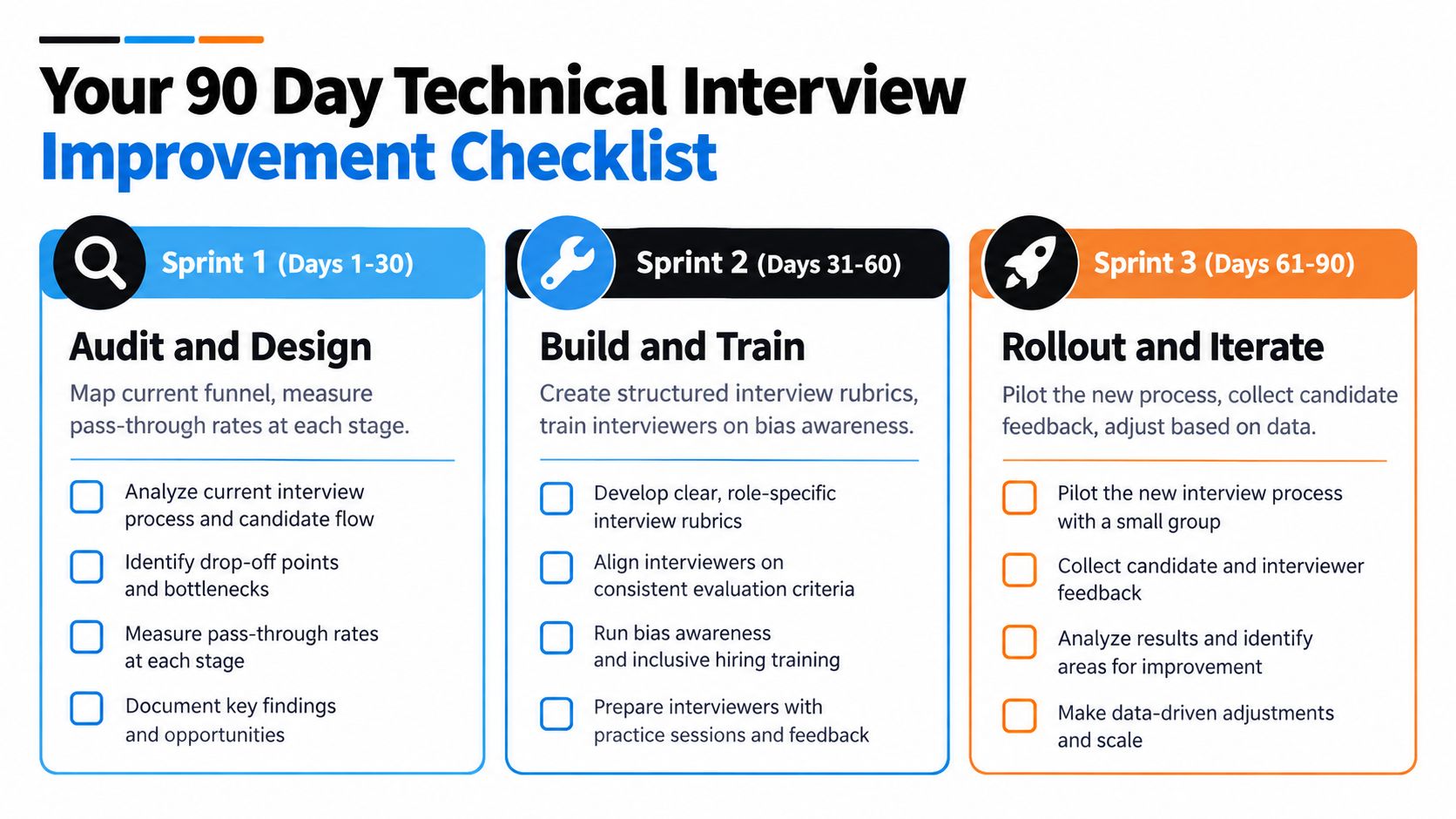
A technical interview programme should be a working operating system, not a binder that interviewers ignore. Give one process owner authority over the roadmap, the rubric, interviewer training, and scope decisions. That owner should be able to reject requests that add another interview without adding a distinct signal.
Days 1 to 30, audit and design
Start by mapping the current funnel from application to decision. Record who owns each stage, what candidates complete, which competencies each stage measures, and where interviewers make progression decisions. Review pass-through patterns by role family and interviewer group, but don't interpret a number without examining the question set and candidate pool behind it.
Then write a one-page interview philosophy. It should define what “technical” means for each role family, how the organisation balances practical work with conceptual knowledge, and what evidence qualifies a candidate for the next stage. Remove duplicate rounds and questions that cannot be linked to a job responsibility.
Use the first sprint to establish governance:
- Process owner: Name one accountable leader.
- Stage owners: Assign a recruiter, technical interviewer lead, hiring manager, and debrief facilitator.
- Write-up standard: Set a deadline for scorecard submission and enforce it.
- Candidate communication: Explain the stages, expectations, format, and accessibility options.
Days 31 to 60, build and pilot
Create scorecards for the priority role families first. Train interviewers on behavioural anchors, follow-up questions, hinting protocols, note-taking, and bias awareness. Run parallel loops using the current and revised rubric where feasible, so the team can compare decision quality and candidate feedback without changing every role at once.
Don't launch a dozen new formats. Pilot the smallest loop that can test the intended signals. A junior role may need a structured coding assessment and collaborative debugging. A senior role may need a practical technical discussion and system design. Every additional stage must justify its time cost.
Days 61 to 90, measure and scale
Review offer acceptance, hiring-manager satisfaction, candidate feedback, interviewer completion of scorecards, and the quality of evidence in debriefs. Retire formats that consume time without producing distinct, job-relevant signal. Keep a change log so leaders can see why the rubric changed and whether the change addressed a real problem.
Refresh the rubric quarterly, or sooner when the role changes materially. Audit assessment accessibility, AI usage disclosures, data retention, and adverse patterns across candidate groups. The process owner should report decisions and exceptions to the CHRO or talent leadership team, not allow each hiring manager to create a private version of the technical interview.
The strongest definition of technical interview meaning is operational: a validated job-simulation stage with explicit competencies, observable evidence, calibrated scoring, and accountable human judgement. HR leaders who define it that way can add AI where it improves consistency without allowing automation or interviewer preference to decide what “technical” means.
Career Central offers AI-driven phone screening, first-round interviews, and coding assessments that can support a structured technical hiring workflow. Visit Career Central to assess how its interview and assessment services could fit your next-quarter process improvement plan.