A hiring manager reopens the same requisition for the third time. The shortlist looks healthy, interviews are completed, and an offer is accepted. Six months later, the new hire still needs heavy supervision, delivery quality remains inconsistent, and the manager asks for another replacement. Meanwhile, recruiters report slow hiring, candidates complain about repetitive screening, and nobody can explain whether the core problem is sourcing, assessment, onboarding, or the role design itself.
That pattern rarely comes from one bad hiring decision. It usually points to a skills mismatch between what the business now requires and what the hiring process is measuring. A practical skills gap analysis gives HR leaders a way to find that mismatch, rank its business impact, and decide whether to hire, move, or develop talent.
The important shift is operational. Don't treat the analysis as an annual HR survey that ends in a presentation. Treat the hiring funnel as a live capability dataset, using sourcing behaviour, AI phone screens, coding assessments, structured interviews, and early performance evidence to improve decisions continuously.
When the Hiring Funnel Tells You Something Is Wrong
An HR leader usually notices the symptoms before the cause. A role stays open longer than expected. Recruiters submit candidates, but managers reject most of them. The few who pass interviews struggle after joining. The requisition returns to the approval queue, and the business pays for the same search again.
At that point, many teams blame the recruitment channel or ask for more applicants. That response is often too shallow. If the same role produces weak outcomes across sourcing, screening, interviews, and early tenure, the funnel is telling you that the organisation hasn't defined or measured the capability it needs.
A useful overview of the selection process helps clarify where each signal enters the funnel. The key is to connect those stages rather than review them in isolation.
Read the funnel as evidence
Track the relationship between:
- Sourcing signals: Which channels produce candidates with relevant experience and role-specific evidence?
- Screening outcomes: Which competencies cause candidates to pass or fail an initial conversation?
- Assessment performance: Do coding, writing, analytical, or work-sample results support the CV?
- Interview feedback: Are interviewers evaluating the same capabilities, or relying on personal preference?
- Early performance: Can new hires apply the required skills during ramp-up and 90-day reviews?
A single weak result may reflect noise. A repeated pattern across three consecutive quarters is different. When pass rates, assessment quality, hiring-manager satisfaction, and early performance all drift in the wrong direction, the organisation has a capability problem, not merely a recruiting problem.
Practical rule: Don't ask recruiters to solve a role-definition problem with more candidate volume.
India's labour market illustrates why this diagnosis matters. The Economic Survey 2025-26 coverage, citing the 2023-24 Periodic Labour Force Survey, reported that 91.94% of Indians aged 14 to 18 had received no skilling exposure, while 7.09% had informal skills without certification and 0.97% had formal skill training. That means employers can't assume the market will supply job-ready capability merely because candidates have completed formal education.
Run the analysis where hiring decisions happen. The funnel exposes the difference between stated qualifications and demonstrated competence, which is exactly where repeated hiring failures begin.
What Skills Gap Analysis Actually Means for HR Teams
Skills gap analysis is a structured comparison between the capabilities a role or business strategy requires and the capabilities people currently demonstrate. The word “demonstrate” matters. A CV, self-rating, or manager opinion can provide context, but none should determine the gap map on its own.
A training needs analysis starts with existing employees and asks, “What should we teach them?” A skills gap analysis asks a broader and more consequential question: Where is the workforce, including candidates, failing to meet the requirements of critical roles, and should the organisation hire, move, or train to close the distance?
That distinction changes the scope of the work.
Start with the roles that carry risk
Don't assess every job family during the first cycle. Start with roles where capability gaps create visible business consequences:
- Critical roles: Positions tied directly to delivery, revenue, customer risk, compliance, or strategic transformation.
- High-volume pipelines: Roles where small assessment errors repeat across many hires.
- Emerging capabilities: Areas such as AI literacy, automation, data interpretation, or new technical platforms.
- Quality and tenure trouble spots: Roles with repeated reopens, poor early performance, or avoidable turnover.
Low-impact job families can wait. A narrow first cycle produces decisions faster and gives HR a credible operating model before the analysis expands.
Define requirements before measuring people
A gap map is only as useful as the role standard behind it. For each priority role, specify the competencies required at the point of independent performance. Separate technical skills from behaviours, domain knowledge, communication, judgement, and learning agility.
The India Skills Report 2025 was cited as showing 54.81% of youth or graduates are employable at industry standards, while NITI Aayog's skilling report noted that 8.7 crore Indians aged 15 to 29 were not studying, working, or in training in 2021, and that 8.25% of graduates were employed in roles aligned with their qualifications. These figures, reported in this analysis of workforce readiness in India, reinforce the need to define job-specific competence instead of treating education as a proxy for readiness.
The output shouldn't be a slide deck describing general weaknesses. It should be a prioritised gap map with role clusters, evidence, business impact, owners, and a chosen remedy.
Data Sources and Assessment Methods to Use
No single data source can reveal a skills gap reliably. Manager interviews explain context, surveys reveal perception, performance data shows application, and structured assessments create comparable evidence. Use all four, but give each source a defined job.
Use qualitative input to find the questions
Manager interviews belong at the start of the process. Ask which tasks new hires fail to perform, which behaviours distinguish strong performers, and which capabilities the role will need as priorities change. Interviews surface emerging requirements that dashboards won't yet show.
Their limitation is obvious. Managers often describe the ideal candidate rather than the minimum effective standard, and each manager may use different language for the same competency. Translate their input into observable behaviours, then validate it against performance and assessment evidence.
Treat surveys as perception data
Employee and candidate surveys can reveal confidence, perceived barriers, and areas where people want development. They can also expose whether a job description is confusing or whether candidates misunderstand the assessment.
Don't treat self-reported proficiency as proof. People rate themselves against different standards, and candidates may optimise responses for the process. Use survey findings to form hypotheses, not to assign final severity.
Let performance data test the hypothesis
Performance evidence should include quality reviews, ramp progress, manager evaluation, and early delivery outcomes where available. It answers the question that surveys can't: Can the person apply the skill in the job?
Look for patterns by role, source, interviewer, assessment result, and manager. If candidates with strong interview ratings repeatedly struggle with the same task, your interview may be measuring confidence rather than competence.
Make structured AI assessments a live signal
AI-driven phone screens and structured assessments earn their place when they apply consistent criteria across candidates. A phone screen can test communication, role motivation, relevant experience, and situational reasoning. A coding assessment can test whether a technical candidate can solve the work rather than merely describe it.
Use these tools as comparable evidence, not as an automatic verdict. Review the competency rubric, monitor adverse patterns, and keep human judgement in the decision loop. A consistent assessment is valuable because it makes variation visible, not because it removes responsibility from HR.
| Data Source | Signal Type | Best Use Case | Key Limitation |
|---|---|---|---|
| Manager interviews | Qualitative context | Defining changing role requirements | Subjective and vulnerable to manager bias |
| Employee or candidate surveys | Self-perception | Finding confidence and experience patterns | Self-ratings don't prove proficiency |
| Performance data | Applied capability | Testing whether skills transfer into work | Can be affected by manager quality and job conditions |
| AI phone screens | Structured behavioural and communication signal | Comparing early-stage candidate evidence | Depends on rubric quality, accessibility, and oversight |
| Coding or work-sample assessments | Demonstrated task performance | Validating technical or practical capability | May measure a narrow task rather than the full role |
The decision rule is simple: if a source can't be compared across candidates or roles, keep it in qualitative context rather than placing it directly in the gap map. For practical guidance on assessment design, see this competency assessment test guide.
Turning Raw Inputs Into a Prioritised Gap Map
Raw input becomes useful only after HR converts it into a common structure. Start by grouping roles into meaningful clusters, such as backend engineering, customer operations, finance analysts, or frontline sales. Don't average the whole organisation. A company-wide score can hide a serious specialist shortage behind strong results in unrelated teams.
For each role cluster, build a competency matrix with three fields:
- Required proficiency: What the role needs for reliable independent performance.
- Current demonstrated proficiency: What assessment, performance, and interview evidence show today.
- Business consequence: What happens when the gap remains open.
Score the gap, then rank the consequence
A simple five-point scale works if the definitions are consistent. For example, a low score can mean the person needs close support, while a high score can mean they handle the competency independently in complex situations. The scale matters less than calibration.
Consider two teams. A technology group may have strong general software knowledge but insufficient backend engineering depth for architecture, reliability, and production troubleshooting. A non-technical operations group may understand its workflows but struggle with data literacy and process automation. Both teams have a “digital skills gap” if leadership uses broad labels. Their remedies are completely different.
The technology team may need targeted specialist hiring, internal pairing, and technical work samples. Operations may benefit from role-specific automation practice, workflow redesign, and managers who can coach data interpretation.
| Competency | Current Avg Score (1-5) | Required Score (1-5) | Gap Severity | Priority Tier |
|---|---|---|---|---|
| Backend engineering depth | 2 | 5 | High | Immediate |
| Production troubleshooting | 3 | 5 | Medium | High |
| Data literacy | 2 | 4 | High | Immediate |
| Process automation | 2 | 4 | High | High |
| Stakeholder communication | 3 | 4 | Medium | Medium |
These scores are an illustrative operating format, not a benchmark. Your organisation must define the evidence behind each level.
Preserve segment-level signal
Link every gap to a role cluster, hiring stage, and business outcome. If a technical skill is missing only in specialist hiring, don't prescribe a company-wide learning programme. If communication scores are weak only during phone screens, inspect the screen design before declaring an organisation-wide soft-skills deficit.
The most common reporting failure is one attractive slide per function with no shared scoring logic. Executives can't compare priorities, finance can't evaluate trade-offs, and the loudest hiring manager wins budget. Use a common matrix, then let the evidence determine which gap moves first. A clear explanation of competency mapping can help teams establish that shared structure.
Segmenting Gaps by Hiring Stage and Role Complexity
A gap map becomes actionable when leaders add two dimensions: where the failure occurs in the funnel and how complex the role is. Without those cuts, HR may spend on training when the job description is wrong, or increase sourcing when the assessment is the bottleneck.
Read the funnel stage before prescribing a remedy
At the top of the funnel, inspect sourcing and job design. If qualified candidates rarely enter the process, the organisation may be using the wrong channels, overstating requirements, offering unclear role information, or excluding viable adjacent backgrounds.
Mid-funnel failure points to screening and assessment. If candidates enter in healthy numbers but fail consistently during structured screens or coding tasks, check whether the rubric reflects actual work. An AI phone screen can make this pattern visible by applying the same questions and scoring logic across applicants, but the hiring team must still validate whether the criteria predict performance.
Late-stage failure usually reveals interview calibration, compensation alignment, decision speed, or inconsistent interviewer judgement. If candidates pass assessments but offers are declined, don't launch a learning programme. Fix the candidate experience and decision process.
Add role complexity as the second axis
Entry-level, mid-level, specialist, and leadership roles require different responses.
- Entry-level roles: Focus on accessible sourcing, reliable screening, and a realistic trainability standard.
- Mid-level roles: Test applied judgement, ownership, and the ability to work without constant supervision.
- Specialist roles: Use targeted external hiring, internal mobility, and work-sample evidence because generic training rarely creates deep expertise quickly.
- Leadership roles: Examine decision quality, influence, succession depth, and the ability to build capability in others.
AI readiness deserves its own cut rather than being buried under “technical skills”. Recent India-focused reporting places graduate employability between 42.6% and 54.81%, AI/ML job readiness at around 46.1%, and notes a 107% year-on-year surge in GenAI enrolments in India. The Mercer analysis of India's graduate skill index shows why learning interest and job readiness must be measured separately.
Without these segments, remediation spend spreads thinly across every function. Build a grid that shows stage, role complexity, competency type, business risk, and owner. Fund the highest-risk intersection, not the department with the strongest internal advocate.
Building a Remediation Plan With Owners and Timelines
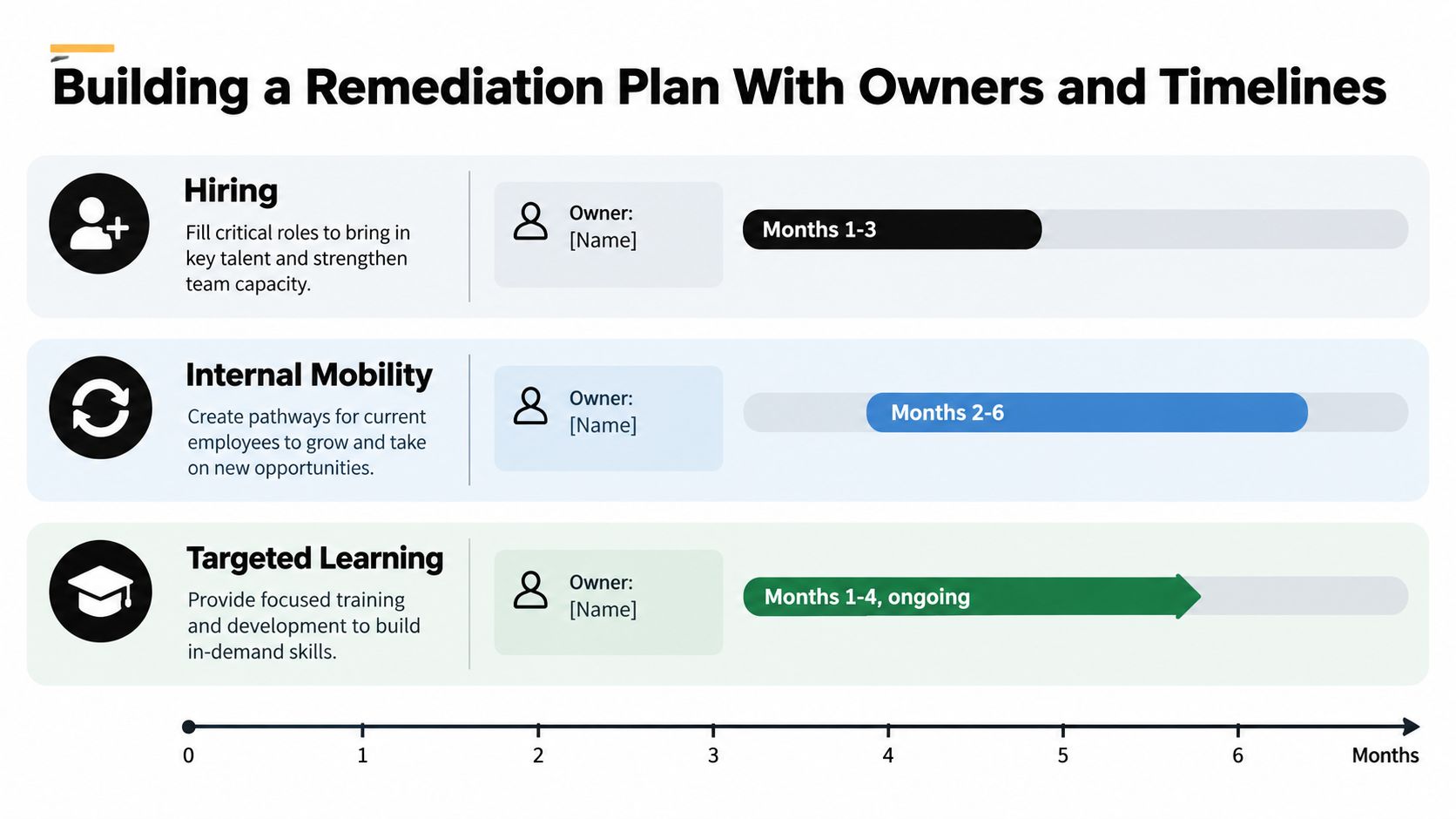
A remediation plan should use three levers, not one. Hiring adds capability from outside. Internal mobility moves existing capability to the work that needs it. Targeted learning develops people where the gap is realistic to close.
The mistake is calling all three “upskilling”. That label hides different owners, costs, timelines, and success measures.
Assign the lever to the failure pattern
Sourcing and screening gaps belong first with Talent Acquisition. The TA leader should adjust channels, role language, screening criteria, and assessment sequencing, then monitor whether the candidate mix improves.
Assessment calibration gaps require HR analytics, the assessment owner, and the relevant hiring managers. They should review pass rates, scoring consistency, completion patterns, and the relationship between assessment evidence and early performance.
Specialist and leadership gaps need business sponsorship. An executive owner must decide whether the organisation will buy capability externally, accelerate internal moves, or accept a slower development path.
Use a 12-week operating plan
A workable plan is short enough to maintain urgency and long enough to observe early evidence.
- Weeks 1 to 4: Confirm priority roles, define competency standards, audit the funnel, and establish the baseline. Name one owner for the data and one accountable business sponsor.
- Weeks 5 to 8: Pilot revised phone screens, coding or work-sample assessments, internal mobility reviews, and targeted learning for the selected role clusters.
- Weeks 9 to 12: Compare funnel and early performance signals, remove weak interventions, scale the strongest one, and publish decisions with owners.
Measure each lever separately. If hiring, mobility, and learning launch together without instrumentation, you'll never know what closed the gap. The organisation will report activity, such as courses completed or interviews conducted, instead of capability gained.
A strong plan also includes a stop rule. If an intervention doesn't change the relevant signal, pause it, inspect the assumption, and redesign the response. HR leaders don't need more programmes that look busy. They need a controlled way to learn which action closes which gap.
KPIs, Rollout Sequence, and Common Pitfalls
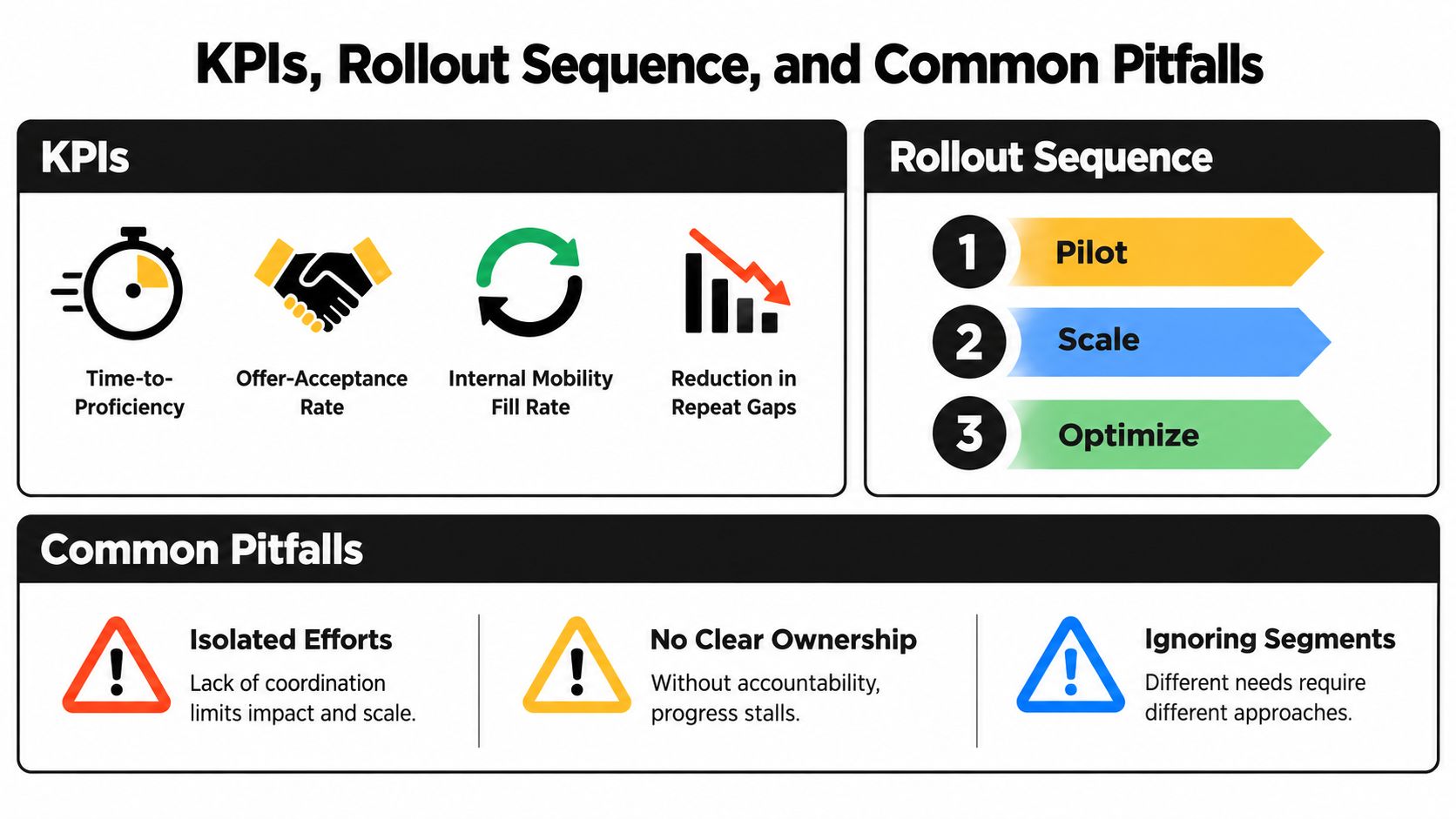
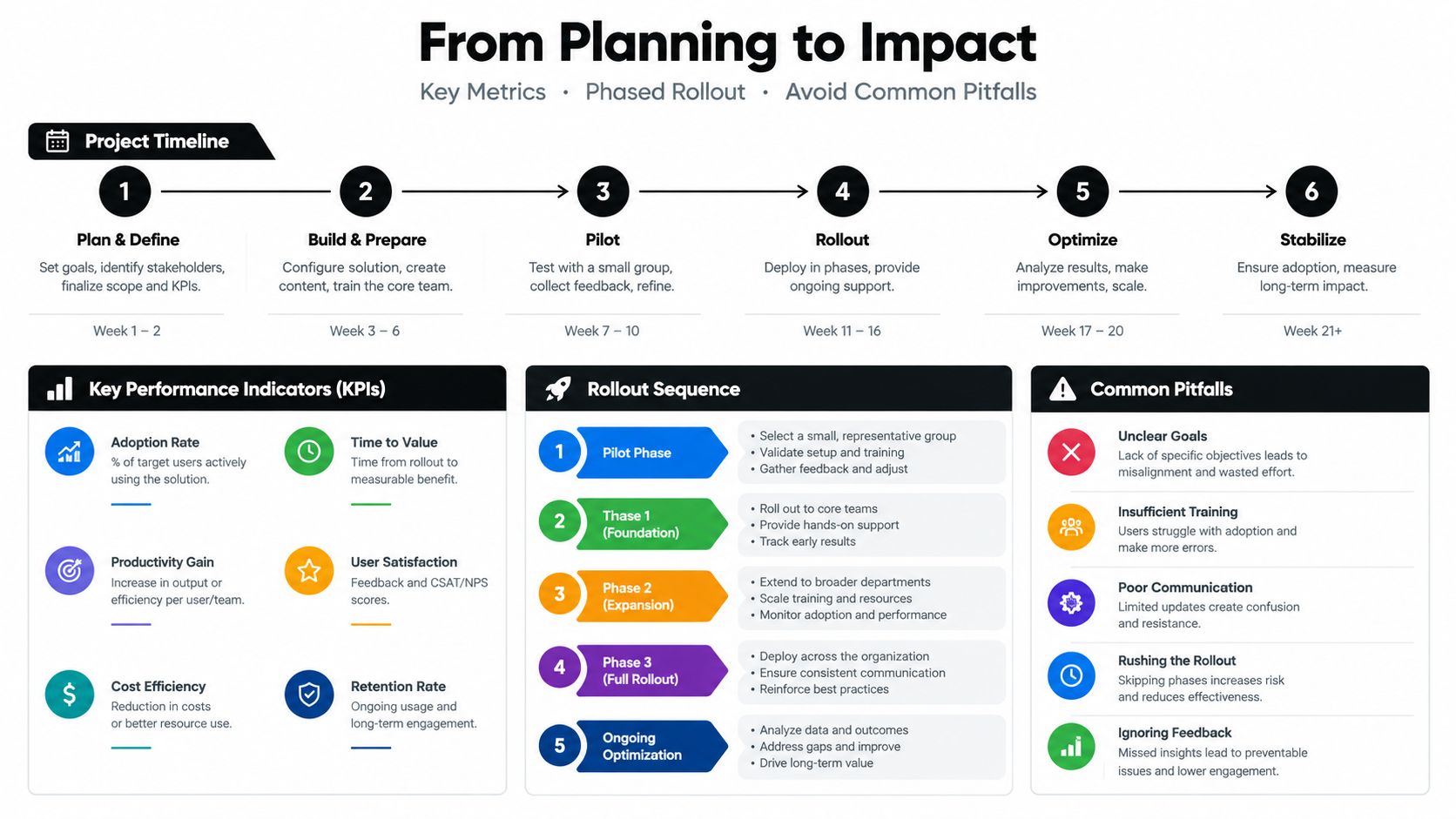
The analysis becomes valuable when it changes operating results. Track time-to-proficiency for priority roles, offer-acceptance rate by role segment, internal mobility fill rate, and the reduction in repeat gaps over successive review cycles. These measures connect capability to hiring and workforce decisions without pretending that course completion equals competence.
Assign an owner to every phase:
- Weeks 1 to 2: Scope the roles and outcomes. The CHRO or Head of Talent owns the decision.
- Weeks 3 to 4: Capture funnel, assessment, survey, and performance data. HR analytics owns data quality.
- Weeks 5 to 6: Prioritise the gap map. The business sponsor approves trade-offs.
- Weeks 7 to 8: Design hiring, mobility, and learning responses. TA, HRBPs, and L&D share delivery ownership.
- Weeks 9 to 12: Pilot the revised funnel and development tracks. The hiring manager owns local execution, while analytics reports the evidence.
Keep the accountability loop active
Most projects fail after the report. HR collects data but doesn't change interview questions. Managers continue hiring against outdated requirements. Learning teams launch broad programmes without linking them to role outcomes. Leaders then conclude that skills gap analysis doesn't work.
Other failures are predictable:
- Ignoring soft skills: Communication, judgement, collaboration, and learning agility often determine whether technical knowledge transfers into performance.
- Overtrusting AI signals: AI-driven screens and assessments should improve consistency, not replace human review or structured governance.
- Skipping follow-up: A gap isn't closed because an intervention launched. Reassess the same competency using comparable evidence.
- Reporting activity instead of capability: Attendance, completion, and interview volume are inputs. Time-to-proficiency and repeat-gap reduction are closer to outcomes.
The senior HR position is straightforward: run skills gap analysis as a recurring decision system inside the hiring funnel. Use AI phone screens and coding assessments to create comparable live evidence, combine that evidence with performance and manager context, segment by role complexity, and assign every remedy to a named owner. Then review whether the gap narrowed.
Career Central helps organisations operationalise this approach with AI-driven phone screening, first-round interviews, and coding assessments that create structured evidence across the hiring funnel. Visit Career Central to see how your team can turn candidate interactions into better skills-gap decisions and a more consistent hiring process.