On Monday morning, the shortlist looks clean. Four hundred CVs made it through the career fair filter. The recruiters have done their part. Now the hard question lands on the CHRO's desk: how do you compare a Tier-1 MBA, a self-taught coder, a lateral sales hire from a regional distributor, and a candidate whose degree says one thing but whose projects say another?
Most hiring teams drift into false confidence. They call it judgment. Often, it's pattern recognition mixed with urgency. A polished CV gets treated as evidence. A confident interview answer gets mistaken for capability. A known campus gets used as a proxy for readiness.
A competency assessment test fixes a specific problem. It does not tell you who to hire in isolation. It gives you a calibration layer so every downstream decision rests on comparable evidence rather than recruiter instinct, brand bias, or inconsistent interviews. That distinction matters even more in India, where large-scale employability and skills benchmarking has made candidate comparison possible at national scale, but has also exposed why a single score can mislead.
Table of Contents
- The Hiring Problem a Competency Assessment Test Solves
- What Competency Assessment Tests Actually Measure
- The Four Main Test Formats and When to Use Each
- How to Design a Competency Assessment Test in Six Steps
- Scoring, Reliability, and Validation That Hold Up
- Integrating Competency Tests with AI Screening and Interviews
- Why One National Benchmark Can Mislead Your Hiring Decisions
- Rollout Checklist and the Future of Competency Testing
The Hiring Problem a Competency Assessment Test Solves
By the time candidates reach shortlist stage, most organisations have already introduced inconsistency into the funnel.
One recruiter screens for pedigree. Another screens for keyword matches. A hiring manager prefers candidates who “sound sharp” in the first ten minutes. None of those methods creates a defensible comparison across backgrounds.
What goes wrong without structured measurement
Three failure modes show up repeatedly.
- Recruiter intuition bias: Teams overweight familiar brands, polished communication, or previous employers that feel credible.
- Inflated self-reported skills: Candidates describe themselves as advanced in Excel, SQL, negotiation, Python, stakeholder management, or leadership. CVs rarely verify any of it.
- Inconsistent interview scoring: One panel is strict, another is generous. One interviewer rewards confidence, another rewards detail. You end up comparing ratings that weren't produced the same way.
That last point is where legal and governance risk starts to creep in. If a rejected candidate challenges the decision, “the panel felt someone else was stronger” is weak documentation. A structured competency assessment test gives you a clearer basis for rejection or progression.
Practical rule: If two recruiters can review the same candidate and reach opposite conclusions, your funnel needs calibration before it needs more volume.
What the test is really doing
A good test doesn't replace judgment. It standardises one part of the decision so judgment has something solid to work with.
That is already happening at significant scale in India. The India Skills Report 2023 says Wheebox administered 20 million examinations in the previous year, including 17.5 million proctored tests. The same report found 50.83% of test participants were employable, up from 46.2% in the prior year. For HR leaders, the important point isn't just the percentages. It's that competency assessment is now being used as a national benchmarking system, not a niche HR tool.
The operational payoff
When competency evidence sits between screening and final interview, three things improve fast:
- Shortlists move faster: recruiters stop debating raw CVs and start comparing scored evidence
- Audit trails improve: every progression decision has a documented rationale
- Candidate challenges become easier to answer: you can point to assessed competencies, not vague impressions
That's the value. A competency assessment test turns an unstructured funnel into a reviewable one.
What Competency Assessment Tests Actually Measure
A competency is a measurable combination of knowledge, skill, ability, and other characteristics that predicts performance in a specific role. A competency assessment test is the instrument you use to generate comparable evidence on those factors.
The test is not measuring whether someone is impressive in the abstract. It is measuring whether they show the ingredients that matter for a defined job.
Start with KSAOs, not buzzwords
HR teams often jump straight to labels like leadership, agility, ownership, or analytical thinking. Those labels are too broad unless you break them down.
The cleaner method is to map the role through KSAOs:
- Knowledge: what the candidate must know
- Skill: what the candidate must be able to do
- Ability: what the candidate can demonstrate under task conditions
- Other characteristics: traits, motivations, or work styles relevant to execution
For a B2B sales role, that might look like this:
- Knowledge: product category, pricing logic, sales process
- Skill: objection handling, pipeline hygiene, proposal writing
- Ability: prioritising leads, synthesising buyer signals, negotiating trade-offs
- Other characteristics: persistence, listening discipline, comfort with ambiguity
For a junior data analyst, the map shifts:
- Knowledge: basic statistics, SQL concepts, data cleaning principles
- Skill: spreadsheet analysis, dashboard interpretation, query writing
- Ability: spotting anomalies, translating business questions into analysis steps
- Other characteristics: detail orientation, learning speed, willingness to test assumptions
This process is easier when the organisation has a structured framework. If your team hasn't formalised one yet, a practical starting point is this guide to competency mapping.
Three framework families HR teams actually use
Most competency models fall into three buckets.
KSAO models
These are the most direct. They tie tasks to measurable requirements. They're less elegant in presentation, but they're practical and usually easier to validate.
Behavioural competency dictionaries
These use libraries of behaviours such as influencing, collaboration, planning, commercial acumen, or resilience. Tools built around SHL-style or Lominger-style dictionaries can help standardise language across the business. They become useful when you need common definitions across many roles, but they can get vague if no one ties them back to work outputs.
AI-augmented job competency graphs
Some newer systems infer competencies from work samples, interview transcripts, coding tasks, and role patterns. These can help scale assessment design. They're useful if you're hiring across many functions and want dynamic role profiles, but they still need human review. A smart graph with a weak job analysis is still a weak assessment.
The framework that wins in meetings is often not the framework that predicts performance. Elegant language doesn't rescue poor measurement.
What matters more than framework choice
The only criterion that really matters is validity. If the assessment doesn't predict whether a candidate can perform the job, the framework behind it is decoration.
That's why experienced teams spend less time naming competencies and more time checking whether the test captures behaviour that shows up on the job.
The Four Main Test Formats and When to Use Each
A competency assessment test is not one format. It is a design choice. The mistake I see most often is using the same format for every role because it's easier to administer, not because it produces the right signal.
Competency assessment test formats compared
| Format | Best Hire Stage | Signal Produced | Typical Length | Common Misuse |
|---|---|---|---|---|
| Knowledge test | Early screening or pre-interview | Domain knowledge, concept recall, rule familiarity | Short to moderate | Treating high recall as proof of job performance |
| Situational judgement test | Mid-funnel | Judgment quality, prioritisation, likely behavioural response | Moderate | Writing generic scenarios that don't match real work |
| Work-sample simulation | Late screening or finalist stage | Demonstrated execution under role-like conditions | Moderate to long | Overdesigning tasks until they become unpaid project work |
| Personality or behavioural style inventory | Supplementary layer after fit is established | Style preferences, behavioural tendencies, possible culture add or tenure risk | Short to moderate | Using it as a direct proxy for task capability |
When each format earns its place
Knowledge tests
Use these when the role has a clear technical baseline. Sales operations, payroll, accounting process roles, compliance support, and junior analyst hiring often benefit from them. They are fast and scalable. Their weakness is obvious. Knowing the right answer isn't the same as applying it under pressure.
Situational judgement tests
SJTs work well when decisions matter as much as technical skill. Customer support leads, people managers, recruiters, and field sales hires all produce useful behavioural signal through role-specific scenarios. If your team also assesses communication quality, a companion tool like a communication skills assessment test can help separate sound judgment from poor articulation.
Work-sample simulations
These are often the most persuasive part of the funnel because candidates have to do the work, not describe it. A written sales email, a SQL task, a dashboard critique, a case memo, or a role play gives hiring managers evidence they can trust. The trade-off is time. Simulations ask more from both candidates and assessors.
Personality and behavioural style inventories
These tools have a place, but not the place many teams give them. They don't directly prove someone can close deals, code cleanly, or manage stakeholders. What they can do is help interpret likely work style, coaching needs, and alignment with a competency profile.
Use personality tools to enrich a hiring decision, not to make one on their own.
A simple selection rule
Pick the format that captures the behaviour you care about with the least distortion. If the role requires judgment, use scenarios. If it requires output, use a work sample. If it requires baseline technical fluency, start with knowledge. If you need behavioural context, add an inventory carefully.
How to Design a Competency Assessment Test in Six Steps
A CHRO usually sees the problem after the first hiring cycle. The test looked efficient, candidates got neat scores, and managers still complained that shortlisted hires varied too much by region, interviewer, and actual job readiness. That happens when the assessment is built as a gate. It works better as a calibration layer that standardises signal across uneven resumes, uneven colleges, and uneven access to training.
That distinction matters in India. Employability gaps by region and gender are real, so a single aggregate score can hide whether a candidate lacks core job skill, struggles with test language, or comes from a market with fewer preparation advantages. Design has to separate those signals.
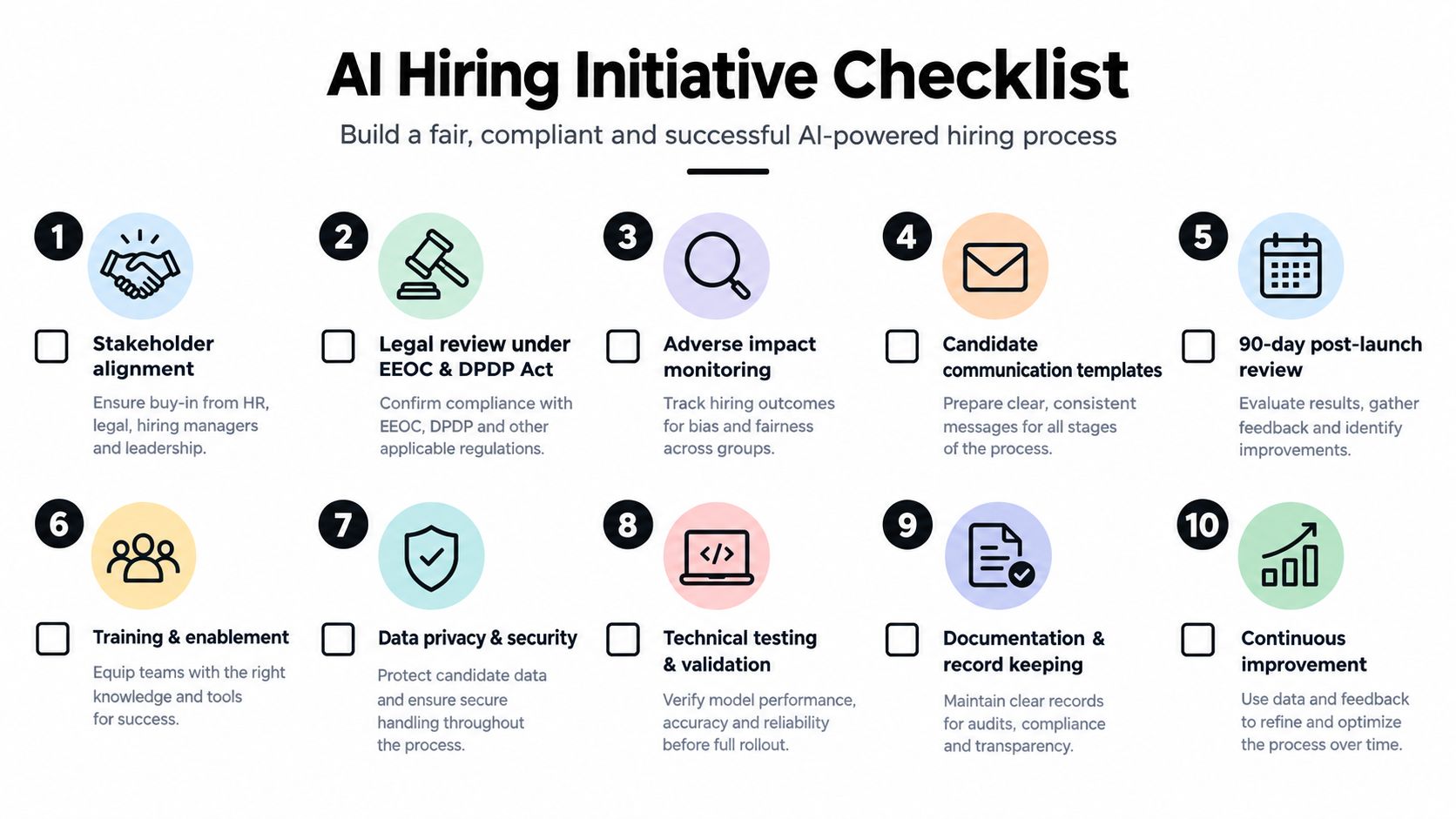
Step 1 to Step 3
Start with decisions, not questions
Define what the test will influence. Will it screen out candidates, sort them into interview tracks, flag training needs, or help calibrate borderline cases? This choice shapes everything that follows. A hiring gate needs tighter controls and stronger evidence. A calibration layer can be shorter, faster, and more diagnostic.
Owner: CHRO delegate, TA lead, hiring manager
Output: assessment use case and decision rulesRun a job analysis around early performance
Focus on the first six to twelve months of the role. Ask managers where new hires succeed, where they fail, and which mistakes are coachable versus expensive. Incumbents often give better detail than managers on what the job really demands under pressure.
Owner: HRBP or TA lead
Output: critical task list and failure pointsConvert tasks into a small competency model
Translate the task list into KSAOs, then cut aggressively. Three to five competencies are usually enough for hiring. More than that creates noise, longer completion times, and weaker score interpretation. For each competency, write the behaviour you expect to see, not a broad label that everyone reads differently.
Owner: HR plus hiring manager
Output: competency map and behaviour indicators
Step 4 to Step 6
Build items from real work conditions
Draft questions, scenarios, or simulations with subject matter experts who know the role well enough to spot fake realism. Good items reflect the constraints of the job: limited information, competing priorities, stakeholder tension, accuracy requirements, and time pressure. The Society for Industrial and Organizational Psychology principles are useful here because they keep item design tied to job relevance rather than generic aptitude.
Owner: SME group with HR review
Output: draft assessmentPilot on known groups before launch
Test the draft on current employees, ideally across performance levels, locations, and demographic groups large enough to inspect patterns. The goal is not only to find bad questions. It is to see whether the assessment distinguishes stronger performers from weaker ones without over-rewarding familiarity with test-taking style, English fluency, or one regional context.
Owner: HR analytics or assessment vendor
Output: pilot results, ambiguity log, timing notes, subgroup reviewSet score rules that support judgment
Finalise cut-offs, bands, or profile rules only after reviewing pilot evidence. In many cases, one total score is the wrong output. A banded decision model often works better: clear advance, advance with interview probe, hold for review, or reject. That gives hiring teams a disciplined way to combine test signal with interviews and experience instead of pretending a single number settles the decision.
Owner: CHRO delegate, legal, HR operations
Output: scoring guide, interpretation notes, validation file
What teams usually get wrong
- They design for speed alone: the test is fast to launch but too blunt to separate readiness from background advantage.
- They assess broad traits instead of job behaviour: scores look tidy, hiring decisions do not.
- They write polished corporate scenarios: candidates respond to ideal workplace fiction, not the trade-offs the role contains.
- They skip subgroup review in the pilot: regional and gender patterns stay hidden until the business starts questioning hiring quality.
- They force one national cut-score too early: local labour market differences get flattened into a number that looks objective but is hard to defend.
A workable assessment is specific, disciplined, and modest about what a score can prove. The best designs do not claim to replace judgment. They improve it.
Scoring, Reliability, and Validation That Hold Up
A hiring committee reviews results from three regions. One cluster scores lower on written case responses, yet those hires perform well once they are on the floor with customers. Another cluster scores high overall but struggles with execution after joining. The problem is usually not the candidates. It is the scoring model.
A competency assessment test earns trust only when the score is treated as a calibration layer, not a hiring verdict. If one number hides whether the candidate struggled with language load, business judgment, or task sequencing, the score is too blunt to support a serious people decision.
Score the behaviour, not the general impression
Use either analytic rubrics or overall rubrics.
- Analytic rubrics score separate dimensions such as accuracy, prioritisation, stakeholder judgment, and communication quality.
- Overall rubrics produce one integrated rating based on the full response.
For large-scale hiring, analytic scoring usually holds up better. It shows what the candidate can do, where the signal is weak, and which gaps should be checked in interview or training. Overall rubrics are faster to apply, but they compress too much information when hiring across locations, assessor pools, and candidate groups.
That trade-off matters. Speed helps operations. Detail protects decision quality.
What to require before launch
Good validation work is less glamorous than test design, but it is what protects the programme when business leaders start asking why one region passed at a lower rate or why women are scoring differently on a supposedly neutral exercise.
Set a clear reliability standard. Many teams use 0.80 as the working benchmark for high-stakes use. Then check criterion validity against actual job outcomes in a reference sample, as noted earlier in the article's discussion of Indian assessment practice. A score that does not relate to performance is just a neat spreadsheet.
Subjective scoring needs extra control. The British Council's India-focused skills assessment report points to limited evidence that assessment agencies consistently produce reliable, valid, and comparable outcomes across schemes. In practice, that means tighter scorer training, clearer rubrics, double-scoring on sample scripts, and periodic recalibration during live hiring.
If two trained assessors watch the same exercise and arrive at very different scores, fix the rubric or the calibration process before using the result to reject people.
Validation evidence at a glance
| Validation Study | Key Metric | Acceptable Threshold | What to Report |
|---|---|---|---|
| Content validation | Role-to-item alignment | Clear documented linkage to critical tasks | Why each section maps to job requirements |
| Criterion-related validation | Score relationship to job performance | Strong enough to support practical prediction, based on local evidence | Whether high scorers also perform well on the job |
| Differential validation | Comparable interpretation across groups | No material distortion in meaning or scoring process | Whether the assessment behaves consistently across candidate segments |
One more point gets missed in rollout meetings. A test can be reliable and still mislead if the same score reflects different constraints across candidate groups. In India, regional access, language familiarity, and gendered exposure to certain work contexts can all affect how a candidate performs on a timed assessment. That is why a single national score should be handled carefully. The better approach is to validate score meaning by role family, hiring channel, and relevant subgroup before treating the result as broadly interchangeable.
Before launch, keep a file that would survive legal review and executive scrutiny: job analysis notes, competency map, draft and final rubrics, pilot summary, assessor instructions, accommodation process, score interpretation rules, and subgroup checks. If the scoring model cannot be defended in a room with HR, legal, and business heads, it is not ready for scale.
Integrating Competency Tests with AI Screening and Interviews
The worst place for assessment data is inside a separate dashboard no hiring manager opens again.
A competency assessment test should feed the funnel, not sit beside it.
A practical funnel design
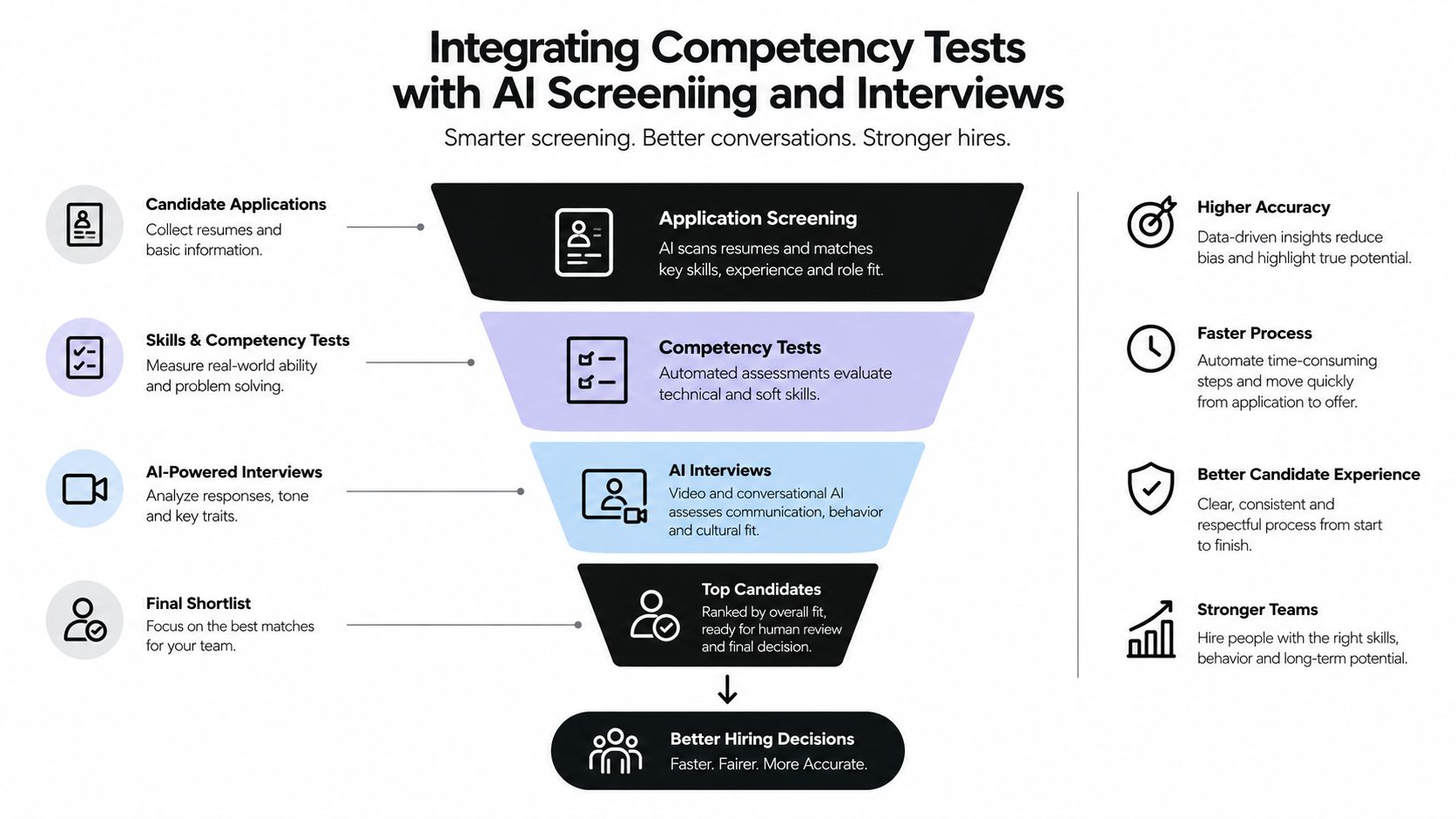
A sensible sequence looks like this:
AI phone screen first
Use it to capture baseline communication, listening, and response structure. This is especially useful when CVs tell you little about how a candidate explains trade-offs or handles prompts.Competency test next
Use technical questions, SJTs, or simulations to measure the work signal you care about. Calibration becomes strongest because everyone faces the same evidence standard.Structured interview last
Reserve human interview time for probing ambiguity. Ask about learning agility, conflict judgment, leadership behaviours, and context around weaker score areas.
That sequence works because each stage contributes a different kind of evidence.
Keep the record unified
For this to work operationally, the recruiter and hiring manager need one candidate record. Platforms such as candidate assessment tools can help centralise scorecards and interview evidence. In that category, Career Central is one option that combines AI phone screening, first-round interviews, and coding assessments with structured candidate scoring, so competency evidence from different stages can be reviewed together.
The trade-off most teams underestimate
Over-automation in early screening can suppress good candidates.
Some people are weak on CV presentation and strong in live reasoning. Others test moderately but perform well when discussing trade-offs aloud. If AI screening becomes a hard gate instead of a triage layer, you risk filtering out the exact candidates whose best competencies emerge in conversation or simulation.
Use automation to organise evidence. Don't use it to eliminate judgment.
Why One National Benchmark Can Mislead Your Hiring Decisions
A national benchmark looks efficient. It also tempts HR teams into bad decisions.
India's employability data makes the problem visible. The India Skills Report 2025 coverage in The Indian Express notes that overall graduate employability was 54.81%, while state-level employability ranged from 84% in Maharashtra to 70% in Uttar Pradesh. It also reports male employability at 53.47% and female employability at 46.53%.
Why a single cutoff distorts the funnel
If you apply one national threshold to every campus, state, and candidate pool, you are not just setting a quality bar. You are importing the distribution of the largest or strongest cohorts into every hiring decision.
That creates two practical problems:
- Regional distortion: a candidate can be highly competitive within one labour market and look weak against a benchmark built elsewhere
- Gender distortion: if one group is already scoring lower on the same benchmark, a blunt cutoff can narrow the funnel before interviews reveal capability
National vs locally calibrated cutoff comparison
| Cohort | Mean Score | Single Cutoff Pass Rate | Local Band Pass Rate |
|---|---|---|---|
| Metro graduate cohort | Varies by employer and role | Higher under a universal benchmark | Reviewed within cohort context |
| Tier-2 or regional cohort | Varies by employer and role | Often compressed by the same benchmark | Better interpreted through local calibration |
| Mixed-gender applicant pool | Varies by employer and role | Can reflect underlying distribution gaps | Better reviewed with segment-aware interpretation |
This is why I treat a competency assessment test as a calibration layer, not a standalone gate. Use locally calibrated bands by role level, region, and hiring segment. Then interpret the score alongside work samples, interview evidence, and market context.
One score can be standardised. Its meaning still depends on who you are comparing and why.
Rollout Checklist and the Future of Competency Testing
A rollout usually fails in operations, not in theory. The design may be sound, but the launch breaks because legal wasn't briefed, assessors weren't calibrated, or candidates weren't told how the score would be used.
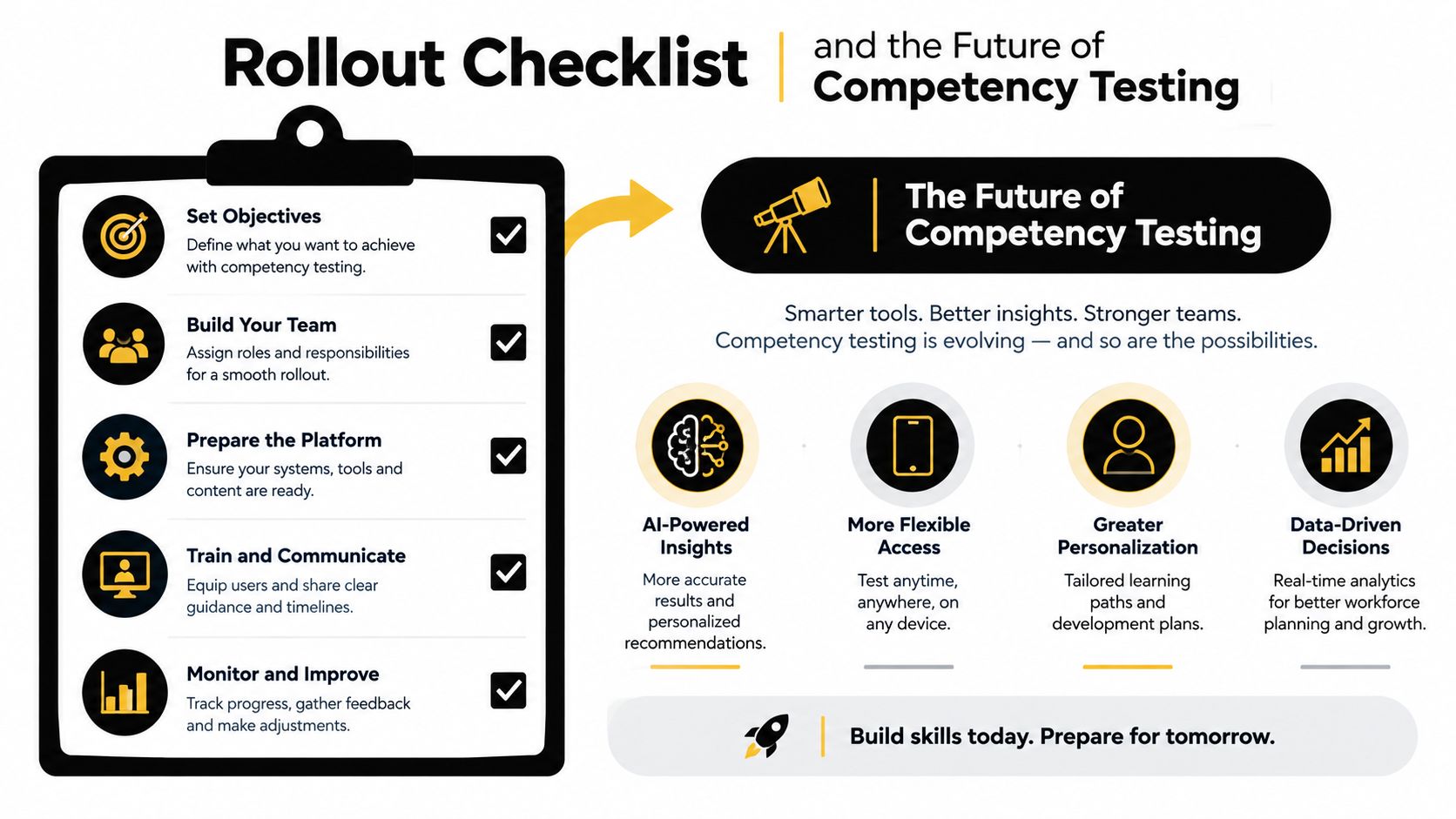
Rollout checks that matter
- Stakeholder alignment: agree what decisions the test will influence and what it will not
- Legal review: confirm consent language, data handling, retention, and accommodation standards under your operating jurisdictions, including DPDP Act considerations where relevant
- Assessor calibration: train raters before launch, not after score disputes begin
- Candidate communication templates: explain purpose, timing, support contacts, and what happens next
- Adverse impact monitoring: review score patterns by cohort before treating results as stable
- Accessibility protocol: define accommodation steps for candidates with disabilities
- Vendor governance: document where data sits, who can access it, and how models are updated
- Score interpretation guide: tell recruiters how to use scores as input, not verdict
- Hiring manager briefing: stop line managers from inventing their own cutoffs
- Ninety-day review: check whether scores are aligning with interview quality and early job performance
What's changing next
The centre of gravity is moving away from static knowledge checks and toward adaptive competencies. India's future-skills discussion points in that direction. The same Indian Express report notes that QS Future Skills Index 2025 ranked India 2nd globally for future-of-work readiness, but 25th overall. It also reports Mercer's India Graduate Skill Index 2025 finding that only 41.7% of Indian graduates are overall employable, with 46.1% job-ready for AI/ML roles and 46% employability in learning agility. That gap matters because it suggests employers will need assessments that capture adaptability, not just recall.
The categories I'd prioritise now are learning agility, prompt-engineering judgment, and cross-cultural collaboration. Treat competency testing as an annual calibration exercise. The role moves. The market moves. The assessment has to move with them.
Career Central helps hiring teams operationalise this kind of competency-based workflow with AI-driven phone screening, first-round interviews, and coding assessments that create structured evidence across the funnel. If you want a hiring process that compares candidates on more than CV polish and panel instinct, visit Career Central.