
The popular advice is wrong: a problem solving assessment isn't automatically a good predictor of job performance. A candidate can excel at abstract puzzles and still struggle to prioritise customers, challenge weak assumptions, or make a sound decision with incomplete information. The assessment only earns its place when it mirrors the decisions the role demands.
That distinction matters in India, where applied reasoning remains a measurable education and employability challenge. India's first PISA participation took place in the 2009–10 cycle, when students from Tamil Nadu and Himachal Pradesh took part. India ranked 73rd out of 74 education systems, ahead of only Kazakhstan, a result that became a historical signal about weaknesses in problem solving and applied reasoning. The historical account of India's PISA participation and later problem-solving evidence provides useful context, but it doesn't justify using a generic aptitude score as a universal hiring answer.
The right question isn't, “Which test is hardest?” It's, “Which assessment produces evidence about the work this person will do?” Start there, and the test type, rubric, interview prompts, and decision rules become much easier to design.
Why Most Problem Solving Assessments Miss the Hiring Outcome
Most assessments claim to predict performance, yet many measure general cognitive fluency more effectively than role-specific judgement. That mismatch comes from poor test design, not from problem solving as a skill. A score has hiring value only when it reflects decisions the role requires.
Start with task analysis, not a vendor catalogue. Identify the decision a candidate will own early in the role, the information available at that point, the constraints they will face, and the trade-offs that define a good result. A customer operations manager may allocate scarce capacity while protecting service quality. A software engineer may diagnose a production issue without creating another failure. A finance analyst may challenge a forecast built on incomplete data.
These are different problems. One abstract reasoning score cannot distinguish them reliably.
Build from the decision backwards
Write the role's critical problem as a short scenario. Include relevant evidence, the ambiguity the candidate must resolve, and the cost of choosing badly. Then define the observable behaviour that demonstrates competence. That decision should determine the test format, the scoring rubric, and the follow-up questions used in interviews or AI phone screens.
Score evidence such as:
- Problem framing: Does the candidate separate symptoms from the underlying issue?
- Information use: Do they identify what matters, what is missing, and what can be ignored?
- Trade-off awareness: Can they explain what they are sacrificing and why?
- Action quality: Do they propose a practical next step rather than an impressive but unusable analysis?
- Learning speed: Do they revise their approach when new evidence changes the situation?
Practical rule: If the hiring manager cannot explain how an assessment score relates to a decision on the job, do not use that score as a selection gate.
India's education data reinforces the need to test application rather than memory. Coverage of ASER findings reported that many Indian youth aged 14 to 18 struggled with basic division, calculating time from a clock, and applying basic maths in everyday contexts. The same coverage reported that a quarter could not read a Standard II-level text fluently. The reporting on applied learning gaps and CBSE's competency shift explains why competency-based assessment has gained institutional attention.
Stop confusing speed with judgement
Timed tests can show how candidates operate under pressure, but speed may reflect familiarity with the format, language exposure, device conditions, or test anxiety. Treat it as one signal, not the construct itself.
Use a short reasoning task only when it serves a clear hiring outcome. Pair it with a role-relevant work sample when the job requires context, communication, or collaboration. Then pass the same rubric into AI phone screening, so automated follow-ups test stated reasoning rather than reward fluency, confidence, or accent. That combination gives hiring teams clearer evidence of how candidates turn thought into action.
How a Problem Solving Assessment Works
A problem solving assessment should show how a candidate turns incomplete information into a defensible work decision. The final answer is only one signal. The assessment must also capture the assumptions, priorities, and reasoning that produced it.
Approve a test only after these four building blocks are defined.
Start with a realistic stimulus
Build the stimulus from information a new hire will handle: a customer escalation, dataset, product defect, operational backlog, or short business case. For a customer support role, present a delayed delivery, an angry customer, and limited refund authority. Ask the candidate to identify the first action, explain the priority, and state what information they would verify. The exercise does not need to reproduce the entire job. It must reproduce the decision pressure.
An abstract puzzle may test pattern recognition, yet it gives little evidence of how someone handles messy evidence. A role-based stimulus exposes prioritisation, assumptions, and the ability to separate a useful conclusion from a decorative one.
Capture reasoning, not just the answer
Multiple-choice items scale well, but they hide process. Add a short explanation, ranking rationale, structured response, or follow-up question. For technical roles, inspect code, tests, error handling, and explanation. For non-technical roles, score assumptions and next steps.
A candidate who reaches the right answer through an unsafe assumption should not receive the same signal as someone who reaches it through a sound method.
Calibrate the scoring rubric
A rubric converts reasoning into consistent evidence. Define strong, acceptable, and weak performance before candidates take the assessment. Include answer examples and behavioural anchors, rather than labels such as “good analytical ability”.
Open-ended case studies reveal process, but they also invite rater drift. Two interviewers can reward different communication styles unless they score the same observable behaviours. Anchor each score to actions, such as identifying the highest-impact risk, requesting missing evidence, or proposing a measurable next step.
Standardise delivery
Timing, instructions, permitted tools, accessibility, language, and technical conditions affect comparability. Give every candidate the same baseline and document reasonable accommodations separately. Feed the same scoring logic into later AI phone-screen prompts, so follow-up questions test the reasoning shown in the assessment rather than fluency, confidence, or accent.
Use this checklist to assess an internal or vendor-built test:
| Building block | Question to ask | Common failure |
|---|---|---|
| Stimulus | Does it mirror a real role decision, such as the customer escalation described above? | Abstract puzzle with no link to that customer escalation decision |
| Response | Can we observe reasoning? | One answer with no explanation |
| Rubric | Are behaviours defined and calibrated? | Unstructured interviewer preference |
| Delivery | Are conditions consistent and accessible? | Different tools, timing, or instructions |
India has access to locally standardised cognitive infrastructure. The India-adapted Wechsler Adult Intelligence Scale, Fourth Edition is described as having India norms and enhanced clinical utility. When cognitive measures are part of the process, choose tools with population-specific norms instead of treating imported reference groups as universally appropriate.
Comparing Case Studies, Situational Judgment, and Coding Tasks
Choose the assessment by the hiring decision it must improve. Use a case study for ambiguous business problems that require structure and recommendations. Use a situational judgment test for repeated choices involving prioritisation, customer handling, or leadership. Use a coding or work-sample task when the role requires a functional technical result.
The best format depends on the signal you need and the stage where you need it. Compare job fidelity, process visibility, funnel scalability, audit defensibility, and candidate experience before selecting a test.
| Criteria | Case Study | Situational Judgment Test | Coding / Work-Sample Task |
|---|---|---|---|
| Hiring outcome | Strategy, operations, consulting, product decisions | Customer handling, leadership judgement, prioritisation | Engineering, analytics, technical delivery |
| Job fidelity | High when based on real role decisions | Moderate unless scenarios match the role | High for technical roles |
| Process signal | Strong when candidates explain assumptions | Moderate, often inferred from choices | Strong through code, analysis, and explanation |
| Scalability | Lower because review takes time | High with structured scoring | Moderate to high with automated checks |
| Audit defensibility | Strong with anchored rubrics | Strong when item logic is documented | Strong when requirements and tests stay consistent |
| Candidate experience | Rich but demanding | Accessible and quick when well designed | Relevant for technical candidates, but frustrating if speed dominates |
| Main risk | Rater inconsistency and preparation burden | Generic scenarios with little realism | Measuring test familiarity or speed instead of collaboration |
Match format to the hiring funnel
Use situational judgment early when you need a consistent screen across many applicants. Build scenarios from real role decisions, then score the options against defined behaviours. Generic workplace dilemmas create clean-looking results with weak hiring value.
Reserve a full case study for later stages, when reviewers can assess reasoning rather than only the final recommendation. Give candidates the same evidence, prompt, preparation conditions, and response expectations. Require assumptions, trade-offs, and an action plan. If reviewers cannot score the work independently, the rubric is not ready.
Coding and work samples should resemble production work. Assess maintainability, testing, communication, and safe handling of edge cases alongside correctness. A fast solution that ignores explanation or collaboration can misrepresent performance on an engineering team.
Feed each format into the next hiring step without changing the competency being measured. An early situational judgment result can shape a focused situational interview question design, while a case study or coding result can guide questions about assumptions, trade-offs, and decisions. For an AI phone screen, use the same competency and scoring logic to select follow-ups. Do not let fluency, confidence, accent, or conversational speed inflate the assessment signal. The phone screen should add context, not replace the rubric with intuition.
Sample Questions With Scoring Rubrics You Can Reuse
Use short, role-specific prompts and score the decision process, not polished language. Replace the nouns, evidence, and constraints for each job, but keep the competency and weighting stable. Remove unnecessary demographic or biographical information before review, and score responses anonymously where practical.
| Question type | Sample prompt | Strong answer signal | Average answer signal | Weak answer signal | Score weight |
|---|---|---|---|---|---|
| Case study | “A subscription product has rising cancellations. Review the customer, product, and support evidence, identify likely drivers, and recommend the first actions.” | Forms hypotheses, tests evidence, states trade-offs, and assigns measures and owners | Names plausible causes but gives broad actions or weak prioritisation | Chooses one cause immediately, repeats the evidence, and offers no validation plan | Framing 30%, evidence use 25%, trade-offs 20%, action plan 25% |
| Situational judgement | “A key customer requests an urgent feature that would delay a reliability fix. What do you do first, and how do you communicate the decision?” | Clarifies risk, consults affected teams, protects reliability, and offers a transparent alternative | Escalates appropriately but gives limited reasoning or sequencing | Promises the feature immediately or rejects it without examining impact | Judgement 35%, stakeholder handling 25%, prioritisation 25%, communication 15% |
| Coding or analysis work sample | “Given a transaction file and a business rule, identify anomalous records, explain your method, and recommend a review workflow.” | Produces correct output, handles edge cases, documents assumptions, and proposes practical controls | Finds obvious anomalies but misses edge cases or provides thin documentation | Uses brittle logic, cannot explain the result, or ignores data quality | Correctness 35%, robustness 25%, reasoning 20%, communication 20% |
The weighting should match the hiring outcome. Give case studies more weight on diagnosis and prioritisation when the role owns ambiguous decisions. Give work samples more weight on correctness and resilience when errors create operational or customer risk. Keep the table visible to every reviewer. A hidden scoring instinct is not a rubric.
Case study calibration
A strong response does not require a perfect diagnosis. It defines knowns, unknowns, and the evidence that would change the recommendation. Reward this sequence: frame the problem, form hypotheses, test evidence, prioritise action, and define measurement.
An average response lists several plausible causes without deciding what to investigate first. It may show awareness, but it does not demonstrate how the candidate would allocate limited time, people, or budget.
A weak response turns the prompt into a generic strategy presentation. Penalise unsupported certainty and missing validation, not vocabulary, accent, or presentation style. Reviewers should record the decision evidence behind each score.
Situational judgement calibration
Score the decision process rather than the most agreeable answer. The candidate should identify competing obligations, assess consequences, involve the right people, and communicate a decision others can act on.
Change the setting for sales, HR, operations, or engineering while preserving the conflict. That keeps the assessment tied to the hiring outcome, whether it is risk control, customer judgement, team coordination, or delivery prioritisation. Do not reward knowledge of an employer's private policy unless that knowledge is required for the job.
Work-sample calibration
Set permitted tools before launch. Allow spreadsheet software for spreadsheet work. For coding tasks, specify the language, documentation, libraries, and testing expectations. If the goal is unaided recall, state that clearly and accept the narrower capability being measured.
Use a consistent time window. Anonymise names, schools, employers, accents, and unrelated personal history before scoring. Have reviewers score independently, then resolve disagreements against the rubric rather than seniority or instinct.
For an AI phone screen, use these scores to choose focused follow-ups, not to create a second opaque test. Ask the same competency-based questions across candidates, keep fluency and conversational speed out of the score, and pass the original rubric to human reviewers. The screen should add context to the work sample or judgement result without inflating bias.
Validating the Assessment and Reducing Bias
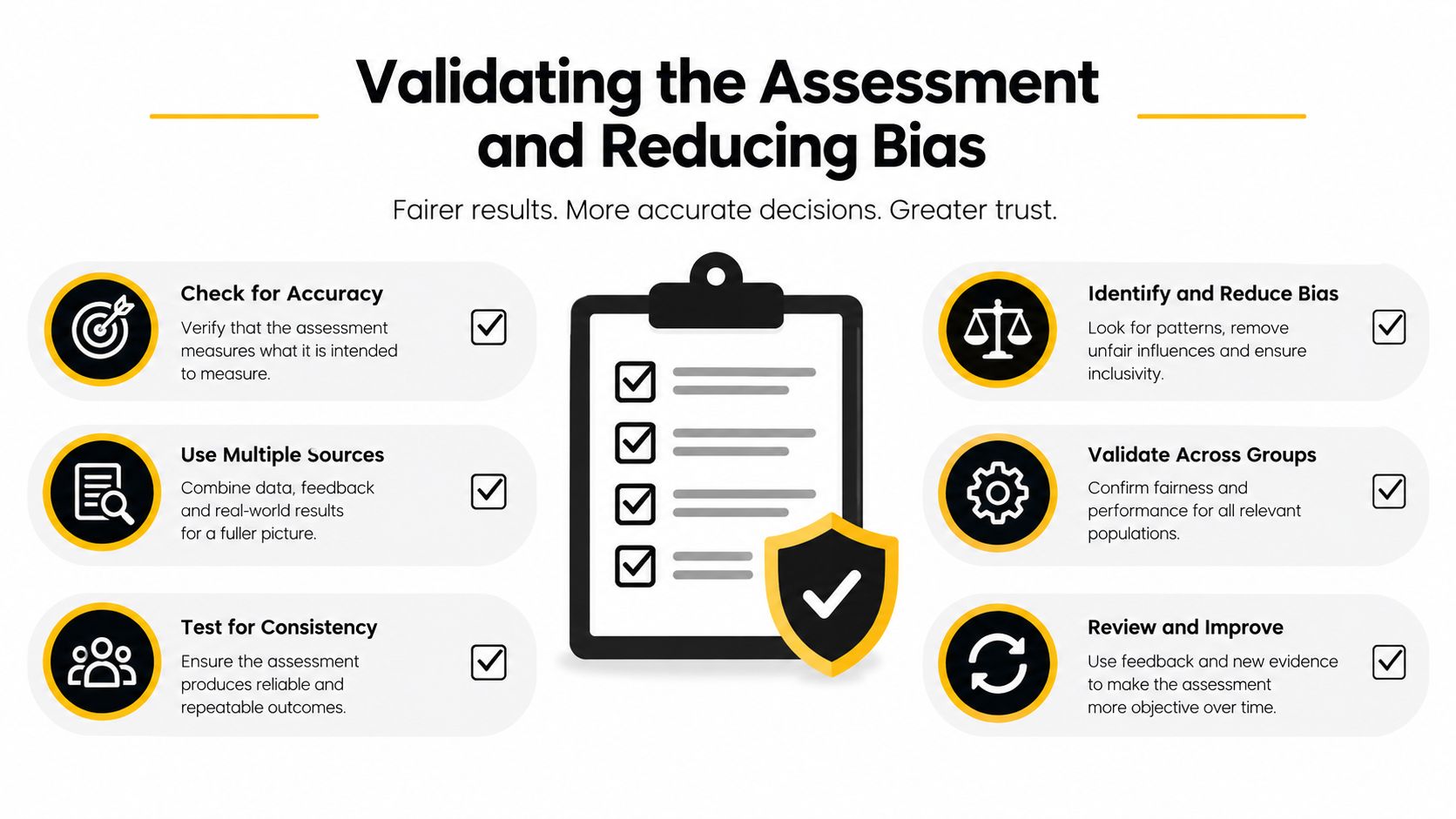
A vendor cannot give you validity. Your team has to build the evidence that the assessment measures job-relevant capability and improves hiring decisions.
Before launch
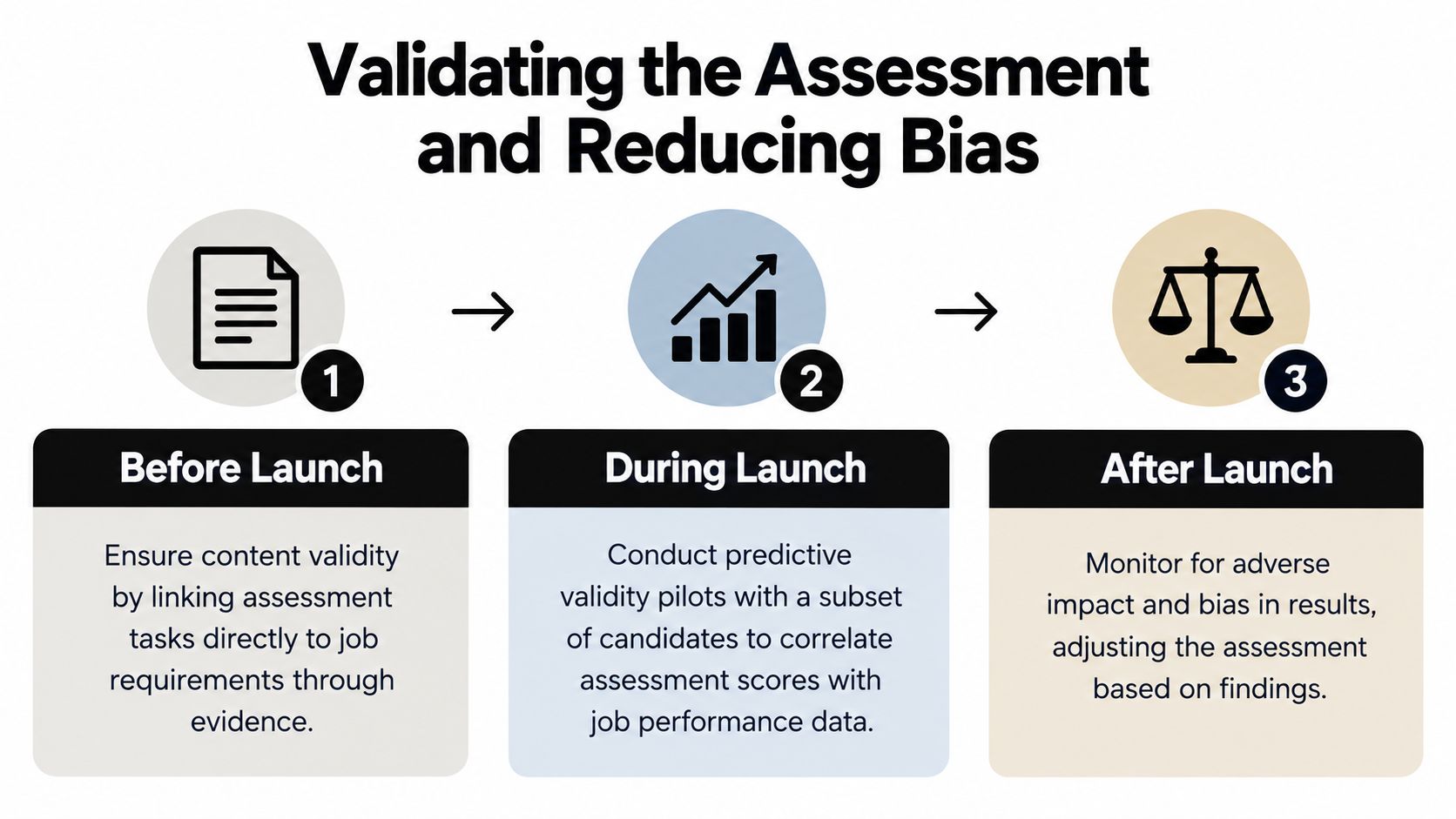
Form a subject-matter panel that includes hiring managers, experienced job holders, and an assessment owner. Require the panel to connect every item to a real work task, remove unnecessary knowledge demands, and flag wording or cultural assumptions that could distort performance.
Run cognitive walkthroughs with people who did not design the test. Ask what each instruction means, which information appears relevant, and where confusing wording could cause failure instead of weak reasoning. Review cut scores separately from item quality. A well-designed task can still produce an unfair threshold.
Use the candidate assessment tools guidance to compare delivery, scoring, and reporting features. Keep job analysis with your hiring team. A platform can administer an assessment, but it cannot decide which capability the role requires.
During launch
Pilot the assessment with a defined group and compare results with later job outcomes. Published hiring-validity evidence can provide context, but it cannot replace evidence from your own role and workforce. One synthesis reports cognitive ability at 0.31, structured interviews at 0.42, job knowledge tests at 0.40, and work samples at 0.33. An India-focused benchmark reports cognitive ability at about 0.54 and structured interviews at about 0.51. These differing estimates support combining methods rather than declaring one test universally superior. Read The cited hiring-validity discussion as background, not as proof that your assessment works.
Record completion conditions, accommodations, technical interruptions, and reviewer decisions. Accommodations can preserve access, but document how the resulting scores remain comparable and interpretable.
After launch
Monitor pass-through rates, performance by demographic group, reviewer disagreement, question exposure, candidate complaints, and score relationships with job outcomes. Set a review cadence, and reassess the test whenever the role or workflow changes materially.
Rebuild the assessment when:
- Job linkage fails: Managers cannot connect poor performance to a scored competency.
- Group differences lack an explanation: A persistent gap has no job-related evidence.
- Coaching dominates: Scores reflect platform familiarity more than reasoning.
- Raters disagree repeatedly: Reviewers apply incompatible interpretations to the same response.
- Outcomes drift: Scores no longer relate to performance after the role or workflow changes.
India's competency reforms illustrate the same principle. SAFAL evaluates foundational literacy, numeracy, and problem solving rather than memorisation, as noted earlier in the discussion of competency-based assessment. Employers should apply that discipline to hiring: assess useful application, then verify that the signal remains fair and tied to the work.
Connecting the Assessment to AI Driven Phone Screening
A test score should direct the interview, not replace it. Configure the AI phone screen to ask consistent, rubric-based questions about observable behaviour. This creates a clear link between the assessment and the hiring decision while limiting personality speculation.
Pass structured evidence into the screen brief instead of a label such as “high aptitude.” Include fields that map directly to the scoring rubric:
- Reasoning structure: Ask how the candidate divided the problem, chose a sequence, and identified the main constraint.
- Trade-off flags: Ask which options they considered, what they deprioritised, and why.
- Quantitative depth: Ask how they checked assumptions, estimates, risks, or edge cases.
- Communication clarity: Ask the candidate to explain the recommendation to a non-specialist.
Route evidence, not verdicts
Use assessment results to select follow-up questions. Set a human handoff for borderline scores, conflicting evidence, or accommodation requests. The AI must not reject a candidate from the score alone. It must not infer protected characteristics, penalise an accent, treat education prestige as a proxy for reasoning, or turn a communication preference into a character judgement.
A controlled prompt might read:
“The candidate received a mixed score for trade-off awareness on the operations scenario. Ask them to describe a time they had to choose between speed and service quality. Probe how they assessed consequences, who they involved, and what evidence they used to review the outcome. Do not ask about protected characteristics or infer capability from accent, school, location, or unrelated personal history.”
This prompt names the scored competency, defines the follow-up, and gives the recruiter a reason to review the recording and evidence. Store the prompt, assessment output, transcript, and reviewer decision together so the workflow remains auditable.
Career Central is one option for organisations evaluating this workflow. Its platform provides AI-driven phone screening, first-round interviews, and coding assessments, including scenario and problem-solving questions in its screening flow. Teams planning broader recruitment process automation should define human review points before switching on automated routing.
Rolling Out a Problem Solving Assessment in 30, 60, and 90 Days
A controlled rollout beats a big-bang launch. Bad data can hide unclear questions, weak scoring anchors, and access barriers. Agree on a rollback rule before the first candidate completes the assessment.
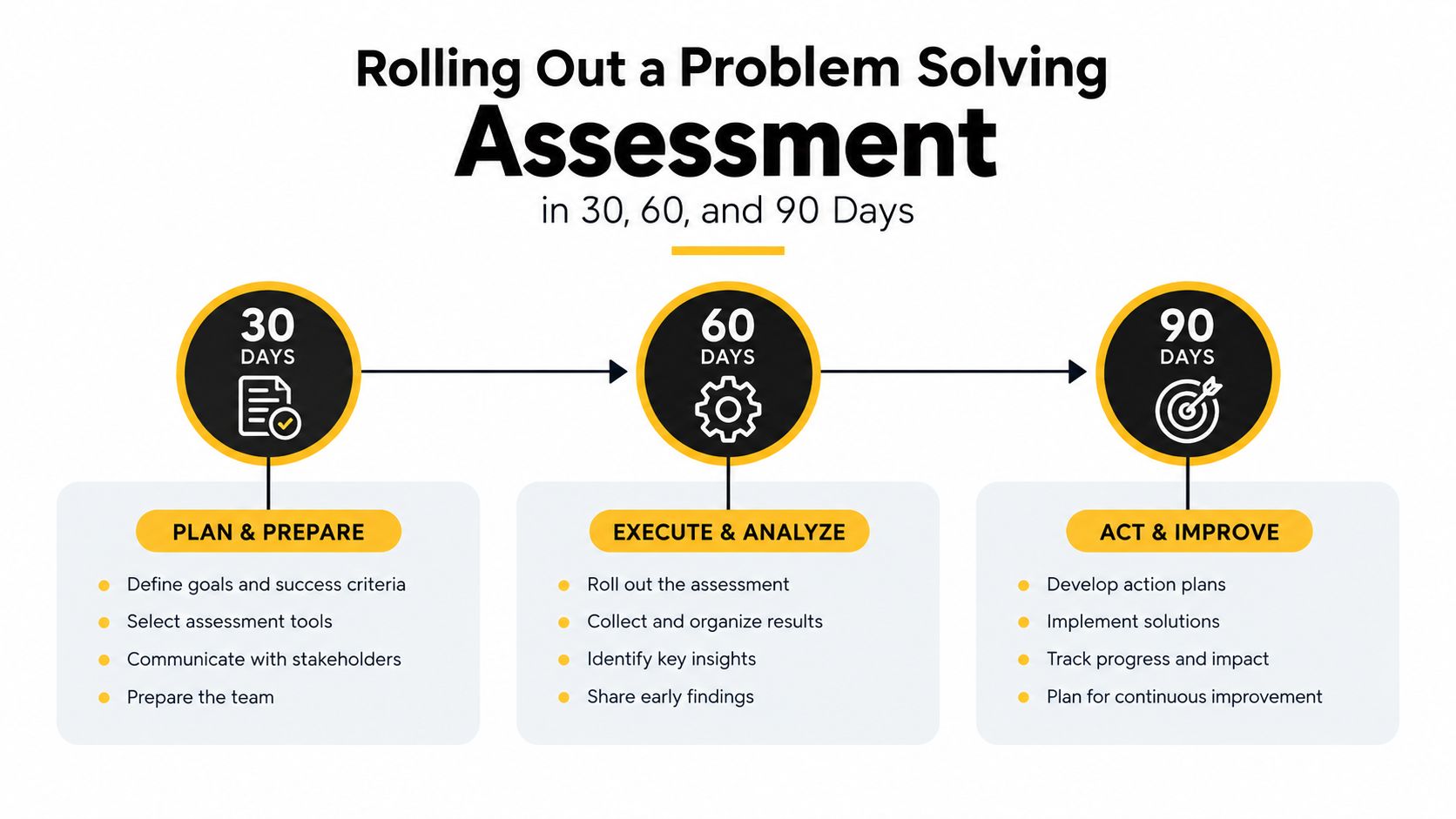
Days 1 to 30
Map the role's decisions, select the assessment format, write the scoring rubric, and obtain subject-matter review. Pilot with 20 to 30 recent hires to establish a baseline, keeping those results separate from live selection decisions.
Test whether reviewers apply the anchors consistently. Remove prompts that reward background knowledge unrelated to the job. Confirm timing, permitted tools, accommodations, identity controls, and data retention before inviting external candidates.
Tie each test dimension to a hiring outcome. A case study may measure trade-off judgment, a situational judgment test may measure prioritisation, and a coding task may measure technical diagnosis. Record the evidence required for each score instead of relying on one composite result.
Days 31 to 60
Connect the rubric fields to the AI phone screen brief. Run the new assessment alongside the existing process for every applicant in the pilot population. Train hiring managers to interpret dimensions and evidence, not just a pass or fail label.
Give the AI specific follow-up rules based on the scored competency. A mixed score for trade-off awareness should trigger a question about balancing speed and service quality. It should not trigger questions about accent, school, location, or personal history. Keep human review for borderline results, conflicting evidence, and accommodation requests.
Review candidate drop-off by stage. A low pass-through rate may reflect a genuine capability threshold, unclear instructions, access barriers, or an over-weighted test component. Investigate the cause before changing the threshold.
Days 61 to 90
Adopt the new funnel only after the parallel evidence is usable. Retire the legacy screen when the team can explain what the assessment adds, which hiring decisions it improves, and where it creates risk.
Track three operating signals:
- Pass-through rate by stage: Shows how the assessment changes funnel flow.
- Score-to-hire correlation at 90 days: Tests whether the signal relates to early job performance.
- Adverse impact ratios across demographic groups: Identifies fairness concerns hidden by an overall average.
Set a quarterly review for question refreshes and threshold recalibration. Treat a 10-point drop in quality-of-hire scores or any demographic flag as a reason to restart the pilot, rather than postponing investigation.
India's hiring market reinforces the need for role-specific testing. The 2025 India Skills Report cited in India-focused coverage found 54.81% of graduates employable at industry standards, while a survey of more than 1,500 students across 22 states and union territories found 1 in 5 students had low readiness in problem solving, critical thinking, and research. The same coverage reported that 28% of job postings were skills-focused as of May 2024. The cited India employability and skills-focused hiring discussion supports a job-relevant assessment instead of a broader aptitude filter.
Check whether digital delivery measures ability or access conditions across language backgrounds, education tiers, and internet environments. The discussion of skills-based hiring and assessment fairness frames the question clearly: are candidates being assessed on problem solving, or on familiarity with the test environment?
Career Central provides AI-driven phone screening, first-round interviews, and coding assessments that can support a rubric-led problem-solving funnel. Review Career Central for a workflow that keeps scoring evidence and human review connected.