
More than 60% of entry-level applicants in India fail initial domain and skills assessments, according to a 2026 report covering employers across multiple sectors. Pre-employment testing software matters because it can identify job-relevant capability before recruiters spend time on phone screens and interviews.
That figure reframes the hiring problem. Many candidates may meet basic eligibility requirements, submit polished CVs, or hold relevant degrees, yet still struggle when asked to solve a practical problem, explain a technical decision, or apply foundational knowledge. The right assessment workflow doesn't replace human judgement. It gives recruiters better evidence for deciding where human judgement is most needed.
Why Pre Employment Testing Software Matters Now
A hiring manager filling an entry-level technology role often starts with a large pool of applicants. CV screening removes candidates who clearly miss mandatory requirements, but it doesn't answer the questions that create the bulk of the work: Can the candidate debug a simple issue? Can they reason with numbers? Can they communicate a solution clearly? Will they apply knowledge rather than repeat memorised concepts?
The 2026 India-specific report found that more than 60% of employers said fewer than 40% of entry-level applicants cleared initial domain and skills assessments. The finding comes from research covering 1,329 participants, including employers and candidates across 12 sectors and eight Indian cities (Business Standard's report on workplace-ready talent). It should be treated as an operational benchmark, not a universal pass-rate target, because employers define assessments differently.
The bottleneck appears before the interview
Consider the daily experience of a recruitment team. A recruiter sends an identical screening invitation to a large candidate group. Some candidates complete it quickly, some abandon it, and others achieve scores that look acceptable until the recruiter reviews the underlying answers. Without structured evidence, the team may invite candidates based on CV familiarity, college reputation, or confident communication rather than capability relevant to the role.
A practical platform separates these signals. A coding assessment can evaluate code quality, efficiency, problem-solving, and technical depth. A structured phone screen can test communication and role-specific reasoning. A first-round interview can then focus on candidates who have already demonstrated enough baseline competence to justify a deeper conversation.
Practical rule: Use testing to decide who deserves recruiter attention, not to remove recruiters from the decision.
Why degrees aren't enough
India's graduate employability data reinforces the gap between formal qualifications and demonstrated readiness. The India Graduate Skill Index 2023 assessed more than 440,000 learners across over 2,500 campuses and found that 45% demonstrated readiness for leading job roles and skills (Mercer | Mettl's India Graduate Skill Index). A later edition reported overall employability declining from 44.3% in 2023 to 42.6% in 2024, while assessing more than 2,800 skills and sub-skills, according to the same source.
The implication for HR leaders is straightforward. Academic credentials can remain useful as one input, but they shouldn't carry the full burden of early selection. A structured assessment creates an auditable record of what a candidate did, how the scoring was applied, and why the person progressed or stopped.
That evidence also makes workflow design more precise. Strong candidates can progress automatically, borderline candidates can receive a targeted retest, and unusual results can be routed for recruiter review. Software works when it reduces avoidable manual effort while preserving a clear human escalation path.
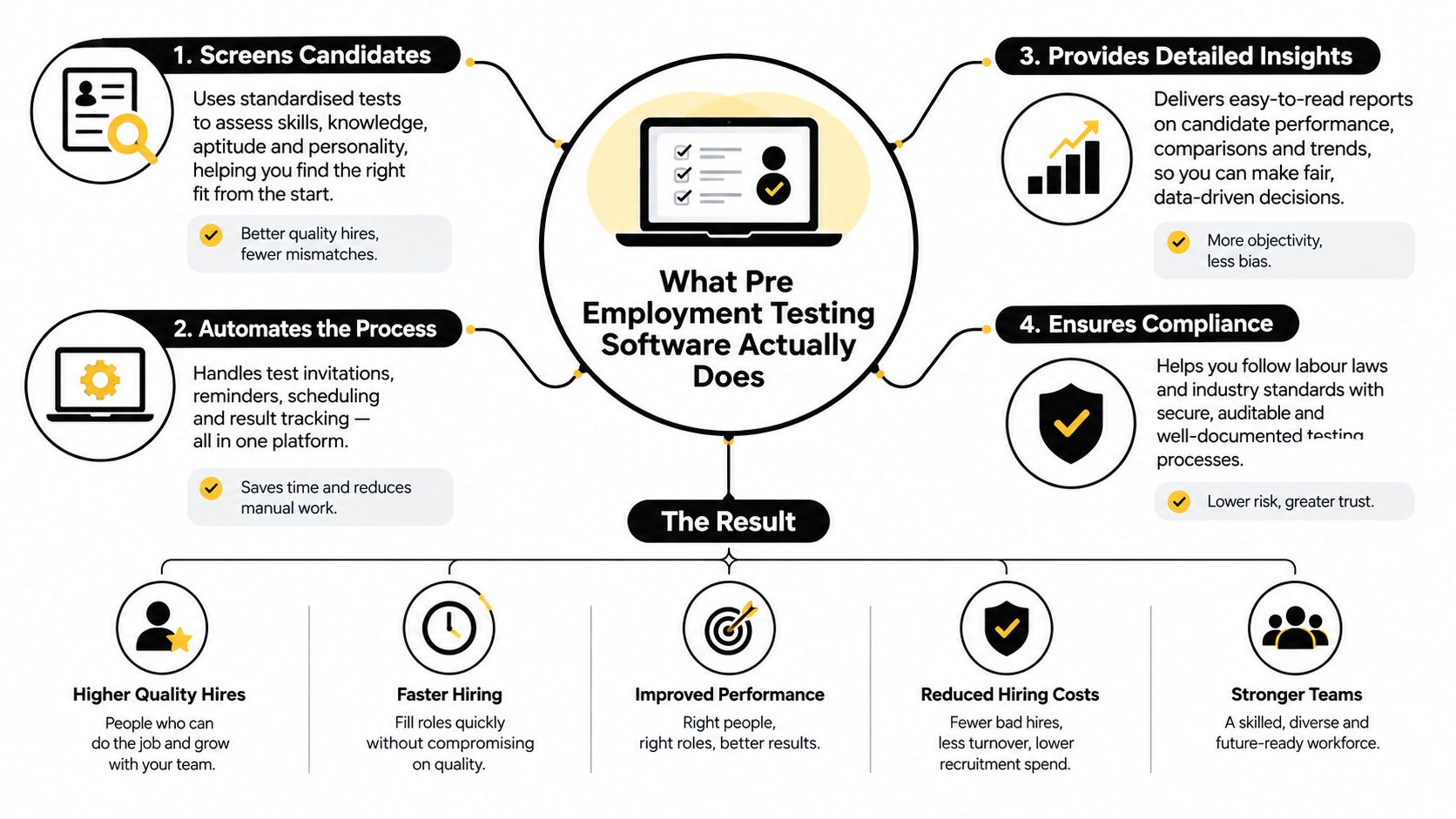
What Pre Employment Testing Software Actually Does
Pre-employment testing software is a measurement layer in the hiring process. It can assess cognitive ability, behavioural preferences, technical knowledge, coding, communication, job judgement, and applied work samples, depending on the platform and role. The useful question isn't how many tests a vendor offers. It's whether each test measures a capability that the job requires.
The main assessment layers
A platform may combine several components:
- Cognitive assessments: These examine reasoning, numerical thinking, verbal understanding, or spatial problem-solving.
- Technical assessments: Coding exercises, debugging tasks, data exercises, software proficiency tests, and role-specific knowledge checks measure applied capability.
- Behavioural and psychometric tools: These describe work preferences, interests, or behavioural tendencies. They can add context, but they shouldn't be treated as a complete prediction of performance.
- AI-led interviews: Phone screens and first-round interviews can apply consistent questions, capture responses, and structure recruiter review.
- Work simulations: Candidates perform tasks resembling the role, which can reveal how they apply knowledge under realistic conditions.
A useful starting point for comparing formats is this guide to candidate assessment tools. The selection should follow the competency, not the other way around. Testing a customer service candidate with an unnecessarily complex cognitive battery creates friction without necessarily improving the hiring decision.
Reliability is not the same as validity
Psychometric quality is a production requirement, not a decorative report feature. An India-focused validation study reported split-half reliability coefficients of r = 0.72 for its Interest Scale and r = 0.96 for its Aptitude Scale. The aptitude component included mechanical, numerical, spatial, verbal, and linguistic reasoning (the India-focused career assessment validation study).
Those coefficients illustrate why a single overall score can mislead. A candidate may achieve a strong aggregate result while one subtest contains inconsistent items or measures a different construct from the one the employer intended to assess. The assessment engine should therefore preserve item-level responses and report results by construct.
Good software also supports validation work outside the candidate dashboard. Assessment owners should be able to examine consistency across subtests, review differential-item performance, and compare results across relevant language, education, location, and demographic groups. A reliable test can produce consistent scores and still fail to predict job performance. That distinction should shape every buying decision.
How to Validate Assessments for Predictive Accuracy
A vendor's claim that an assessment is validated is only the beginning of the conversation. HR leaders need evidence that the test works for the specific role, candidate population, and decision point where they plan to use it.
Start by defining the outcome. For a software engineering role, that might include code quality, debugging performance, training completion, probation outcomes, or supervisor ratings. For a customer-facing position, it could include structured interview ratings, training performance, quality scores, or observed communication standards. The outcome must be job-relevant and recorded consistently.
A practical validation sequence
Define the construct. Write down whether the test measures numerical reasoning, written communication, debugging, technical depth, or job-task judgement. Avoid labels such as “culture fit” unless you can explain the observable behaviour behind them.
Check reliability by construct. Review consistency for each subtest rather than relying on the total score. The reported Indian validation study shows why aptitude and interest measures can have materially different reliability results.
Pilot with the intended population. Use Indian candidate groups who resemble the actual hiring funnel. Include relevant variation in education, location, language, and experience instead of validating only with an idealised sample.
Compare scores with later outcomes. Test scores should be examined against interview ratings, training completion, probation outcomes, or supervisor performance. Completion rates alone tell you whether candidates finished the test, not whether the test predicted work.
Review differential items and thresholds. An item may appear neutral while disadvantaging candidates because of language, access conditions, or irrelevant prior exposure. Analyse pass rates and unusual patterns before setting a permanent cut-off.
Version the assessment. Keep records of test forms, item changes, scoring rules, model updates, and threshold decisions. Otherwise, a later outcome comparison may combine different assessments without anyone realising it.
Use thresholds as routing rules
A pass mark shouldn't create a false impression of precision. A calibrated threshold can route candidates into differentiated workflows: demonstrated competence may trigger progression, borderline performance may prompt targeted retesting, and anomalous results may require human review.
For AI-led coding or interview assessments, require evidence that the system distinguishes foundational knowledge from applied problem-solving. The platform should show the basis for a recommendation, not just produce a rank order. A useful competency assessment test framework can help teams connect questions to observable job behaviours before they configure automated scoring.
Reliability supports confidence that a test is measuring consistently. Predictive validation supports confidence that the result matters. You need both.
Does Assessment Reduce Bias or Just Relocate It
Structured testing can reduce subjectivity in CV screening, but fairness depends on what the assessment measures and how candidates take it. Bias can shift into question design, language, access conditions, scoring rules, proctoring, or recruiter interpretation.
A reported 2025 Naukri hiring trend found that 62% of Indian companies valued skill-based assessments as a critical stage in fresher recruitment, up from 38% three years earlier (the reported Naukri hiring trend). Wider adoption shows that employers are relying more on assessments. It does not establish that the tests predict performance fairly for Indian candidates.

The test environment can shape the score
A result may reflect more than the target competency. English fluency, internet stability, device access, familiarity with online testing, college background, city, and the physical setting can affect performance. Candidates from smaller towns, non-elite institutions, or return-to-work groups may face disadvantages unrelated to job performance.
A technically capable candidate who loses connectivity can appear less capable than someone with reliable access. A timed, English-heavy assessment may measure language comfort more than the communication behaviour required for the role. Proctoring can also turn a legitimate interruption into a negative integrity signal when the system lacks context.
Fairness requires measurement
One reported 2025 survey found that 42% of job seekers experienced hiring bias, compared with 21% in 2023 (the reported survey on job-seeker hiring bias). The figures do not identify the cause, but they show why automation should not be treated as proof of objectivity.
Recruitment teams should monitor:
- Completion patterns: Compare who starts, finishes, and abandons the assessment.
- Pass-rate differences: Review results by gender, region, language, college background, and accessibility needs where lawful and appropriate.
- False negatives: Examine candidates who failed but later performed well after human review or hiring.
- Accommodation outcomes: Record how candidates request reasonable alternatives or support.
- Human overrides: Log disagreements with automated recommendations and the evidence behind each decision.
A consistent scoring process is only as fair as the questions, conditions, and job criteria behind it.
The practical test is whether the assessment predicts job performance for the Indian applicant population without creating avoidable adverse selection. Availability, automation, and anti-cheating controls do not demonstrate predictive validity. Teams need evidence that scores reflect relevant capability rather than connectivity, language, or familiarity with the testing format.
India-Specific Compliance and Vendor Governance
The most visible software features are usually question libraries, automated scoring, integrations, identity checks, and proctoring. The harder procurement work concerns candidate data, explainability, retention, and vendor accountability.
Recruitment systems may process CVs, identity documents, educational records, references, employment histories, assessment responses, interview recordings, and model-generated recommendations. Under India's Digital Personal Data Protection framework, HR teams need a clear operating position on notices, purposes, access, retention, deletion, and connected processors. The exact legal implementation should be reviewed with qualified counsel, but the operational controls shouldn't wait for a contract dispute.
Compare governance before features
| Area | Basic vendor answer | Procurement standard |
|---|---|---|
| Candidate notice | “Candidates accept the terms.” | The notice explains what data is collected, why it is used, and how candidates can exercise relevant rights. |
| Data storage | “We use secure cloud infrastructure.” | The vendor identifies storage locations, access controls, subprocessors, and transfer arrangements. |
| Retention | “Data is retained according to policy.” | The employer can configure retention periods and verify deletion across connected systems. |
| AI recommendations | “The model ranks candidates.” | Recruiters can inspect evidence, understand material factors, and record a human decision. |
| Model changes | “The system improves over time.” | The vendor documents model updates, version changes, validation impact, and approval controls. |
| Incident response | “We monitor security.” | Contracts define notification, investigation, cooperation, and remediation responsibilities. |
A vendor may offer strong security and still provide weak explainability. A platform may explain a score but lack a reliable deletion workflow. Evaluate both dimensions rather than accepting a general compliance statement. This cognitive ability assessment test guide provides useful context for connecting assessment design with responsible use.
Automation expands the control surface
Automated hiring doesn't necessarily reduce compliance work. It can add an assessment provider, an AI interview service, a proctoring processor, an analytics layer, and ATS integrations to the recruitment stack. Each connection creates another place where candidate information may be stored, copied, transformed, or retained.
Ask vendors where data is stored, which subprocessors they use, how access is logged, whether deletion requests propagate across integrations, and how recruiters can override automated decisions. Require a data-flow map before production launch. The platform should support an audit trail that shows the assessment version, score, recommendation, reviewer, and final outcome.
Building Your Evaluation Framework
A sound buying decision starts with the hiring problem, not a feature comparison page. A platform that excels at coding tests may be unsuitable for a frontline role. A broad psychometric library may still fail if it doesn't provide evidence that the selected measures predict performance in your Indian applicant population.
Use a weighted evaluation that covers four connected areas.
Measure the work
Begin with the job analysis. Identify the tasks that distinguish effective performance, then map each assessment item to an observable competency. For a developer, that may include debugging, efficiency, code quality, and technical depth. For a sales role, it may include communication, judgement, and response to customer scenarios.
Reject assessments that measure interesting traits without a defensible connection to the role. A longer test isn't automatically better. Candidate effort is justified only when the resulting evidence improves a real hiring decision.
Validate the decision
Ask the vendor to show reliability by construct, validation design, candidate population, and outcome measures. Then define your own review cycle:
- Before launch: Confirm the blueprint, item relevance, accessibility, scoring rules, and human-review triggers.
- During rollout: Monitor completion, technical failures, candidate feedback, score distributions, and subgroup patterns.
- After hiring: Compare assessment results with training, probation, supervisor performance, and other job-relevant outcomes.
- After changes: Recheck results whenever the test form, scoring model, threshold, or AI workflow changes.
Govern the data and the model
Require candidate notices, purpose limitation, configurable retention, deletion workflows, access controls, subprocessor visibility, and documented model updates. Make explainability practical. A recruiter should be able to see why a recommendation was made and record why a human accepted or rejected it.
Career Central provides AI-driven phone screening, first-round interviews, and coding assessments for organisations, including structured candidate scoring, automated technical screening, AI-powered proctoring, scheduling, and detailed assessment reports. Those capabilities should be evaluated against the same standards as any other vendor: job relevance, predictive evidence, fairness monitoring, explainability, and data governance.
Decision test: Don't ask whether the software can assess candidates. Ask whether your team can defend the assessment, explain the result, and show that it relates to performance.
The strongest implementation is usually narrower than the vendor demo. Start with a small set of high-volume roles, define the competencies, pilot the workflow, review adverse signals, and compare assessment results with later outcomes. Expand only when the evidence supports expansion.
Career Central offers AI-driven phone screening, first-round interviews, and coding assessments that help organisations evaluate communication, technical capability, and structured candidate responses earlier in the hiring funnel. Review the assessment workflow and discuss how it could fit your India hiring process by visiting Career Central.