
Your shortlist looks strong on paper. The degrees match, the CVs use the same confident language, and every candidate appears to have the required experience. Yet once interviews and onboarding begin, performance separates quickly. One person learns the workflow, spots errors and handles unfamiliar problems. Another struggles with the same information, despite having an equally polished application.
That's where a cognitive ability assessment test can add useful evidence. It can show how candidates reason, interpret information and learn, but only when the assessment measures capabilities relevant to the role and reflects the population being tested. In India, that qualification matters because language, education, region and access to opportunity can influence scores just as strongly as job-related reasoning.
Why Cognitive Ability Tests Matter in Modern Hiring
A hiring manager recruiting customer-support analysts might receive hundreds of applications. CV screening can identify education and experience, but it rarely shows how quickly someone can interpret a new policy, connect information from separate sources or make a sound decision when the answer isn't obvious. Interviews help, but they also depend on interviewer judgement, candidate confidence and the questions selected.
A structured cognitive assessment adds a different signal. It can examine reasoning, problem solving, information processing and learning potential under consistent conditions. That doesn't make the score a complete portrait of a candidate. It makes it one controlled observation that can be compared with other job-related evidence.
Practical rule: Use the test to answer a job question, not to assign a broad label such as “intelligent” or “not intelligent”.
The distinction matters. A numerical reasoning module may make sense for a financial analyst who interprets dashboards, while a verbal comprehension exercise may be more relevant to a policy writer. A generic IQ-style score can conceal these differences and encourage recruiters to treat a convenient number as a final decision.
The value comes from job alignment
Start with a task analysis. List the decisions, information sources and learning demands that define acceptable performance. Then select the narrowest set of cognitive constructs that represent those demands.
For example, a service operations role may require candidates to:
- Interpret written information: Apply a process rule to a customer situation.
- Sequence decisions: Follow a structured escalation path without skipping conditions.
- Work accurately with data: Compare records and identify discrepancies.
- Learn procedures: Retain new instructions during training.
A well-designed test can make these requirements visible earlier than an unstructured conversation. It can also reduce reliance on prestige signals such as college name or fluent interview performance, but only if the assessment has appropriate local norms and is administered fairly.
The risk runs in the opposite direction when an organisation imports a foreign test, applies a universal cutoff and calls the result objective. That process can filter out capable candidates for reasons unrelated to the role. The practical roadmap is therefore straightforward: define the construct, check local evidence, provide access and accommodations, monitor outcomes, and keep human review in the decision.
What Cognitive Ability Assessment Tests Actually Measure
Cognitive ability isn't one indivisible trait. A useful assessment separates the mental activities a person will use at work and reports them clearly enough for recruiters to interpret without overclaiming.
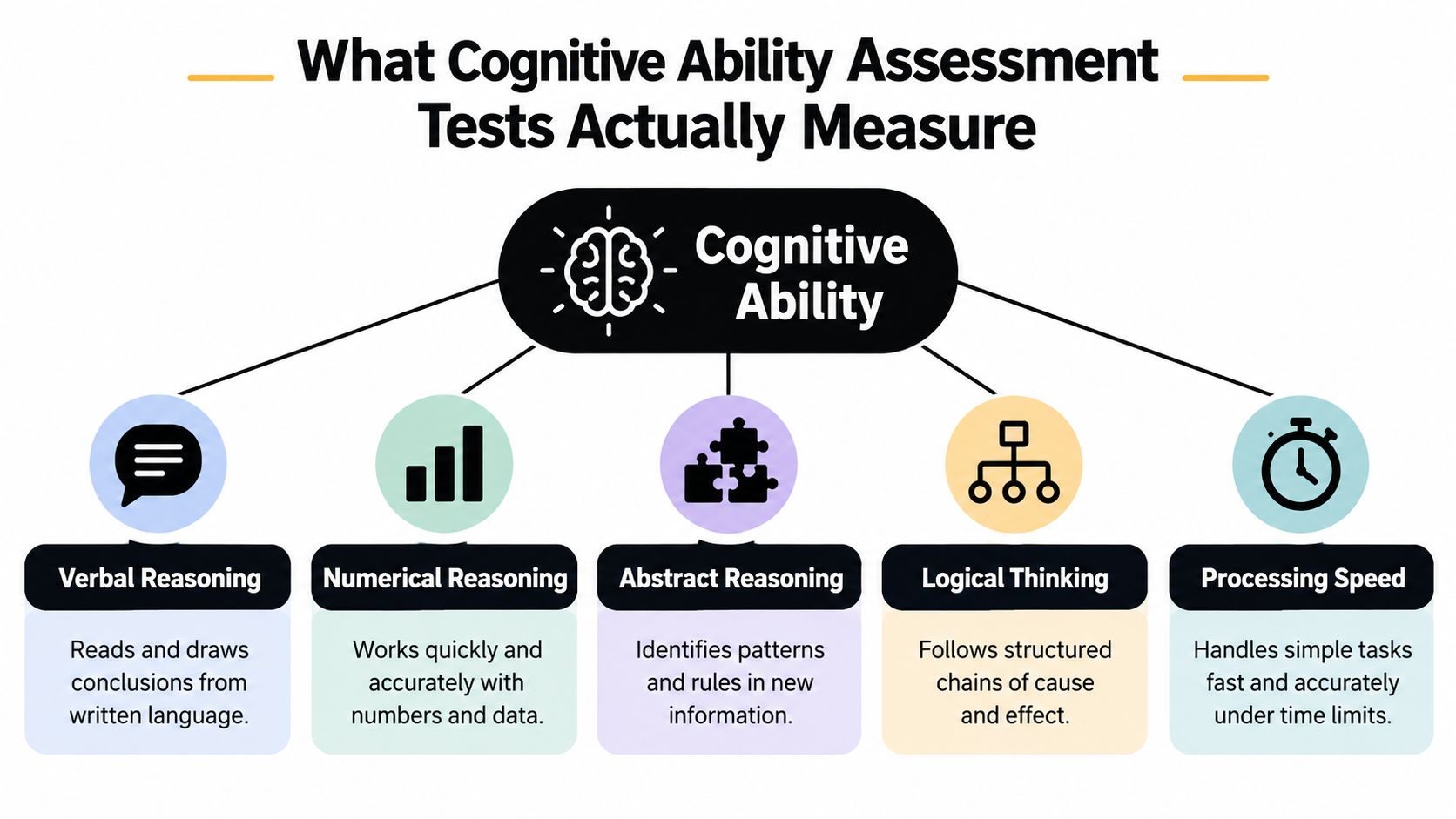
Five practical constructs
Verbal reasoning examines whether a candidate can understand written language, identify meaning and draw a defensible conclusion. It may suit roles involving policies, contracts, customer communication or written analysis. It can also be heavily affected by language familiarity, so employers must distinguish job-required comprehension from general English fluency.
Numerical reasoning focuses on interpreting quantities, tables, ratios or trends. It isn't necessarily advanced mathematics. A procurement coordinator may need to compare supplier data, while a business analyst may need to identify a pattern in a performance report.
Abstract reasoning presents unfamiliar shapes, sequences or relationships. Candidates infer a rule and apply it to new information. This can be useful where employees must learn systems or solve problems that don't resemble examples they've seen before.
Logical thinking tests structured cause and effect. It asks whether a person can follow conditions, identify an implication or select the next valid step. Recruiters assessing this construct can also use a dedicated online logical reasoning test when the role depends on ordered decisions.
Processing speed concerns how quickly and accurately someone handles relatively simple information under time pressure. Speed should never be treated as an automatic virtue. If the job rewards careful judgement more than rapid responses, an aggressive time limit may measure test-taking pace rather than performance.
Ability is not the same as familiarity
A candidate may perform poorly because the instructions are linguistically complex, the interface is unfamiliar or the testing conditions are distracting. That's why test interpretation should consider administration, language, device access and any accommodation used.
A multidimensional profile is usually more informative than one score. It can show that a candidate has strong numerical reasoning but needs more time on verbal items, or that a person reasons accurately despite slower processing speed. Those distinctions support better placement and interview probing than a single pass or fail label.
Common Types of Cognitive Ability Assessments
Choosing the assessment type should follow the work, not the vendor's feature list. A numerical test may be highly relevant to an analyst and largely irrelevant to a role where success depends on reading nuanced instructions and managing competing priorities.
| Assessment type | Useful signal | Typical role fit | Main caution |
|---|---|---|---|
| Numerical reasoning | Interpreting figures and quantitative relationships | Finance, operations, analytics and technical roles | Don't turn it into an advanced mathematics exam unless the job requires that level |
| Verbal reasoning | Understanding written information and drawing conclusions | Policy, support, legal, communications and administrative work | Language fluency may contaminate the score |
| Abstract reasoning | Detecting patterns in unfamiliar information | Technical, analytical and learning-intensive roles | Explain the construct and avoid presenting it as a complete intelligence measure |
| Logical reasoning | Applying rules and following conditional relationships | Coding, compliance, troubleshooting and process work | Use realistic time limits and review accessibility |
| Clerical or perceptual measures | Comparing information quickly and accurately | Records, administration, data handling and transaction processing | Excessive speed pressure can punish careful candidates |
| Combined battery | A broader profile across relevant domains | Roles with mixed cognitive demands | Only include components supported by job analysis |
Evidence from India supports the battery approach, while also warning against generic interpretation. An Indian validation study of the General Aptitude Test Battery examined 3,694 working adults across professional and technical, administrative and managerial, clerical, and sales occupations. It identified four stable dimensions, form perception, numerical aptitude, general intelligence and clerical perception, with retest reliability coefficients ranging from 0.61 to 0.83 and validity coefficients ranging from 0.50 to 0.82 (Indian GATB validation study).
That finding doesn't mean every employer should deploy all four dimensions. It means a role-specific combination can be more defensible than an undifferentiated IQ score. A recruiter comparing assessment vendors should ask which construct each module measures, why it belongs in the workflow and how its score relates to the outcomes the organisation cares about.
For a broader overview of formats and use cases, see types of aptitude tests. The practical test is simple: if removing a module wouldn't change how the job is performed, question why candidates must complete it.
Validity, Reliability, and What Indian Evidence Shows
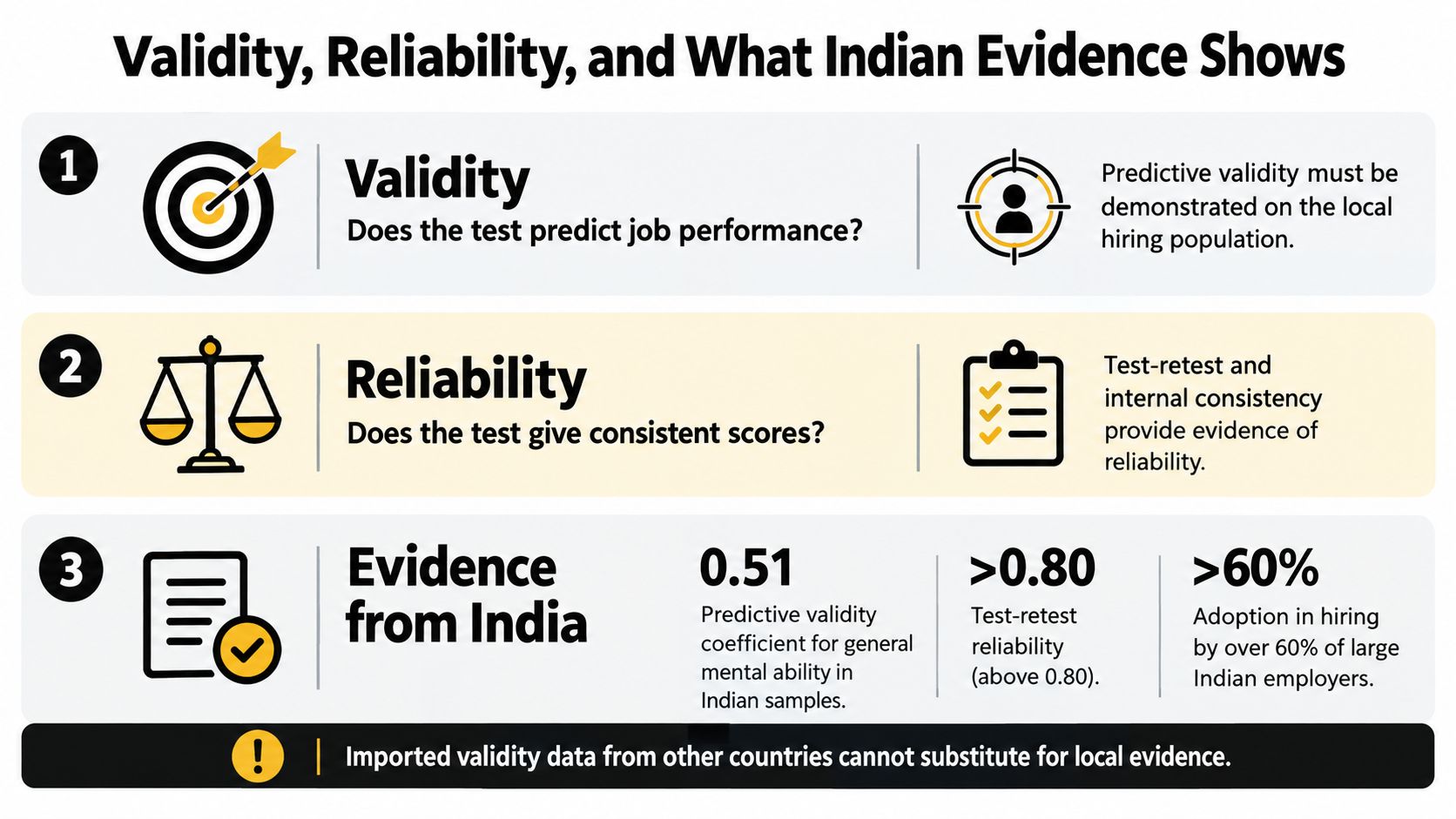
A reliable test produces reasonably consistent results under comparable conditions. A valid test supports the intended interpretation of those results. The two ideas are related, but they aren't interchangeable. A test can be consistent and still measure the wrong capability.
What employers should verify
Ask vendors for evidence rather than accepting “scientifically validated” as a sufficient answer.
- Construct validity: Does the assessment measure reasoning, memory, numerical interpretation or another defined capability?
- Criterion-related validity: Do scores relate to outcomes such as interview progression, training completion, coding-test performance or early job performance?
- Reliability: Are scores stable enough for the decision being made?
- Normative relevance: Was the reference group similar to the candidates and role population?
- Administration consistency: Do candidates receive comparable instructions, time limits, devices and support?
The Indian GATB evidence is useful because the factor structure remained meaningful across occupational groups. Its reported reliability and validity ranges also show why employers should examine the precise coefficient and sample behind a vendor's claim instead of relying on a headline figure.
Scale matters, but so does purpose
The Longitudinal Aging Study in India began in 2010 and recruited more than 70,000 participants aged 45 years and older across all 29 Indian states, using a stratified, multistage area-probability sample. Its dementia-assessment substudy included structured measures of memory, verbal fluency and attention-related abilities (Longitudinal Aging Study in India evidence).
This isn't a recruitment validation study, and employers shouldn't treat it as one. Its value is methodological. Responsible interpretation needs representative samples, multiple cognitive domains and standardised administration. A vendor using a narrow or highly educated reference group can't automatically support comparisons across India's full workforce.
Validation also continues after launch. Track whether scores relate to outcomes in the actual role, whether candidates complete the assessment under comparable conditions and whether selection decisions change when the test is combined with structured interviews. If the relationship weakens for a particular job family or group, review the assessment rather than lowering standards or increasing the cutoff.
Fairness Risks in Linguistically and Educationally Diverse Hiring Pools
Objectivity doesn't guarantee fairness. A computer can score every candidate identically while the test itself advantages people who have had greater exposure to its language, format or underlying educational conventions.

An English-heavy assessment may measure reading fluency as much as reasoning. A timed written test may favour candidates accustomed to formal examinations. A problem presented through a culturally familiar context may be easier for one group to decode than another, even when the job itself doesn't depend on that context.
Indian research on Raven's Coloured Progressive Matrices illustrates the danger of imported norms. Existing norms classified 78.5 percent of a 1,752-child sample from Delhi, Hyderabad and Patna in the bottom tenth percentile, indicating severe mismatch for disadvantaged government-school populations (research on Indian Raven's norms).
The finding concerns children, not a recruitment sample, so it shouldn't be used to predict workplace performance. It does demonstrate how a norm can produce implausible conclusions when the reference group doesn't represent the people being assessed.
Audit the item, not just the final score
Fairness review should examine where candidates lose points and where they leave the process.
- Language groups: Compare completion and success patterns across the languages used in recruitment.
- Education groups: Check whether performance changes sharply with school or degree background in ways unrelated to job outcomes.
- Location: Review access, device quality, connectivity and test environment by region.
- Gender and other relevant groups: Monitor progression, completion and criterion-related validity.
- Disability and accommodation: Confirm that accessible formats preserve the construct rather than adding an avoidable barrier.
Differential-item analysis can identify questions that are disproportionately difficult for a group after accounting for the intended ability. Employers should also test whether one national cutoff produces materially different selection rates across applicant groups. A lower score isn't automatically evidence of discrimination, but unexplained and job-irrelevant differences deserve investigation.
A fair assessment doesn't erase difference. It separates job-relevant difference from unequal opportunity to demonstrate capability.
Use language-appropriate instructions, distinguish verbal from nonverbal reasoning and avoid treating one score as a universal measure. Where the job allows it, reasonable accommodations such as extra time, screen-reader compatibility or an alternative accessible format can improve access without changing the capability being assessed.
Legal and Ethical Considerations for AI-Enabled Cognitive Screening
AI can standardise scoring and support high-volume recruitment, but automation also makes weak assumptions easier to apply at scale. If a model ranks candidates using an assessment with poor local norms, efficiency only accelerates the wrong decision.
Employers should treat transparency and contestability as operational requirements. Candidates need to know that an automated assessment contributes to a hiring decision, what broad capability it evaluates and how they can request support or review. A black-box rejection may be statistically defensible in a vendor presentation and still feel procedurally unfair to the person excluded.
Independent legal analysis warns that automated employment evaluations may overlook disability, health conditions, gender identity, maternity-related circumstances and other individual limitations, creating disparate-impact risks even when the assessment appears neutral (analysis of automated employment evaluation risks).
What to require before procurement
A procurement conversation should cover evidence, rights and operational controls:
- Role-specific validation: Ask how the test predicts outcomes for the exact job family and hiring population.
- Adverse-impact monitoring: Require selection, completion and predictive-accuracy reviews across relevant groups.
- Training-data documentation: Understand what data shaped the scoring logic and whether the model has changed.
- Candidate notice: Provide plain-language information about the assessment and automated processing.
- Accommodation route: Offer a clear process for requesting accessible administration.
- Human review: Ensure an authorised reviewer can examine exceptional cases and documented concerns.
- Appeal or correction path: Give candidates a way to report technical problems or request reconsideration.
- Independent audit readiness: Preserve the records needed to test results after deployment.
Regulatory approval shouldn't replace internal validation. India doesn't yet provide employers with a dedicated equivalent of the EU AI Act for high-risk recruitment systems requiring formal conformity assessment, transparency and human oversight, so organisations must build their own governance evidence rather than waiting for a regulator to certify a tool.
A highly predictive assessment can still be unacceptable if candidates can't understand or challenge its use. Conversely, a transparent assessment with modest predictive value may support a more trusted process when combined with structured human judgement.
Best Practices for Designing and Auditing Cognitive Assessments
Good deployment starts before the vendor demo. Write a short assessment specification that connects each module to a real work demand, the outcome used for validation and the groups whose results require monitoring.
Build the workflow around evidence
Analyse the role first. Interview job experts, review critical incidents and identify the reasoning demands that distinguish acceptable from strong performance. Don't add verbal, numerical or abstract modules just because a platform includes them.
Select local evidence. Ask for normative samples, language versions, reliability statistics, factor evidence and predictive studies involving Indian candidates. India's own assessment history shows why adaptation matters. In 1922, Herbert Rice adapted the Binet intelligence scale into a Hindustani point-scale test, with norms reportedly developed from 1,488 boys (history of Indian intelligence testing).
Design accessible administration. Test the interface with assistive technologies, provide clear instructions and document how accommodations affect scoring. A candidate shouldn't be penalised for a disability, language barrier or avoidable technical obstacle.
Pilot before setting thresholds. Compare assessment results with structured interview ratings, work samples, training outcomes or early performance. A cutoff should reflect job requirements and available evidence, not the vendor's default recommendation.
Audit after launch. Review selection rates, completion rates, item behaviour, complaints, accommodations and criterion-related validity at regular intervals. Monitor results by language, education, gender, location and other relevant groups, while protecting candidate privacy.
Keep humans accountable. Use the test as one input. A trained reviewer should consider structured interview evidence, work samples, qualifications and documented accommodations before making a decision.
Audit question: If a candidate challenges the result, can your team explain what was measured, why it mattered and how fairness was checked?
That question exposes weak programmes quickly. A vendor may provide a polished dashboard, but the employer still owns the decision, the candidate experience and the consequences of an inappropriate cutoff.
Building a Fair and Effective Cognitive Assessment Strategy
A defensible strategy balances three tests. Validity asks whether the assessment predicts something the job needs. Fairness asks whether candidates have a comparable opportunity to demonstrate that capability. Governance asks whether the organisation can explain, monitor and review the decision.
Use a cognitive assessment when the role contains genuine reasoning or learning demands, the selected constructs come from job analysis and local evidence supports interpretation. Adjust the design when one language, education group or region shows unexplained disadvantage. Pause deployment when the organisation can't provide accommodations, explain the scoring logic or connect results to job outcomes.
The assessment should sit inside a broader process, not replace it. Combine relevant cognitive evidence with structured interviews, realistic work samples and role-specific technical exercises. Career Central's candidate assessment tools can support AI-driven phone screening, first-round interviews and coding assessments, but any platform should be configured around documented hiring criteria and reviewed for subgroup outcomes.
Your decision framework can remain practical:
- Adopt when validity, accessibility and monitoring are in place.
- Adjust when the construct is useful but administration or subgroup results need improvement.
- Pause when the test creates unexplained exclusion or lacks a defensible evidence trail.
Start with one role, document the assumptions and review the outcomes before scaling. Efficient hiring matters, but an efficient process that removes capable people for irrelevant reasons isn't a quality process.
Career Central provides AI-driven phone screening, first-round interviews and coding assessments that can include structured scenario and problem-solving questions. Visit Career Central to explore assessment workflows that can complement a carefully validated cognitive testing strategy.