
The most popular advice about a logic test for programmers is wrong. Hiring teams don't need harder puzzles, longer tests, or more aggressive surveillance. They need an assessment that reveals how a candidate reads requirements, reasons through uncertainty, tests assumptions, and works inside the conditions of a real job.
I've seen strong candidates fail because the browser froze, the prompt was ambiguous, or the test rewarded memorised patterns instead of sound engineering judgement. I've also seen polished applicants pass easy exercises and struggle with basic debugging once hired. The difference isn't cleverness. It's assessment design.
India's technology market makes this distinction especially important. The country's IT industry directly employs more than 4 million people and supports approximately 12 million additional indirect jobs, according to Communications of the ACM's account of India's software industry. A broad, varied talent pool needs a consistent signal, but consistency doesn't mean pretending every candidate has had the same education, equipment, language exposure, or preparation.
Why Logic Tests Beat Resume Gut Feelings
A recruiter opens a requisition for a backend developer and receives a stack of CVs. One candidate has a prestigious university, several recognisable employers, and polished project descriptions. Another has a lesser-known degree, freelance work, and a repository full of modest but practical applications. A third lists every framework currently popular in the market, yet can't explain how their systems handle invalid input.
Resume review alone can't reliably separate those profiles. It records where candidates have been, not how they think when a requirement is incomplete, a test fails, or a first solution runs too slowly.

A well-built logic test gives every applicant the same problem, constraints, and evaluation rules. That doesn't make the process automatically fair, but it makes the evidence easier to compare. A candidate who identifies ambiguous requirements, writes sensible pseudocode, handles empty input, and explains a trade-off has demonstrated something a job title can't show.
Recruiter's rule: Use the CV to decide who deserves a fair chance. Use the test to examine how that person solves a relevant problem.
This is why I prefer a targeted programming exercise to an impressive-looking puzzle. A question about processing records, validating an API payload, or finding a bottleneck in a data pipeline can expose practical reasoning more effectively than an obscure algorithm that most engineers rarely use. The test should measure capabilities the role requires, not the candidate's ability to recognise a familiar interview template.
A logic test also creates a useful conversation. When a solution fails a hidden case, ask the candidate what they'd inspect first. When the code works but uses an inefficient approach, ask what would change at larger scale. Their explanation reveals whether they understand the result or merely reached it.
For a broader view of how structured reasoning exercises fit into technical hiring, see this guide to problem-solving assessments. The key is to treat the score as one job-related signal, not a verdict on intelligence, potential, or personal worth.
Designing the Perfect Programming Challenge
The best challenge starts with the role, not a coding-question library. Before writing the prompt, identify the work the successful hire will perform and the mistakes that would create operational risk. A platform engineer may need to reason about throughput and failure recovery, while a frontend engineer may need to transform messy state into predictable user behaviour.
Start with a realistic requirement
Write a short scenario with explicit inputs, outputs, constraints, and examples. Then deliberately include the details candidates must clarify. A good task might ask them to process a sequence of events where duplicates, missing values, and out-of-order records are possible. A weak task asks for a textbook algorithm without explaining why the business needs it.
Avoid trivia. Don't test whether someone remembers an obscure language method when the job provides documentation, code search, and modern development tools. Test whether they can choose a suitable approach, implement it correctly, and explain what could break.
Calibrate difficulty to the job
A junior test should reveal whether the candidate can decompose a problem, use basic control flow, and validate assumptions. A senior test should add architectural judgement, performance reasoning, or ambiguous requirements. Difficulty shouldn't come from deliberately confusing wording.
Use a layered challenge rather than one cliff edge:
- Requirements reading: Ask the candidate to identify assumptions and clarify edge cases.
- Pseudocode: Look for a coherent plan before syntax enters the picture.
- Implementation: Let them use a language appropriate to the role.
- Adversarial testing: Ask for cases that could defeat the first solution.
- Explanation: Require a concise account of complexity, trade-offs, and remaining risks.
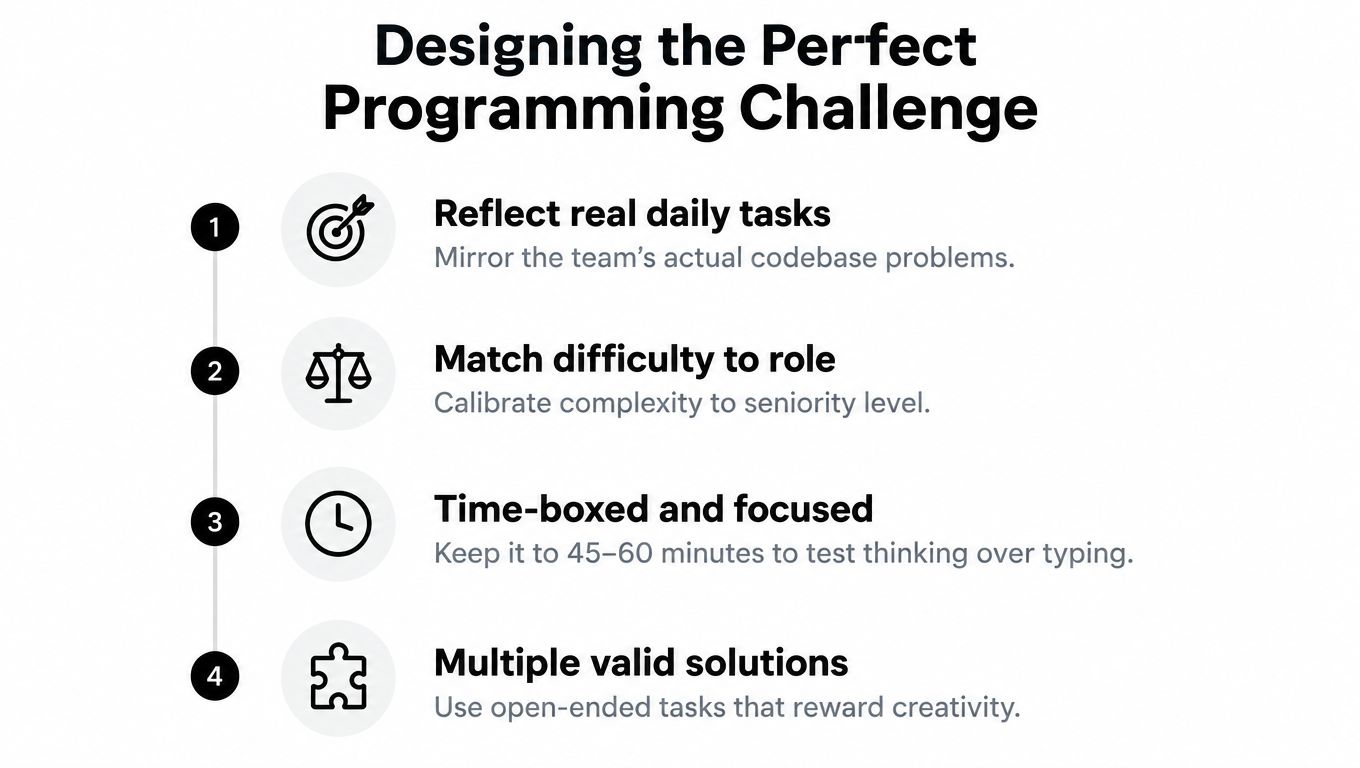
The time limit should test thinking, not typing endurance. A focused 45 to 60 minute exercise can work when the problem is clear, the editor is stable, and the candidate knows how the session will run. Give candidates the instructions, permitted resources, expected environment, and accessibility process before the test begins. Unexpected rules create noise that has nothing to do with programming.
Build more than one valid route
Don't design a puzzle with one secret trick. A good challenge allows a straightforward solution and rewards candidates who improve it thoughtfully. For example, an initially simple search may be acceptable for a small input, while a stronger candidate can identify when indexing or a different data structure would matter.
Use a pilot group to catch ambiguity, accidental language bias, and unrealistic assumptions. Review not only completion rates but also the explanations produced by capable engineers. If good candidates interpret the requirement in different ways, fix the prompt before blaming the candidates.
Teams comparing online options should examine test configuration, coding languages, sandbox stability, review workflows, and candidate support. This overview of online coding tests is useful as a starting point, but your own job analysis should control the final design.
Choosing the Right Assessment Platform
The platform isn't a neutral delivery box. It shapes what candidates can do, what recruiters can observe, and which failures appear in the report. Choose it as carefully as you choose the question.
For a small team, a lightweight environment may be enough. You need a reliable editor, language execution, hidden tests, candidate instructions, and a way to review code and notes. Paying for advanced proctoring or complex integrations before the hiring process is stable adds cost without improving judgement.
A growing organisation needs more control. Look for reusable question libraries, role-specific templates, time controls, custom test cases, structured scoring, and integrations with the applicant tracking system. Recruiters should be able to invite candidates, see completion status, and share results without exporting sensitive data into scattered spreadsheets.
An enterprise team should assess governance as well as functionality. Ask where candidate data is stored, who can access recordings, how long information is retained, how accommodations are recorded, and whether the platform supports consistent permissions. A technically complex dashboard is useless if interviewers can't understand the evidence or if candidates can't complete the test on ordinary equipment.
Compare the environment, not just the feature list
| Hiring situation | Prioritise | Avoid |
|---|---|---|
| Lean startup | Fast setup, stable execution, simple review | Complex administration that recruiters won't use |
| Scaling team | Templates, ATS integration, analytics, reviewer workflows | A single generic test for every engineering role |
| Enterprise hiring | Permissions, auditability, customisation, support | Unclear data handling and opaque scoring |
| Distributed recruitment | Browser reliability, clear instructions, accessibility support | Treating connection failures as candidate failures |
The candidate experience deserves equal weight. Test the invitation email, login process, editor, language selection, autosave, submission flow, and support route from a normal laptop. A platform that works perfectly for an engineering administrator can still frustrate an applicant who has never used it.
Use analytics to investigate the process, not to create false precision. Completion failures, repeated browser errors, and unusual timeouts may indicate an environment problem rather than weak reasoning. Review those signals alongside candidate feedback and interviewer observations.
When comparing candidate assessment tools, include AI-assisted workflows in the discussion. Career Central offers AI-driven phone screening, first-round interviews, and coding assessments, including timed challenges that evaluate problem-solving, syntax, algorithmic fluency, and logical reasoning. It belongs in the same evaluation conversation as any other platform, alongside your requirements for validation, fairness, integrations, and human review.
Scoring and Evaluation Criteria That Matter
Code that compiles is not necessarily good code. Code that fails one test is not necessarily evidence that the candidate lacks ability. A fair scoring method separates the dimensions that matter and tells interviewers what evidence to record.
A practical rubric can begin with the following weighting:
| Criterion | Weight | What to inspect |
|---|---|---|
| Correctness | 50% | Does the solution produce the required result across normal and adversarial inputs? |
| Complexity | 20% | Is the approach efficient enough for the role's expected workload? |
| Robustness | 15% | Does it handle null, empty, malformed, boundary, and unexpected input? |
| Readability | 10% | Can another engineer understand and maintain the solution? |
| Explanation | 5% | Can the candidate describe assumptions, trade-offs, and limitations? |
These weights are a starting point, not a universal law. A backend role may demand closer inspection of complexity and failure handling. A product-facing role may place more emphasis on readable logic and clear communication. Keep the categories stable enough for comparison, but adjust the job-related emphasis before the hiring campaign begins.
Inspect the failed cases
Hidden tests should cover the mistakes experienced interviewers see repeatedly:
- Empty or null input: The candidate assumes a record always exists.
- Off-by-one logic: The loop skips the first or last valid item.
- Integer overflow: Arithmetic works on examples but fails at a larger boundary.
- Shared-state mutation: A helper changes data another part of the solution still needs.
- Excessive time complexity: The code works on a sample but becomes unusable as input grows.
- Example overfitting: The candidate matches visible cases without modelling the requirement.
Ask the candidate to test their own solution before showing the final score. Their test selection is evidence. So is their response when a case fails. A candidate who calmly isolates the defect and revises the assumption may show stronger engineering judgement than someone who produces a flawless answer only because the problem matched a memorised pattern.
Skill-based assessment deserves serious weight in India's technical hiring market. In a 2021 survey of 957 technology recruiters, 38% said they would hire a developer with excellent coding skills despite educational qualifications, as reported by The Economic Times. That supports structured evaluation, but not an automatic cutoff.
Use a threshold only when the role has an essential capability. Otherwise, rank candidates by the rubric and combine the result with a work sample, structured interview, and reference evidence. Record why someone passed or failed. If reviewers can't explain a decision in job-related terms, the scoring system isn't ready.
Combating Cheating and Ensuring Fairness
AI has changed the logic test for programmers, but banning every external tool won't restore the old assessment model. Candidates work with search, documentation, autocomplete, code assistants, and review tools in real jobs. The useful question is not whether a candidate can avoid all assistance. It's whether they can understand, direct, test, and take responsibility for the output.
A controlled test can use different modes for different purposes. An unaided section can measure independent reasoning. A permitted-tools section can assess how the candidate validates generated suggestions and catches mistakes. A follow-up discussion can expose whether the submitted code reflects their understanding.
Secure the process without intimidating honest candidates
Randomised question pools reduce answer sharing, and plagiarism checks can flag copied structures. Live observation may be appropriate for high-risk roles, but intrusive monitoring can introduce its own bias, particularly when candidates use assistive technology or work in environments with limited privacy.
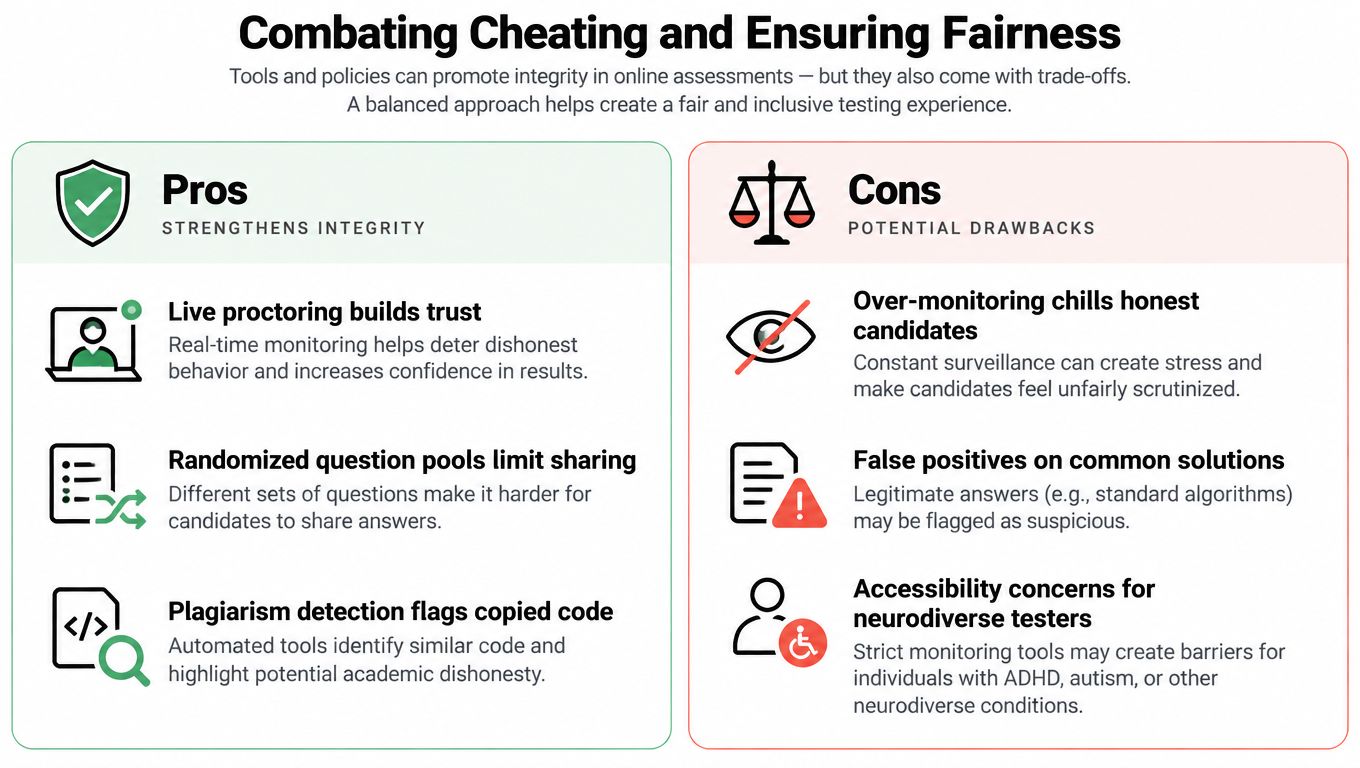
Explain the rules in advance. Tell candidates whether documentation, search, AI tools, notes, or another person are allowed. Offer an alternative verification method when monitoring fails. A short live review of the candidate's decisions is often more informative than assuming that a screen recording proves authorship.
Infrastructure is part of fairness. Candidates may face unreliable connectivity, older devices, unfamiliar keyboards, language barriers, or limited access to quiet working space. Provide a test environment check, clear support instructions, reasonable accommodations, and a way to report technical failure without penalty.
The available Indian evidence demands caution in interpreting scores. One reported study found that over 60% of assessed candidates could not write code that compiled, while only 1.4% wrote code that was both functionally correct and efficient, according to the report summarising the assessment. Those figures show why employers need rigorous evaluation, but they don't prove that a short test predicts production performance.
Fairness check: If a candidate fails because of the device, wording, monitoring setup, or access conditions, you haven't measured programming logic. You've measured the test environment.
Track completion failures, support requests, timeouts, and score patterns by relevant candidate groups. Don't use demographic information to lower standards. Use it to detect whether your process creates barriers unrelated to the job, then improve the process and validate the revised version.
Next Steps for Implementing Logic Tests
Start with one role and one hiring problem. Don't launch a universal programmer test across every team before you know whether the exercise predicts anything useful.
Create the operating standard
Write a short assessment brief containing the role competencies, permitted tools, time limit, scoring matrix, accommodation process, and reviewer instructions. Have an engineering manager, recruiter, and hiring leader approve it together. Their agreement prevents the common failure where recruiters administer one test and engineers judge it by an entirely different standard.
Then run the challenge internally with engineers who understand the role. Ask them where the prompt is ambiguous, which requirements are unrealistic, and whether the scoring captures meaningful differences. Revise the exercise before sending it to candidates.
Run a controlled pilot
Use the first hiring cycle as a validation exercise. Keep notes on:
- Candidate experience: Did people understand the instructions and complete the session without avoidable friction?
- Assessment evidence: Did the solution reveal reasoning, debugging, dependability, and communication?
- Interviewer consistency: Did reviewers reach similar conclusions from the same rubric?
- Hiring relevance: Did the result add information beyond the CV and structured interview?
- Access and fairness: Did technical problems or unnecessary monitoring interfere with performance?
Don't turn the first pass mark into a permanent gate. Compare assessment evidence with later interview observations and work performance, while respecting privacy and employment law. If candidates with low scores perform well in the next stage, investigate the test. If high scorers struggle to explain basic decisions, investigate that too.
Train the reviewers
A rubric only works when people apply it consistently. Give reviewers examples of correct, inefficient, fragile, and well-explained solutions. Instruct them to comment on observable behaviour, not confidence, accent, university, or communication style unrelated to the role.
Make the process repeatable:
- Define the job signal. Identify the reasoning and coding behaviours the role requires.
- Prepare the environment. Test browsers, languages, instructions, accessibility, and support.
- Pilot the challenge. Remove ambiguity and confirm that capable engineers can demonstrate their skills.
- Administer consistently. Apply the same rules while allowing documented accommodations.
- Review with the matrix. Score correctness, complexity, reliability, readability, and explanation separately.
- Validate outcomes. Check whether the assessment improves hiring decisions, then revise it.

Avoid the three shortcuts that damage trust: a single puzzle for every role, an unexplained automatic rejection score, and surveillance treated as proof of fairness. A strong logic test is a structured conversation starter. It helps you decide what to ask next, not what to assume forever.
Career Central provides AI-driven screening, first-round interviews, and coding assessments for organisations hiring technical candidates. Use Career Central to add timed programming challenges to a structured hiring process, then keep human reviewers responsible for interpreting the evidence and making the final decision.