
A hiring team sends the same online coding test to every software candidate. One applicant finishes quickly, but produces brittle code and struggles to explain the choices. Another runs out of time while designing a thoughtful solution. A third submits polished work that later raises questions about copied code or outside assistance. The test generated plenty of data, but not necessarily useful evidence.
That's the operational problem with coding tests online. They can standardise technical screening for large candidate pools, yet a poorly chosen format can measure speed, familiarity with puzzle patterns, or tolerance for artificial pressure instead of job performance. The assessment should therefore be treated as one decision tool in a broader funnel, not as an automatic verdict.
Introduction - Why Coding Tests Online Matter Now
India offers a useful historical example of how quickly digital assessment became normal in recruitment. A Korn Ferry talent acquisition survey reported that 53% of Indian talent acquisition professionals used applicant tracking systems, 53% used video interviewing, and 51% used online assessment tools, compared with global averages of 48%, 46%, and 47%. The figures belong to the survey period, but they establish an important baseline. Digital screening was already familiar to Indian hiring teams rather than an experimental idea.
That familiarity matters in technical recruitment. Employers hiring engineers often need a repeatable way to evaluate many applicants, but repeatability alone doesn't make an assessment valid. A test can be easy to administer and still produce noisy results if its difficulty, time limit, language, or scoring model has little connection with the role.
I've seen the same failure pattern repeatedly. Recruiters adopt a platform because it promises automation, then discover that candidates are being rejected for an irrelevant edge case, that honest applicants dislike intrusive proctoring, or that interviewers can't interpret the score. The platform wasn't necessarily the problem. The hiring team hadn't decided what evidence it needed.
A sound approach starts with three questions: What work must this person perform? What behaviour should the assessment reveal? Which other signal will balance the coding result? Once those answers are clear, format, question design, security controls, and human review become much easier to choose.
The Three Main Formats for Online Coding Tests
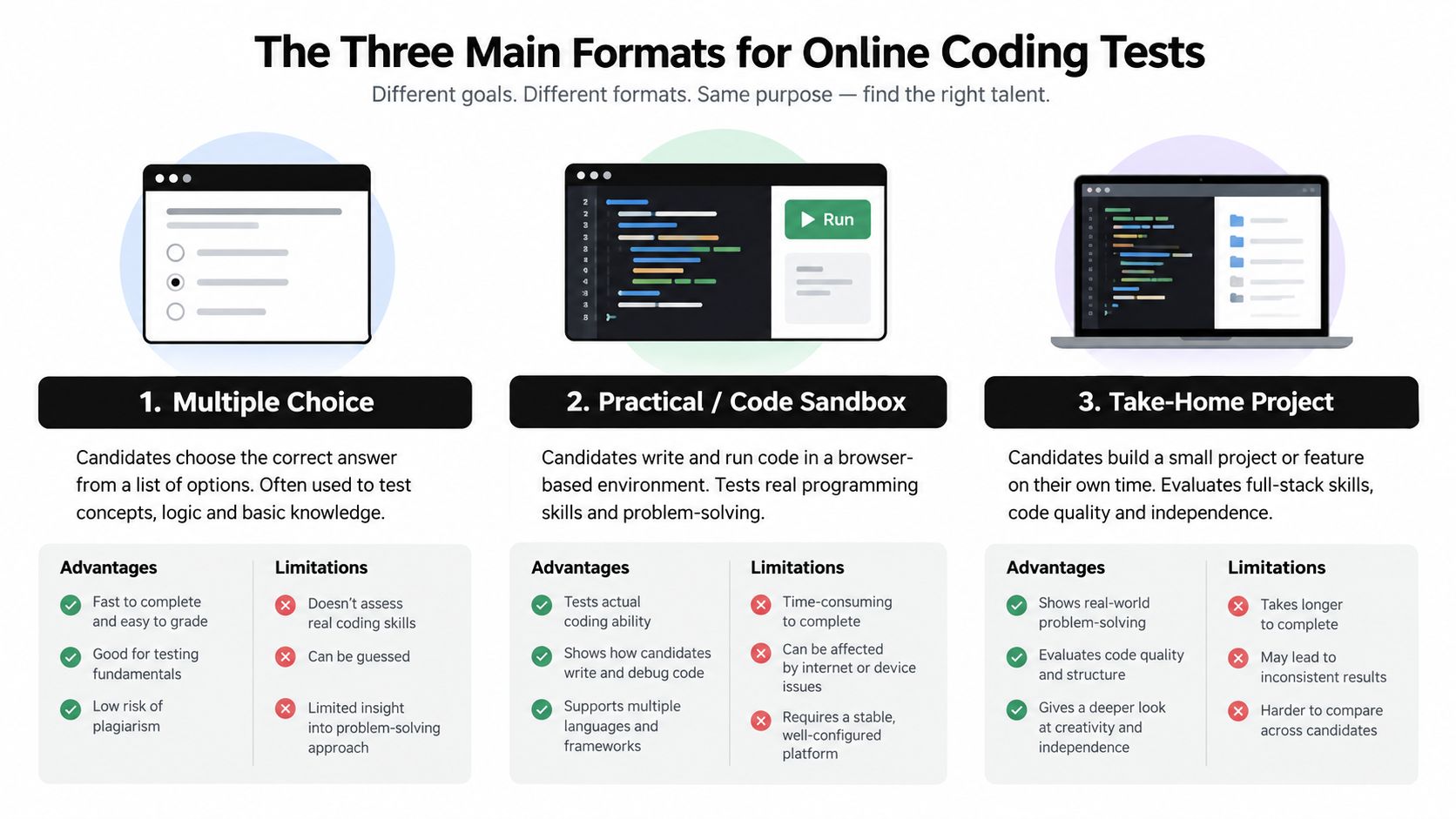
The three formats that many organizations use are timed challenges, take-home assignments, and live pair programming. Each measures a different slice of capability. Treating them as interchangeable is a fast way to create an unfair funnel.
Timed challenges
A timed challenge works well when you need an initial signal on basic problem-solving, syntax, or algorithmic fluency. It's efficient and straightforward to compare, especially for junior roles. The weakness is that a strict clock can penalise candidates who clarify requirements, test assumptions, or build a maintainable solution before optimising it.
Take-home assignments
A take-home exercise gives candidates room to structure code, write tests, document decisions, and work in a way that resembles a real project. It can reveal more about engineering judgement than a puzzle, but it introduces a serious candidate-experience cost. Candidates may spend substantial unpaid time, use tools the employer can't observe, or abandon the process if the assignment feels disconnected from the job.
Live pair programming
Pair programming exposes the thinking that finished code hides. The interviewer can observe how a candidate asks questions, responds to feedback, handles ambiguity, and communicates while solving a problem. It's valuable for collaborative roles, although interviewer quality becomes a major variable. A distracted or overly interventionist interviewer can distort the result.
| Format | Time Required | Skills Measured | Candidate Experience |
|---|---|---|---|
| Timed challenge | Short, fixed session | Speed, fundamentals, algorithmic reasoning | Convenient, but pressure-heavy |
| Take-home assignment | Flexible, often longer | Code quality, structure, testing, judgement | Realistic, but demands more time |
| Live pair programming | Scheduled session | Collaboration, communication, reasoning, adaptability | Interactive, but interviewer-dependent |
Practical rule: Choose the format that lets you observe the behaviour the role requires, not the format your platform makes easiest to send.
Before selecting a format, clarify what a technical interview means in practice. A timed screen may be enough for an early filter, while a collaborative role needs evidence that the candidate can work through a problem with another person.
Question Types and How Scoring Actually Works
A credible assessment begins with job-relevant questions. Algorithmic challenges can test data structures and logical reasoning, but they shouldn't dominate a role that mainly involves maintaining services or querying data. Debugging tasks are often closer to day-to-day work because they reveal how candidates isolate faults, interpret existing code, and verify a fix.
System design questions belong later in the funnel or in more senior hiring. They can reveal trade-offs around reliability, interfaces, data flow, and operational constraints. For specialised roles, include SQL, framework, language, or API questions that reflect the actual stack. A Python data role and a JavaScript front-end role shouldn't receive the same generic test just because both are labelled engineering positions.
Build scoring around evidence
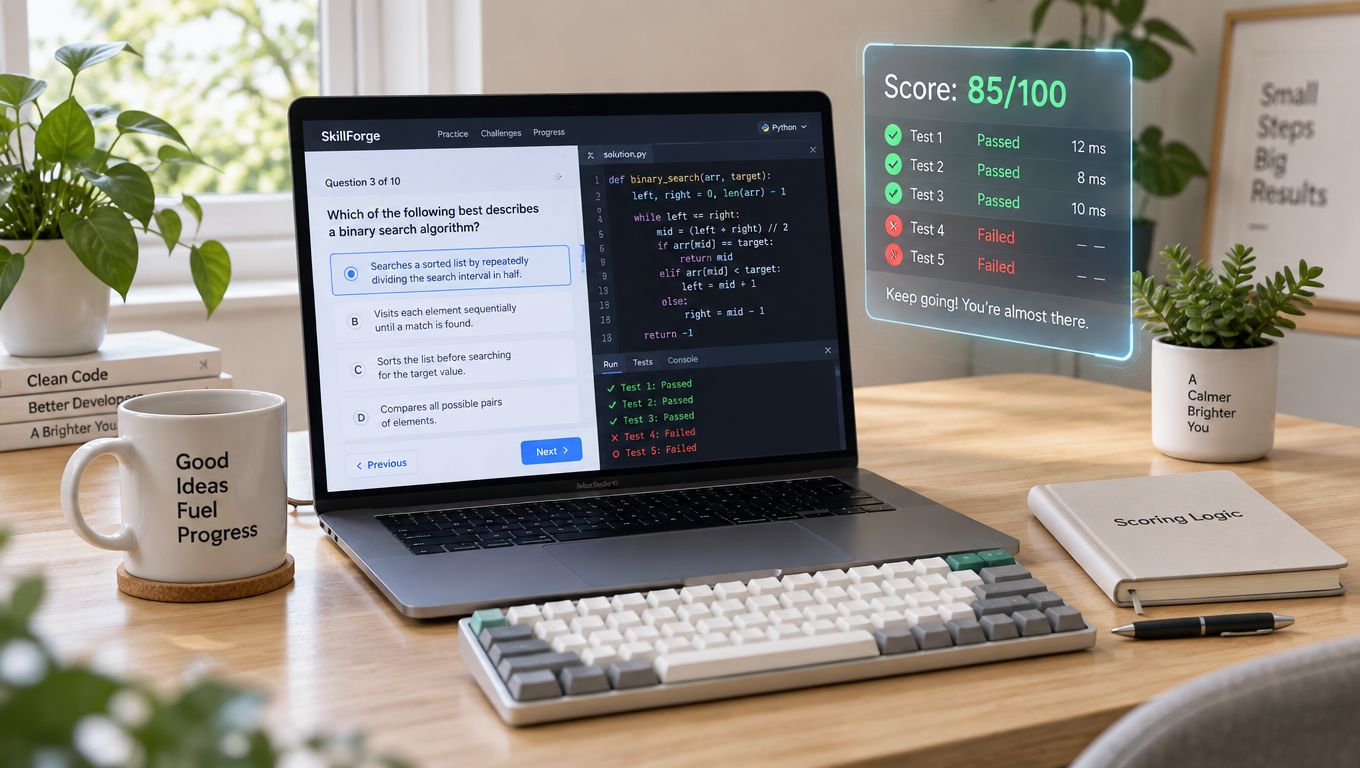
Automated scoring commonly combines compilation or execution results with dynamic test cases, hidden cases, and static analysis. Dynamic tests show whether the submitted code handles expected inputs. Hidden cases can expose brittle assumptions. Static analysis can flag issues such as unreachable code, unsafe patterns, or poor maintainability. None of these should be treated as a complete measure of engineering ability.
A useful scoring model separates correctness from other signals:
- Correctness: Does the solution produce the expected result?
- Quality: Is the code readable, structured, and reasonably maintainable?
- Reasoning: Did the candidate make sensible assumptions and explain trade-offs?
- Role relevance: Does the task resemble the work the person would perform?
Security controls need the same layered thinking. Browser lockdown may limit navigation, but it can frustrate honest candidates and won't solve identity concerns alone. Proctoring can add evidence, while behavioural analysis, identity checks, gaze estimation, and object detection may provide additional signals. An India-focused academic implementation combines captcha-less behavioural login analysis, OTP verification, browser-based coding, face analysis, gaze estimation, and object detection to flag suspicious behaviour for review.
Use these controls proportionately. A suspicious signal should trigger human review, not an automatic rejection, and candidates should know what the process monitors. Teams designing assessments for C can use a focused guide to coding tests in C, then adapt the questions to the role rather than copying a generic bank.
Choosing the Right Format for Your Role and Seniority
Format selection becomes clearer when the hiring team starts with the work rather than the candidate's title. A junior backend engineer may need a short exercise covering basic data handling, error management, and test writing. A timed challenge can provide an initial signal, but a brief follow-up discussion should check whether the candidate understands the submitted solution.
A senior engineer needs a different lens. A take-home design task may reveal how the person decomposes a service, handles failure modes, and documents trade-offs. The assignment should be tightly scoped and reviewed for decisions, not aesthetic polish. If the organisation can't commit to a consistent review rubric, the take-home format will create more subjectivity than insight.
For a team lead, live pair programming often has greater value than another isolated coding screen. The interviewer can introduce a requirement change and observe whether the candidate adapts without losing clarity. That interaction also shows whether the person explains technical decisions in a way that helps less experienced colleagues.
| Hiring need | Suitable starting format | What to watch for |
|---|---|---|
| Fundamental capability | Timed challenge | Don't confuse speed with depth |
| Independent engineering judgement | Take-home assignment | Control scope and review effort |
| Collaboration and leadership | Live pair programming | Train interviewers to avoid coaching unevenly |
The common mistake is applying all three formats to every applicant. That approach lengthens the process, increases candidate fatigue, and often collects duplicate evidence. A better design uses one primary technical assessment and one structured follow-up that tests a different competency.
If you can't explain why a question predicts success in the role, remove it.
Integrating Coding Tests into an AI-Driven Screening Workflow
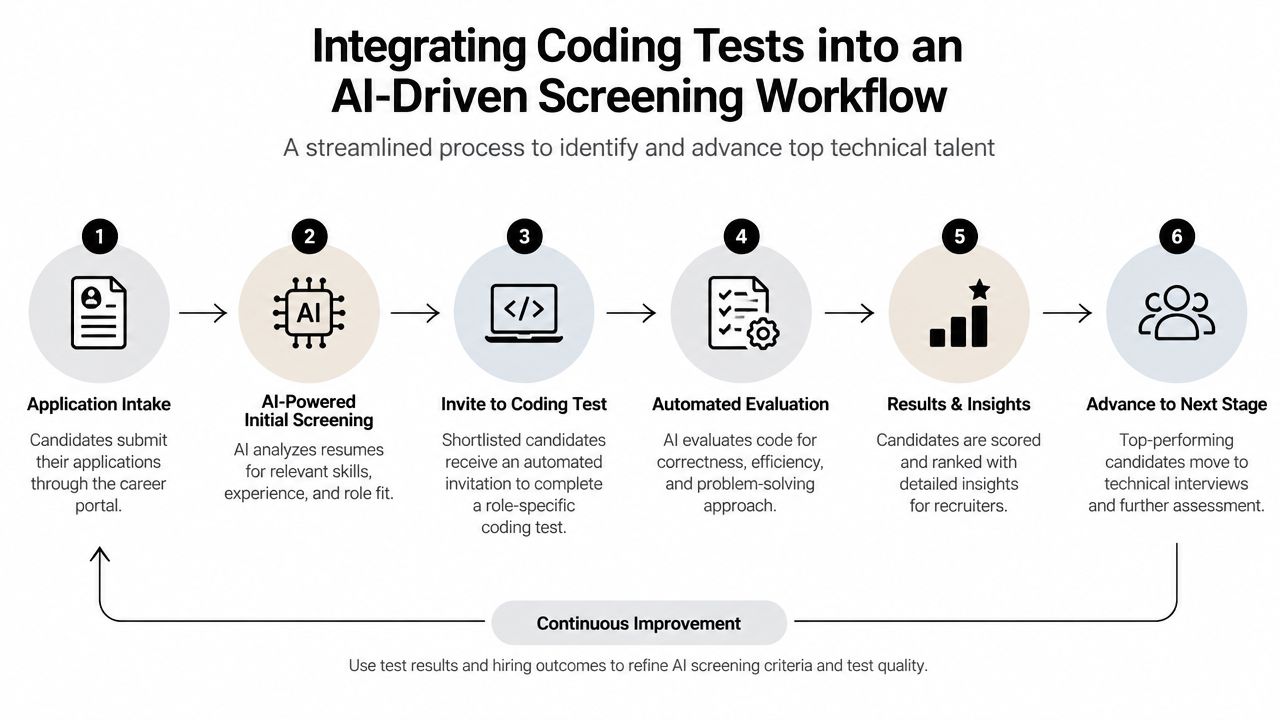
An online coding test works better when its place in the funnel is explicit. The sequence shouldn't be “send test, inspect score, decide”. It should assign each stage a narrow purpose and prevent the same evidence from being collected repeatedly.
A practical workflow
Start with eligibility and motivation. An ATS can organise applications against agreed criteria, while an AI phone screen can ask consistent questions about availability, location, compensation expectations, and relevant experience. Human recruiters should define and audit those criteria. Automation shouldn't quietly turn proxies into exclusion rules.
Use the coding test for technical evidence. Send the assessment only when the candidate meets the basic role requirements and understands the time commitment. Keep the task relevant, provide clear instructions, and avoid making the first technical contact an unnecessarily difficult puzzle.
Add a structured follow-up. A recruiter or engineer can ask the candidate to explain the approach, discuss an alternative, or debug a small variation. This protects against over-reliance on a score and helps distinguish genuine understanding from memorised patterns or external assistance.
Reserve human judgement for exceptions and trade-offs. AI can help organise responses, flag inconsistencies, and summarise structured evidence. Hiring managers still need to evaluate context, potential, and the consequences of a false negative. Candidates should also have a route to raise technical or accessibility concerns.
India's enterprise experience shows why this workflow appeals to high-volume teams. A CIO report on virtual hiring in Indian enterprises found that coding assessments were used by 26% of Indian companies versus 22% globally. The same survey reported that technical or domain assessments and communication assessments were each used by over 40% of companies in India, while virtual hiring produced cost savings for 51% of Indian enterprises and shortened recruitment cycles for 47%. These figures concern broader virtual hiring adoption, not a guarantee that any particular coding platform will improve outcomes.
Teams comparing candidate assessment tools should therefore ask how coding, communication, aptitude, and interview evidence will sit together. Career Central offers AI-driven phone screening, first-round interviews, and coding assessments within a hiring workflow, which makes it one possible option for teams seeking to connect those stages rather than run a coding test in isolation.
Best Practices for Evaluating Engineers Beyond Code Correctness
Correct code is a threshold, not a complete hiring decision. Production engineers need to understand requirements, communicate uncertainty, review other people's work, and make trade-offs that aren't visible in a final output. A candidate who solves a challenge perfectly but can't explain assumptions may be a weaker choice than someone whose solution is sound, testable, and clearly reasoned.

Score the working method
Ask candidates to describe how they interpreted the requirement before they code. During a live session, note whether they clarify inputs, identify edge cases, and respond constructively when the interviewer introduces new information. In a take-home exercise, look at tests, naming, structure, comments, and the explanation of decisions.
A balanced rubric can include:
- Problem solving: Does the candidate break ambiguity into manageable decisions?
- Communication: Can they make technical reasoning understandable to the intended audience?
- Code quality: Is the solution readable, testable, and proportionate to the task?
- Adaptability: Do they accept feedback and revise without becoming defensive?
- Role alignment: Does the behaviour match the collaboration and ownership demands of the job?
The rubric matters because interviewers are vulnerable to recency and halo effects. A memorable opening answer can colour the rest of the assessment, while a single mistake can overshadow strong evidence elsewhere. Require interviewers to record observations against defined criteria before discussing an overall recommendation.
Don't reward unnecessary complexity. Ask whether the candidate chose an appropriate solution for the constraints, not whether they used the most advanced technique available. The assessment should reflect how your team builds software, including the need to make clear decisions under incomplete information.
The Case for Multi-Skill Assessment Over Coding-Only Testing
Coding-only funnels assume that programming output represents the whole job. It doesn't. Engineers may need to query data, reason quantitatively, explain decisions to non-specialists, participate in customer conversations, or learn an unfamiliar codebase. A coding test can provide strong evidence for one part of that work while saying little about the rest.
India's hiring environment makes this limitation especially important. The India-focused technical screening overview describes growing interest in multi-skill packages that combine coding, SQL, aptitude, communication, and video-based evaluation. It also references a campus-oriented recommendation for a 90 to 120 minute software engineer package combining a coding test, aptitude, and a structured AI interview. The cited material presents this as a recommendation, not a universal standard.
The same source connects the shift to persistent graduate employability challenges, with employability remaining below half in many cohorts according to India Skills Report 2025 and related 2025 hiring coverage. That context doesn't justify testing everything. It supports a more careful question: which combination of short assessments gives the hiring team enough evidence without making candidates complete a series of overlapping hurdles?
A sensible package might use coding to test implementation, SQL to test data reasoning, and a structured interview to test explanation and judgement. The exact mix should follow the role. For a front-end position, an interface task may be more relevant than a database exercise. For a support engineering role, debugging and communication may matter more than advanced algorithms.
The principle is simple: collect distinct signals, not more signals. If two stages measure the same skill, remove one and use the time to investigate a genuine risk.
Implementation Checklist and Final Thoughts
A coding assessment strategy becomes practical when the team can operate it consistently. Before launching the next campaign, confirm the following:
- Define job outcomes. List the technical and behavioural capabilities the role requires.
- Select one primary format. Use a timed challenge, take-home task, or live pairing session for a clear reason.
- Write representative questions. Base tasks on realistic work, not puzzles chosen only because they are easy to auto-score.
- Set a proportionate time expectation. Tell candidates what the assessment involves and avoid unpaid work that exceeds the evidence you need.
- Create a scoring rubric first. Separate correctness, reasoning, quality, communication, and role relevance.
- Layer integrity controls carefully. Combine appropriate verification and monitoring signals, then route flags to human review.
- Add one complementary signal. Use a focused aptitude, SQL, communication, or structured interview stage when the role needs it.
- Audit outcomes. Compare assessment recommendations with later interview evidence and hiring-manager observations, then revise weak questions.
High-volume hiring doesn't require a longer funnel. India's engineering talent scale has helped make standardised assessment infrastructure important. A coding assessment market report describes Asia-Pacific as the dominant regional market, with 38.4% of the global coding assessment platform market in 2025, or about USD 1.07 billion, and identifies India as a major adoption centre because of its engineering talent pool and IT sector. The same source states that India produces more than 1.5 million engineering graduates annually, that some Indian enterprises process upwards of 200,000 coding evaluations per quarter, and that platforms globally process over 50 million coding assessments annually. These are market-research claims, so use them as context rather than proof of a particular vendor's performance.
The best process is shorter because every stage has a job. Test coding where coding matters, evaluate communication where collaboration matters, and let people review evidence that automation can't interpret responsibly.
Career Central provides AI-driven phone screening, first-round interviews, and coding assessments for organisations that want a connected technical hiring workflow. Visit Career Central to see how your team can combine coding tests online with structured screening instead of making code the only gate.