
A campus hiring team opens its coding dashboard and sees a worrying pattern. Most submissions have failed before the first test case runs. The recruiters now have a difficult choice: reject candidates who may understand programming but struggled with the platform, or move forward with applicants whose code never became executable.
That's why a coding test in C should be treated as a job-fit diagnostic, not a competition in puzzle solving. A well-designed assessment reveals whether candidates can reason about compilation, memory, interfaces, constraints, and failure paths. A poorly designed one rewards familiarity with obscure algorithms and the test platform.
C remains a practical hiring signal in India because it is still widely recognised and learned. A HackerRank survey reported that 80% of Indian developers knew C, compared with 75% who knew Java and 65% who knew C++. The same survey found that 70% of around 3,700 Indian developers taught themselves coding either exclusively or alongside formal education, while 33% were exclusively self-taught. The survey coverage by The Times of India helps explain why a practical C screen can still establish a common baseline across varied education paths.
The recommendations below focus on what predicts engineering performance, from compile discipline and pointer safety to role-appropriate design judgement. They cover objectives, difficulty tiers, sample tasks, staged scoring, integrity controls, fairness in India, and automation rollout.
Table of Contents
- Why a Coding Test in C Still Matters for Hiring Teams
- Defining Test Objectives and Difficulty Tiers
- Sample Tasks and Reference Solutions
- Time Limits and the Staged Scoring Rubric
- Anti-Cheat Measures and Proctoring Choices
- Candidate Experience and Fairness in India
- Integrating with Interview Automation and Rolling Out
Why a Coding Test in C Still Matters for Hiring Teams
C tests matter when the job touches software that must interact closely with hardware, memory, operating systems, or strict performance constraints. Firmware engineers, device-driver developers, kernel specialists, systems programmers, high-performance trading engineers, and maintenance teams may all need C literacy even when their wider toolchain includes C++, Rust, Python, or scripting languages.
The test shouldn't ask every candidate to solve the same abstract algorithm. A firmware applicant needs to demonstrate safe buffer handling and predictable resource use. A systems candidate should show pointer discipline and an understanding of ownership. An application developer may need only enough C fluency to maintain a native extension or diagnose a production defect.
Practical rule: If the role doesn't use the behaviour you're testing, the result is noise, not signal.
India's education history also supports C as a durable baseline. A study of Indian school computer science education found that many schools and curricula historically used C++ for object-oriented programming, while Python was introduced more widely in the 2013–2014 curriculum. The India-focused education study describes a transition in teaching practice, not the disappearance of C-family foundations. Engineering curricula have continued to expose many candidates to C and C++ before they enter the hiring market.
The strongest reason to retain a C screen is diagnostic clarity. Compilation exposes syntax errors, missing declarations, incompatible types, header problems, and warnings that candidates often overlook. Runtime tests then reveal whether the candidate understands the contract. Memory checks and edge cases show whether they can protect the program beyond the happy path.
That sequence saves senior interviewers from spending time on candidates who cannot yet produce a reliable executable solution. It also gives recruiters a more useful conversation than a single pass or fail label. A candidate who compiles cleanly but misses an overflow case needs a different follow-up from someone whose submission never builds.
The data reinforces that distinction. One India-focused programming-skills study reported that only 4.77% of engineering candidates reached the minimum logic-correct threshold for a programming job, while 64.22% produced code that couldn't compile and 31.01% produced code that was logically and functionally incorrect. Business Standard's report on the study makes a compile-first assessment workflow difficult to dismiss.
Defining Test Objectives and Difficulty Tiers
Start with the job description, not the question bank. A C assessment should measure only the behaviours the role requires, and each behaviour should appear in an observable task.
Use four objectives:
- Compile correctness: Can the candidate produce code that builds under the stated compiler and flags?
- Idiomatic structure: Are functions cohesive, names meaningful, and interfaces understandable?
- Memory and resource handling: Does the candidate manage buffers, ownership, allocation, and cleanup safely?
- Problem decomposition: Can the candidate break a requirement into testable steps while respecting time, memory, and portability constraints?
These objectives don't carry equal weight for every role. For application work, compilation and decomposition may dominate. For embedded work, memory safety and boundary handling deserve more attention. For a testing or maintenance position, debugging a deliberately flawed module may be more predictive than implementing a fresh algorithm.
Choose the tier before choosing the problem
Use the following table as a starting point. The duration is a design recommendation, not a candidate performance statistic.
| Tier | Typical Role | Core Skill Screened | Suggested Duration |
|---|---|---|---|
| Tier 1 | Fresher or intern | Foundational syntax, compilation, basic debugging, simple control flow | 30 minutes |
| Tier 2 | Junior engineer | Pointer fluency, modular problem solving, data structures, cleanup paths | 60 minutes |
| Tier 3 | Senior or specialist | Design judgement, performance trade-offs, portability, robust error handling | 90 to 120 minutes |
A fresher test should establish whether the candidate can read a specification, write a small function, compile it, and correct straightforward defects. Don't use a senior systems problem as a prestige filter for entry-level hiring. That choice mostly measures prior exposure to difficult interview formats.
A junior test can introduce linked structures, ownership rules, and hidden cases that expose shallow pointer knowledge. It should still provide a clear contract. Candidates shouldn't lose points because the question itself is ambiguous.
A senior test needs a system boundary. Ask the candidate to parse input, define an error model, preserve invariants, or explain a trade-off between speed and memory. Seniority appears in decisions and safeguards, not in the number of lines the candidate writes.
One India-specific skills report found that candidates from top-100 colleges were much more likely to produce compilable code than candidates from other colleges, with 69% versus 31% reported in the study. The Business Standard coverage shows why difficulty should be calibrated carefully. If the assessment is too demanding too early, it may measure access to prior coaching and campus opportunity instead of the capability your role needs.
Sample Tasks and Reference Solutions
A useful C assessment mirrors the job. Give candidates one task that tests executable fundamentals, one that exposes ownership and pointer discipline, and one that requires systems judgement. Three focused tasks produce better evidence than a single algorithm puzzle, especially when the role could be embedded, systems, or application development.
Task one for foundational fluency
Ask the candidate to reverse a null-terminated C string in place without using the standard library. The function should receive a writable character buffer and return nothing.
A compact reference solution is:
void reverse_string(char *s) {
    if (s == NULL) {
        return;
    }

    char *end = s;
    while (*end != '\0') {
        end++;
    }

    if (end == s) {
        return;
    }

    end--;

    while (s < end) {
        char tmp = *s;
        *s = *end;
        *end = tmp;
        s++;
        end--;
    }
}
Hidden tests should cover a null pointer when the contract permits it, an empty string, one character, even and odd lengths, and a buffer containing spaces. Watch for three predictable defects: treating the terminator as data, moving the end pointer before handling an empty string, and reading past the buffer. For an application role, this task checks basic correctness. For embedded work, it also shows whether the candidate respects a fixed writable buffer.
Task two for practical pointer work
Ask a junior candidate to build a fixed-capacity least-recently-used cache. A suitable design uses a hash map for lookup and a doubly linked list for recency. Require the candidate to define ownership, move a hit to the front, evict the least recent item when full, and provide cleanup that frees every allocation.
The reference design should include:
- A cache structure containing capacity, current size, the map, and list sentinels.
- A node containing a key, value, and previous and next pointers.
- A lookup path that returns the node in constant expected time.
- Detach and insert helpers, so list manipulation is not duplicated.
- An eviction path that removes the tail node from both the list and map.
- A destroy function that releases nodes, keys, map storage, and the cache itself.
Hidden tests should probe repeated updates, a capacity of one, missing keys, eviction after access, duplicate keys, allocation failure, and destruction of an empty cache. Reviewers should inspect for lost nodes, stale map entries, double frees, and cleanup paths that work only after successful insertion. This is a job-fit diagnostic for systems candidates because it tests state ownership and failure handling, not memorised data structures.
Teams setting up hidden tests and consistent code review can use this guide to technical interview assessment platforms. Configure the platform around the role's contract, rather than using the same cache prompt for every engineering opening.
Task three for specialist reasoning
For a senior candidate, ask for a parser for a limited subset of the Protocol Buffers wire format. Provide a byte buffer and its length. Require a function that extracts supported field numbers and values while returning an explicit error code.
The reference solution should separate varint decoding, field-key decoding, wire-type dispatch, and output storage. The parser must check the remaining buffer before every read. It must reject truncated varints, unsupported wire types, invalid field keys, and length-delimited fields whose declared size exceeds the remaining input.
Hidden tests should target empty input, a one-byte varint, a varint that reaches its boundary, truncated input, a zero-length field, a declared length larger than the buffer, repeated fields, and integer overflow during length conversion. Common failures include advancing the cursor before validation, storing an unsigned length in a signed type, and accepting malformed input because parsing reaches the end without crashing. For a systems role, these failures matter more than whether the candidate produces an elegant abstraction.
Reference solutions should evolve. If a rejected submission reveals an ambiguous requirement or missing edge case, update the test and rubric. The hiring team should preserve the signal that predicts the work, not protect an old question bank.
Time Limits and the Staged Scoring Rubric
Time pressure should reveal prioritisation, not create an artificial panic test. Give a fresher enough time to compile, inspect failures, and make a correction. Give a senior candidate room to explain design choices and handle invalid input. The suggested limits are 30 minutes for Tier 1, 60 minutes for Tier 2, and 90 to 120 minutes for Tier 3, with the senior window reserved for tasks involving deeper memory, parsing, or concurrency concerns.
Score submissions in gates. A candidate who never reaches execution shouldn't receive the same recommendation as someone whose code passes most functional cases but misses one boundary condition.
| Tier | Time Limit | Compile Gate | Hidden Tests | Edge Cases | Code Quality |
|---|---|---|---|---|---|
| Tier 1 | 30 minutes | 20% | 50% | 20% | 10% |
| Tier 2 | 60 minutes | 15% | 45% | 25% | 15% |
| Tier 3 | 90 to 120 minutes | 10% | 40% | 30% | 20% |
These weights are operational recommendations. The largest component should remain functional behaviour, but compilation must carry enough weight to distinguish executable work from an untested draft. Code quality should never rescue broken logic, and passing visible examples shouldn't compensate for violating a buffer-size contract.
A simple review path works well:
- Reject: The submission doesn't compile, or it contains unsafe behaviour that makes the result unusable.
- Review: The candidate compiles and shows partial correctness, but hidden tests expose a material gap.
- Advance: The candidate compiles, passes the required functional threshold, handles the important edge cases, and produces maintainable code.
For example, a Tier 2 submission might compile cleanly, pass most standard cache operations, fail eviction after a repeated access, and omit a complete destroy path. That candidate shouldn't receive a clear hire recommendation. The code demonstrates useful fundamentals, but the missing invariant and cleanup weakness require a structured follow-up.
The staged approach is supported by India-specific assessment evidence. One report found that only 36% of software engineers could write compilable code, while 14% compiled both solutions and 22% compiled exactly one when candidates faced two problems. It also reported that only 2.21% wrote fully functional code using best-practice efficiency and correctness criteria. The report covered by Slashdot supports scoring compilation, runtime behaviour, edge handling, and quality separately instead of collapsing everything into one opaque score.
Anti-Cheat Measures and Proctoring Choices
Integrity controls should match the sensitivity of the role. Heavy surveillance on a low-risk fresher screen creates friction without necessarily improving hiring decisions. A lightweight process may be insufficient for a security-sensitive systems position.
| Stance | Signal Quality | Candidate Friction | Cost | Best For |
|---|---|---|---|---|
| Timed, unproctored test with plagiarism checks | Moderate | Low | Low | High-volume campus screening |
| Webcam and screen recording with tab-switch limits | Stronger identity and process signal | Moderate | Moderate | Most corporate C roles |
| Locked device with approved compiler and disabled networking | Strong control over the environment | High | High | Security-sensitive or proprietary systems work |
| Declared AI-allowed assessment with oral verification | Measures reasoning with tools in the loop | Moderate | Moderate | Teams hiring for modern assisted development |
Plagiarism detection should compare submissions across the same assessment and account for standard C patterns. A shared loop, common error return, or familiar linked-list helper isn't proof of misconduct. Reviewers should investigate unusual structural similarity and ask the candidate to explain the implementation.
Webcam and screen recording should never be a surprise. Tell candidates what the system captures, whether tab switching is logged, which compiler is available, whether external documentation is allowed, and how long the recordings are retained. Clear disclosure improves trust and gives candidates a fair opportunity to prepare their environment.
Device lockdown is justified only when the role warrants it. It can reduce unauthorised assistance, but it can also fail candidates because of permissions, operating-system differences, unstable connectivity, or unfamiliar compiler settings. Run the locked environment internally before inviting applicants.
AI policy needs an explicit choice. If AI assistance is prohibited, say so and use process controls plus a short human verification interview. If it's allowed, assess the candidate's ability to inspect, test, correct, and explain generated code. Don't pretend a hidden policy produces a clean signal.
Candidate disclosure checklist: State the allowed tools, compiler, time window, recording rules, AI policy, retry policy, support channel, and data-retention practice before the assessment begins.
Candidate Experience and Fairness in India
A strong C assessment can still produce a weak hiring decision if a power cut, unstable connection, or unfamiliar platform determines the result. Candidate experience is a fairness constraint. The test must measure C skill, not access to a powerful laptop, reliable electricity, or first-language English.
Separate coding ability from platform familiarity. Provide the problem statement as plain text alongside any formatted document. Use clear English, define every input and output contract, and remove idioms that require cultural interpretation. Candidates from different cultural backgrounds may face additional barriers, as explained in this guide to cultural differences in interviews. Where the platform allows it, offer an approved local setup or offline compiler bundle for candidates with unreliable connectivity.
A controlled retry window protects the validity of the assessment. If a power cut or platform failure ends the first attempt, let the candidate retry under the same scoring rules. This does not award extra marks. It removes an unrelated technical failure from the measurement.
India's talent pipeline includes people with different educational routes and levels of access. The HackerRank survey cited earlier found that 70% of around 3,700 Indian developers taught themselves coding either exclusively or alongside formal education, while 33% were exclusively self-taught. The Times of India's coverage of that survey reinforces a practical hiring rule: a formal college pathway should not become an unstated requirement for passing a C test.
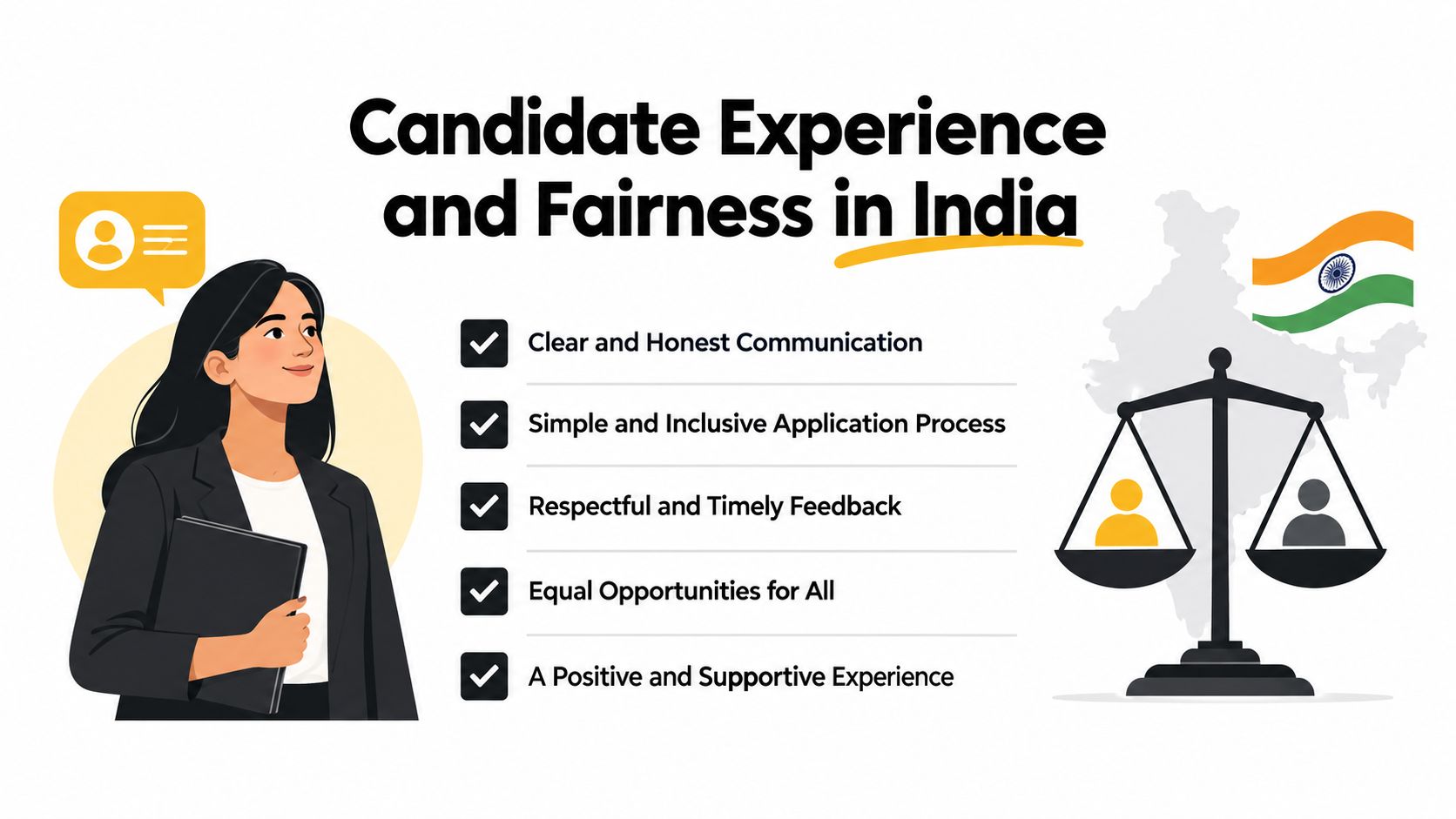
Run a fairness audit after each hiring batch. Compare pass rates by region, college tier, and gender. A gap larger than ten percentage points should trigger an inspection of the assessment, instructions, platform, and access conditions before anyone concludes that candidate quality differs. The threshold is a review trigger, not proof of discrimination.
Use these controls:
- Platform rehearsal: Let candidates run a harmless compiler check before the scored task.
- Language clarity: Replace dense prose with short requirements and concrete examples.
- Infrastructure support: Provide a visible route for reporting a broken test, timeout, or submission error.
- Consistent evaluation: Apply the same compile, hidden-test, edge-case, and quality rubric after a retry.
- Human review: Escalate unusual platform failures instead of issuing an automatic rejection.
The broader Indian assessment market raises practical questions about language support, proctoring, and platform familiarity. This comparison of pre-employment assessment tools in India shows why accessibility and integrity must be designed together. A secure test that works only for candidates with a particular device or language comfort is not a fair test.
Integrating with Interview Automation and Rolling Out
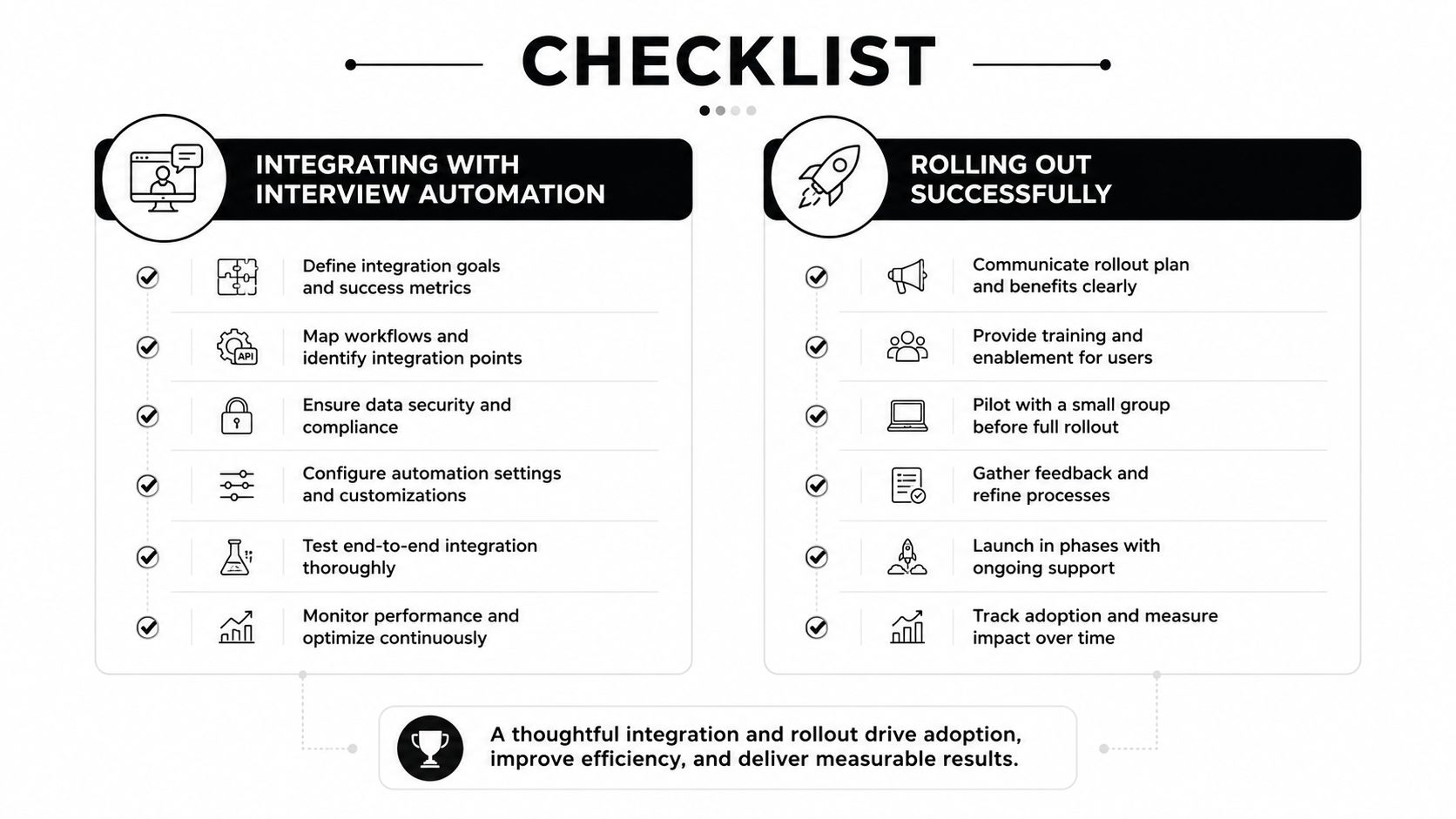
Treat the assessment as a hiring workflow, not an isolated link. The integration normally has three practical touchpoints: an invitation API that sends the right test for the role, a code-execution sandbox that runs the submission consistently, and a score webhook that returns the result to the Applicant Tracking System.
Role-based routing should happen before the invitation is sent. A firmware requisition can receive a memory and buffer task, while an application role receives a narrower C-maintenance screen. Set the scheduling window, reminders, accessibility instructions, AI policy, and escalation route in the same workflow so recruiters don't improvise after candidates begin.
Pre-launch checklist
- Calibrate the test: Run it with a small internal or pilot cohort and inspect every compile error, timeout, and ambiguous instruction.
- Approve cut-offs: Have engineering and talent stakeholders agree what counts as advance, review, or reject before results arrive.
- Validate the sandbox: Test compiler flags, standard-library availability, memory limits, hidden tests, logging, and failure messages.
- Train recruiters: Teach them what compilation, hidden-test, edge-case, and quality outcomes mean so they don't overread a single score.
- Prepare candidate communication: Explain the environment, permitted tools, retry process, privacy information, and support contact.
- Debrief the pilot: Record technical failures, candidate questions, reviewer disagreements, false rejects, and changes required before launch.
The common rollout mistakes are predictable. Teams launch a Tier 2 problem before validating a basic compiler flow. They ignore bandwidth and device conditions in Indian hiring. They treat automated scoring as a replacement for structured debriefs. Automation should reduce administration, not remove human judgement from borderline decisions.
Teams comparing implementation options can use this overview of candidate assessment tools while defining their own requirements. The important design choice is to keep test content, scoring rules, AI-use disclosure, and human review checkpoints configurable. AI-assisted assessments are moving from simple detection questions towards explicit policy choices, so a rigid workflow will age badly.
Build the first version around a narrow role, pilot it, audit the outcomes, and revise the tasks. A coding test in C becomes valuable when every failure tells the hiring team something about job readiness, rather than merely showing who completed a familiar puzzle fastest.
Career Central provides AI-driven phone screening, first-round interviews, and coding assessments for organisations that need a more consistent hiring process. If you're building a role-specific C assessment, visit Career Central to see how its interview automation can support structured screening and human review.