

You've just finished a panel interview for a critical role. One interviewer says the candidate showed strong judgement and gives a 4. Another remembers a hesitant answer, writes “not a good fit”, and gives a 2. Neither rating is supported by a shared definition of what good performance looks like, so the hiring discussion turns into a debate about impressions.
That situation is common across Indian recruitment teams, particularly when candidates move through phone screens, first-round interviews, coding assessments and panel discussions. An interview scorecard can bring discipline to that process, but only if it measures job capability rather than fluency, familiarity with corporate interviews, or similarity to the interviewer. A polished form alone doesn't create fair hiring.
The Hidden Cost of Unstructured Interviews
Two hiring managers can hear the same answer and reach opposing conclusions. One notices that a candidate identified a practical solution under pressure. The other focuses on the candidate's accent, pauses, or lack of familiarity with the interviewer's preferred terminology. Without agreed criteria, both responses can appear reasonable because the organisation never defined the evidence it needed.
The problem grows when each stage adds another personal interpretation. A recruiter may prioritise confidence during a phone screen, a technical interviewer may focus on one imperfect answer, and a senior panel member may let a strong opening impression shape the rest of the conversation. These are familiar forms of recency bias, affinity bias and the halo effect, and they can turn a hiring process into a test of presentation style rather than role capability.
A useful overview of common interview mistakes shows why vague questioning and weak preparation create problems for both sides. Candidates receive inconsistent experiences, while employers struggle to explain why one person advanced and another did not.

Why impressions are poor evidence
“Strong communicator” sounds useful until a hiring team asks what the candidate did. Did they explain a complex issue to a non-technical stakeholder? Did they listen, clarify an ambiguous requirement and adapt the explanation? Or did they merely speak fluently and confidently?
The same issue appears with labels such as “culture fit”, “energy” and “seniority”. These phrases often hide untested preferences about language, region, educational background, age or perceived similarity. They also make feedback difficult to challenge. A candidate can't respond to “not quite right” because it identifies no observable gap.
Practical rule: If an interviewer can't point to what the candidate said or did, the rating is probably an impression, not evidence.
Unstructured interviews also create operational risk. Different candidates may receive questions of very different difficulty, interviewers may score one competency heavily while ignoring another, and panel discussions can allow the most senior voice to overwrite independent observations. The organisation then has a decision, but not a defensible measurement process.
A scorecard addresses the gap by defining the job-related criteria before interviews begin. It doesn't remove judgement. It makes judgement visible, comparable and open to review.
What Makes an Interview Scorecard Different
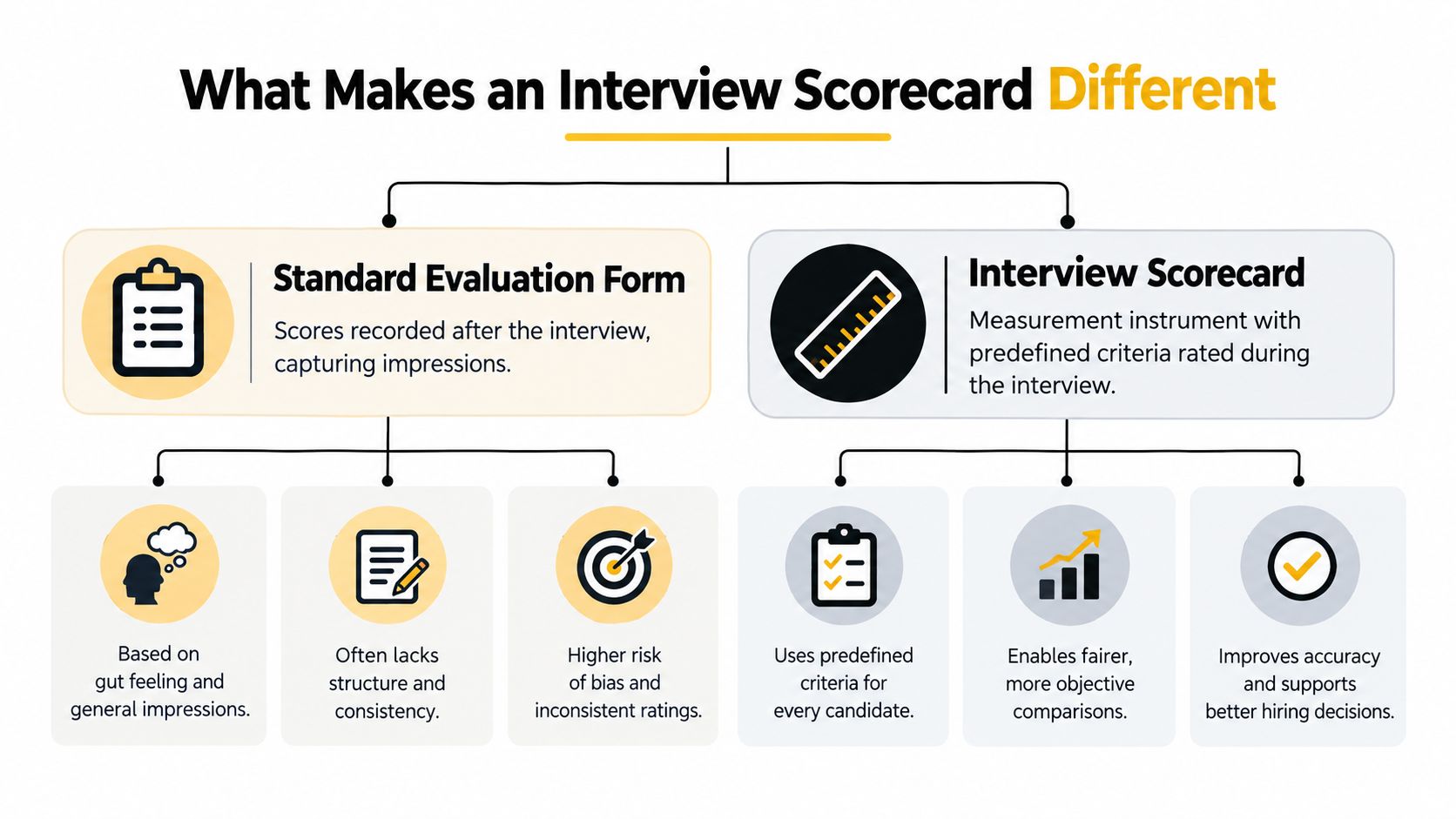
A hiring panel can ask polished questions, record strong impressions and still disadvantage candidates who speak differently, live in another region or lose connectivity during a remote interview. An interview scorecard addresses that risk only when its design makes evidence comparable. It is not a feedback form with numbers added. It operationalises a structured interview by defining the competencies, questions and evidence standards before the first candidate is assessed.
Structured interviews have stronger selection evidence than informal conversations, but the scorecard itself does not guarantee fairness. Design, administration, and review determine whether it measures job-related capability or merely gives subjective preferences a numerical appearance. Guidance on structured interview design in India provides a useful reference for setting those controls (source on structured interview scorecards in India).
Start with the work, not a generic template
Begin with job analysis. Identify the outcomes the person must deliver, the decisions they will make and the constraints they will face. Translate those requirements into a short set of competencies that interviewers can assess consistently.
For a software engineer, “technical problem-solving” might include:
- Problem framing: identifies the core requirement and relevant constraints.
- Solution reasoning: proposes an approach and explains meaningful trade-offs.
- Technical depth: analyses complexity, reliability and maintainability.
- Production judgement: anticipates operational risk and describes mitigation.
These behavioural anchors show interviewers what evidence separates one rating from another. “Excellent technical skills” does not. Anchors also need accessibility checks. If a candidate has a poor connection, an interviewer should not treat a dropped call as weak reasoning. If the role does not require polished English, accent, fluency or regional vocabulary should not influence the rating.
Use identical or equivalently difficult questions for every candidate. Interviewers may clarify wording or adjust delivery for accessibility, but the underlying competency and challenge should remain comparable. Ask each interviewer to score independently immediately after the response and before panel discussion. This limits conformity and recency effects while preserving individual evidence.
Treat the scorecard as a measurement instrument
A defensible scorecard connects four parts:
- Defined competencies: Each dimension describes a job-related capability, not a personality preference.
- Standardised prompts: Questions give candidates comparable opportunities to provide evidence.
- Anchored ratings: Each point on the scale describes observable performance.
- Evidence fields: Interviewers record what led to the rating, not whether they liked the candidate.
A 1 to 5 scale can work when every point has a clear meaning. A candidate who names a solution without explaining trade-offs may meet a lower anchor. Someone who analyses complexity and explains production-risk mitigation demonstrates stronger evidence. The numbers do not create objectivity. The behavioural descriptions and consistent administration do.
The scorecard should specify how the final decision is made. Preserve original scores, record material disagreements and document the evidence behind the recommendation. Then review outcomes by region, language, interview mode and connectivity issues. That check reveals whether the process protects fairness or merely makes bias easier to defend.
Essential Components and Scoring Methods
Build the scorecard around requirements that affect hiring success. Generic competency libraries often create polished documents with dimensions interviewers cannot assess consistently. A smaller, role-specific framework is easier to train, complete and audit, especially when candidates may differ in region, language or internet access.
For a technical role, a documented weighting might assign 40% to technical problem-solving, 30% to coding quality, 20% to communication and 10% to role-specific judgement (structured interview scorecard guidance). The exact split matters less than the reasoning behind it. Use job analysis to set the weights, then check whether the process gives every candidate a fair opportunity to demonstrate each competency. A confident interviewer's preference should not determine the weighting.
Three methods, three different strengths
| Method | Best For | Key Advantage | Implementation Note |
|---|---|---|---|
| Independent scoring | Panels and multi-stage interviews | Limits conformity and dominant voices | Record each rating immediately after the response |
| Anchored scoring | Roles where evidence can be observed directly | Converts broad qualities into comparable behaviour | Require written evidence for every rating |
| Weighted aggregation | Roles with clearly different competency priorities | Prevents one memorable trait from dominating | Document weights and apply them consistently |
Independent scoring helps when interviewers hold different responsibilities. A technical assessor can record a coding-quality score before hearing a hiring manager's reaction. The panel can discuss disagreements later, while preserving the original ratings and evidence. This record also helps reveal whether one interviewer is systematically penalising regional accents, language fluency or connectivity interruptions.
Anchored scoring works only when the anchors describe behaviour. “Strong communication” is too broad. “Explains a technical decision clearly, responds to questions and adjusts the explanation for a non-technical audience” is assessable. A well-designed interview evaluation form makes that evidence visible instead of burying it in a final recommendation.
Weighted aggregation is useful when competencies have unequal consequences. A safety-critical judgement should not be cancelled out by a charming introduction. Still, arithmetic can create false precision. A candidate may receive a high aggregate score while providing insufficient evidence on a required capability, or lose points because a video call failed rather than because performance was weak.
Make uncertainty explicit
Add an insufficient evidence option and keep it separate from a poor score. A candidate may face a connectivity problem, misunderstand an unclear prompt or need a reasonable accommodation. Record the cause, then decide whether to repeat the question, arrange human review or adjust the interview format.
Before launch, run sample answers through the rubric with interviewers. Compare how they interpret each anchor and revise wording that produces predictable disagreement. Calibration continues after launch. Review score distributions and evidence quality by region, language, interview mode and technical access. That review shows whether structured scoring protects fairness or merely gives inconsistent decisions a more objective appearance.
Integrating Scorecards with AI and ATS Platforms
Technology can improve consistency, but it can also automate a weak design at scale. If the competency is vague, an AI phone screen may produce more neatly formatted vagueness. If the rubric rewards fluent delivery rather than job capability, a platform can make that bias faster and harder to notice.
Start by mapping each scorecard dimension to a specific stage. A phone screen might assess eligibility, relevant job knowledge and communication required for the role. A coding assessment may evaluate task performance and code quality. A first-round interview can test problem-solving and judgement. The same competency shouldn't be redefined at every stage.
Preserve evidence across the workflow
An ATS integration should carry more than a final recommendation. It should preserve:
- The competency assessed: What construct was the stage designed to measure?
- The candidate evidence: What response, work sample or behaviour supported the rating?
- The rating status: Was the result a score, insufficient evidence or a technical failure?
- The reviewer identity: Who assessed the evidence, and at what stage?
- The decision path: Which thresholds or review rules affected progression?
This structure lets HR leaders investigate disagreement between an automated assessment and a human rating. It also prevents information loss when a candidate moves from screening to interview and then to a hiring panel.
Keep people accountable
AI-assisted interviewing requires human review, particularly when a candidate's response may be affected by accent, connectivity, disability or unfamiliarity with the format. The system can organise transcripts, scores and inconsistencies. It shouldn't become the final authority on capability without a route for review.
Career Central is one example of a managed platform offering AI-driven phone screening, first-round interviews and coding assessments, with candidate responses, transcripts and scores incorporated into the evaluation workflow. Whether an employer uses that platform, an ATS module or an internal tool, the governance principle remains the same: configure the rubric first, test how the technology applies it and audit outcomes by candidate segment.
Practical automation guidance should also include recruitment process automation as a workflow question, not merely a technology purchase. Decide who reviews exceptions, when a human must intervene and how candidates can request reconsideration.
Automation should standardise the evidence path, not outsource responsibility for the decision.
Validating Scorecards Against Hiring Outcomes
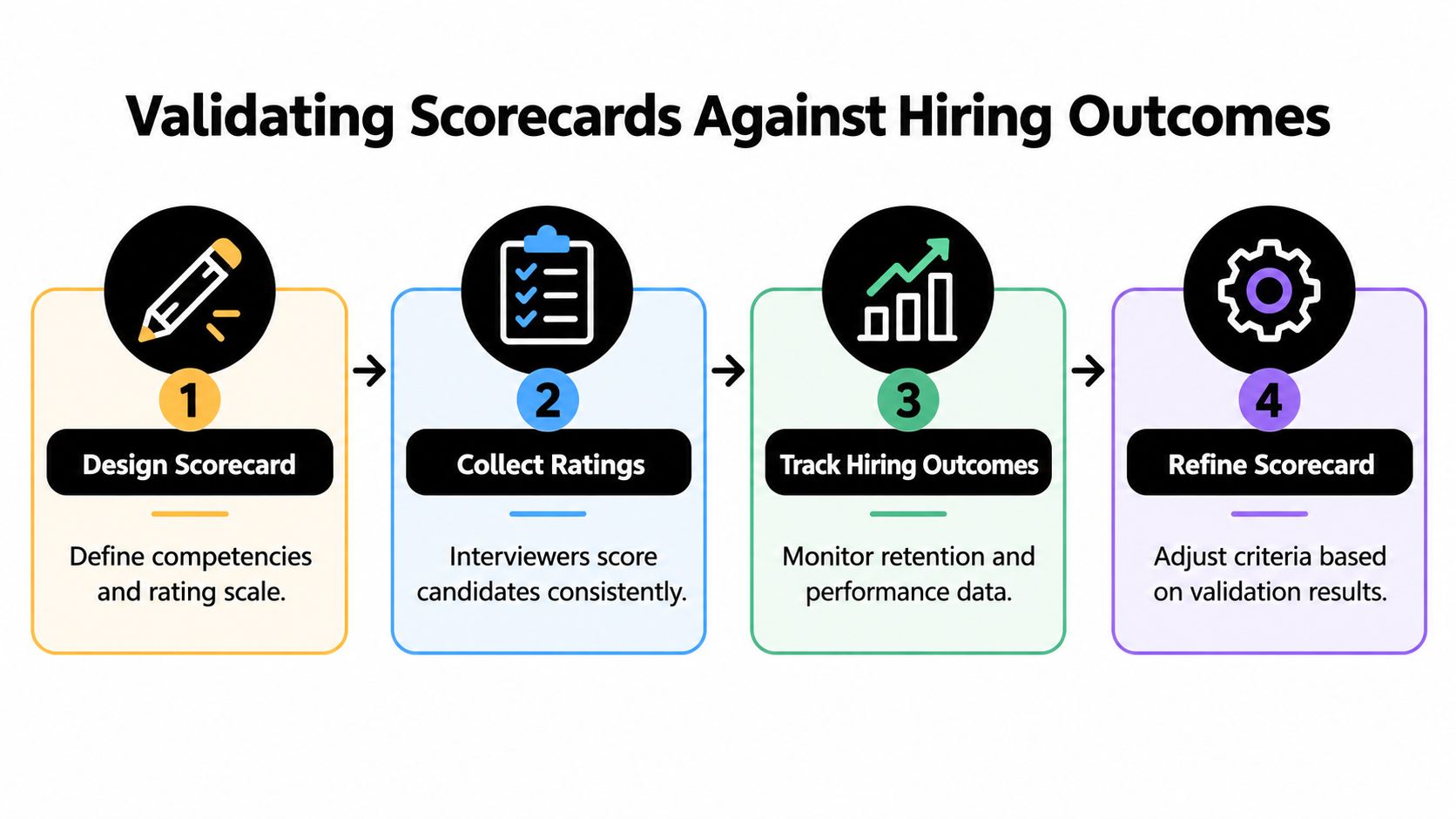
A polished scorecard can still produce unfair hiring decisions. The test is not whether the form looks consistent, but whether its ratings are reliable across interviewers and connected to performance after joining.
Validation should begin with a local question: what evidence would show that each competency predicts success in this role? Prior structured-interview research suggests that average validity varies with implementation quality (evidence on structured interviews and scorecard design). Define the outcome before reviewing scores, such as probation completion, quality, productivity, retention or manager assessment. Set a sensible time lag so the measure reflects job performance rather than early familiarity with the workplace.
Validate the full chain
An India-wide 2025 survey of more than 10,000 respondents found that only 32% of job seekers felt adequately prepared for interviews, with the readiness problem especially pronounced among freshers and professionals with one to three years of experience (India Employer Forum coverage of the interview readiness index). That finding should change how HR leaders read interview scores. A rating may reflect coaching access, regional exposure to corporate hiring practices, language comfort or reliable internet access, rather than the capability required for the job.
Track each competency separately from the final hiring decision. Compare those ratings with later outcomes, then examine whether the relationship holds across relevant candidate groups where lawful and ethically appropriate. A scorecard that predicts performance for candidates from major urban centres but weakens for candidates interviewing through unstable connectivity needs redesign, even if its overall average looks healthy.
Look for errors, not just averages
A useful validation review asks four questions:
- Which competencies predict later performance? A dimension with little relationship may need clearer anchors, better questions or removal.
- Which interviewers score differently? One may use the full scale while another gives nearly everyone the same rating.
- Where are false negatives? Review rejected candidates who later showed strong capability through another route or comparable work.
- Where are false positives? Examine high scorers who underperformed and identify which evidence the process missed.
Also review missing evidence, rating variance and pass rates by stage. If one question repeatedly produces “insufficient evidence”, improve its wording or delivery before blaming candidates. Until local results support a competency or weighting, treat it as a working hypothesis. The scorecard earns credibility when it predicts outcomes without turning regional, linguistic or connectivity advantages into a hidden measure of merit.
Protecting Fairness in Diverse Candidate Populations
A scorecard can show identical ratings for candidates who never had an equal chance to demonstrate capability. One candidate answers through stable broadband in Bengaluru, another handles interruptions from a smaller city, and a third works in a second language. The form may look objective while measuring connectivity, accent familiarity, or interview confidence alongside job-related skill.
Fairness depends on three tests: whether each competency relates to the role, whether candidates receive a reasonable opportunity to show it, and whether interviewers score the evidence rather than its delivery style. In India's diverse labour market, vague criteria can encode preferences linked to language, region, gender, caste, age, educational pedigree, or perceived cultural similarity. Structured and unstructured interview guidance supports written behavioural evidence, job-related constructs, and selection-ratio monitoring where lawful and ethically appropriate.
Replace “culture fit” with observable requirements
“Culture fit” often gives interviewers permission to choose people who feel familiar. Define the behaviour the role requires instead, such as handling disagreement respectfully, documenting decisions, or escalating risk early. Ask every candidate questions that create a comparable opportunity to demonstrate those behaviours.
Separate communication requirements from job knowledge, problem-solving, and task performance. A candidate can communicate effectively in the language required for the role without sharing an interviewer's accent, regional vocabulary, or conversational style. A technically strong candidate may also need an accommodation or a clearer prompt during a remote assessment.
Fairness check: Would the rating change if the same evidence came through a different accent, regional vocabulary, level of interview familiarity, or internet connection?
Monitor where the process filters people out
Where lawful and ethically appropriate, compare selection rates across relevant demographic groups. The four-fifths rule provides an initial adverse-impact screen: if a group's selection rate is below 80% of the highest-selected group's rate, review the question wording, competency definitions, interviewer behaviour, and cutoff scores. Treat this as a review trigger, not proof of discrimination.
Examine every stage, not only the final hiring decision. A group may pass an initial screen but drop sharply at a coding assessment, or perform well technically and then fail a loosely defined “executive presence” criterion. Stage-level analysis identifies the mechanism, including whether a timed task, language requirement, device constraint, or scoring anchor is filtering candidates.
Record uncertainty instead of penalising it
“Insufficient evidence” is different from “poor evidence”. A connectivity interruption, unfamiliar accent, disability-related barrier, or poorly phrased prompt can prevent a candidate from demonstrating a skill. Set a defined human-review or repeat-assessment route instead of automatically turning missing information into a low score.
Record interviewer confidence and accommodation needs. Give candidates a way to report a technical failure or request review, particularly when an automated stage affects progression. Human review should follow a stated rule, not depend on whether a candidate knows whom to ask.
Calibration should test the quality of evidence, not only agreement between interviewers. If interviewers repeatedly cite fluency, confidence, or educational pedigree for a competency that does not require those attributes, rewrite the anchor. If candidates from one location receive lower ratings despite comparable evidence, examine interviewer severity and local delivery conditions.
A structured rubric protects fairness only when it exposes unfair influence. Success means giving candidates a comparable opportunity to show the capability the job requires, then preserving an audit trail that connects each rating to that capability.
Career Central provides AI-driven phone screening, first-round interviews, and coding assessments with structured candidate scoring, transcripts, and evaluation data. Visit Career Central to review how its interview workflows could fit a recruitment operation.