
The hiring manager says the shortlist is weak. Recruiters say they're drowning in applications. Interviewers spend hours meeting candidates who fail basic requirements, while strong applicants disappear because nobody reviewed their evidence consistently. More sourcing hasn't solved the problem. In many Indian hiring teams, the breakdown sits in the candidate screening process, between application volume and meaningful evaluation.
A reliable process doesn't try to predict everything from a CV or a short conversation. It builds an evidence chain. Each stage answers a narrow question, records what supports the answer, and passes a clear artefact to the next reviewer. That approach protects recruiter capacity, interviewer time, candidate trust, and the quality of the final decision.
Why Your Current Screening Is Probably Failing
A recruiter widens sourcing after a hiring manager rejects the shortlist. Reviewers skim more CVs, keyword filters expand, and screening calls increase. The pipeline produces more activity, yet the same candidates fail during interviews while stronger applicants disappear without a consistent review.
The underlying failure is measurement. Teams track activity instead of decision quality: applications reviewed, profiles submitted, and calls completed. Those counts can rise even as screening accuracy falls. A large shortlist may indicate a permissive first gate or a decision made without recorded evidence of what the candidate can do.
Indian applicant volumes intensify the pressure to automate or skim. Keyword matching finds familiar terms, but it cannot show whether a candidate used a skill in a relevant setting. An incomplete CV may also be treated as a failed requirement when the defensible outcome is “evidence missing, verify”.
Run a three-symptom diagnosis
Take the last hiring cycle for one role and examine decisions, not workload.
- Low interview-to-offer conversion: The first screen is admitting candidates who satisfy surface criteria but lack role-relevant capability. Raise the evidence required before interview or add a job-related assessment.
- Different rejection outcomes for similar profiles: Reviewers are interpreting the role differently. Add written rubric anchors, common questions, and a calibration session.
- Rejection reasons that cannot be defended: The process captures impressions rather than evidence. “Not a fit” and “weak profile” do not identify the failed requirement for a candidate, recruiter, or auditor.
Practical rule: Another trained reviewer should be able to see what was checked, which evidence was found, and why the candidate progressed or stopped.
Structured interviews support that evidence chain by replacing informal “culture fit” conversations with consistent questions and scoring. Meta-analytic research reports a mean operational validity of 0.42 for structured interviews predicting later job performance, which is why shared questions and scoring anchors matter more than interviewer intuition (structured interview validity guidance).
Build the fix around the failure observed. False positives require a higher evidence threshold. Reviewer disagreement requires a standardised rubric. Weak documentation requires evidence capture inside the workflow, rather than an optional note. For AI-assisted screening, retain the input, recommendation, reviewer decision, and reason for any override so the evidence chain remains auditable.
Where Screening Actually Fits in Hiring
Screening is neither sourcing nor final selection. Sourcing creates the applicant pool. Screening decides whether there is enough role-relevant evidence to progress. Selection uses deeper evaluation to compare candidates and make a hiring decision. Onboarding begins after that decision and has a different purpose entirely.
A study of recruitment and selection systems among Indian IT software companies describes a sequence of manpower requisition, hiring approvals, application sourcing, screening and shortlisting, interviews, and reference or background checks. The study contacted approximately 105 companies and analysed 50 complete responses, identifying screening and shortlisting as a distinct stage between sourcing and interviews (Indian IT recruitment and selection study).
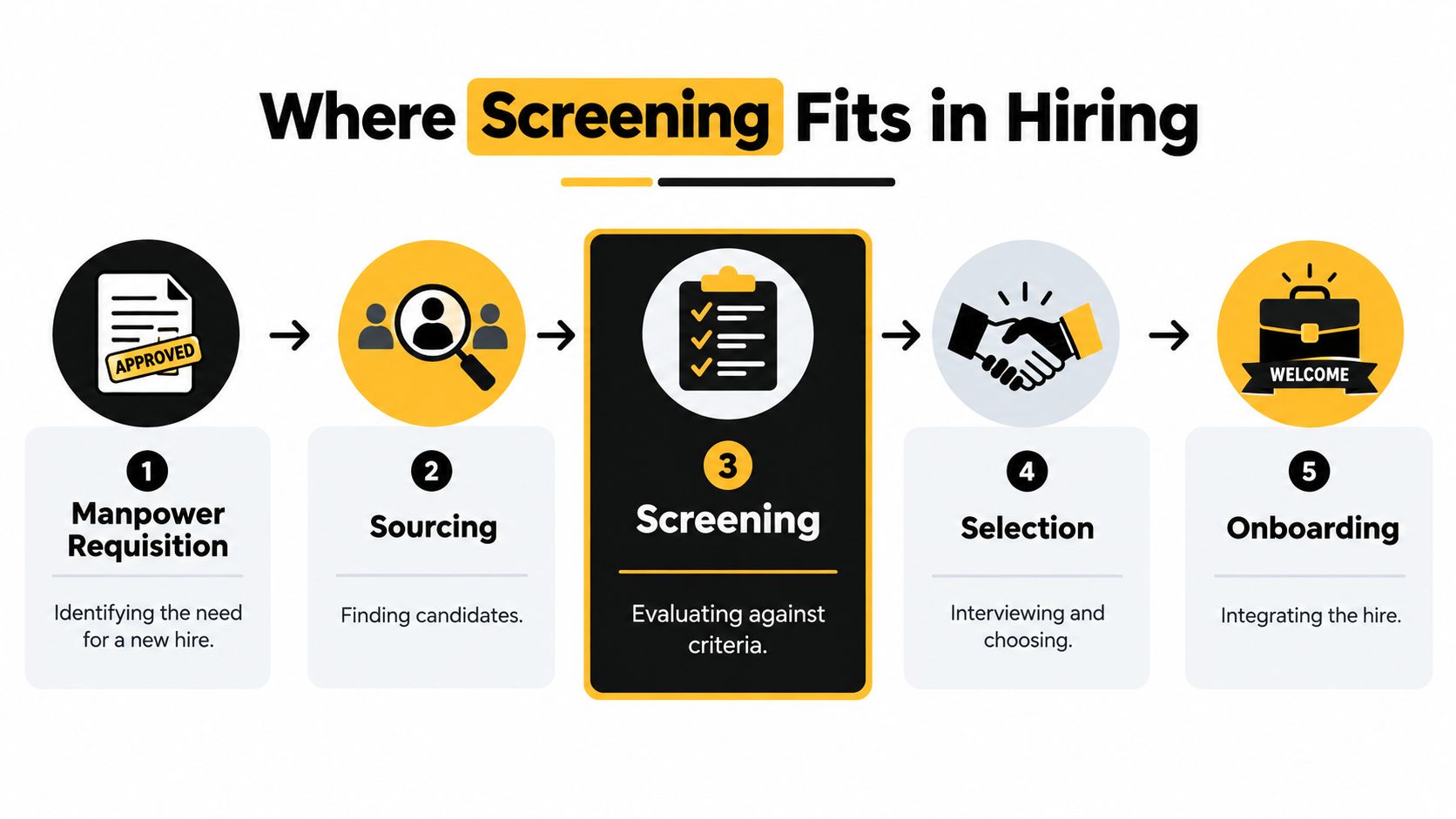
That position matters because it prevents scope creep. Sourcing teams should focus on channel choice, outreach, and applicant generation. Recruiters screening those applications should verify minimum requirements and gather comparable evidence. Interview panels should investigate capability through structured questions, technical evaluation, or work samples. Background checks should verify the information that requires external confirmation.
Build a clean handoff
Every candidate who reaches interview should carry a compact evidence record:
- Role criteria: The must-have skills, experience requirements, work location or availability constraints, and any lawful work-authorisation requirement.
- Evidence summary: The CV or application evidence supporting each criterion, with missing information clearly marked.
- Assessment result: The relevant task, score, reviewer, and any concern requiring interviewer follow-up.
- Screening record: Standardised answers, compensation alignment, availability, and the reason for progression.
- Open questions: Items that need verification, not assumptions disguised as rejection reasons.
This handoff stops interviewers from restarting the screen and stops recruiters from making technical judgements they aren't equipped to make. It also gives the panel a precise brief: investigate the evidence that exists, test what remains uncertain, and score the same competencies across candidates.
Screening works when it narrows the decision without pretending to make the final decision. The stage should produce a defensible recommendation, not a polished-looking pile of CVs.
The Four Measurable Gates of Screening
A practical India-focused workflow moves candidates through four evidence gates: eligibility and CV screening, a job-relevant aptitude or coding assessment, a structured technical or functional interview, and a standardised HR or behavioural review (four-gate screening workflow). These gates can run in an ATS, spreadsheet, or shared assessment system. The tool matters less than clear ownership, consistent sequencing, and records another reviewer can understand.
Gate one checks eligibility
The recruiter compares each application with pre-agreed requirements, including relevant skills, experience, location, compensation constraints, availability, and lawful work authorisation where applicable. The output is a completed eligibility record with evidence and gaps, not a subjective recommendation.
Set each rule before applications are opened. “Must demonstrate experience with the core platform” can be tested against the CV or application. “Looks senior enough” cannot. If evidence is missing, send the profile for clarification rather than treating silence as a rejection reason.
Gate two tests capability directly
Use a job-relevant aptitude, coding, writing, analytical, or work-sample assessment. It should reflect a real responsibility of the role and produce either a score or an anchored evaluation that a second reviewer can interpret.
For software hiring, assess code quality, debugging logic, and the explanation of trade-offs. For sales hiring, use a structured discovery scenario or written account plan. The result should show demonstrated capability and identify the specific gaps the interview must examine. A credential can inform the review, but it should not replace evidence of performance.
Gate three gathers comparable interview evidence
The technical or functional interviewer asks the same core questions and applies the same scoring anchors to every candidate. Record evidence from the answer, including what the candidate did, explained, or missed. A lower score should reflect an omitted required behaviour or weak reasoning, not an interviewer's general impression or familiarity with the candidate's background.
Gate four checks behavioural and practical alignment
The HR or behavioural review covers job-relevant working conditions, such as availability, communication requirements, collaboration examples, and realistic compensation alignment. It should not become an unstructured culture screen or a second opportunity to reward similarity. Record the question, the evidence, and any exception that needs escalation.
| Gate | Input | Output | Pass/Fail Rule | Reviewer |
|---|---|---|---|---|
| Eligibility and CV screening | Application, CV, agreed requirements | Evidence matrix with missing items marked | Every must-have is evidenced or sent for verification | Recruiter |
| Job-relevant assessment | Coding, aptitude, writing, or work sample | Scored assessment with reviewer notes | Predefined competency threshold | Functional assessor |
| Structured technical or functional interview | Standard questions and candidate evidence | Anchored scorecard with evidence | Minimum score on each critical competency | Technical or functional interviewer |
| HR or behavioural review | Standard questions on practical alignment | Behavioural and logistics record | Predefined requirements met, or exception escalated | HR or trained recruiter |
A shortlist is not a success metric if hiring managers reject most candidates at interview. The gates should improve the quality and comparability of evidence, while leaving the final hiring decision to the accountable panel.
Designing Scoring Rubrics That Survive Reviewer Disagreement
A job description becomes useful for screening only after someone turns it into observable competencies. Start by separating must-haves from preferences. A must-have should represent a requirement the person needs to perform the job. A nice-to-have can improve the decision but shouldn't become a knockout.
Assign weights to the competencies, then define what each score means. A five-point scale is practical only when the numbers have behavioural anchors. “Strong communication” is an adjective. “Explains a complex implementation in a logical sequence, answers follow-up questions directly, and identifies an unresolved risk” is evidence.
Use anchors instead of adjectives
For a mid-level software role, a debugging competency might look like this:
- 1: Cannot isolate the failure or explain the debugging approach.
- 3: Identifies the likely cause and proposes a workable fix, but misses an important validation step.
- 5: Isolates the cause systematically, explains trade-offs, validates the fix, and identifies a regression risk.
For a sales role, discovery might be scored differently:
- 1: Presents a solution without establishing the customer's problem.
- 3: Asks relevant questions and identifies a stated need, but doesn't connect it to business impact.
- 5: Clarifies the problem, decision process, urgency, stakeholders, and measurable business consequence before proposing a next step.
The mechanics stay consistent even though the competencies change. Each score needs a one-line evidence note from the application, assessment, or interview. “Score 3, explained the deployment process but did not describe rollback validation” is defensible. “Score 3, average answer” is not.
For a practical guide to keeping interview questions, criteria, and evidence aligned, use this interview scorecard framework.

Calibrate before the funnel gets busy
Run a calibration session with sample profiles before live screening starts. Reviewers score independently, compare results, and discuss where the anchors were interpreted differently. The owner then rewrites ambiguous anchors rather than asking reviewers to “use better judgement”.
Repeat the exercise quarterly and inspect score patterns. A reviewer who consistently scores above or below the panel mean may be applying different standards, even when the person is acting in good faith. Calibration isn't about forcing identical scores. It's about making disagreements traceable to evidence and improving the rubric when the evidence exposes a gap.
Skills-First Screening Without Becoming Credential-First Again
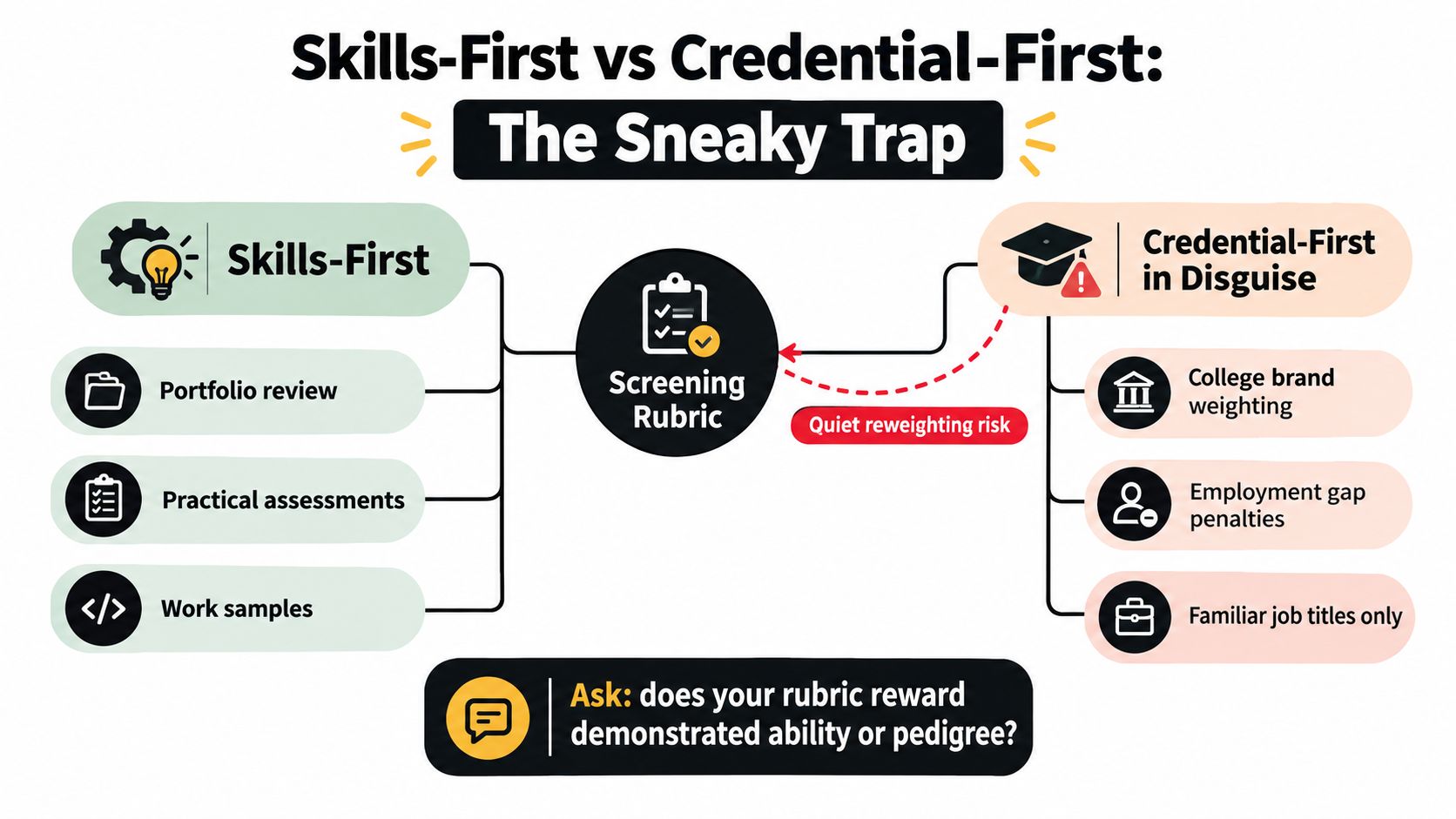
“Skills-first” can become credential-first with a new label. A model may claim to match competencies while rewarding prestigious college names, familiar employers, conventional job titles, uninterrupted employment, or the language used by established candidates.
India-focused evidence shows the tension clearly. 39% of hiring managers prioritise skills over education or career history, 77% of Indian candidates are more likely to apply when job advertisements emphasise skills, 32% of employers still prefer degrees or a linear career path, and 42% weigh degrees and skills equally (India skills-first hiring evidence). The figures describe a market moving towards skills-based evaluation without having removed credential bias.
Keyword filters create the same problem at scale. A candidate from a smaller city may demonstrate capability through a portfolio, freelance work, regional-language customer experience, informal training, or a micro-credential. If the filter expects a familiar title or a particular institution, it may reject evidence before a human sees it.
Define the evidence before choosing the filter
Start with the competency, not the proxy. If the role requires SQL analysis, define the acceptable evidence: a work sample, a structured assessment, a portfolio project, or a previous responsibility with verifiable outcomes. If the role requires customer communication, test that requirement directly rather than using college brand or accent as a shortcut.
Then build equivalence into the rubric:
- Accept multiple proof types: Portfolio work, assessments, relevant projects, and transferable responsibilities can evidence the same competency.
- Separate missing evidence from failed evidence: A CV that doesn't mention a skill is not proof that the candidate lacks it.
- Route unconventional profiles: Send non-linear careers, unfamiliar titles, and borderline matches to human review.
- Record the override: Explain which evidence caused the reviewer to advance or reject the recommendation.
Measure false negatives, not just throughput
A screening audit should compare who the system advances with who later demonstrates the required skill in an assessment or structured interview. Review the shortlist by education background and geography, then investigate whether rejection rates reflect genuine competency differences or access to familiar credentials.
Set an override rule before deployment. Human review should be mandatory when the evidence is incomplete, the candidate uses an unconventional title, the recommendation rests mainly on credential proxies, or the system's confidence is low. The objective isn't to bypass automation. It's to stop automation from turning historical hiring habits into an apparently objective standard.
AI-Assisted Phone Screening, Done Defensibly
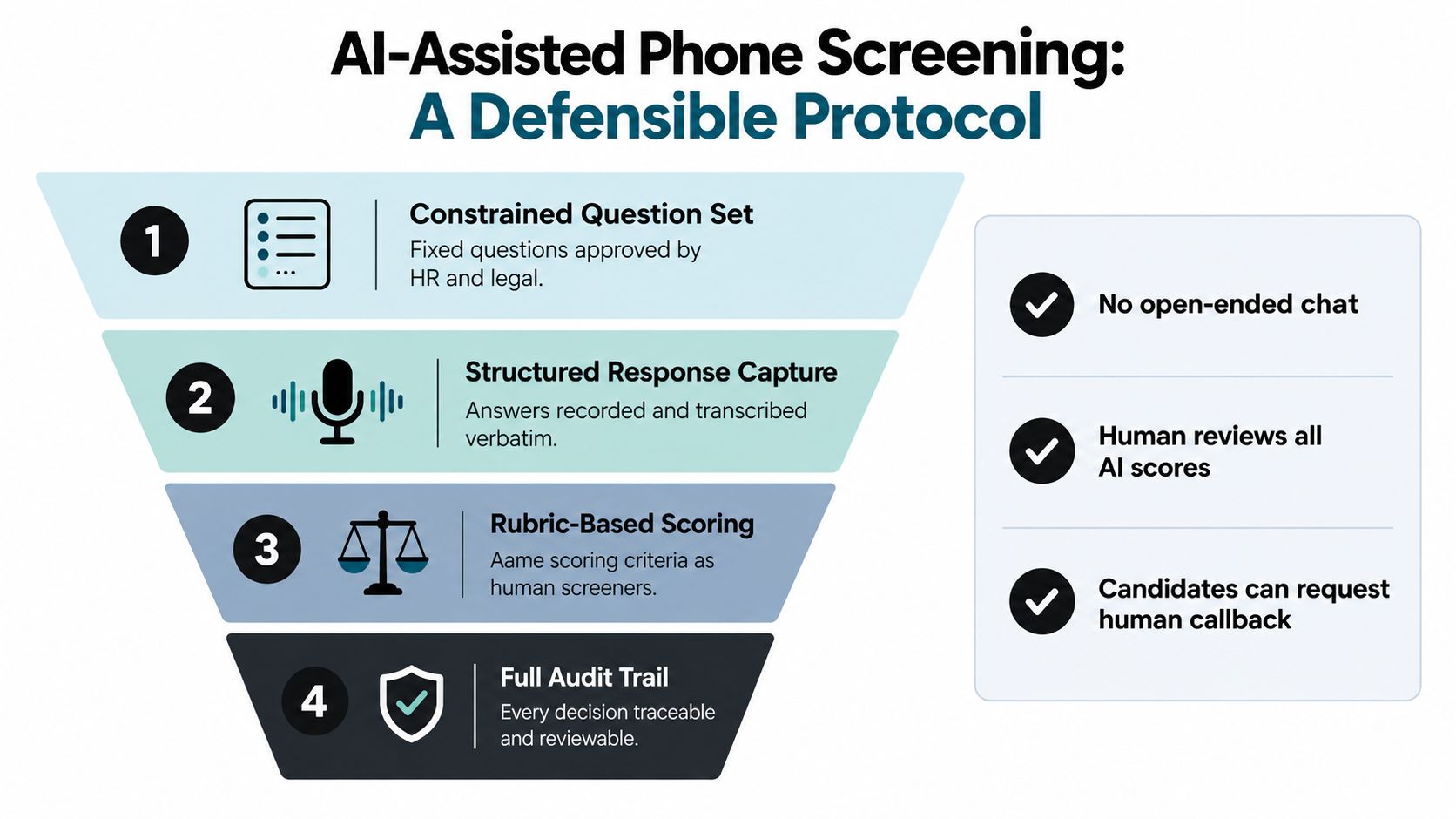
The useful question isn't whether AI should participate in phone screening. It's whether the system can collect comparable evidence, explain its recommendation, and provide a correction route when the evidence is incomplete.
A defensible protocol is constrained rather than conversational. Capture consent, disclose recording or automated evaluation, verify identity and work authorisation where lawful, ask a fixed sequence of role-relevant questions, apply a pre-approved rubric, and send borderline cases to a human reviewer.
Compare control with convenience
AI-assisted screening can ask every candidate the same approved questions and capture answers consistently. A human-led screen can clarify an unusual career path, recognise missing context, and decide when a candidate deserves a second look. The trade-off is not just speed versus cost. It's consistency versus contextual judgement.
The screen should test availability, relevant experience, communication requirements, compensation alignment, and a small number of behavioural or technical probes. It must not infer protected characteristics or use accent, fluency, college brand, employment gaps, or other unsupported proxies for capability.
Track the operating signals that show whether the system is helping:
- Completion rate: How many invited candidates finish the screen?
- Pass-through rate: How many advance under the agreed rubric?
- Human-overturn rate: How often does a reviewer change the AI recommendation?
- Adverse-impact rate: Do pass outcomes differ materially across candidate groups?
- Dropout rate: At which question or process point do candidates stop?
A 2026 survey of Indian HR and recruitment decision-makers reported that 74% uncovered identity fraud among candidates or employees during 2025. The same survey reported accuracy as the leading provider-selection criterion at 49%, followed by candidate experience at 36% and speed at 32% (Indian hiring identity-fraud survey). That ordering is a useful warning. A rapid but inaccurate rejection can cost more than a modest delay.
Platforms such as Career Central's recruitment process automation can support AI-driven phone screening, first-round interviews, and coding assessments, but the employer still owns the rubric, consent design, escalation rules, and validation of recommendations. No platform removes the need for human adjudication when evidence is ambiguous.
The Funnel KPIs and Bias Checks You Actually Need
A weekly screening dashboard doesn't need to become a data science project. It needs stable definitions, consistent cohorts, and enough detail to show where evidence quality drops.
Track these rates by source and demographic group:
- Application-to-screen: Completed screens divided by applications received.
- Screen-to-interview: Interview invitations divided by candidates with a completed screen.
- Interview-to-offer: Offers divided by completed interviews.
- Offer acceptance: Accepted offers divided by offers made.
- Joining: Candidates who join divided by accepted offers.
- Early attrition: Early leavers divided by joined hires, using the organisation's agreed early-tenure window.
Read the measures together. A high screen-to-interview rate paired with a low interview-to-offer rate usually indicates false positives at the screen. A strong interview-to-offer rate with weak joining may point to compensation alignment, candidate communication, or offer handling. A source that produces fewer applications but stronger joining outcomes may deserve more attention than a channel optimised for volume.
Use the recruitment yield pyramid as a reporting structure, but keep the underlying definitions explicit. A dashboard can look precise while mixing different cohorts or counting pending reviews as rejections.
Add an adverse-impact review
At each gate, compare pass rates across gender, college tier, and prior-company source where collection and use are lawful and appropriate. Flag gaps that exceed the four-fifths rule, then investigate the criterion and evidence rather than assuming the group difference proves bias or proves validity.
For AI-assisted steps, add three controls:
- Blinded agreement: Compare model recommendations with blinded human ratings on a held-out sample.
- Subgroup error analysis: Inspect false positives and false negatives separately across relevant groups.
- Manual adjudication: Require human review when confidence is low or evidence is incomplete.
A practical rollout can happen in stages:
- Days 0 to 30: Choose two roles, define must-haves, write the rubric, and calibrate the panel.
- Days 31 to 60: Use the four-gate sequence, track funnel KPIs, and complete the first adverse-impact review.
- Days 61 to 90: Expand to the next role family, retire indefensible degree or employment-gap knockouts, and schedule quarterly rubric calibration.
The recurring failures are predictable: optimising for screen-pass rate instead of quality of hire, allowing reviewers to reinterpret anchors, failing to validate screening scores against later performance, and treating shortlist volume as the win. A defensible candidate screening process is a steady operating habit, not a launch event. The HR leaders who improve it keep auditing the evidence after attention has moved elsewhere.
Career Central provides AI-driven phone screening, first-round interviews, and coding assessments that produce structured candidate evidence for early-stage evaluation. If you're rebuilding a screening funnel, visit Career Central to see how its approach can fit alongside your rubrics, human review rules, and hiring analytics.