
You're probably dealing with one of these two situations right now.
Your team interviews a lot of people, recruiters are chasing hiring managers for notes, candidates are waiting too long, and the feedback that finally goes out sounds like it was written by legal and a tired ATS. Or you're at the other end of the spectrum: interviewers write bespoke paragraphs for everyone, the process crawls, and nobody can keep that level of effort up once hiring volume climbs.
Both models break. One kills trust. The other kills throughput.
Candidate feedback after interview isn't a nice extra anymore. It's part of the hiring product. If the experience is sloppy, candidates don't just feel annoyed. They decide your company is disorganised, evasive, or disrespectful. In India, a 2026 job-seeker survey reported that 20% of respondents said lack of interview feedback was their biggest frustration, behind no response after applying at 29% and long delays between interview stages at 26%. That's not a side complaint. It's one of the top pain points in the market.
Most HR content still gives lazy advice: “be timely”, “be empathetic”, “personalise where possible”. Fine. But that advice falls apart in high-volume hiring unless you redesign how feedback is captured, approved, and sent. The question isn't whether feedback matters. It does. The question is how to deliver useful, stage-specific feedback at scale without burning interviewer hours or creating legal messes.
Why Post-Interview Feedback Has Become a Business Metric
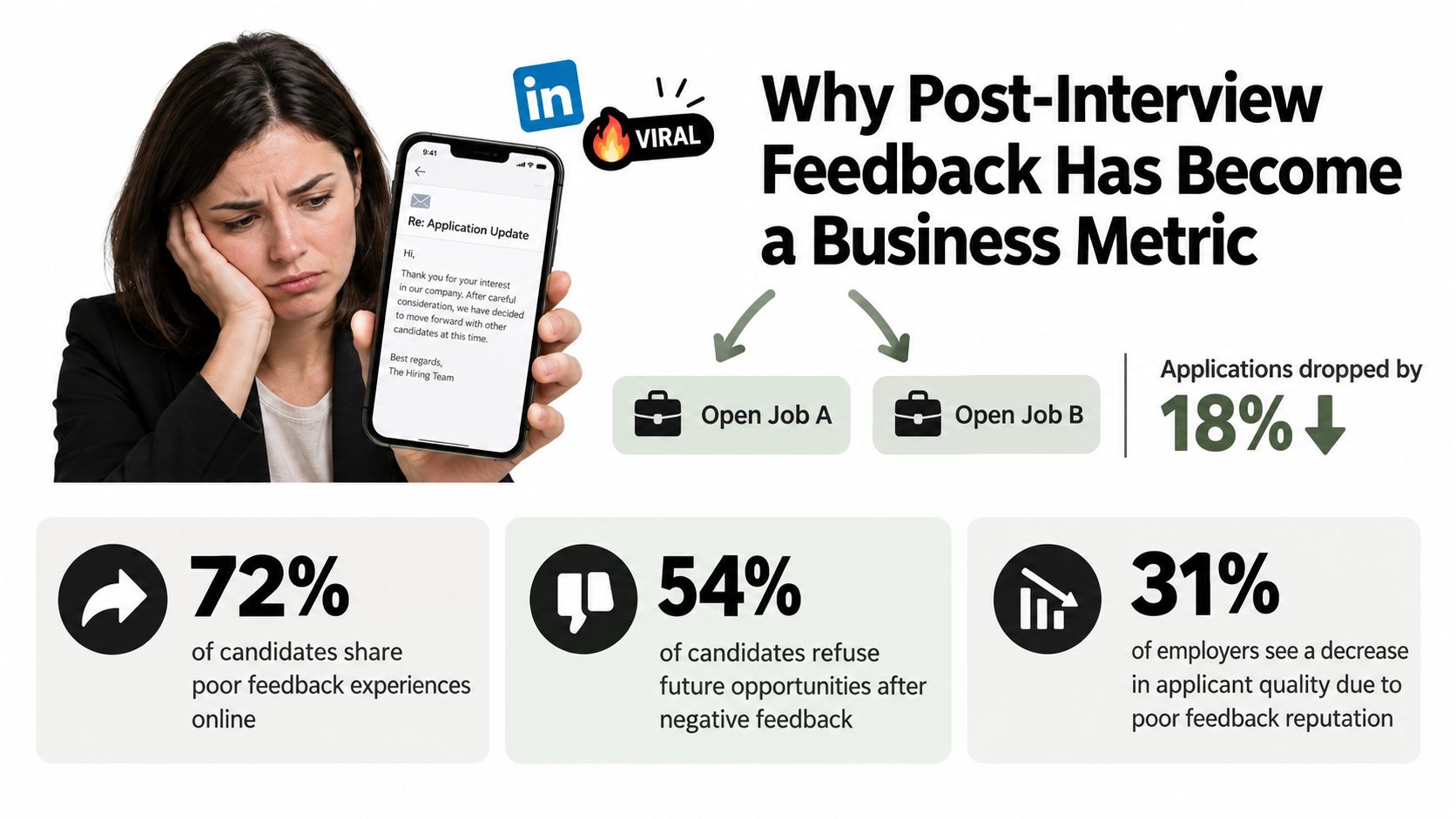
A vague rejection email used to be treated as an internal process flaw. Now it's a public brand event.
Candidates screenshot messages. They compare notes in WhatsApp groups, Slack communities, alumni circles, and LinkedIn comments. Recruiters still act as if post-interview communication is private correspondence. It isn't. It's visible evidence of how your company behaves when the answer is no.
What the data says in India
If you still think candidate feedback after interview is mostly about politeness, the Indian data says otherwise.
An India-based academic study found that communication quality had a significant positive effect on candidate experience, with the regression model explaining about 39% of the variance in candidate experience according to this recruiter communication study. That's the point many miss. Communication isn't decoration around the hiring process. It is a major part of the experience itself.
The commercial downside of bad communication also shows up after the interview ends. An Antal India survey reported in The Times of India found that among candidates who had a bad interview experience, nearly 35% blamed no feedback after the interview, 30% blamed long waits between rounds, 41% said they would not recommend the company, and 42% said they would never join it.
Practical rule: If your recruiters can't tell you how long candidates wait for a post-interview decision, you don't have a feedback process. You have a hope-based process.
What leaders should track
I'd stop treating feedback as a recruiter courtesy and start treating it as an operating metric with owners.
Track these four things:
- Time to feedback: How long interviewed candidates wait before they hear something meaningful.
- Feedback completion discipline: Which interviewers submit usable notes quickly, and which ones slow the system down.
- Reapplication and re-engagement patterns: Whether strong runners-up return for later roles.
- Candidate sentiment by stage: Especially after phone screens, panel rounds, and final interviews.
Most talent teams spend more money trying to refill damaged pipelines than they would spend fixing post-interview communication. That's backwards. Clear feedback is one of the cheapest ways to preserve goodwill with people you might want back later.
When and How Quickly to Send Feedback
The default rule should be simple. If you interviewed the candidate, you owe them a timely answer.
Not a perfect answer. A timely one.
Use a stage-based timing rule
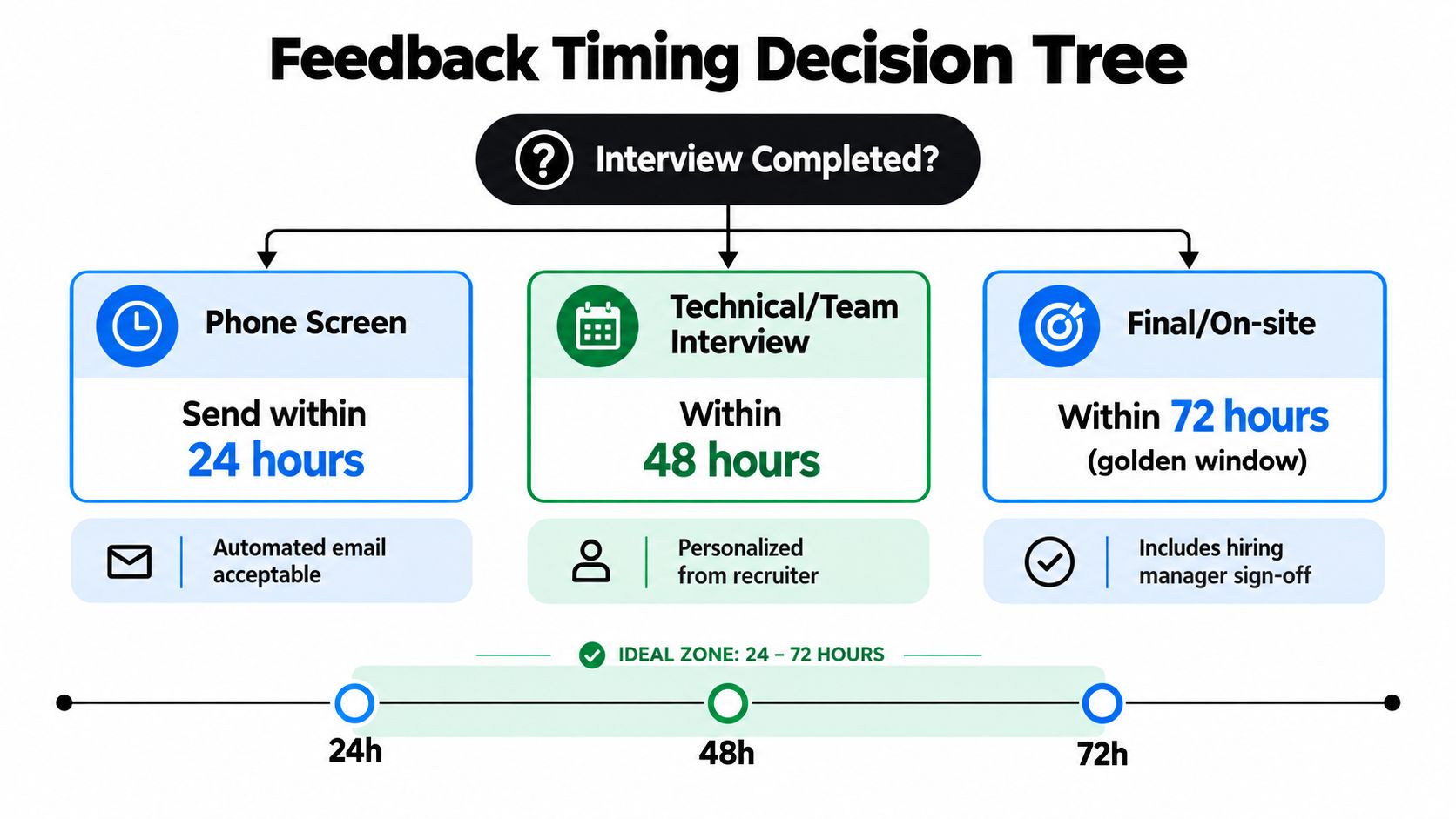
For high-volume hiring, I recommend a 24 to 72 hour window as the default operating standard. That means:
- Phone screen: Send feedback within 24 hours.
- Technical or team interview: Send feedback within 48 hours.
- Final round or onsite: Send feedback within 72 hours.
- Sensitive or senior rejections: Use a short call first, then follow with a written summary.
This isn't just about speed. It's about credibility. Once candidates wait too long, even decent feedback lands badly because they've already decided your process is chaotic.
Match the sender to the stage
Don't make the same person send every message.
A cleaner model looks like this:
- Recruiter sends early-stage outcomes: Phone screens and first-round updates should usually come from the recruiter. It keeps the process consistent.
- Hiring manager signs off on later-stage decisions: Final-round feedback should reflect the actual decision maker, even if the recruiter delivers it.
- Panel chair or loop owner consolidates internal notes: One person should synthesise the signal so the candidate doesn't receive a patchwork summary.
Every interviewed candidate should get an acknowledgement within one business day and a substantive feedback message within the stage window, even if the update is simply that the team needs more time.
Know when to pause
There is one place where speed should not override judgement.
If you're still actively comparing two finalists, don't send detailed explanatory feedback that locks you into a narrative too early. Tell the candidate the decision is pending and give a firm follow-up date. That protects the panel from biasing itself after the fact, and it prevents messy reversals.
Here's the standard I'd enforce: acknowledge quickly, decide visibly, explain clearly. Teams that miss any one of those usually miss all three.
A Feedback Structure That Works for Hire and No-Hire
Most feedback fails because it has no structure. It rambles, hides the point, or turns into personality commentary. Recruiters need a repeatable pattern that works whether the answer is yes or no.
I use a five-part structure: outcome, evidence, skill signal, next step, human tone.
The five parts
Outcome
Say the decision directly. Don't make the candidate decode the first three lines.Evidence
Tie your feedback to something observable from the interview.Skill signal
Separate what the candidate showed from what the role requires at this level.Next step
Give a clear action, timeline, or future pathway.Human tone
Add one real sentence that sounds like a person, not a policy.
How this looks in practice
| Feedback Component | Hire Outcome (Example) | No-Hire Outcome (Example) |
|---|---|---|
| Outcome | We'd like to move you forward to the offer discussion stage for the Product Manager role, and your recruiter will contact you by Thursday. | We've decided not to move forward for the Operations Lead role after this round. |
| Evidence | In the case discussion, you prioritised customer impact and margin trade-offs clearly, and the panel aligned on your decision quality. | In the stakeholder scenario, your answer stayed high-level and didn't show how you'd resolve competing priorities across finance and sales. |
| Skill signal | You showed the judgement and communication range we expect for this level, especially in cross-functional decision-making. | You demonstrated solid functional knowledge, but this role needs stronger evidence of leading ambiguous, multi-team decisions at the next level. |
| Next step | Your recruiter will walk you through compensation and timing, and we expect to complete the process this week. | We'd be open to reconnecting if a role opens that matches your current level more closely. |
| Human tone | Your example about rebuilding launch planning after a missed deadline was one of the clearest discussions in the process. | We appreciated how candidly you spoke about a difficult team reset in your current role. |
What most teams get wrong
They write “not the right fit” and think they've done their job. That phrase tells the candidate nothing, and it tells your legal team nothing useful either.
Good evidence is specific. It refers to a case answer, a technical trade-off, a stakeholder example, or a decision the candidate made in the room. If your interview process doesn't generate that kind of signal, the bigger problem isn't the feedback email. The problem is the interview design itself. If your team still relies on vague conversational assessment, fix that first with structured and unstructured interview methods.
Tone should be human, not sentimental
You don't need long praise paragraphs. You need one sentence that proves someone paid attention.
Good:
- We appreciated your breakdown of the vendor migration trade-offs.
- Your example on handling an escalation with a difficult client was thoughtful and grounded.
Weak:
- Thank you for your interest in our esteemed organisation.
- Unfortunately, after careful consideration, we regret to inform you.
Good candidate feedback after interview sounds calm, direct, and role-tied. It doesn't apologise for making a decision. It explains the decision.
Ready-to-Use Message Templates You Can Adapt
Templates are useful. Blind copy-paste is not.
A template should save thinking time, not replace thinking. If your recruiters paste the same message into every rejection, candidates will spot it immediately.
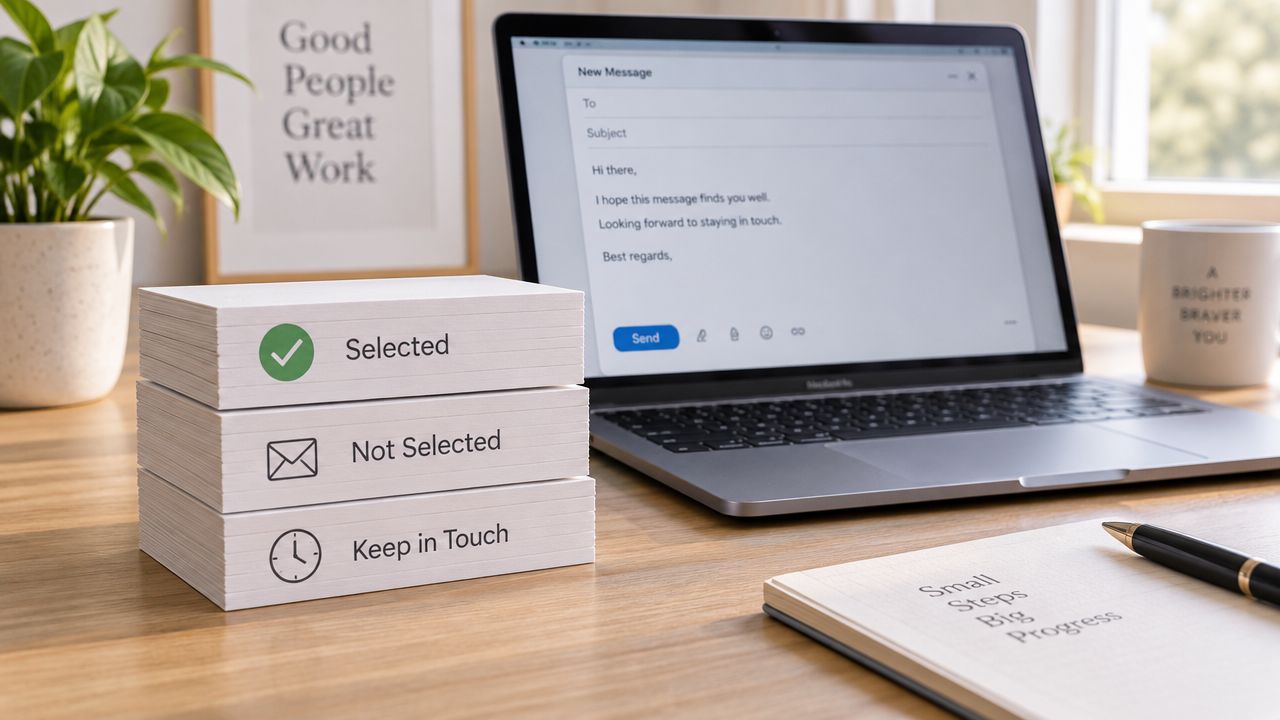
Template for selected candidates
Trigger: Candidate is moving to offer or final approval.
Sample message:
Subject: Update on your interview for the Senior Analyst role
Hi Priya,
Thank you again for meeting with the team. We'd like to move you forward in the process for the Senior Analyst role. Your interview showed strong judgement in the forecasting discussion, especially when you explained how you'd handle conflicting data from sales and finance.
Your recruiter will contact you by tomorrow with the next steps, including timing for the final discussion and compensation process.
We appreciated the clarity of your example on rebuilding a reporting process under deadline pressure.
Best,
Aman
Why it works: the subject line avoids drama, the outcome is immediate, and the evidence is role-specific.
Template for not selected with reasons
Trigger: Candidate completed an interview and deserves a substantive no-hire message.
Sample message:
Subject: Update on your application for the Customer Success Manager role
Hi Neha,
Thank you for the time and preparation you brought to the interview process. We've decided not to move forward for this role.
The team's decision came down to level alignment. In the customer escalation scenario, you showed solid relationship instincts, but we needed stronger evidence of managing complex cross-functional escalations independently across multiple stakeholders.
We appreciated your thoughtful example about retaining a dissatisfied client during a renewal cycle, and we're grateful for the time you invested.
Best,
Ritika
Why it works: it starts with respect, gets to the point, and gives a usable reason without drifting into vague judgement.
Template for pipeline nurture
Trigger: Strong candidate, not selected now, worth revisiting later.
Sample message:
Subject: Staying in touch about future roles at our company
Hi Arjun,
Thank you again for meeting with us. We've filled this role with a candidate whose recent experience was more closely aligned to the current team's immediate needs.
Your interview stood out for its clarity and commercial judgement, particularly in the pricing discussion. We'd like to stay in touch and reconnect if a similar role opens in the coming months. If you're open to that, I'll reach out directly when a suitable position comes up.
Thank you again for the conversation. Your perspective on market-entry trade-offs was valuable.
Best,
Meera
Why it works: it doesn't say “we'll keep your CV on file”, which candidates rightly ignore. It gives a real re-engagement posture.
Before any template goes out
Use a pre-send check:
- Role title verified: Make sure the message names the correct job.
- Personalisation added: Include one real interview detail.
- Decision and next step clear: The candidate shouldn't have to guess what happens now.
For executive roles, send from a named recruiter or hiring leader. For high-volume frontline roles, a recruiter-sent template can work if the content still feels specific.
The Personalization-versus-Throughput Trade-Off
Most advice becomes dishonest.
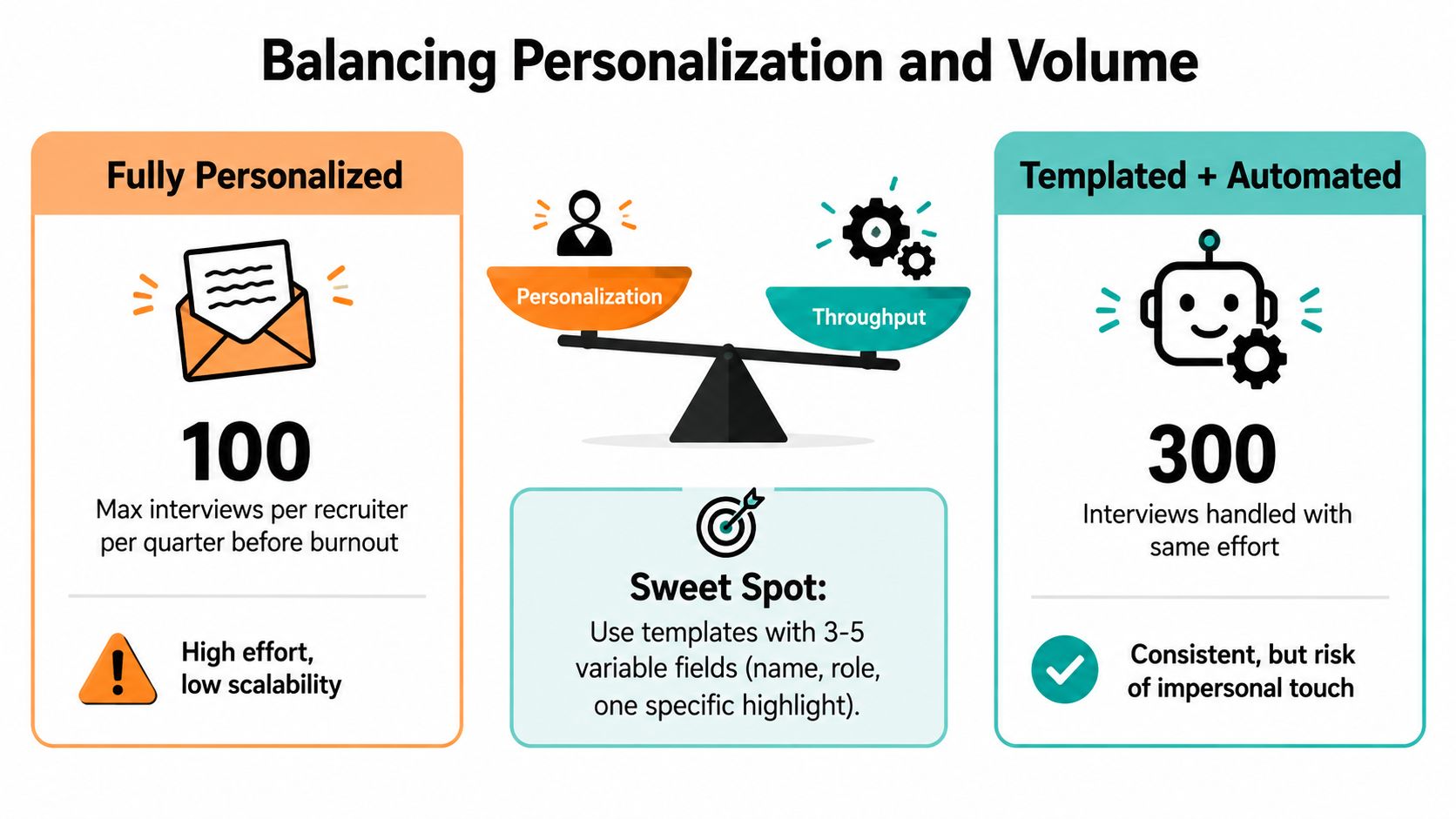
You cannot write fully personalised feedback for every candidate in high-volume hiring and pretend it scales cleanly. It doesn't. Recruiters get buried, interviewers delay notes, and the quality collapses anyway. The answer isn't to abandon personalisation. The answer is to decide where it matters most.
Three operating modes
I'd separate feedback delivery into three models.
| Mode | Best use case | Strength | Risk |
|---|---|---|---|
| Fully human | Final rounds, senior hires, sensitive rejections | High nuance | Slow and hard to sustain |
| Templated plus variables | Mid-funnel interviews, standard professional roles | Consistent and faster | Can sound formulaic |
| AI-assisted structured capture | Early rounds, phone screens, high-volume hiring | Scalable and stage-specific | Needs strong review rules |
The mistake is using one model for every stage.
Where AI actually helps
The best use of AI in candidate feedback after interview isn't writing flowery rejection emails. It's capturing structured signal right after the screen or first interview.
If an AI-driven phone screen records competency-aligned responses, tags evidence against a scorecard, and drafts a concise summary, the recruiter doesn't start from a blank page. They review, adjust, and send. That's useful. It preserves throughput without forcing interviewers to become copywriters.
This matters even more in India, where The Week's hiring coverage noted that only one-third of job seekers feel prepared for interviews and also highlighted prompt feedback and follow-ups as major drivers of candidate experience. Candidates often need more than a generic no. They need directional signal on preparation, role fit, or expectations.
The sweet spot is simple: personalise final-round feedback, use templated-plus-AI for the middle of the funnel, and automate structured early-stage feedback where hiring volume is highest.
The fairness check you need
AI-generated feedback has one obvious failure mode. It starts producing the same rejection in slightly different wording for everyone.
That creates two problems. First, candidates feel fobbed off. Second, your process may mask weak evaluation discipline because the wording looks polished even when the underlying signal is thin.
Run a variance check. Review batches of candidate-facing notes and look for repeated phrases, repeated rationale, and repeated competency language. If every message sounds interchangeable, your automation is too generic or your scorecards are too shallow.
Legal and Compliance Pitfalls to Avoid
The fastest way to create risk is to let interviewers write whatever comes to mind and then forward parts of it to candidates.
Internal debrief notes and candidate-facing feedback are not the same document. Treating them as interchangeable is sloppy and risky.
Phrases that create unnecessary exposure
A lot of common hiring language is dangerous because it's vague enough to imply bias.
Avoid phrases like:
- Cultural fit: This can hide subjective preference and drift into protected-characteristic territory.
- Overqualified: Depending on context, this can invite age-related interpretation.
- Wouldn't fit the team energy: That's personality judgement dressed up as assessment.
- Might not cope with the pace: Unless tied to role-specific evidence, it's too loose.
Keep candidate feedback after interview tied to the role, the rubric, and what the person demonstrated in the interview.
Separate internal notes from external messages
Your hiring team needs room for candid internal evaluation, but even that should stay factual. If you need a stronger process around evidence and recordkeeping, tighten the background verification process and decision controls around who records what and where.
Use this split:
- Internal debrief: Detailed notes, panel disagreement, comparative judgements, calibration comments.
- Candidate-facing feedback: Decision, observable evidence, role-linked rationale, next step.
One-line internal notes are often worse than detailed ones because they invite shorthand bias. “Didn't like presence” is a legal problem waiting to happen. “Did not provide a clear example of leading a cross-functional launch despite repeated follow-up questions” is much safer and much more useful.
Short do and do not list
Do this:
- Quote the role requirements: Anchor the decision to the actual job.
- Use factual observations: Refer to interview responses, not personality labels.
- Keep channels separate: External message should be curated, not copied from panel chat.
Don't do this:
- Characterise personality: Avoid labels like arrogant, timid, immature, polished.
- Reference protected characteristics: Explicitly or indirectly.
- Speculate about hypotheticals: Don't say they'd fail, wouldn't cope, or couldn't manage unless your evidence clearly supports a role-specific gap.
Measuring and Scaling Feedback With AI Tools
If you don't measure feedback, it will always lose to the next urgent vacancy.
Talent leaders need an operating dashboard, not another policy memo. You need a small set of metrics, clear owners, and tools that remove manual friction from the early stages.
The four metrics that matter
Track these at minimum:
| Metric | Target | Owner | Source |
|---|---|---|---|
| Candidate feedback NPS | Improving trend over time | Head of Talent Acquisition | Candidate survey after interview stage |
| Time-to-feedback | 48 hours | Recruitment Operations or TA Lead | ATS timestamps |
| Offer-acceptance rate by stage | Monitored for pattern shifts | Head of Recruitment | ATS and offer records |
| Feedback-completion rate by interviewer | Full completion against internal SLA | Hiring manager and interviewer lead | Scorecard or interview platform logs |
You don't need fifty dashboards. You need one that leaders review.
Where automation fits
AI can help in three practical ways.
First, it can turn phone-screen transcripts or first-round interview responses into structured scorecards. Second, it can draft stage-specific messages tied to competency gaps or strengths. Third, it can produce dashboard rollups that show where the process is slowing down and which interviewers regularly miss the standard.
That's where a tool such as Career Central fits. It provides AI-driven phone screening, first-round interviews, and coding assessments, which can support structured evaluation and feedback capture in the early funnel. If you want a stronger foundation for measurement, build your dashboard around core HR analytics rather than isolated recruiter activity.
Where humans still need to decide
Don't outsource judgement just because software can generate sentences.
Humans should still own:
- Final hiring decisions
- Nuanced rejection wording for late-stage candidates
- Legal review of risky or disputed cases
- Calibration on borderline candidates
Automation should handle capture, synthesis, and reminders. Humans should handle judgement, nuance, and accountability.
A practical 30-60-90 rollout
First 30 days
Audit your current process. Measure how long interviewed candidates wait, where feedback gets stuck, and which stages produce the worst candidate complaints. Standardise scorecards for the top roles first.
By 60 days
Introduce stage-based templates, assign sender ownership by interview round, and pilot structured capture for phone screens or first interviews. Start reviewing interviewer completion rates weekly.
By 90 days
Add AI-assisted drafting for early and mid-funnel feedback, keep human review in place, and report your dashboard to TA leadership monthly. If the data shows delay hotspots, fix the workflow before you add more headcount.
Don't need a bigger hiring team to improve candidate feedback after interview. They need a more disciplined process, better structured signals, and less blank-page writing.
If your hiring team is still chasing interview notes in spreadsheets and sending vague rejection emails days late, fix the process before the next hiring spike exposes it again. Career Central offers AI-driven phone screening, first-round interviews, and coding assessments that can help teams capture structured signal early and turn it into faster, more consistent candidate feedback after interview.