The candidate cleared every interview round, accepted the offer, and joined on Monday. By Wednesday, HR discovered that the degree certificate was forged and the previous employer had no record of the person's employment. The hiring team now had a business problem, a manager who needed an immediate replacement, and a candidate relationship that had deteriorated because verification started too late.
That situation is why the background verification process has moved beyond a post-offer formality. In India, employers are increasingly treating BGV as a risk-gated workflow, with timing decisions based on role sensitivity, access to data, regulatory exposure, and the quality of evidence available. The right process protects hiring speed without allowing an avoidable red flag to become an onboarding decision.
Table of Contents
- What the Background Verification Process Does in 2026
- The End-to-End Background Verification Workflow
- Types of Checks and When Each One Matters
- Legal and Compliance Requirements for Hiring in India
- How to Choose and Manage a Background Verification Vendor
- Connecting Background Verification with AI Screening and Your ATS
- Decision Rules for Red Flags, Discrepancies, and Candidate Rights
- Checklist, KPIs, and Pitfalls You Can Use This Week
What the Background Verification Process Does in 2026
A candidate is ready to join, but the education record is incomplete and the previous employer has not replied. The hiring manager wants a decision today. A modern background verification process gives HR a controlled way to decide whether the role can proceed, pause, or require safeguards, based on verified evidence.
It confirms identity, tests education and employment claims, and can assess criminal, credit, regulatory, address, and other role-specific exposure. The output should not be a long vendor file that nobody reads. It should be an adjudicated report with enough evidence for HR and the hiring manager to make a defensible decision.
India has no single federal background-check law. The process is shaped by state rules, the IT Act 2000, sector-specific requirements, and the Digital Personal Data Protection framework. The notification of the DPDP Rules on 14 November 2025 created an 18-month compliance runway ending on 13 May 2027. The rollout also places stronger expectations on consent, purpose limitation, and retention controls. The hiring implications of the 2025 DPDP Rules matter because BGV records are personal data.
From checklist to risk gate
The older process issued an offer, sent a spreadsheet to a vendor, waited for a report, and treated the vendor's conclusion as final. That approach starts too late for sensitive roles and gives excessive authority to an output that may contain incomplete or disputed information.
A risk-gated process connects the ATS, screening tools, and BGV platform. A role-risk field can trigger a check after application, after a conditional offer, or before joining. Application-stage screening may identify claims requiring later verification. BGV can then use structured ATS fields such as employment dates, education history, and addresses, reducing duplicate data entry and conflicting candidate responses.
Practical rule: Start BGV early enough to prevent avoidable access risk, while limiting sensitive-data collection to a clear, role-based purpose.
Industry reporting in India has placed pre-onboarding, or “Day 0,” verification at over 25% of large enterprises, citing cheating in virtual interviews, moonlighting, and fraudulent experience certificates as drivers. Reporting on the shift towards pre-joining checks shows why timing belongs in workforce risk design, not only recruitment administration.
The two points that stall many verification workflows are employment checks where former employers do not respond and UAN or EPFO mismatches that require candidate explanation. Set escalation timelines, record outreach attempts, and keep an inconclusive case separate from a failed one.
Every check should end in one of four outcomes:
- Green: The evidence supports the candidate's claims and the role can proceed.
- Amber with conditions: The issue is understood, but a documented control, restricted access, or additional review is needed.
- Red: Evidence indicates material misrepresentation or unacceptable role-related risk.
- Inconclusive: The source has not responded or the evidence is insufficient, so the case remains pending rather than being labelled a failure.
The End-to-End Background Verification Workflow
A reliable background verification process assigns ownership clearly. HR owns purpose, consent, role risk, candidate communication, and the final decision. The vendor owns source outreach, evidence collection, status updates, and report preparation. Neither side should take over adjudication.
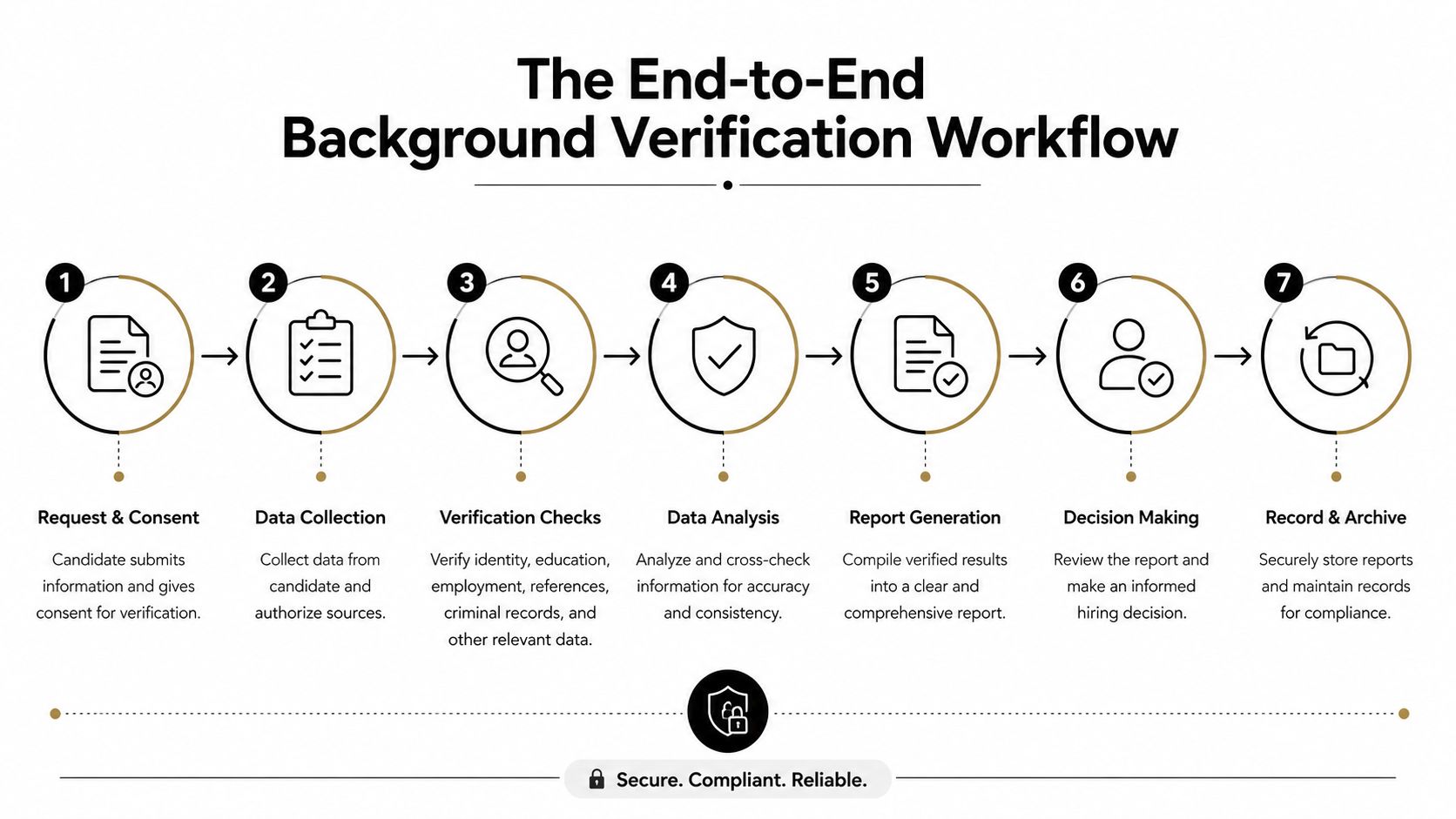
Nine stages that keep cases moving
Capture consent and issue the notice. HR should explain what will be checked, why it's needed, how the information will be used, and how candidates can raise a correction request. Consent shouldn't be buried in a general offer pack.
Collect data securely. The candidate submits identity documents, address history, education details, employment dates, and role-specific information through a secure portal. HR should validate that the fields are complete before the vendor starts.
Create the case. The vendor opens a case in the BGV platform, maps each field to a check, and records missing information as an exception rather than allowing silent gaps.
Run primary checks in parallel. Identity, address, education, and employment checks can begin together. Identity and criminal checks are commonly handled within 24 hours, while employment verification often takes 3–5 days and education verification 5–7 days. These operational bands are part of the supplied workflow guidance and should be treated as planning ranges, not guarantees.
Gate secondary checks by role. Criminal court, credit, regulatory, drug, or media checks should follow the role-risk policy. A back-office role doesn't automatically justify the same data collection as a treasury or regulated position.
Tag discrepancies and request an explanation. The vendor should identify the exact mismatch, source, date, and evidence. Give the candidate a defined response window, such as 48–72 hours, and keep their explanation attached to the case.
Adjudicate with HR evidence. HR decides whether the result is green, amber, red, or inconclusive. The decision record should state the role risk, evidence considered, candidate response, approver, and next action.
Update the ATS and manager. The hiring manager should receive a decision-ready status, not unnecessary personal documents. The ATS should show whether the offer is cleared, conditional, held, or revoked.
Close or archive correctly. HR confirms pre-joining clearance, applies any conditions, or starts the approved revocation process. Retention and deletion dates should be recorded at case closure.
The two points that stall many teams are employment checks where former employers don't respond and UAN or EPFO mismatches that require candidate explanation. A vendor that marks these cases “failed” is creating administrative certainty, not investigative accuracy. Teams building the broader hiring workflow should also review their candidate assessment tools so assessment data and BGV inputs don't conflict.
Types of Checks and When Each One Matters
A check is useful only when it informs a hiring decision. Identity confirms that the person is who they claim to be. Education verification supports qualification decisions. Employment checks test experience, tenure, and role history. Criminal, credit, regulatory, drug, and media checks become more relevant when the job carries specific safety, fiduciary, reputational, or statutory exposure.
The supplied India HR guidance reports that 48% of Indian employers discovered resume discrepancies during checks, while another India HR guide reported discrepancies in 18% of resumes. The India background verification overview presents these figures as evidence that BGV is a material risk-control activity, not a ceremonial HR step. Because the figures come from different reported sources and definitions, they shouldn't be combined into one benchmark.
| Check Type | Cost Band | Typical TAT | Indicative Failure Rate | Decision It Unlocks |
|---|---|---|---|---|
| Identity, Aadhaar or PAN match | Low | Fast | Not consistently established in the supplied data | Confirms identity and prevents record mixing |
| Address, physical or digital | Low to mid | Fast to moderate | Not consistently established in the supplied data | Supports location, access, and role-risk decisions |
| Education and university verification | Mid | Moderate | Not consistently established in the supplied data | Confirms qualification and institution claims |
| Employment, UAN, HR call, payslip trail | Mid | Moderate to slow | Not consistently established in the supplied data | Tests tenure, designation, and experience |
| Criminal court and police verification | Mid to high | Moderate to slow | Not consistently established in the supplied data | Determines whether role-specific safety or trust review is needed |
| Credit and CIBIL review | Mid | Moderate | Not consistently established in the supplied data | Supports fiduciary-role assessment where law and policy permit |
| Regulatory screening | High | Variable | Not consistently established in the supplied data | Checks licensing, sanctions, and sector exposure |
| Drug screening | Mid to high | Variable | Not consistently established in the supplied data | Supports safety-sensitive role decisions |
| Social media or enhanced media review | Variable | Variable | Not consistently established in the supplied data | Identifies defined reputational or conduct concerns, not general opinion |
Match the bundle to the role
| Role risk tier | Required check bundle |
|---|---|
| Low-risk back office | Identity, employment, and education |
| Mid-risk sales or finance | Low-risk bundle, plus criminal and address |
| High-risk leadership, treasury, or regulated function | Mid-risk bundle, plus credit, regulatory, and enhanced media |
Weight human review more heavily where evidence is harder to obtain or records are less standardised. Self-employed candidates, graduates from less digitally accessible institutions, and remote roles with weak supervisor trails often need additional documentation rather than automatic rejection. A discrepancy rate of about 13% across multiple Indian sectors has been reported by a neutral news source, and an annual verification report cited 3,67,542 individuals with at least one failed check in FY 2024–25. The reported scale of discrepancy management in India supports a consistent adjudication policy, not informal decisions made case by case.
Legal and Compliance Requirements for Hiring in India
Compliance begins before a vendor receives a document. HR should define the purpose of each check, present a notice that matches that purpose, obtain consent where required, and set a retention rule. Without these controls, BGV files can become permanent employee archives.
The DPDP framework matters because verification records are personal data. Under the 2025 Rules rollout described in the supplied compliance reference, non-hired candidate data must be deleted within 180 days. The broader compliance runway ends on 13 May 2027, so teams should configure controls now instead of waiting for the final deadline. Translate the practical hiring changes into system fields, workflow steps, and deletion rules, as noted earlier.
Convert the rules into operating actions
| Law or regulation | HR obligation | Retention or action | Penalty if missed |
|---|---|---|---|
| DPDP framework and Rules | Give a clear notice, collect valid consent where required, limit use to the stated hiring purpose, and protect personal data | Delete non-hired candidate BGV data within 180 days under the rollout guidance. Define a documented retention schedule for hired candidates | Exposure to regulatory, contractual, and grievance consequences |
| IT Act 2000 framework | Apply reasonable security and careful handling to sensitive personal information | Restrict access, log downloads, and review vendor controls | Data-security and privacy exposure |
| State-specific requirements | Check whether the role or location requires police verification or an additional local process | Use the applicable state process and preserve evidence of completion | Local compliance and hiring-risk exposure |
| RBI, SEBI, IRDAI, NBFC, and KYC expectations | Apply role-appropriate screening for regulated, fiduciary, customer-data, and licensed functions | Map each check to the relevant policy and regulator expectation | Regulatory scrutiny and control weakness |
| Criminal-law disclosure rules | Avoid treating every allegation or record as equivalent. Assess legal status, relevance, and connection to the role | Record the evidence, candidate explanation, and basis for the decision | Unfair or poorly supported hiring action |
Capture consent before collection begins. The notice should identify the data categories, purpose, participating parties, and route for correction or grievance. If a vendor contacts a former employer before consent is recorded, the audit trail is already weak.
Data minimisation should shape access as well as collection. A hiring manager generally needs the decision, evidence category, and relevant rationale, not an unrestricted copy of every document. Store the source record in a controlled system, limit downloads, and record who reviewed an exception.
Cross-border processing requires a separate review. Ask where the vendor stores data, which subcontractors can access it, how a case is deleted, and how the organisation retrieves records when employment ends. Sector rules may add requirements, so a generic BGV package is insufficient for banking, insurance, securities, or NBFC roles.
Set the approval gate on day 0. Decide which checks can run in parallel, which require a candidate explanation before adjudication, and which must clear before access to sensitive systems or regulated duties. That timing decision reduces TAT pressure without allowing a material risk to pass unchecked.
Compliance test: If HR can't explain why a particular check is necessary for a particular role, the check probably shouldn't be in the default package.
How to Choose and Manage a Background Verification Vendor
Run vendor selection like an operations exercise, not a procurement comparison based on headline price. Two providers can quote different amounts because one bundles source fees and manual follow-up while another lists them separately. Ask whether court or access fees, re-checks, international handling, and exception management are included.
Score both vendors against the same evidence. Use a 1–5 score, where 1 means the vendor can't demonstrate the capability and 5 means the capability is proven in a live reference, sample report, or contract commitment.
| Criterion | Weight | Vendor A Score (1–5) | Vendor B Score (1–5) | Notes |
|---|---|---|---|---|
| Source coverage and verification depth | 25 | Test court, university, employer, and regulatory sources | ||
| Check-level TAT commitments | 15 | Require separate commitments by check type | ||
| Data security and access controls | 15 | Review ISO 27001, SOC 2, CERT-In, and access evidence | ||
| Consent and candidate workflow | 10 | Confirm notice, reminders, correction, and grievance handling | ||
| Dispute resolution and escalation SLA | 10 | Check ownership of inconclusive and disputed cases | ||
| Pricing transparency | 10 | Identify component fees, bundles, rechecks, and pass-through charges | ||
| ATS and webhook integration | 10 | Test status sync, error handling, and audit logs | ||
| Reporting and auditability | 5 | Review evidence trails and decision-ready reports |
What to test before signing
Request sample outputs for a clean case, a discrepancy, and an inconclusive case. Ask how the vendor handles an unresponsive employer, an institution that has no digital record, a UAN mismatch, and a candidate who disputes the result. The answer should describe evidence and escalation, not only a status label.
Commercial red flags include automatic renewals that aren't surfaced clearly, unlisted database charges, subcontracting without notice, and vague language around data deletion. Contract clauses should address indemnification, confidentiality, approved subprocessors, data location, breach handling, audit rights, service credits, and return or deletion of data at exit.
Once the vendor is live, hold weekly TAT reviews until the workflow stabilises. Run monthly accuracy audits using re-check sampling, and maintain an escalation playbook with named owners. In every quarterly business review, track four core measures: average TAT by check, discrepancy rate, first-time-clear rate, and vendor SLA adherence. For high-volume teams, add candidate complaint volume and unresolved-case ageing.
If hiring volume is uneven, document the logic behind package pricing and volume commitments. A structured bulk hiring process needs predictable exception handling, because a vendor that performs well on a small batch may struggle when several cases require manual follow-up at once.
Connecting Background Verification with AI Screening and Your ATS
AI screening and BGV answer different questions. AI may assess whether a candidate's stated experience matches a job requirement, while BGV tests whether selected claims can be supported by external evidence. Problems arise when teams treat both tools as separate data silos and ask candidates to enter the same information repeatedly.
The ATS should be the control point. Store structured employment dates, education claims, addresses, consent status, role-risk tier, and BGV status as separate fields. A resume parser can populate the first version of those fields, but verification should never overwrite the candidate's original claim. Understanding how resume parsing works helps teams distinguish extraction from verification.
A cleaner trigger design
Trigger BGV after a conditional offer or when a defined role-risk threshold is reached. Suitable thresholds include access to sensitive personal information, financial authority, child-facing duties, regulated activity, or public-trust responsibilities. Don't send every application into a full screening workflow when the role doesn't justify that data collection.
A practical integration sequence looks like this:
- AI screening extracts claims from the resume and assessment.
- The ATS stores the claims and assigns a role-risk tier.
- A webhook triggers BGV when the approved condition is met.
- The BGV platform returns status and evidence links through a controlled integration.
- The ATS displays one decision dashboard showing screening signal, verification status, exceptions, and offer readiness.
One recurring failure occurs when an AI tool flags an employment gap that BGV later clears through employer records. If the ATS has no adjudication field, recruiters may act on the earlier flag and ignore the verified result. Add a source-of-truth hierarchy, preserve both records, and require human review when the outputs conflict.
Decision Rules for Red Flags, Discrepancies, and Candidate Rights
A red flag isn't automatically a rejection. It is a signal that needs a relevance test, evidence review, and role-specific decision. Treating every mismatch equally produces false negatives, unfair outcomes, and unnecessary delays, especially where the discrepancy comes from data-entry errors or an unresponsive source.
A workable model has three tiers:
| Discrepancy Type | Tier | Action | Approver |
|---|---|---|---|
| Minor mismatch under 90 days or spelling variation in a non-critical field | Tier 1 | Auto-clear if supporting evidence is consistent | BGV operations or HR operations |
| Employment gap under six months, or supervisor unavailable after two attempts | Tier 2 | Request evidence and conduct manual review | HR plus hiring manager |
| Material misrepresentation of degree or role, fake experience letter, or relevant pending criminal matter | Tier 3 | Escalate, pause access, and review against policy and law | HR, business panel, and legal where needed |
The thresholds above are operating rules, not legal conclusions. Each organisation should test them against role requirements, internal policy, applicable law, and the quality of the source evidence.
The five-step adjudication record
- Collect evidence: Preserve the source response, document, date, and method of verification.
- Invite a response: Give the candidate a defined window, such as 5 business days, and state what evidence would resolve the issue.
- Review proportionately: Include HR and the business, with legal participation for serious or sensitive cases.
- Record the outcome: Mark green, amber, red, or inconclusive, and explain the reasoning.
- Keep an appeal trail: Record the candidate's correction, the re-check, and the final approver.
The same two-month employment gap can lead to different decisions. For a junior analyst, payroll evidence and a credible explanation may resolve it quickly because the gap doesn't contradict a critical qualification. For a senior finance controller, the team may examine the dates more closely if the claimed experience supports fiduciary authority or regulated work. The difference is not arbitrary leniency. It is risk context applied consistently.
Candidates should have a practical route to access, correction, and grievance. HR shouldn't hide behind the vendor's report. If the candidate disputes the result, pause the adverse decision long enough to review the evidence and communicate the conclusion clearly.
Checklist, KPIs, and Pitfalls You Can Use This Week
A background verification process becomes reliable when recruiters can run it without asking for an exception every time. Put the workflow, SLA expectations, decision rules, and purge dates in the ATS or an operating sheet that the whole team can use.
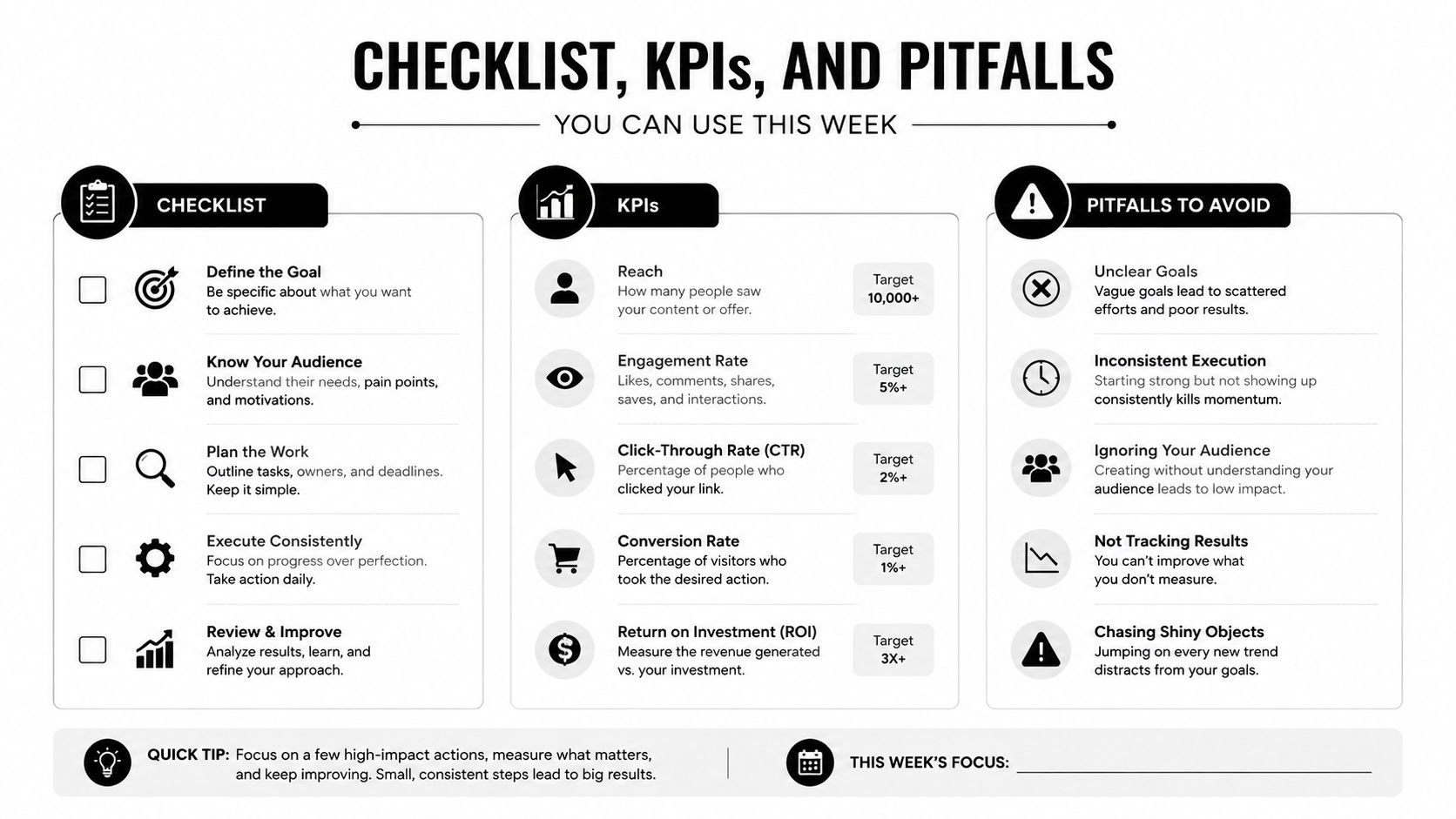
Service bands and dashboard measures
| Check group | Planning TAT |
|---|---|
| Identity and address | 24–48 hours |
| Employment and education | 5–7 business days |
| Court and database checks | 7–10 business days |
| Global checks | 15–25 business days |
These are planning bands supplied for operations design. A vendor should explain what causes a case to exceed them and how the escalation works.
Track the following in a weekly dashboard:
- Pass rate: Monitor the overall outcome mix, but don't use it as the only quality measure.
- First-time-clear rate: Shows whether the intake data and candidate instructions are working.
- Discrepancy rate: Segment by check type, source, role, and vendor.
- Average TAT: Measure from consent completion to decision, not from an informal request.
- SLA adherence: Separate vendor delay from candidate delay and source delay.
- Candidate NPS or complaint volume: Reveals whether the process is creating avoidable friction.
- Cost per check: Review alongside re-checks, manual exceptions, and failed integrations.
Ten failures to remove from the workflow
- Triggering BGV before a conditional offer without a documented role-based reason.
- Skipping written consent or using a notice that doesn't describe the actual checks.
- Maintaining weak supervisor and employer contact data.
- Treating an unresponsive source as proof of fraud.
- Ignoring DPDP retention and deletion controls.
- Treating vendor output as the final hiring decision.
- Failing to communicate an adverse or conditional outcome.
- Mixing AI pre-screening and BGV data without source labels.
- Letting unresolved cases remain open without an owner or ageing rule.
- Forgetting regular vendor audits, including review of subprocessors and evidence quality.
Copy-paste checklist for TA
- Confirm the role-risk tier before requesting BGV.
- Issue the conditional offer where policy requires it.
- Capture consent and the complete privacy notice.
- Tell the candidate what documents and contacts are needed.
- Validate ATS fields before handing the case to the vendor.
- Record the vendor case ID and expected check-level TAT.
- Review amber, red, and inconclusive results through the adjudication policy.
- Log the candidate's explanation and all evidence considered.
- Update the ATS with the decision and approver.
- Set the retention and purge date at case closure.
- Confirm clearance before access, joining, or sensitive-system provisioning.
Career Central helps hiring teams combine AI-driven phone screening, first-round interviews, and coding assessments with a more organised recruitment workflow. Visit Career Central to see how its assessment capabilities can help your team create cleaner ATS inputs before the background verification stage.