Bulk hiring is the high-throughput recruitment of many similar roles inside a compressed window. In India, that usually means 56.2 crore employed persons and 8.7 lakh new jobs added in the same quarter, so even small hiring shifts create large headcount movements that HR teams have to absorb fast (PLFS labour market data).
If you're running a ramp right now, you already know the core problem isn't posting jobs. It's keeping quality intact while applicant volumes, interview load, and onboarding pressure all hit at once.
Table of Contents
- What Bulk Hiring Looks Like Inside an Organisation
- Why India-Specific Data Changes the Definition
- Bulk Hiring Versus Other Recruitment Models
- The Four-Phase Operating Model for Bulk Hiring
- When Bulk Hiring Stops Being a Speed Exercise
- Metrics and Risk Signals That Matter at Scale
- Best Practices for HR Leaders Running Bulk Hiring
- Decision Checklist and Frequently Asked Questions
What Bulk Hiring Looks Like Inside an Organisation
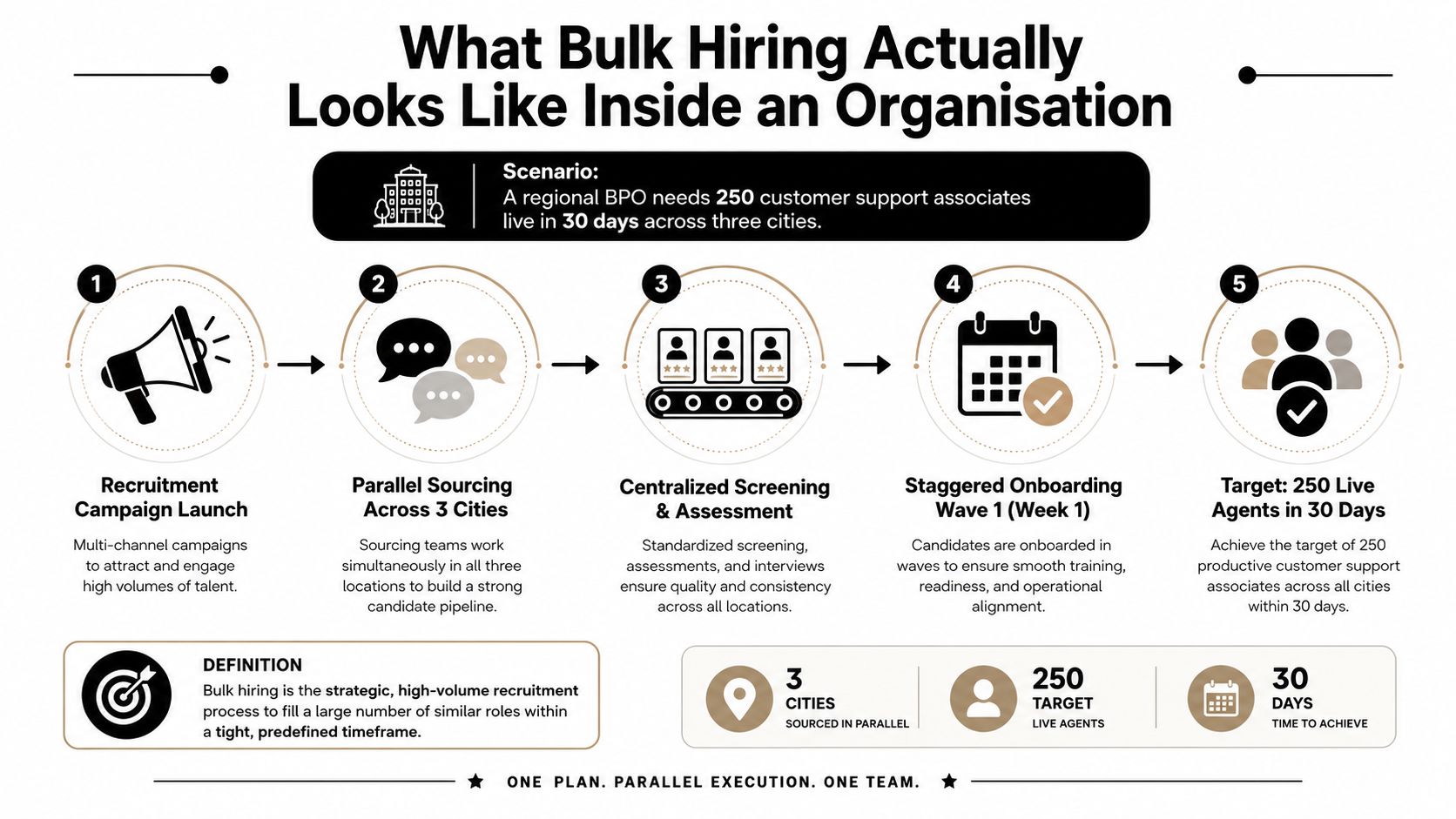
A regional BPO needs 250 customer support associates live in 30 days across three cities. That is bulk hiring in operational terms. The hiring manager does not want a slow, custom process. They need a repeatable system that moves a large cohort from application to offer to joining without breaking service levels.
The working model HR teams use
Bulk hiring is a time-boxed hiring drive for many similar roles under one charter. It differs from everyday flow hiring, where requisitions arrive one by one and each role gets a custom process. In bulk hiring, HR clusters requisitions, uses one JD template with location variants, runs a shared assessment battery, and often brings people in through a shared onboarding cohort.
That structure matters because it compresses three bottlenecks at the same time. Requisition approval has to move fast enough to launch the campaign. Interview panel capacity has to scale beyond the normal manager rhythm. Offer-to-joining logistics have to be handled in batches, not as one-off follow-ups. If any one of those breaks, the whole drive slows down.
Practical rule: if the business expects identical or near-identical roles, standardise the process first and personalise second. That order keeps throughput high without turning the funnel into guesswork.
What changes inside the hiring team
A bulk charter changes how recruiters work day to day. They stop managing isolated openings and start managing a shared pipeline with consistent screening rules, common interview slots, and grouped start dates. The recruiter's job becomes less about chasing each requisition separately and more about maintaining flow across the funnel.
It also changes how the business judges success. In a normal role search, one strong hire can hide a messy process. In bulk hiring, weak screening or inconsistent offers show up immediately because the volume magnifies every error. That is why bulk hiring meaning should be treated as an operating model, not just “hire more people quickly.”
Why India-Specific Data Changes the Definition
India makes bulk hiring heavier than the phrase sounds. Official labour market data shows 56.2 crore employed persons in Q2 FY26, 8.7 lakh new jobs added in that quarter, and female labour force participation rising from 23.3% in 2017-18 to 41.7% in 2023-24, while unemployment fell from 5.6% to 3.2%. That is a far larger and more active labour pool than older hiring playbooks assume.
The pipeline is wide at the top and thin where it matters
India hiring teams are not struggling to find applicants. They are struggling to sort signal from noise. One India hiring intelligence report says application volume per open role has grown by over 80% since 2022, and recruiters now see roughly 200 to 500 applications for roles that used to attract 50 to 100 (Keelzo India hiring intelligence 2026). That changes the funnel shape completely.
The top of the funnel gets wider, but the middle does not get easier. Screening load rises sharply, panel time stays flat, and the offer stage becomes a narrow tail. In practice, bulk hiring stops being a sourcing problem and becomes an evaluation problem. The bottleneck is quality control under volume, not reach.
India hiring cycles add another layer of pressure
Bulk hiring here is also tied to campus recruitment, retail peaks, BFSI hiring, and operational expansion in sectors such as IT services, manufacturing, and customer operations. National employment reporting shows labour force participation at 59.3% for people aged 15+ in 2025, with 79.1% for men versus 40.0% for women. Sourcing has to be segment-specific, not generic (PLFS annual employment data).
Operational takeaway: in India, the real question is not “can we attract enough applicants?” It is “can we evaluate them fast enough without lowering the bar?”
That is why the role cluster matters. Frontline operational roles usually create the heaviest screening load, with high application volume and tight conversion at both shortlist and offer stages. Entry-level customer operations looks similar on the surface, but the risk shifts toward inconsistent screening quality and drop-offs in the middle of the funnel. Location-based support roles are different again, because availability depends more on geography and shift fit, which makes the intake less predictable even when the applicant count looks healthy.
| India Bulk-Hiring Pipeline Shape by Role Cluster | Avg Applicants per Posting | Screen-to-Shortlist Ratio | Interview-to-Offer Ratio |
|---|---|---|---|
| Frontline operational roles | High | Tight | Tight |
| Entry-level customer operations | High | Moderate | Tight |
| Location-based support roles | High | Tight | Moderate |
Bulk Hiring Versus Other Recruitment Models
Bulk hiring only makes sense when the role pattern matches the method. If you need a handful of senior hires, treat bulk hiring as the wrong tool. If you need many similar hires under one competency model, it's the right one.
Use the model that fits the job architecture
Executive search is built for senior judgement, stakeholder alignment, and rare-fit evaluation. Niche hiring is built for hard-to-find skills where depth matters more than volume. Phased intake is for organisations that want controlled expansion without flooding panels or onboarding at once. Bulk hiring trades individual depth for cohort throughput, and that's a good trade only when the work itself supports standardisation.
| Criteria | Bulk Hiring | Executive Search | Niche Hiring | Phased Intake |
|---|---|---|---|---|
| Role volume | High | Low | Low to medium | Medium |
| Time-to-fill tolerance | Low | Medium | Medium to low | High |
| Sourcing depth | Broad | Deep | Deep | Moderate |
| Per-candidate evaluation cost | Lower | Higher | Higher | Moderate |
| Employer brand dependency | High | High | Medium | Medium |
| Onboarding design | Cohort-based | Individualised | Individualised | Staggered |
A blunt selection rule
Choose bulk hiring when the business needs 50 or more similar hires within a quarter, hiring managers agree on one competency model, and onboarding can be run in cohorts. If any one of those three is missing, switch to a different model or use a hybrid. A common example is executive search for leadership roles and bulk hiring for the frontline layer underneath.
That's the trade-off senior TA leaders need to call out early. The more standard the job, the more bulk hiring pays off. The more unique the job, the more it hurts.
The Four-Phase Operating Model for Bulk Hiring
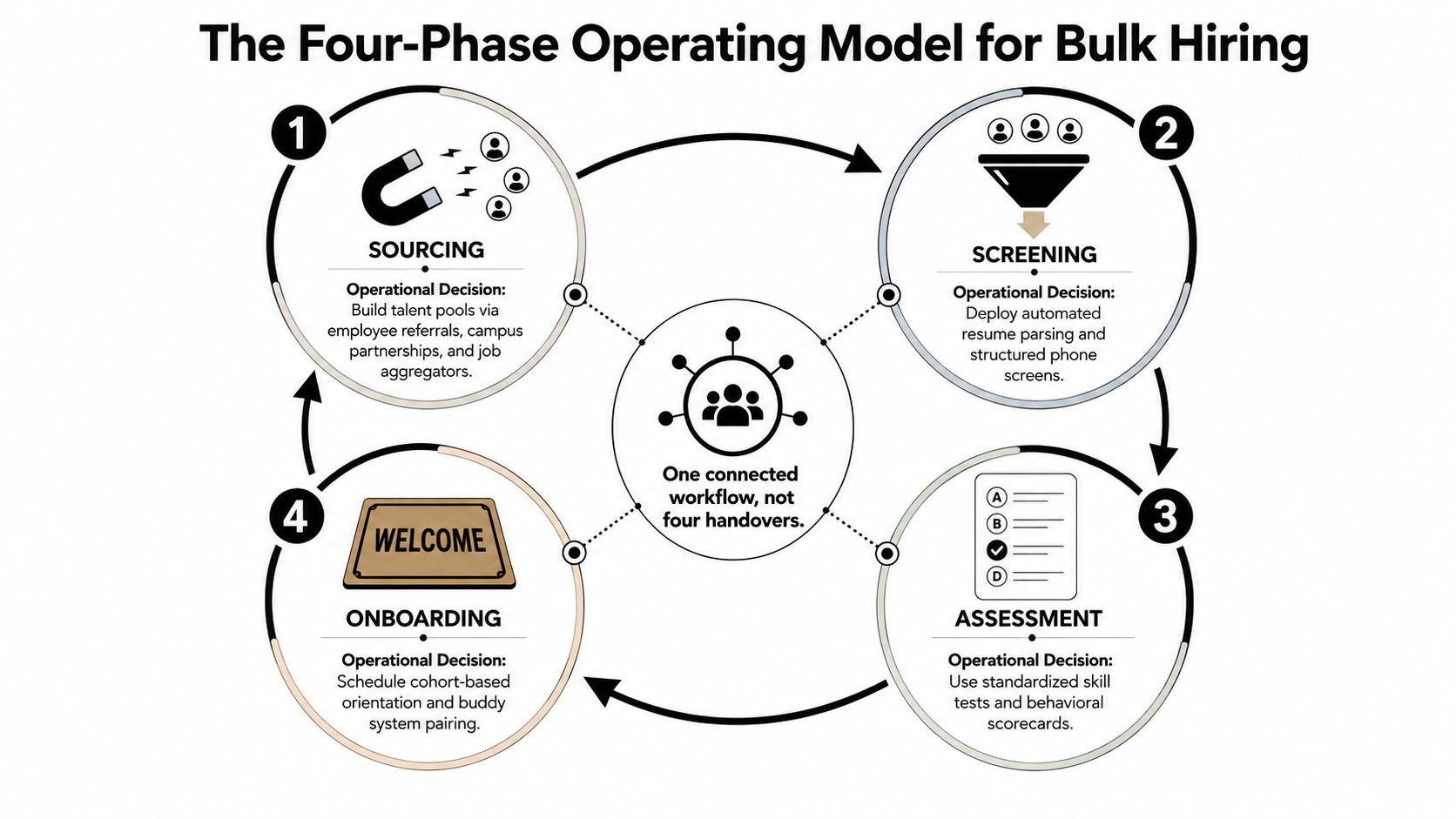
Bulk hiring works when sourcing, screening, assessment, and onboarding behave like one connected system. If those phases are treated as separate handovers, teams lose candidates at every seam. The fix is discipline, not heroics.
Sourcing and screening
Sourcing starts with channel mix and a clean JD. For high-volume roles, recruiters need referral programmes, campus links, and aggregators working off the same role logic. The JD should say what matters, then localise only where location or shift rules change.
Screening is where the surge either gets controlled or gets messy. AI-driven resume parsing and first-round asynchronous interviews are useful here because they move the first decision point away from human calendars. That frees recruiters to spend time on qualified candidates instead of sorting noise.
Assessment and onboarding
Assessment should be standardised enough to compare candidates at scale and short enough that people finish it. Structured scorecards work better than loose manager opinion, because bulk hiring needs comparability, not improvisation. If the role is entry level, keep the task practical and relevant to the job.
Onboarding should be cohort-based, not individualised one by one. A shared start date, a shared induction, and a buddy system reduce confusion and help managers absorb new joiners without building separate routines for each person. The weakest bulk hiring programmes usually fail at the boundary between assessment and onboarding, where candidate communication becomes inconsistent.
Human review should happen after the first filter, not before it. If managers are reading every résumé manually in a 300-seat ramp, the process has already failed.
When Bulk Hiring Stops Being a Speed Exercise
Bulk hiring stops working when speed hides quality loss. At Indian application volumes, that threshold is not theoretical. It's visible in the funnel when recruiters are drowning in applicants, yet shortlist quality keeps slipping because the team can't inspect every profile carefully.
The three signals that the model is breaking
The first signal is rising offer-to-joining drop-off. If accepted offers aren't turning into joined headcount, the issue is rarely just candidate intent. It usually points to weak pre-close communication, poor location fit, or rushed expectation setting.
The second signal is recruiter screen fatigue. When recruiters have reviewed too many similar profiles, they start making shallow distinctions. The third signal is assessment-to-shortlist inversion, where assessments create more work than clarity. If the test is producing lots of “maybe” candidates, the process is too noisy.
What to do instead of forcing bulk further
At that point, talent pooling, evergreen sourcing, and micro-batch hiring become better complements. Talent pools reduce cold-start effort. Evergreen sourcing keeps a live bench warm. Micro-batches make quality control easier when the business can accept a slower intake. None of those should be treated as a sign that bulk hiring is dead. They're a sign that the hiring problem has changed.
The hard call for a CHRO is simple. If the role is standard but the evaluation load has outgrown the team, keep the bulk model and upgrade the screening layer. If the role itself is changing too quickly, stop pretending it's a bulk problem and move to phased hiring.
Metrics and Risk Signals That Matter at Scale
The standard recruiting KPIs do not show where bulk hiring breaks once volume spikes. Time to fill, cost per hire, and offer acceptance rate still matter, but they can hide a process that is leaking quality upstream. At 200-plus applicants per role, the risk shows up before the final decision.
Watch the funnel, not just the finish line
Track stage-by-stage conversion every week. That tells you where candidates are dropping out, and it is more useful than one blended metric. Recruiter screen accuracy also needs review. A screen that sends the wrong people forward only adds noise and wastes interviewer time.
Assessment pass-rate drift is another warning sign. If pass rates swing without a clear change in role requirements, the scoring model needs recalibration. Post-offer ghosting should be treated as a signal too. It usually points to weak communication, unclear location fit, or loose compensation positioning.
Tie each metric to a decision
If the top of the funnel looks healthy but shortlist quality is still poor, audit the screening rules. If assessments are filtering too hard, shorten them or redesign them. If candidates disappear after offer, tighten the close and improve joining coordination.
Candidate assessment tools should raise signal quality, and Career Central's guide to candidate assessment tools is a useful reference for keeping screening focused on the right signal.
Weekly dashboard rule: if a metric does not lead to a staffing, screening, or onboarding decision, it is reporting theatre.
Best Practices for HR Leaders Running Bulk Hiring
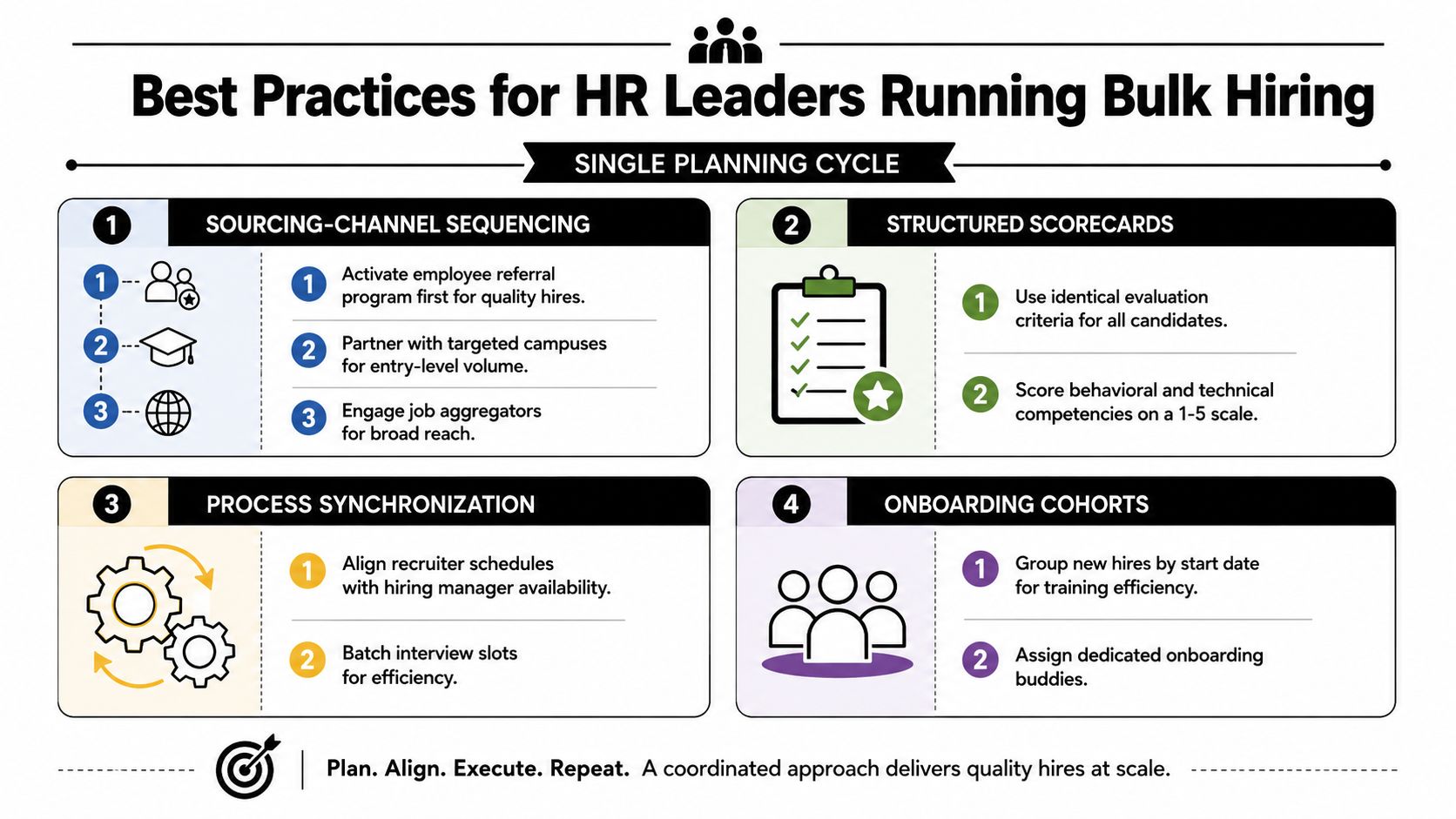
Bulk hiring should run like a controlled campaign, not a loose hiring spree. The best teams sequence their sources, standardise evaluation, and keep managers aligned on the same scorecard. If you want scale without slippage, make the process boring in all the right places.
Lock the process before the volume arrives
Start with channel sequencing. Referrals should go first, because they usually produce more reliable signal. Then use targeted campuses for entry-level volume, and aggregators for breadth. Don't let every channel use a different promise or a different JD.
Use identical scorecards across panels. If one manager grades communication and another grades attitude with no shared rubric, the hiring decision becomes political. Same JD, same competencies, same scoring scale.
Keep knockout rules at the top of the funnel. If shift flexibility, location, or basic skill requirements matter, filter them early. That protects interviewer time for candidates who can join and perform.
Use AI where it saves human time, not where it replaces judgement
AI-driven screening and first-round interviews should convert screening time into interviewer time. They shouldn't remove hiring managers from the process. The point is to let managers spend time on qualified candidates instead of reading every application.
For entry-level roles, cap assessment length at 25 minutes. Use work-sample tasks instead of generic aptitude tests whenever the role allows it. And set a same-day disposition SLA for every candidate, because slow feedback destroys momentum in bulk campaigns.
If you need a platform to support phone screening, first-round interviews, and coding assessments, Career Central fits that use case without changing the logic of the operating model. The tool should support the process, not define it.
Keep governance tight after launch
Run weekly funnel reviews with the business. That keeps the process honest when volume starts to strain the team. Then complete a day-30 post-onboarding quality audit, because speed that damages early performance isn't success.
Decision Checklist and Frequently Asked Questions
Use this checklist before approving any bulk requisition. If the answer to more than one item is unclear, the business probably needs phased hiring instead of a large one-shot drive.
| Signal | Bulk Hiring Still Works | Switch to Phased or Niche |
|---|---|---|
| Headcount is concentrated in similar roles | Yes | No |
| One competency model can cover the cohort | Yes | No |
| Onboarding can be run in waves | Yes | No |
| Screening capacity is already staffed | Yes | No |
| Location spread is manageable in one process | Yes | No |
| Business can tolerate slower, staged intake | No | Yes |
Four FAQs HR leaders usually have
Does bulk hiring work for blue-collar and gig roles? Yes, and in India it often fits operational hiring better than specialist search. The key is to manage attendance, location, and shift fit with the same discipline you'd use for a BPO or retail ramp.
How do you run bulk hiring across multiple cities without losing consistency? Use one JD, one scorecard, one assessment pattern, and city-level sourcing variants. The moment each location invents its own process, comparison breaks down.
When should you bring in an RPO or partner? Use one when internal screening capacity can't handle the surge or when the business wants the ramp delivered through a repeatable external process. A 300-seat BPO ramp, a 120-store retail rollout, and a 600-driver logistics hire all justify outside support if the internal team can't run them cleanly.
How do you measure quality after offer acceptance? Don't stop at joined headcount. Review early attendance, manager feedback, and whether the cohort matches the competency profile that the role needed.
Bulk hiring is not just “many hires at once.” In India, it's a decision about whether your process can absorb volume without losing control of quality. If you need help building that balance into your hiring engine, visit Career Central and use its AI-driven phone screening, first-round interview, and coding assessment workflows to tighten the funnel before the next surge hits.