
Most hiring teams are told to “write better interview questions”. That advice is incomplete. A structured interview guide isn't a question list that sits in a shared folder. It's a measurement system, and it only works when the role, questions, scoring anchors, interviewer behaviour, evidence capture, and candidate experience all operate together.
That distinction matters in India, where interviews often carry substantial decision-making weight. A 2025 study of lecturer recruitment reported that 34.2% of appointments used direct interview-only selection, compared with 25.8% using a demonstration lecture plus interview and 24.2% using a written test plus interview. The figures come from one recruitment setting, not the whole Indian labour market, but they show why interview governance deserves more attention when other evidence is limited. (Read the India lecturer recruitment study)
Why Your Interview Guide Is Probably Failing
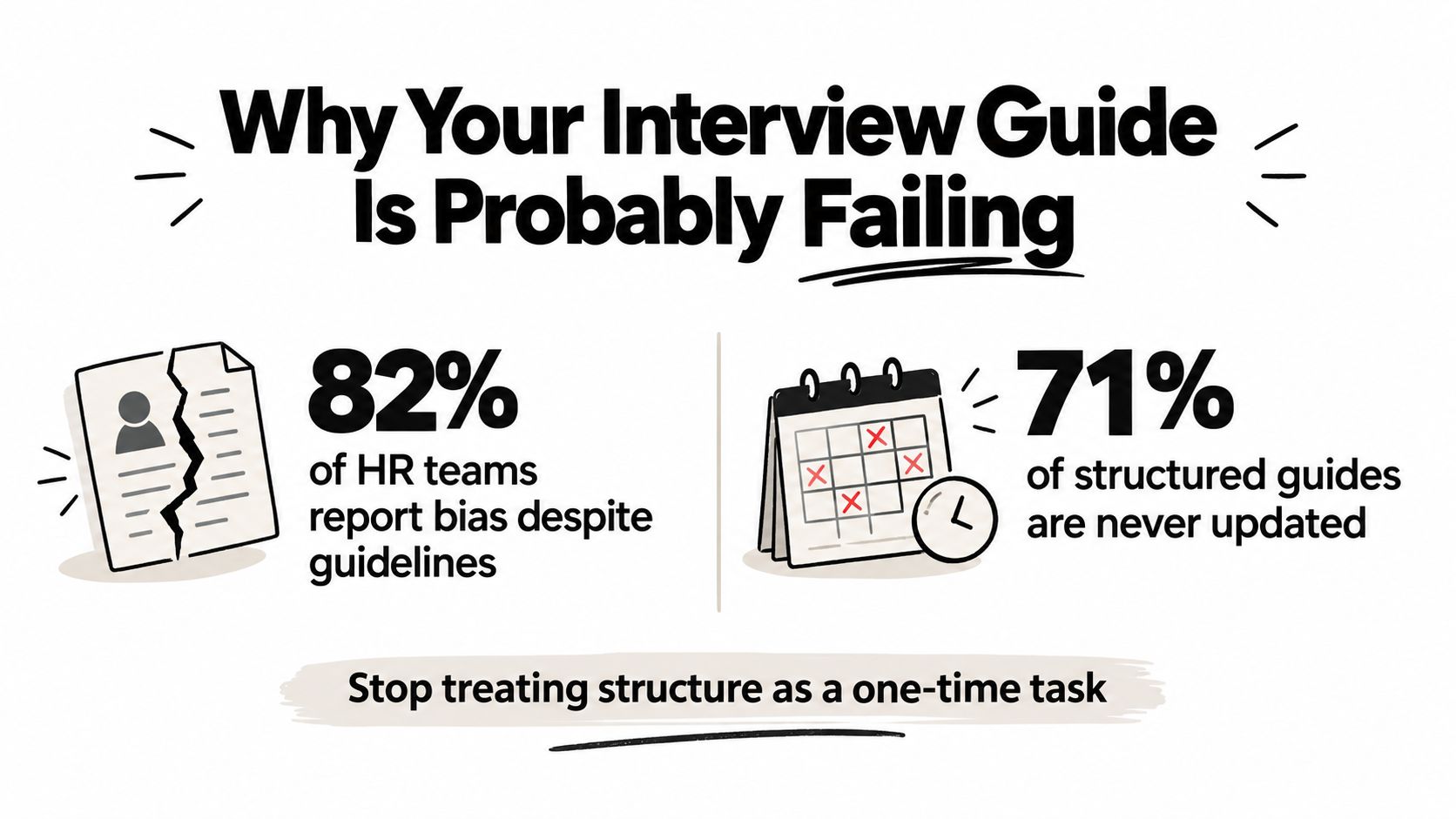
Your guide is probably failing if it tells interviewers what to ask but not what counts as good evidence. A standardised conversation can still produce inconsistent, weak decisions when one recruiter rewards confidence, another rewards technical detail, and a third relies on “culture fit”.
A Bengaluru study of 60 recruitment professionals found that only 46.67% used standardised evaluation criteria, while 65% relied on intuition-based decisions and 55% reported hiring fit at 60% or lower. These figures are directional rather than nationally representative, but they expose the operational gap: many teams have some form of structure, yet still let instinct dominate the final decision. (Review the Bengaluru recruitment study)
Start with the work, not the questions
Before writing a single prompt, define what success looks like in the role. Speak to the hiring manager, strong incumbents, adjacent stakeholders, and whoever owns performance expectations. Collect observable outcomes, recurring challenges, decisions the person must make, and mistakes that create material risk.
Turn that evidence into four to six competencies. Keep job knowledge separate from behaviour. “Understands Indian payroll compliance” is different from “communicates difficult decisions clearly”. Combining them creates double-counting and makes a score difficult to interpret.
A practical competency map for a sales role might look like this:
| Competency | Observable evidence | Suggested emphasis |
|---|---|---|
| Discovery | Identifies customer needs, constraints, and buying authority | High |
| Commercial judgement | Connects customer problems to a viable solution and deal path | High |
| Negotiation | Handles objections without giving away value prematurely | High |
| Pipeline ownership | Maintains accurate next steps and manages risk early | Medium |
| Cross-functional collaboration | Coordinates delivery, product, and customer expectations | Medium |
The emphasis column is not decorative. It determines how much each competency contributes to the final decision. A role that depends on consultative selling shouldn't let a polished presentation score outweigh weak discovery evidence.
Practical rule: If an interviewer can't describe the behaviour they're scoring, the competency isn't ready for an interview guide.
Treat the guide as a living instrument
A good guide has a defined core, controlled flexibility, and a review cycle. Every candidate receives the same competency questions and scoring framework. Interviewers can ask limited probes, but only to obtain missing evidence, such as the candidate's own action, the result, or what they learned.
That balance matters because excessive rigidity can make an interview inaccessible and unnatural, while excessive flexibility destroys comparability. The Mumbai study of professionals used predetermined domains, then refined questioning as early interviews produced evidence. Researchers conducted 139 semi-structured, in-depth interviews across three organisational cases, demonstrating how a consistent framework can still support detailed discussion. (Explore the Mumbai interview research)
Use a simple build sequence:
- Analyse the job: document outcomes, decisions, and recurring work demands.
- Define competencies: write behavioural definitions that describe observable performance.
- Assign weights: reflect the role's actual priorities, not the seniority of the person proposing them.
- Draft questions: request specific past evidence or a role-relevant response to a defined situation.
- Create anchors: describe weak, competent, and exceptional evidence before interviews begin.
- Pilot and revise: remove questions that produce vague, repetitive, or irrelevant answers.
Your current guide is a draft until it produces comparable evidence across recruiters, hiring managers, business units, and locations. See also common interview mistakes, especially the ones that turn a structured process back into an informal conversation.
Writing Questions That Compare Candidates
Questions become comparable when they target the same competency, demand specific evidence, and receive the same scoring treatment. “Tell me about yourself” can open a conversation, but it gives interviewers little consistent evidence for a hiring decision.
Write prompts that expose the decisions the role requires. Behavioural questions test demonstrated experience. Situational questions test judgement when candidates have limited relevant history or must handle unfamiliar conditions. For experienced hires, make past actions the main evidence source rather than relying on polished intentions.
Use prompts that expose ownership and judgement
A behavioural question can follow STAR logic without asking candidates to recite an acronym. Ask what happened, what responsibility they personally owned, what action they took, and what result followed. The interviewer should score the evidence, not the candidate's fluency with the format.
For a customer success role, ask: “Tell me about a time you inherited an unhappy customer account. What did you personally do, how did you prioritise the problem, and what happened afterwards?” Probe only for missing evidence, such as “What was your specific contribution?” or “What evidence did you use to judge the result?”
Role specificity makes comparison stronger. For an operations coordinator, ask: “Describe a time a supplier or internal team missed a commitment that affected delivery. How did you identify the risk, what did you change, and what was the operational result?” This reveals ownership, prioritisation, communication, and follow-through without turning the interview into a general conversation.
For a junior engineering hire, ask: “Describe a time you found a defect or incorrect assumption in a project. How did you investigate it, what did you change, and how did you verify the result?” An entry-level candidate could receive a situational alternative: “You discover that a change passes your local checks but breaks an integration environment. What would you investigate first?”
Test questions before approving them
A question belongs in the guide only if it produces usable evidence. If candidates repeatedly give vague answers, narrow the prompt around a decision, action, or outcome. If interviewers need different explanations to make it understandable, rewrite it before the next stage. Remove prompts that generate the same evidence as another question.
Run early interviews with a consistent scoring approach and compare the evidence each prompt produces across interviewers and locations. Questions should support speed for Indian hiring teams without sacrificing a shared measurement system. For scenario-based prompts, use these situational interview questions as a reference.
Use the same approved questions for every candidate in the same role and stage. Permit probes to clarify missing evidence, not to pursue an interviewer's curiosity or give one candidate extra opportunities to perform.

Designing Scoring Rubrics That Hold Up Under Audit
A scorecard is not a row of numbers followed by a paragraph about “overall impression”. It's a technical specification for converting interview evidence into a decision.
Use a five-point anchored scale:
| Score | Meaning | Evidence standard |
|---|---|---|
| 1 | No relevant evidence | Cannot provide a relevant example or shows a clear gap |
| 2 | Limited evidence | Provides partial, vague, or largely interviewer-led evidence |
| 3 | Competent evidence | Demonstrates the level required for the role with relevant detail |
| 4 | Strong evidence | Shows clear ownership, sound judgement, and a positive result |
| 5 | Exceptional evidence | Provides repeated, specific, independently verifiable evidence above the role target |
Anchors must describe behaviour, not personality. “Confident and impressive” is not an anchor. “Explains the trade-off, identifies the affected stakeholders, and describes how the decision was reviewed” is an anchor.
The available benchmark reports a mean operational validity of 0.42 for structured interviews predicting job performance, with a broad 80% credibility interval of 0.18 to 0.66. That spread is the point. Structure helps, but design and execution quality materially affect whether the process predicts anything useful. (Review the structured interview validity benchmark)
Score evidence before opinions
Interviewers should capture notes about what the candidate said, assign item-level scores, and submit them before panel discussion. Don't average impressions first. If one interviewer gives a 2 for commercial judgement and another gives a 4, compare the evidence behind those ratings.
Calculate the weighted total only after each competency has been scored:
Weighted total = sum of competency score multiplied by competency weight
Retain the individual question scores, evidence notes, and any documented changes. A final number without its components cannot tell you whether the candidate had a real weakness or whether one interviewer scored unusually harshly.
Watch for charisma contamination. If the score rises because the candidate is fluent, warm, or similar to the interviewer, the rubric is measuring social comfort rather than job evidence. A useful interview evaluation form should make evidence fields unavoidable and “culture fit” too vague to function as a hidden veto.
Interviewer Training and Calibration That Works
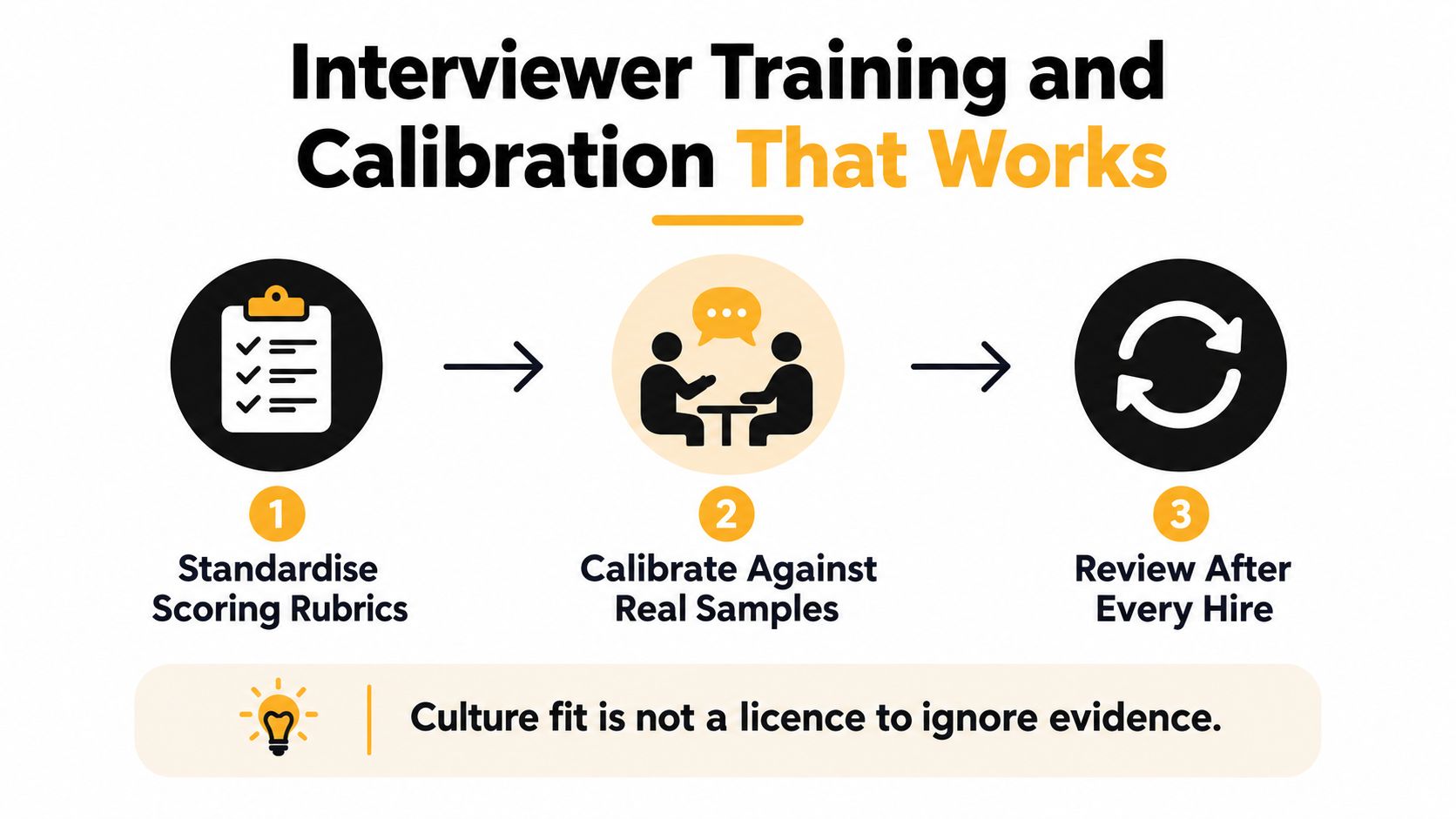
A shared rubric won't calibrate a team by itself. Two interviewers can read the same anchor and assign different meanings to it, especially when one routinely scores generously and another treats every answer as a test of perfection.
An IIM Bangalore working paper notes prior research showing low interviewer agreement, including inter-rater reliability of only 0.47 in one study. It identifies standardised questions and consistent response evaluation as mechanisms for improving agreement. (Read the IIM Bangalore working paper)
Run calibration with real answers
Use a practical 90-minute session:
- Define the standard: review every competency and clarify what each rating level requires.
- Score sample responses: give interviewers the same anonymised answers and have them score independently.
- Compare the spread: ask what evidence moved each person towards a rating.
- Resolve anchor gaps: rewrite vague criteria and add examples of weak, acceptable, and exceptional answers.
- Practise probing: distinguish a permitted evidence probe from an unplanned new question.
- Set operating rules: require independent scoring before discussion and document reasons for any later change.
Don't let seniority settle a disagreement. The panel should return to the answer, the competency, and the anchor. If the evidence doesn't support a rating, the rating shouldn't survive because a hiring manager feels strongly about it.
Audit interviewer severity
After interviews, examine whether particular interviewers score nearly everyone high or low, whether their notes contain evidence, and whether their scores diverge systematically from the panel. Review patterns across roles and locations, while respecting applicable privacy and employment rules.
Calibration is an operating rhythm, not an annual workshop. Revisit anchors when a new interviewer joins, when a role changes substantially, or when repeated disagreement shows that the rubric is unclear.
“Culture fit” can describe a legitimate, job-related behaviour. It can't be a licence to ignore evidence.
Legal, EEO, and AI Integration Considerations
A structured interview guide is also a governance document. Every question should connect to a legitimate job requirement, use the same core wording for comparable candidates, and avoid personal topics that aren't necessary to assess performance.
Document the reason for each competency, the permitted probes, the scoring anchors, and any approved format adaptation. Keep evidence separate from conclusions. Where your organisation collects demographic information for lawful equality monitoring, retain item-level interview data so HR can examine adverse-impact patterns through legally appropriate categories and processes.
Build a clean AI handoff
AI phone screens and coding assessments can sit upstream of the human interview, but they shouldn't become an unexplained decision black box. Use the same competency language across stages. If the human interview assesses “problem-solving”, the earlier automated stage should pass forward the relevant evidence, not merely a generic fit label.
A useful handoff contains:
- the competency assessed;
- the exact task or question;
- the candidate's response or work output;
- the scoring rule used;
- confidence or exception flags;
- a route for human review.
Career Central offers AI-driven phone screening, first-round interviews, and coding assessments with role-specific workflows, transcripts, and scores. Used as an upstream layer, that evidence can help human interviewers focus on the competencies the guide is designed to measure.
Never allow an automated score to override a documented accommodation, a language-related format adjustment, or a human review requirement. Test whether the system behaves consistently across relevant candidate groups, languages, and accessibility needs. Compliance is stronger when the process is designed for inspection from the start.
Candidate Experience as a Design Control
A rigid interview guide can create the very unfairness it was meant to prevent if it treats every candidate as though they have identical communication needs, preparation access, and familiarity with formal interviews.
An India-focused 2025 survey reported that only 32% of more than 10,000 job seekers felt adequately prepared for interviews. Separate reporting on a 2025 foundit survey found that 72% of candidates who abandoned a hiring process cited poor communication or unreasonable delays, while 58% said they wouldn't reapply after a negative interview experience. (Read the India candidate experience reporting)
Put the candidate instructions in the guide
Tell candidates what the interview will assess, whether questions will focus on past examples or scenarios, how long the conversation is expected to take, and what happens next. Provide reasonable notice of technical requirements and explain how they can request an accommodation or language support.
Standardise the job-relevant elements, not every human interaction. Candidates can receive the same core questions and scoring criteria while using an approved interpreter, requesting a reasonable timing adjustment, or explaining an answer in a supported language. The evidence standard stays constant, but the route to expressing that evidence can be accessible.
Create explicit service rules:
- Before the interview: send format, competencies, preparation guidance, and contact details.
- During the process: explain delays instead of leaving candidates to guess.
- After the interview: provide the next-step timeline and a channel for factual corrections.
- For accommodations: record the approved adjustment without treating it as a scoring weakness.
A candidate correction channel shouldn't allow scores to be negotiated. It should allow factual errors in notes, identity details, or process records to be flagged and reviewed. That distinction protects both fairness and auditability.
Piloting, Auditing, and Your 30-Day Rollout
A polished document proves nothing. A structured interview guide earns its place only after a controlled pilot shows that interviewers can apply it consistently and that scores connect to later hiring outcomes. Start with two roles that demand different evidence, such as a customer-facing role and a technical role.
A practical 30-day sequence
Days one to five: complete the job analysis, choose four to six competencies, assign weights, and remove requirements that do not affect job performance.
Days six to ten: write the core questions, permitted probes, five-point anchors, candidate instructions, and evidence fields. Ask a recruiter and hiring manager to score sample answers independently, then compare their reasoning rather than only their totals.
Days eleven to fifteen: train interviewers, run the pilot, and require scores before the debrief. Record skipped questions, improvised probes, missing evidence, and disagreements about anchor definitions.
Days sixteen to twenty: examine score distributions and interview notes. Flag competencies that receive the same score for every candidate, questions that produce no usable evidence, and interviewers whose ratings repeatedly diverge from the panel.
Days twenty-one to thirty: revise the guide, document each change, publish operating rules, and assign an owner for future reviews. Store versions in a tracked location so nobody relies on an outdated copy.
Track whether the system earns trust
Use a compact audit template:
| Audit area | Question |
|---|---|
| Comparability | Did candidates receive the same core questions for the same stage? |
| Evidence | Does each score cite job-relevant candidate evidence? |
| Calibration | Are interviewer disagreements resolved through anchors? |
| Candidate experience | Were format, timing, delays, and accommodations handled as specified? |
| Outcome link | Can interview scores later be compared with probation or performance outcomes? |
Track score variance across interviewers, offer acceptance by interview score band, and six-month performance correlation. Treat these as diagnostic signals, not targets to hit. High agreement with no relationship to later performance indicates consistent measurement of the wrong construct.
Review questions against probation or early-tenure outcomes. Retire items that fail to distinguish evidence quality, and refresh competencies when the role changes. As the lecturer recruitment evidence cited earlier shows, documented structure matters most where interview-only selection carries the decision.
Give the CEO a concise operating summary: the team defines success before interviews, asks comparable questions, scores observable evidence, calibrates interviewers, monitors candidate experience, and tests whether hiring scores connect with later performance. Together, these habits turn the guide into a measurement system rather than a prettier questionnaire.
Career Central provides AI-driven phone screening, first-round interviews, and coding assessments with role-specific questions, structured candidate scoring, transcripts, and evidence for human review. Visit Career Central to design a more consistent hiring workflow around the competencies your teams need.