
You've opened a requisition for a Python developer, copied a familiar template, and watched it fill with vague phrases such as “strong Python skills”, “good communication”, and “experience with scalable applications”. That description may attract applications, but it won't help your team identify the person who can build, test, deploy, and support the software you need.
A useful Python developer job description should describe a working stack, not just a programming language. It should tell candidates what they'll build, how they'll contribute, which tools matter, how performance will be assessed, and what level of ownership the role requires. This guide gives you a modular template for doing that consistently, with practical options for web development, automation, data engineering, backend systems, and AI-enabled products.
Table of Contents
- Introduction and Template Overview
- Defining Role Summary
- Listing Responsibilities and Deliverables
- Structuring Skills Requirements
- Tailoring Junior and Mid Level Roles
- Tailoring Senior and Lead Level Roles
- Designing Screening Criteria
- Building an Interview Question Bank
- Crafting Sample Coding Assessment Prompts
- Writing Inclusive Language
- Suggesting Salary Bands and Benefits
- Quick Reference Checklist
Introduction and Template Overview
A strong JD saves time before recruitment starts. It gives hiring managers a shared definition of the role, gives recruiters searchable criteria, and gives candidates enough context to decide whether their experience fits. If the advert only says “Python developer”, you'll receive profiles ranging from scripting specialists to backend engineers, data analysts, automation professionals, and machine learning practitioners.
Use the template as a set of modules rather than a document to copy unchanged:
- Role summary: Explain the team, mission, product area, and expected impact.
- Responsibilities: Describe the work the person will perform and the deliverables they'll own.
- Skills: Separate essential capabilities from useful additions.
- Seniority: Match autonomy, architecture, collaboration, and mentoring expectations to the level.
- Screening: Convert the JD into ATS tags, scorecard criteria, and phone-screen questions.
- Assessment: Test realistic Python work, including APIs, data handling, testing, and deployment where relevant.
- Inclusion and compensation: Remove unnecessary barriers and present benefits clearly.
For better results, align every keyword with a real responsibility. If you list FastAPI, candidates should know whether they'll build REST services with it. If you require SQL, clarify whether the role involves query writing, schema design, reporting, or pipeline work. Guidance on creating searchable, candidate-ready wording is available in this job description keyword guide.
Practical rule: If a requirement doesn't affect the work, the interview, or the first stage of performance, remove it.
Defining Role Summary
The opening summary has one job. It should help a qualified candidate understand the role quickly and recognise why their experience is relevant.
Use this structure:
We're hiring a [seniority] Python developer to join [team or function] and [core mission]. You'll work with [primary stack] to [business or product outcome], partnering with [key collaborators]. Success will mean [observable impact].
Avoid writing a summary that treats Python as the entire role. India-facing technical listings increasingly pair Python with RESTful APIs, JSON, MongoDB, Redis, Django, and Flask, which reflects a broader backend and integration skill set rather than isolated scripting work, as shown in this India-focused Python role reference.
Choose the role context before filling in the technology. A web development summary might read:
We're hiring a mid-level Python backend developer to join our product engineering team. You'll build and maintain REST APIs with Django and PostgreSQL, collaborate with frontend engineers and product managers, and improve the reliability of customer-facing workflows. Success will mean shipping well-tested features, documenting service behaviour, and resolving production issues with increasing independence.
An automation-focused version should emphasise workflows and operational value:
We're looking for a junior Python automation developer to support our operations team. You'll create maintainable scripts that connect internal systems, validate incoming data, and reduce repetitive manual work. You'll receive code review and technical guidance while developing stronger testing, Git, and database skills.
For data work, name the pipeline responsibility:
We're hiring a Python data engineer to build dependable ingestion and transformation workflows. You'll use Python and SQL to prepare data for reporting and analytics, work with platform engineers on deployment, and improve data quality through validation and monitoring.
Keep the summary accurate. Don't promise ownership of architecture if the person will implement assigned features. Don't advertise “AI innovation” when the actual work is maintaining internal scripts. Candidates make better decisions when the summary reflects the actual environment.
Listing Responsibilities and Deliverables
Responsibilities should describe outcomes and working relationships, not a long inventory of tools. Start by choosing the work categories that apply to the position, then write bullets with an action, an object, and a result or quality standard.
Application development
- Build backend features: Develop Python services, business logic, and integrations that support the product roadmap.
- Extend web applications: Work with Django, Flask, or FastAPI where the role requires framework-based development.
- Maintain existing systems: Investigate defects, improve maintainability, and contribute safely to legacy code.
APIs and integration
- Design service interfaces: Create REST APIs with clear contracts, validation, error handling, and documentation.
- Handle data exchange: Work with JSON and external services while protecting data quality and service reliability.
- Collaborate across teams: Coordinate with frontend, QA, product, and platform colleagues on dependencies and release readiness.
Automation and data workflows
- Automate repeatable processes: Replace manual operational steps with observable, maintainable Python workflows.
- Develop data pipelines: Extract, validate, transform, and load data using appropriate Python and SQL techniques.
- Investigate data issues: Trace failed jobs, document root causes, and add safeguards against repeat failures.
Quality and delivery
- Write automated tests: Cover important behaviour with unit and integration tests.
- Review code: Provide useful feedback focused on correctness, readability, security, and maintainability.
- Support releases: Use Git workflows and CI/CD processes to move changes safely through environments.
- Debug production issues: Reproduce faults, communicate impact, and implement fixes with appropriate testing.
Official India-facing public-sector descriptions require capabilities that extend beyond Python syntax, including API design, microservice and cloud architecture, Git workflows, CI/CD, testing, debugging, and database skills, as reflected in this Software Developer and Senior Developer listing.
Don't include every category in every JD. A backend role may need detailed API and testing responsibilities but only a brief reference to data pipelines. An automation role should reverse that emphasis. Add deliverables such as “document API changes”, “maintain pipeline validation”, or “participate in incident reviews” so candidates can picture the work.
Structuring Skills Requirements
The skills section should answer a hiring question, not display technical vocabulary. Separate what the person must use from what would help them contribute faster.
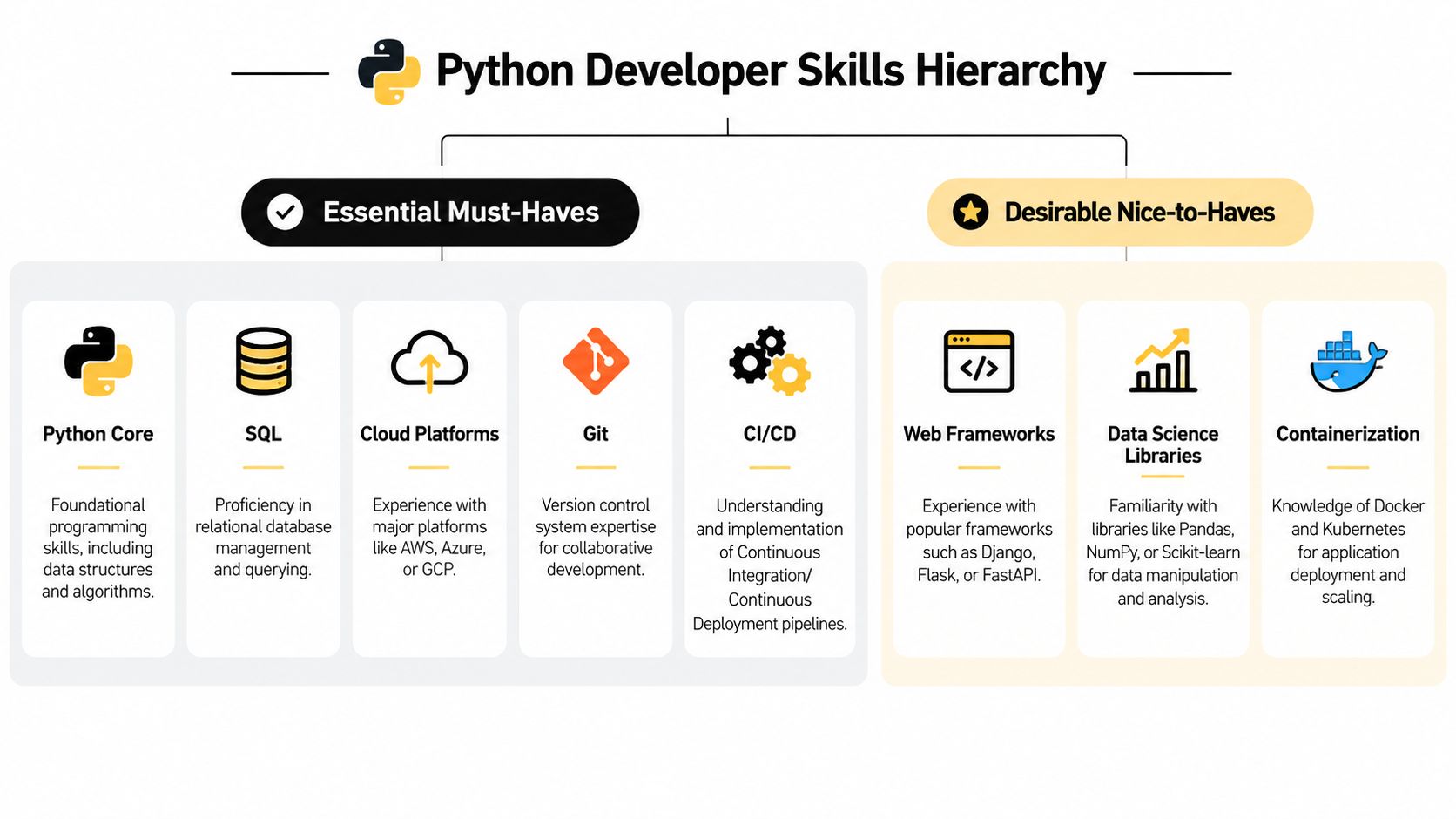
A practical hierarchy looks like this:
- Essential must-haves: Python programming, relevant problem-solving ability, SQL where data storage or querying is part of the job, Git, and the framework or platform required for immediate delivery.
- Role-specific essentials: REST APIs for backend roles, pipeline concepts for data roles, automation design for operations roles, or cloud deployment for platform-heavy positions.
- Desirable additions: Django, Flask, FastAPI, Docker, Kubernetes, Pandas, NumPy, Scikit-learn, PyTorch, Databricks, or deeper system design experience, depending on the team's actual work.
- Collaboration capabilities: Code review, documentation, debugging communication, stakeholder cooperation, and willingness to learn the team's development process.
India's hiring signal supports this stack-based approach. One India-focused source cites a projection of 1.4 million new IT jobs by 2025, with over 38% expected to require Python and full-stack skills, indicating that employers are framing Python work around web development, automation, data pipelines, and APIs rather than treating the language as a standalone qualification. See the India full-stack Python career analysis for that market context.
Write proficiency in observable terms
Avoid “expert Python developer” unless you can define expert. Use language such as:
- Working capability: “Can write readable Python modules, use common data structures, handle exceptions, and explain implementation choices.”
- Production capability: “Can design, test, deploy, and troubleshoot Python services in a team environment.”
- Advanced capability: “Can make architecture decisions, assess trade-offs, and guide other engineers through complex delivery.”
Don't make every technology mandatory. Requiring Django, Flask, FastAPI, AWS, Azure, GCP, Docker, Kubernetes, PyTorch, and Databricks for one generalist role will narrow the pool without improving hiring accuracy. Name the primary stack, then identify transferable experience as acceptable where it genuinely is.
Tailoring Junior and Mid Level Roles
Seniority should change the verbs in the JD. A junior developer contributes within a defined scope and grows through feedback. A mid-level developer owns meaningful features, handles ambiguity, and participates actively in technical decisions.
For a junior automation role, write:
- Implement Python scripts from clear requirements.
- Add tests and documentation with support from senior engineers.
- Use Git pull requests and respond to code-review feedback.
- Investigate straightforward failures and escalate issues with useful diagnostic details.
- Learn the team's SQL, CI/CD, and deployment practices.
For a mid-level backend role, write:
- Own backend features from technical discovery through release.
- Design REST API changes with attention to validation, security, compatibility, and observability.
- Review pull requests and improve team coding standards.
- Diagnose production issues across application, database, and deployment layers.
- Contribute to system design discussions and explain trade-offs to technical and non-technical colleagues.
The difference isn't merely the amount of experience listed. It's the scope of decisions the candidate will make. Junior candidates should see structured support, accessible reviews, and a realistic learning path. Mid-level candidates should see ownership, cross-functional work, and responsibility for delivery quality.
Don't demand senior-level independence from a junior hire. That wording often signals an unsupported environment and discourages capable early-career applicants. Likewise, don't describe a mid-level role as “assisting with tasks” if the person will own services or releases.
Tailoring Senior and Lead Level Roles
Senior and lead descriptions must focus on technical judgement. A senior Python developer usually contributes code, but the defining expectation is the ability to shape reliable solutions across services, data, testing, and operations.
A senior role can include:
Design service boundaries, review architecture proposals, improve performance and reliability, mentor engineers through code reviews, and communicate technical risks to product and engineering leadership.
A lead role needs a wider mandate:
Set technical direction for Python-based systems, establish engineering standards, coordinate delivery across teams, support hiring and development, and make pragmatic architecture decisions aligned with product priorities.
Separate technical leadership from people management. A senior engineer may mentor colleagues without managing performance. A lead may own delivery coordination without holding formal line-management responsibility. State which model applies.
Senior and lead candidates also need context about constraints. Mention whether they'll work with an existing monolith, several services, data-heavy workflows, internal platforms, or customer-facing APIs. Explain the decisions they'll influence, such as service design, cloud deployment, testing strategy, incident response, or technical roadmaps.
Avoid inflated language such as “rock star”, “ninja”, or “guru”. Those labels don't define scope and can make the role sound immature. Replace them with evidence-based expectations:
- Architecture: “Evaluate service design options and document trade-offs.”
- Delivery: “Lead technical planning for complex initiatives.”
- People: “Mentor engineers and raise the quality of code reviews.”
- Stakeholders: “Explain technical constraints and risks to product partners.”
- Operations: “Improve observability, incident learning, and release confidence.”
A senior JD should attract someone who can make sound decisions. A lead JD should make the organisational influence explicit.
Designing Screening Criteria
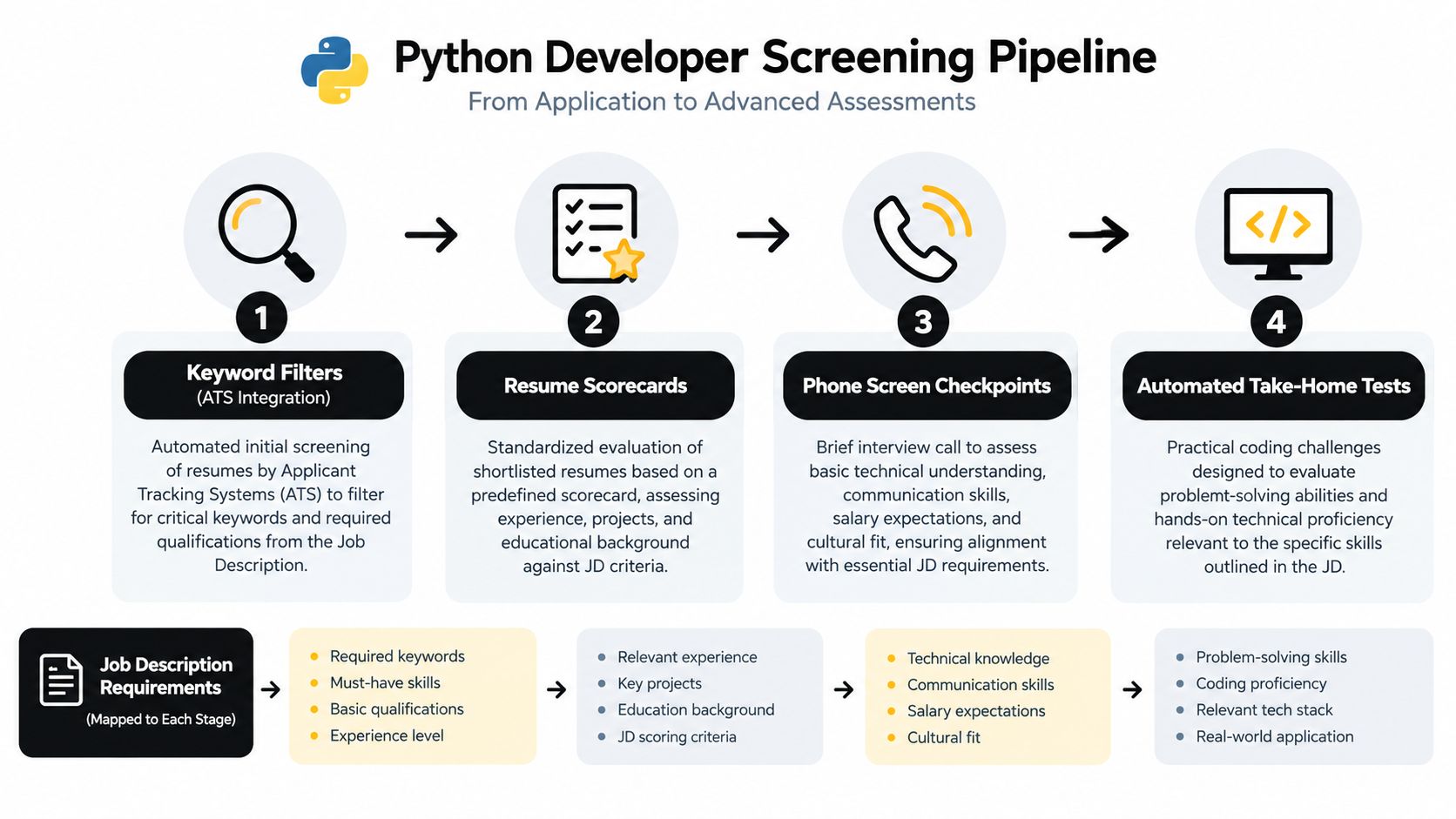
Your screening process should test the stack you advertised. If the JD prioritises Python, SQL, APIs, Git, and cloud delivery, the pipeline should assess those capabilities in proportion to their importance.
Translate the JD into an ATS structure
Create three groups in your ATS:
- Required keywords: Python, SQL, Git, REST APIs, and the named framework or cloud platform that the person must use immediately.
- Context keywords: API design, database querying, testing, CI/CD, debugging, automation, data pipelines, or microservices.
- Transferable alternatives: Equivalent frameworks, cloud platforms, database technologies, or deployment tools where the engineering concepts transfer.
Exact keyword matching helps recruiters find relevant evidence, but it shouldn't replace human review. A CV may describe API work without using the same framework name, or show practical capability through projects rather than formal job titles.
Use a consistent resume scorecard
Score the evidence, not the candidate's writing style. A simple scorecard can ask:
| Criterion | Evidence to record |
|---|---|
| Python application | Features, services, scripts, or pipelines built |
| Data capability | SQL use, schema work, validation, or transformation |
| Delivery practice | Git, reviews, testing, CI/CD, or deployments |
| Role fit | Relevant domain, product context, and level of ownership |
| Communication | Clear examples of collaboration and problem-solving |
Don't reject a candidate solely because they lack a particular degree if the role doesn't require it. Don't treat a long technology list as proof of proficiency.
Make the phone screen diagnostic
Ask candidates to explain one Python project they personally worked on. Follow up with questions about the problem, design choice, testing approach, deployment path, and a difficult issue they resolved. Their answers reveal ownership more reliably than a self-rated skill level.
The strongest candidates commonly combine Python with SQL depth, system design, and cloud readiness, rather than relying on syntax knowledge alone, as discussed in this India hiring findings analysis.
Use structured assessment methods rather than relying on unrecorded impressions. This candidate assessment tools guide can help you compare approaches while keeping the process consistent.
Building an Interview Question Bank
A good interview moves from fundamentals to applied judgement. Every question should map to a requirement in the JD and have a defined signal for a strong, acceptable, or weak answer.
Language and coding fundamentals
For junior candidates, ask:
- How would you choose between a list, set, tuple, and dictionary?
- How do you handle exceptions without hiding useful failure information?
- How would you structure a small Python module so another developer can test it?
For mid-level candidates, ask:
- How would you improve a slow Python function after confirming the bottleneck?
- When would you use asynchronous programming, multiprocessing, or a simple synchronous approach?
- How do you manage dependencies and configuration across environments?
The interviewer should ask for reasoning, not trivia. A candidate who can explain trade-offs and testing decisions offers stronger evidence than someone who recites terminology.
APIs, databases, and architecture
Give the question a realistic setting:
Design an API for a workflow that receives requests, validates input, stores state, and reports failures. What would you document and test?
Follow with SQL questions appropriate to the role. Ask candidates to explain joins, indexing decisions, transaction behaviour, or query debugging. For senior applicants, explore service boundaries, failure modes, observability, security, and operational ownership.
Troubleshooting and behaviour
Ask candidates to diagnose a failed deployment, an unexpectedly slow endpoint, or a pipeline that produces incomplete data. Then ask how they'd communicate the issue to a product manager and what they'd change to reduce recurrence.
Behavioural questions should focus on observable actions:
- Tell us about a time you disagreed with a technical approach.
- How have you handled feedback on a code review?
- Describe a situation where requirements changed during delivery.
- How do you decide when to ask for help?
Use a rubric. Rate whether the candidate identifies assumptions, tests hypotheses, communicates clearly, and learns from the result. Don't let confidence or conversational similarity substitute for evidence.
Crafting Sample Coding Assessment Prompts
Coding assessments should resemble the work described in the JD. A puzzle that tests obscure syntax won't tell you whether someone can build maintainable services or dependable automation.
Junior prompt
Task: Write a Python script that reads structured input, validates required fields, identifies invalid records, and produces a clean output file plus an error report.
Expected deliverables:
- Readable Python code with a clear entry point.
- Tests for valid, missing, and malformed data.
- A short README explaining how to run the script.
- Sensible error handling and no silent data loss.
Evaluate structure, correctness, test coverage, naming, and explanation. Allow candidates to state assumptions rather than penalising them for requirements the prompt doesn't define.
Mid-level prompt
Task: Build a small REST API using Django, Flask, or FastAPI. The service should accept requests, validate payloads, persist data, expose retrieval endpoints, and return useful error responses.
Look for:
- Clear API design and input validation.
- Appropriate database interaction.
- Unit and integration tests.
- Sensible project structure.
- Documentation and setup instructions.
- Thoughtful handling of edge cases.
Ask the candidate to explain one design choice during review. That discussion often reveals more than the submitted code because it shows how they reason about trade-offs.
Senior or data-focused prompt
Task: Design a data ingestion workflow that receives records from an external source, validates and transforms them, stores the results, and reports failures for investigation. For an AI-enabled team, add an integration point that sends prepared data to a model or AI service, with clear handling for timeouts, invalid responses, and sensitive information.
India's AI market is projected to grow at a 25% compound annual growth rate until 2027, and India-focused skills reporting continues to place Python, machine learning, and SQL at the centre of AI requirements, according to this NASSCOM-linked AI skills analysis. That makes data pipeline and AI integration tasks relevant for roles featuring those responsibilities.
Use a technical interview assessment platform guide when deciding how to host, standardise, and review these exercises.
Keep the assignment focused. Assess the capabilities you advertised, publish the evaluation criteria, and give candidates a reasonable opportunity to explain assumptions. Never score polish alone. Reward correctness, maintainability, testing, security awareness, and practical judgement.
Writing Inclusive Language
Many JDs exclude capable candidates through unnecessary wording rather than necessary requirements. Replace personality labels with behaviours and replace inflated expectations with specific evidence.
| Avoid | Use instead |
|---|---|
| Rock star Python ninja | Python developer who can build and maintain reliable services |
| Must be a native English speaker | Can communicate clearly with colleagues and stakeholders |
| Aggressive career growth | Opportunities to develop technical depth and take on broader ownership |
| Perfect candidate | Candidate who meets the essential capabilities and can grow into the role |
| Culture fit | Ability to collaborate effectively within the team's working practices |
| Young, energetic team | Collaborative team with a practical, learning-focused environment |
Don't confuse long hours with commitment. If the role has on-call work, travel, time-zone requirements, or fixed availability, state the actual expectation and explain how the team supports it. If those conditions aren't essential, leave them out.
Write qualifications around skills and evidence. “Degree from a top university” can exclude people who developed strong capability through vocational study, self-directed learning, open-source work, or career progression. If a regulated environment requires a specific qualification, explain why. Otherwise, make relevant experience an acceptable route.
Use accessible language in the advert itself. Define acronyms such as CI/CD, avoid unexplained internal terminology, and distinguish between “required on day one” and “can learn after joining”. This improves clarity for candidates and gives recruiters a fairer basis for screening.
Inclusive wording test: Ask whether a candidate could understand the work, assess their fit, and apply without guessing what your coded language means.
Suggesting Salary Bands and Benefits
Compensation guidance only works when it reflects the employer's actual budget and the role's real scope. Don't publish a broad figure to attract applications, then negotiate from a materially different position. Decide the band before posting and explain what moves an offer within it.
The brief doesn't provide verified India-specific salary figures, so the table below intentionally uses placeholders that must be replaced with your approved ranges. Don't publish placeholder text in the live advert.
| Seniority level | Annual salary range INR | Key benefits |
|---|---|---|
| Junior Python developer | Insert approved range | Health cover, structured mentorship, learning support, leave |
| Mid-level Python developer | Insert approved range | Health cover, flexible work options, technical development budget, leave |
| Senior Python developer | Insert approved range | Health cover, flexible work options, leadership development, leave |
| Lead Python developer | Insert approved range | Health cover, flexible work options, strategic influence, learning support, leave |
Location, domain, company size, framework depth, cloud responsibility, and leadership scope can all affect the appropriate band. A backend engineer responsible for production services shouldn't be benchmarked against an entry-level scripting position. Likewise, an AI integration role may need a different compensation approach from general application maintenance.
Benefits should clarify how the employment experience works. State whether work is remote, hybrid, or office-based. Explain health cover, paid leave, parental support, retirement contributions, flexible hours, equipment, learning budgets, and any applicable on-call compensation.
A strong benefits section also describes growth. Candidates want to know whether they'll receive code review, mentoring, access to technical communities, ownership of meaningful work, or a path towards senior and lead responsibilities. Don't list “competitive salary” without context. Give candidates enough information to decide whether the opportunity is worth pursuing.
Quick Reference Checklist
Use this checklist before publishing a Python developer job description. A JD is ready when a candidate can understand the work, a recruiter can screen consistently, and an interviewer can assess the advertised capabilities.
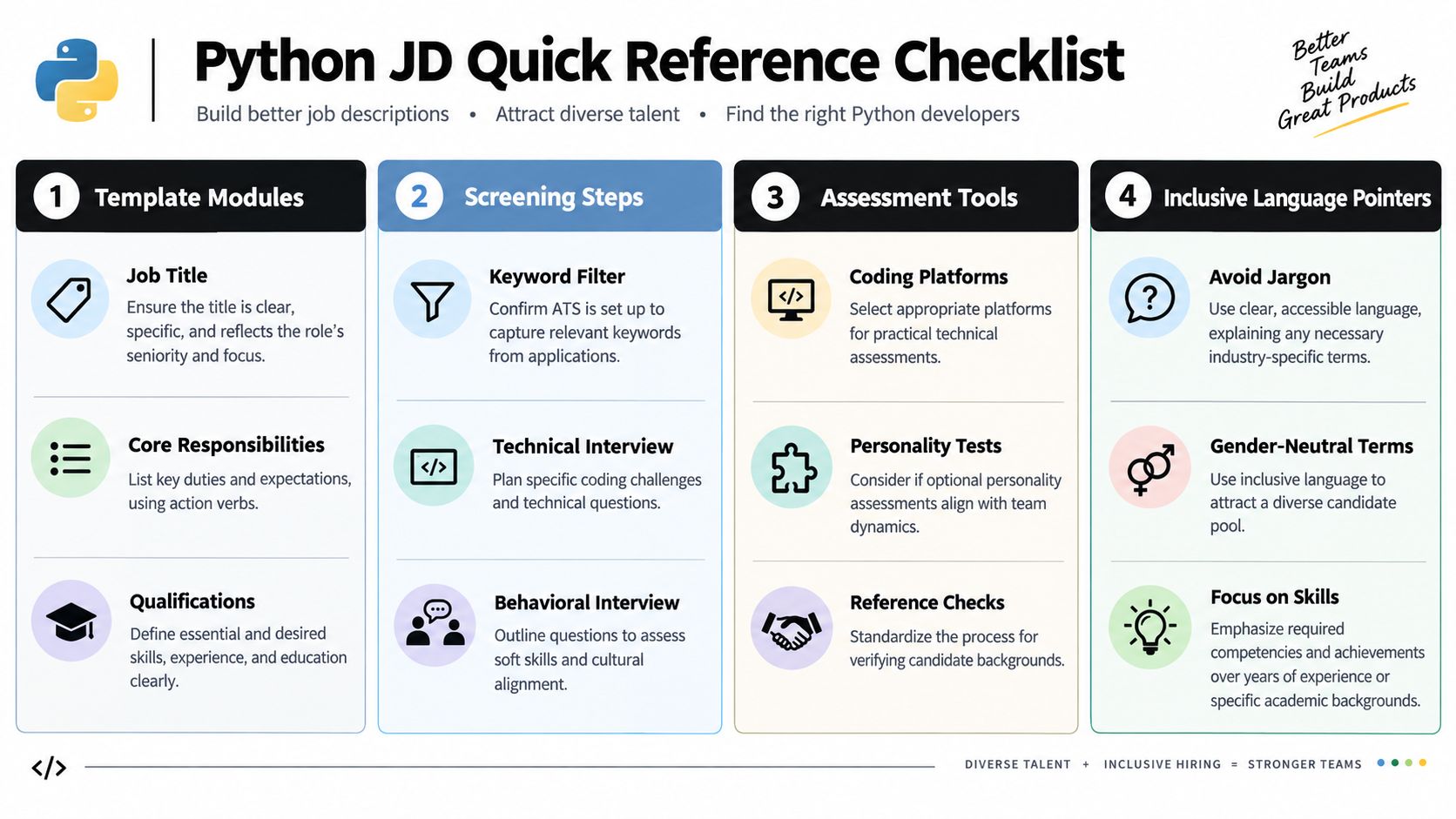
Template modules
- Job title: Name the seniority and focus, such as Python Backend Developer, Python Automation Developer, or Python Data Engineer.
- Role summary: Identify the team, product context, core mission, primary stack, and expected contribution.
- Responsibilities: Use action verbs and describe deliverables across application work, APIs, automation, data, quality, and deployment.
- Qualifications: Separate essential skills from desirable additions and accept credible equivalent experience where appropriate.
- Benefits: State the working model, health support, leave, learning opportunities, and progression clearly.
Screening steps
- ATS setup: Add Python plus the relevant framework, database, cloud, Git, testing, and CI/CD terms.
- Resume scorecard: Record evidence of application work, SQL or data capability, delivery practice, ownership, and collaboration.
- Phone screen: Ask for one project explanation, including design, testing, deployment, and problem-solving.
- Technical assessment: Test the work the candidate will perform, not irrelevant puzzle-solving ability.
- Interview rubric: Define what strong answers demonstrate before interviews begin.
Final quality audit
- Scope check: Does the role summary match the responsibilities?
- Stack check: Are all mandatory technologies used in the actual work?
- Level check: Do autonomy and architecture expectations match the seniority?
- Inclusion check: Have you removed coded, gendered, degree-based, and unnecessary barriers?
- Compensation check: Are the approved range and benefits accurate?
- Candidate experience check: Can applicants understand the process, assessment format, and decision criteria?
Hiring standard: Screen for the ability to apply Python in a real delivery context. Syntax is only one part of the job.
Career Central offers AI-driven phone screening, first-round interviews, and coding assessments for organisations hiring technical talent. Visit Career Central to make Python developer screening more structured, practical, and consistent with the skills your JD requires.