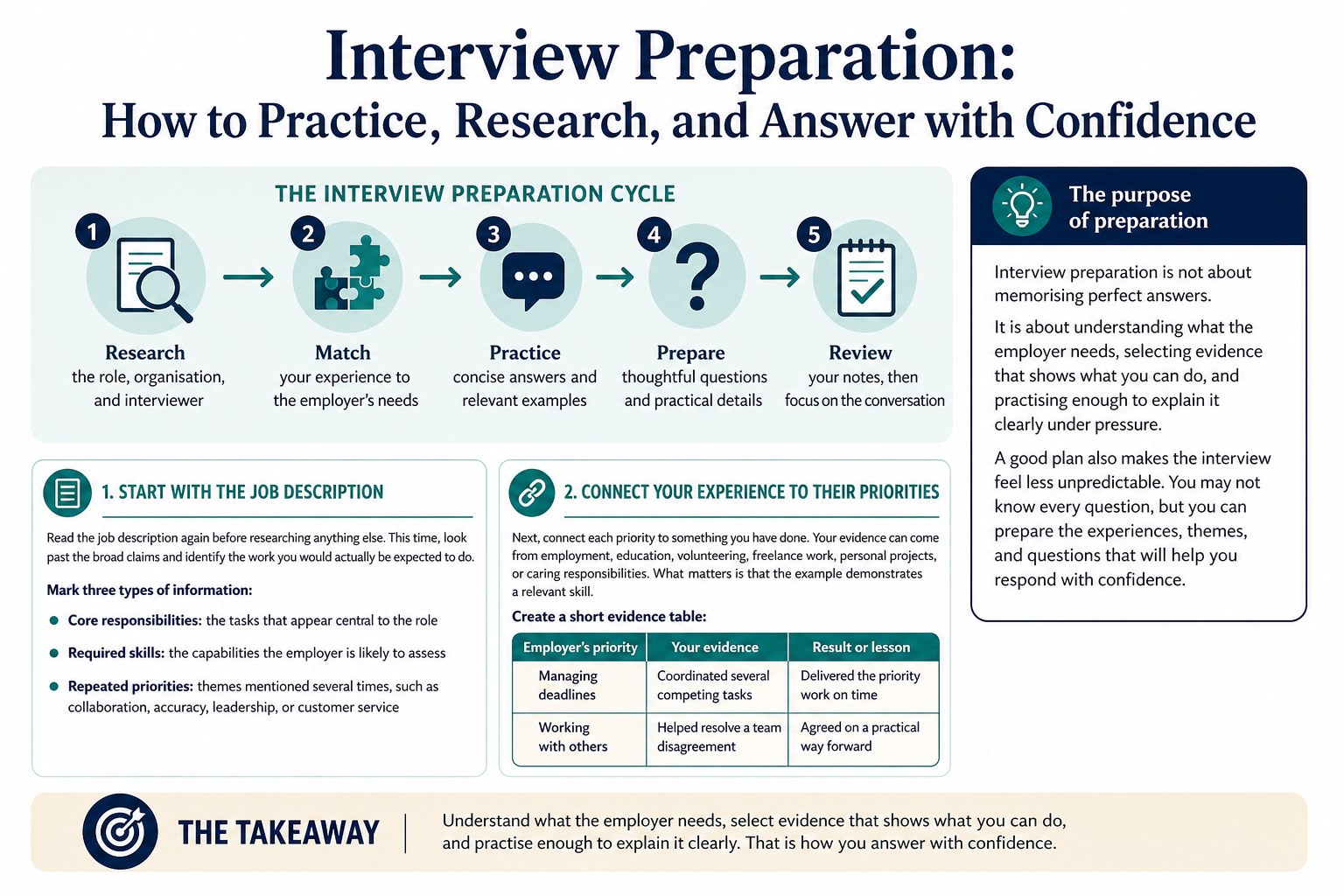
Interview preparation is not about memorising perfect answers. It is about understanding what the employer needs, selecting evidence that shows what you can do, and practising enough to explain it clearly under pressure.
A good plan also makes the interview feel less unpredictable. You may not know every question, but you can prepare the experiences, themes, and questions that will help you respond with confidence.
Start with the job description
Read the job description again before researching anything else. This time, look past the broad claims and identify the work you would actually be expected to do.
Mark three types of information:
- Core responsibilities: the tasks that appear central to the role
- Required skills: the capabilities the employer is likely to assess
- Repeated priorities: themes mentioned several times, such as collaboration, accuracy, leadership, or customer service
Next, connect each priority to something you have done. Your evidence can come from employment, education, volunteering, freelance work, personal projects, or caring responsibilities. What matters is that the example demonstrates a relevant skill.
Create a short evidence table:
| Employer’s priority | Your evidence | Result or lesson |
|---|---|---|
| Managing deadlines | Coordinated several competing tasks | Delivered the priority work on time |
| Working with others | Helped resolve a team disagreement | Agreed on a practical way forward |
| Improving a process | Simplified a recurring task | Reduced avoidable steps and confusion |
This exercise helps you prepare substance rather than scripts.
Research the organisation with a purpose
Research should improve your answers and questions. Collecting background facts that never enter the conversation is not especially useful.
Focus on four areas:
- What the organisation does: Understand its main services, products, customers, or public purpose.
- What the role contributes: Consider how the position supports a team, customer group, or business goal.
- What appears important now: Review current priorities, recent announcements, and changes relevant to the role.
- How the organisation describes itself: Notice the values and working principles it emphasises, but look for concrete meaning behind broad language.
If you know who will interview you, reviewing their professional background may help you understand their perspective. Keep the research professional and relevant.
Turn your findings into a few useful notes. For example: “The team is expanding this service, so I should be ready to discuss adapting to change.” That is more valuable than trying to memorise a page of company history.
Build a flexible bank of examples
Many interview questions ask for evidence: a time you solved a problem, handled conflict, made a mistake, influenced someone, or managed competing demands.
Prepare five or six examples that cover different strengths. A single example may answer several questions when framed differently. Useful themes include:
- Achieving a demanding goal
- Responding to a setback
- Improving a process
- Collaborating with a difficult or diverse group
- Learning something quickly
- Taking responsibility for an error
- Making a decision with limited information
Choose examples that include meaningful action from you. If the story is mainly about what your manager or team did, the interviewer may struggle to assess your contribution.
Structure answers without sounding rehearsed
For questions about past behaviour, a simple structure keeps your answer focused:
- Situation: Briefly establish the context.
- Task: Explain what you needed to achieve.
- Action: Describe what you personally did and why.
- Result: State what happened and what you learned.
Spend most of your time on the action. Candidates often give too much background, then rush through the part that shows their judgement.
You do not need to recite this structure mechanically. Treat it as a way to check that your answer has a clear beginning, useful detail, and a conclusion.
For motivation questions, connect three things: what interests you about the work, what relevant strengths you bring, and why this particular opportunity makes sense. Avoid relying only on praise for the organisation. The interviewer also needs to understand the fit.
Practice aloud, not only in your head
An answer that feels clear internally can become long or vague when spoken. Practising aloud reveals where you lose the thread, overuse jargon, or bury the important point.
Record yourself answering a small set of likely questions. Listen for:
- Whether you answer the question promptly
- How long it takes to reach your main point
- Whether your own actions are clear
- Unsupported claims such as “I’m a strong communicator”
- Repeated filler words
- An ending that shows a result or lesson
Practise more than once, but do not memorise every sentence. Aim to remember the shape of the answer: context, key actions, outcome. This gives you enough structure to stay concise while allowing the conversation to sound natural.
A mock interview with another person can also help. Ask them to interrupt with follow-up questions rather than simply reading from a list. Real interviews are interactive, and follow-ups often test how well you understand your own example.
Prepare for difficult moments
Confidence does not require an immediate answer to every question. It is reasonable to pause, take a breath, and gather your thoughts.
If a question is unclear, ask for clarification. If you need a moment, say, “Let me think of the most relevant example.” A short, deliberate pause is usually better than beginning an answer without direction.
When you lack direct experience, do not bluff. Acknowledge the gap, connect the question to the closest relevant experience, and explain how you would approach the situation. Honest reasoning can be more persuasive than an overstated claim.
For questions about mistakes or weaknesses, choose something genuine but manageable. Show self-awareness, the steps you took, and evidence that your approach has changed.
Bring questions that help you judge the role
Your questions should help you make a decision, not merely demonstrate interest. Choose three or four, knowing that some may be answered during the interview.
You might ask:
- What would be the most important priority in the first few months?
- How will success in this role be assessed?
- What challenges is the team currently working through?
- How does the team share feedback and make decisions?
- What distinguishes someone who performs well in this position?
Avoid asking questions that a brief review of the job description would answer. Ask about pay, flexibility, and working arrangements when they are relevant to your decision; the appropriate timing may depend on the stage of the process.
Use a final-day checklist
The day before the interview, confirm the format, time, location or meeting link, interviewer names, and anything you need to bring. Test your technology for a remote meeting. For an in-person interview, plan the journey and allow extra time.
Review your notes, but stop intensive preparation early enough to rest. Immediately before the interview, focus on three reminders: what the role needs, the evidence you want to communicate, and the questions you want to ask.
You are not trying to perform a flawless script. You are preparing for a professional conversation in which both sides assess fit.