
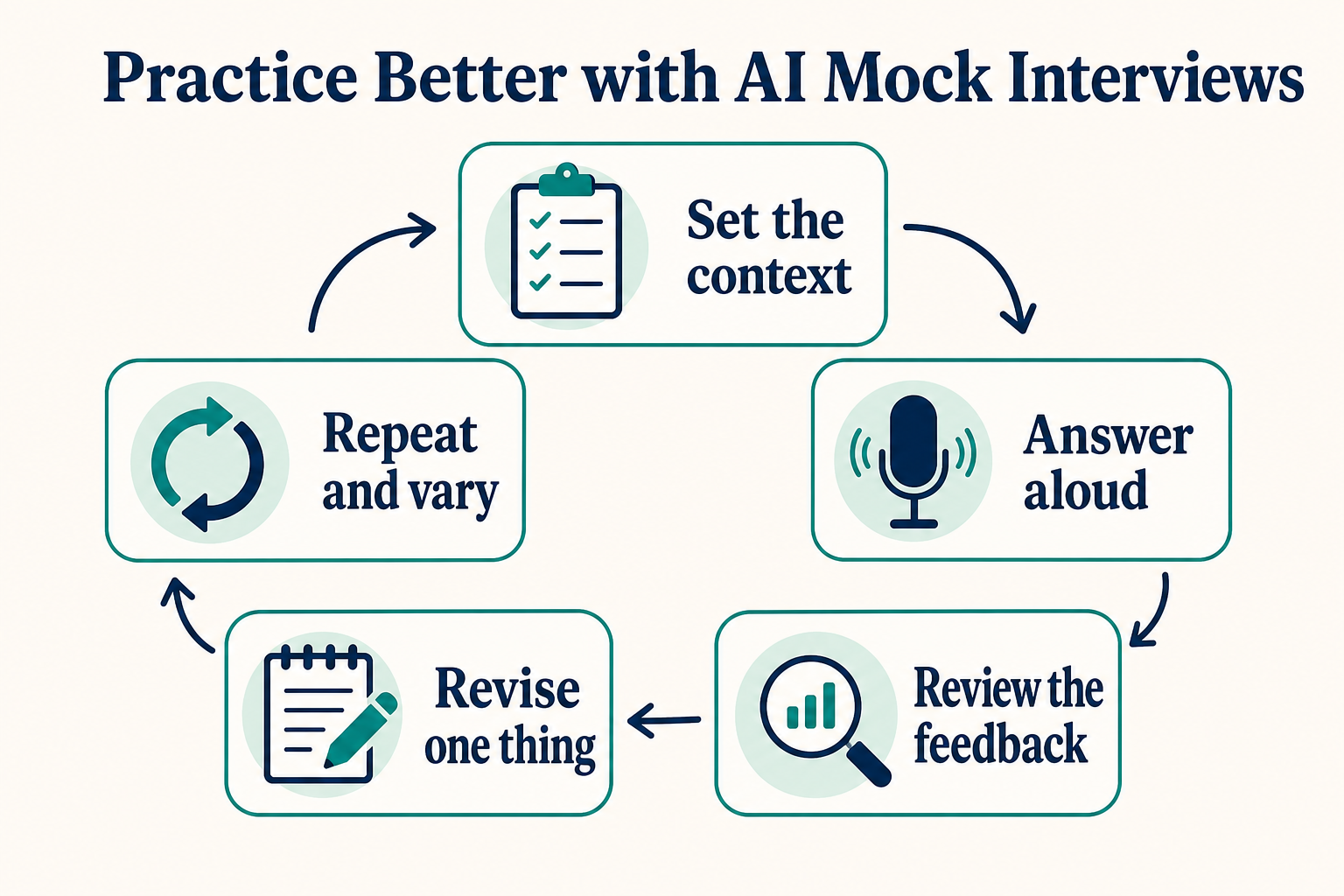
An interview invitation often creates two competing reactions: excitement that you made the shortlist, followed by concern about how you will perform under pressure. Reading common questions can help, but it does not recreate the experience of hearing a question, organising your thoughts, and answering without a script.
An AI mock interview gives you a low-pressure place to practise that process. Used thoughtfully, it can help you sharpen your examples, notice unclear answers, and become more comfortable speaking about your experience. The aim is not to memorise a perfect response. It is to make clear, relevant answers easier to produce when the real conversation begins.
What an AI mock interview can—and cannot—do
A mock interview AI tool typically presents questions, captures or evaluates your responses, and offers feedback. The exact format varies, but the central benefit is repetition: you can practise several times without needing another person to organise and conduct every session.
That makes it useful for:
- becoming comfortable answering aloud
- testing whether your examples are specific enough
- improving the structure and length of your responses
- identifying questions that expose gaps in your preparation
- practising follow-up questions
- reducing anxiety through familiarity
That last point matters. Mock interviews can build confidence and improve performance, especially when you treat them as rehearsals rather than tests.
Still, AI feedback has limits. It may miss context, misunderstand specialist language, or favour a style that does not suit you. It cannot reliably predict how a particular interviewer will respond or decide whether you are right for a role. Use it as a practice partner, not an unquestionable judge.
Start with the real job, not generic questions
Imagine you are preparing for a project manager interview. A generic session might ask about your strengths and weaknesses. A focused session should also explore competing deadlines, difficult stakeholders, budget constraints, and decisions made with incomplete information.
Before you begin, gather:
- the job description
- your CV or résumé
- notes about the organisation
- the expected interview format
- three to five examples from your work, education, volunteering, or personal projects
If the tool allows you to supply context, include the role title, seniority level, key responsibilities, and important skills from the job description. Ask for the type of interview you expect: behavioural, competency-based, technical, case-based, or a combination.
Do not share confidential employer information, customer data, private source code, or personal details you would not want stored. Check the tool’s privacy terms before uploading documents or recording yourself.
Make your first attempt realistic
It is tempting to pause after every question and craft an ideal response. Resist that temptation during your initial run. Sit somewhere quiet, use the device you expect to interview on, and answer aloud without consulting notes.
A useful first session might include six to eight questions. That is long enough to reveal patterns without making the review unmanageable. Ask for follow-up questions when your answer is vague or when an interviewer would reasonably want more detail.
For behavioural questions, use a simple structure:
- Situation: Briefly establish the context.
- Task: Explain what you were responsible for.
- Action: Describe what you personally did and why.
- Result: State the outcome and what you learned.
The structure should support your story, not make it sound mechanical. Spend most of your answer on your actions and decisions rather than on background detail.
Review substance before presentation
After the session, do not try to correct everything at once. First, examine what you said. Only then consider how you delivered it.
For each answer, ask:
- Did I answer the question directly?
- Was my example relevant to the role?
- Did I distinguish my contribution from the team’s?
- Did I explain my reasoning?
- Did I provide a concrete result where possible?
- Would an interviewer understand unfamiliar terms?
- What follow-up question did my answer invite?
Next, review presentation. Notice answers that ramble, begin with a long preamble, contain repeated filler words, or end without a clear point. These are habits to refine, not reasons to flatten your natural speaking style.
Choose one or two priorities for the next round. For example: “State the result clearly” and “Keep the context under 30 seconds.” Focused improvement is more useful than chasing a broad score.
Repeat without memorising
Suppose your first answer to “Tell me about a difficult stakeholder” lasts four minutes and never explains the outcome. Rewrite it as bullet points—not a script—and answer again. On the next attempt, ask the AI to challenge your decision or question what you would do differently.
This builds flexibility. A memorised answer can unravel when the wording changes, while a well-understood example can be adapted to several questions.
Vary your sessions as the interview approaches:
- Content round: Strengthen examples and fill knowledge gaps.
- Challenge round: Request probing or sceptical follow-ups.
- Concise round: Practise giving shorter, direct answers.
- Full simulation: Complete the interview without stopping.
- Unexpected round: Include questions you have not prepared.
For specialist roles, combine conversational practice with role-specific exercises. Candidates in software engineering or data science, for instance, may need to explain their reasoning while solving a problem. These technical interview preparation tips can help you plan that part of your practice.
Add human judgement before the real interview
Once your answers are stronger, conduct at least one practice session with a trusted person if possible. A colleague, mentor, friend, or careers adviser may notice qualities an automated review misses: warmth, credibility, awkward phrasing, or an answer that makes sense only to someone in your field.
Ask them specific questions. “Did my leadership example show how I influenced people?” will produce more useful feedback than “How did I do?”
Your final preparation should also include questions for the interviewer, practical checks for the meeting, and a concise explanation of why the role interests you. AI practice is one part of preparation, not the whole process.
The best session leaves you sounding more like yourself—only clearer, better prepared, and less dependent on finding the right words under pressure. When you are ready to turn that approach into a structured practice plan, prepare for your interview.

