
A candidate can define serverless functions, list a few triggers, and still struggle when you ask what happens after a timeout, why an invocation was denied, or how a deployment can be rolled back safely. That gap matters. A Lambda interview should reveal whether someone can operate an event-driven system, not whether they have memorised a glossary.
A practical hiring process moves from execution basics to permissions, reliability, scaling, deployment, and observability. The questions below pair each domain with model-answer signals, follow-up prompts, scoring guidance, troubleshooting situations, and a suitable interview format for junior, mid-level, and senior candidates. They also help interviewers distinguish a technically correct answer from production judgement.
AWS Lambda has a meaningful presence in India's web stack. One technology dataset reports 1,550 Indian companies using AWS Lambda, while another census identifies 2,570 India-based websites running on the service and gives Lambda a 46% share of India's serverless segment. The technology dataset provides useful context for hiring teams: Lambda knowledge is relevant to real production environments, particularly where employers need engineers who can compare serverless functions with containers and virtual machines.
Career Central can support this process with AI-driven phone screening, first-round interviews, and coding assessments. The platform can help recruiters test the right depth before a hiring manager spends time on a technical panel.
1. Lambda Function Basics and Execution Model
Start with a question that looks simple but exposes whether the candidate understands the platform:
Question: What is AWS Lambda, and what happens when a function is invoked?
A strong junior answer should explain that Lambda runs code in response to an event without requiring the team to manage the underlying servers. The candidate should identify the function handler, event payload, execution environment, configured runtime, timeout, memory, and IAM execution role. They should also explain that Lambda functions are normally designed to be stateless, even though an execution environment may be reused for later invocations.
A mid-level candidate should distinguish synchronous invocation, where the caller waits for a response, from asynchronous invocation, where Lambda accepts the event and processes it independently. They should explain cold starts, warm reuse, initialisation code, and why placing expensive work outside the handler can improve reuse without relying on reuse for correctness. A senior candidate should connect these details to architecture, latency, failure handling, and service selection.
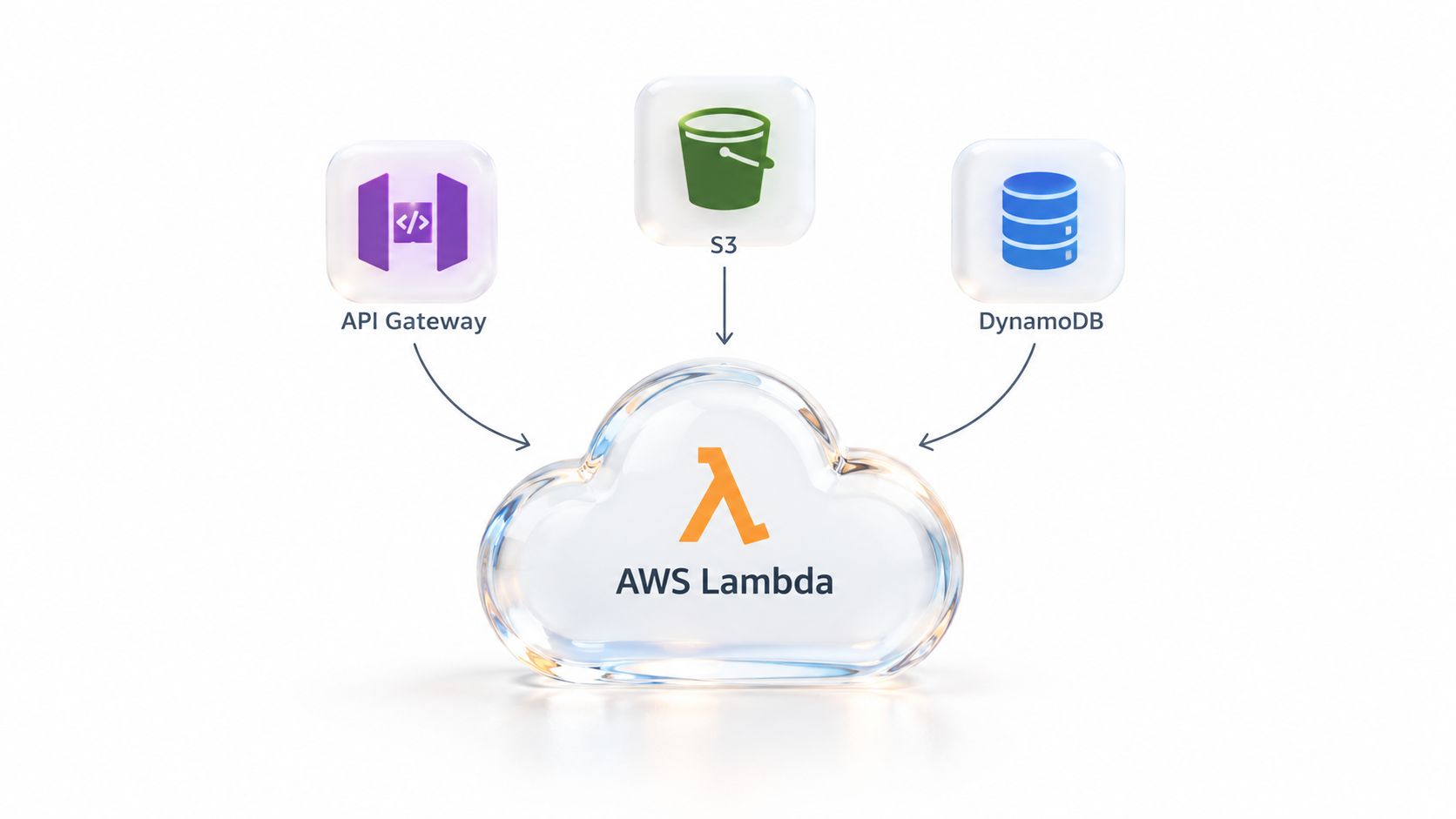
An S3 upload might invoke a function that validates an image and writes metadata to DynamoDB. An API Gateway request might invoke a function that validates input and returns a response. A scheduled EventBridge rule might start a backup or housekeeping task. The right design depends on whether the workload needs a user-facing response, durable buffering, or independent retry behaviour.
Follow-up and scoring signals
Ask, “What would you initialise outside the handler, and what would you never assume about a warm environment?” Look for connection clients, configuration loading, and reusable clients outside the handler, balanced by a clear warning that state can disappear or become stale.
Use this scoring guide:
- Foundational: Defines Lambda and describes a handler and event accurately.
- Applied: Explains invocation modes, cold starts, configuration, and statelessness.
- Production-ready: Connects lifecycle behaviour to latency, retries, observability, and architecture.
For preparation ideas beyond Lambda, point candidates to AWS fundamentals interview questions. A junior interview can spend roughly 15 minutes on this domain. For a senior candidate, turn it into a short architecture discussion rather than accepting a definition.
2. Lambda Event Sources and Invocation Patterns
Ask the candidate to choose an invocation pattern for a realistic workload:
Question: How would you process an image uploaded to S3, expose a request-response API, and consume messages from SQS? What changes between those designs?
The answer should separate the event source from the invocation behaviour. API Gateway commonly represents a synchronous request path. S3 notifications can initiate background processing, while an SQS event source mapping polls the queue and delivers messages to Lambda in batches. DynamoDB Streams can deliver database change records, and SNS can fan out a notification to multiple subscribers.
The candidate shouldn't name services. They should explain what the caller expects, where buffering occurs, how a failure is surfaced, and whether the function can safely process the same event more than once. For an SQS consumer, a strong answer mentions visibility timeout, batch size, message acknowledgement, poison messages, and a dead-letter queue. For a stream source, the candidate should discuss record ordering, checkpoints, and what happens when one record in a batch fails.
India-focused serverless coverage describes Lambda as relevant to low-latency, event-driven workloads in areas such as fintech, e-commerce, and API-heavy applications, with Mumbai and Hyderabad regions supporting latency and data-residency considerations. This India serverless market overview gives useful context for scenario design, but the interview should test engineering decisions rather than regional familiarity.
Practical prompt
Give the candidate this situation: an order service publishes an event, an inventory function updates stock, and a notification function sends an email. Ask what should happen if the notification provider is unavailable.
A strong response keeps the order path independent from email delivery, uses durable messaging, retries safely, and records failures for later action. A weak response retries synchronously inside the checkout request until the user waits or the function times out.
Recruiter signal: Candidates who know triggers but can't explain acknowledgement, buffering, or duplicate delivery have memorised integrations without understanding event-driven systems.
Score the answer as basic if it lists triggers, capable if it matches patterns to workloads, and strong if it handles ordering, retries, duplicates, and downstream protection. This domain works well in a technical interview because it reveals design judgement without requiring code.
3. Lambda Permissions, IAM Roles, and Security
Security questions should force candidates to identify who is allowed to do what. Ask:
Question: A Lambda function must read objects from one S3 bucket, write selected records to DynamoDB, and retrieve a secret. How would you configure its permissions?
The expected answer begins with a dedicated execution role for the function. That role should grant only the required actions on the required resources. The candidate should distinguish permissions granted to the function from permissions that allow another principal or service to invoke the function. They should also know that a resource-based policy can control invocation in situations such as cross-account access.
Ask a follow-up: “The function can read the secret but receives an access-denied error when writing to DynamoDB. How do you investigate?” A good candidate checks the function's actual role, policy action and resource scope, region and account identifiers, key permissions where encryption is involved, and the CloudTrail or application evidence available. They should avoid solving the issue by attaching broad administrator access.
A VPC question can reveal whether the candidate understands network access as a separate concern. A function connected to private resources may need appropriate subnets, routing, and security-group configuration, while its IAM role still controls AWS API access. These are related controls, not replacements for one another.
Use AWS networking and security interview questions when building a broader security screen around Lambda.
What a strong answer includes
- Least privilege: Permissions are narrow, resource-specific, and tied to the function's actual task.
- Separation of roles: Deployment permissions and runtime permissions aren't casually combined.
- Secret handling: Sensitive values come from a managed secret store, not source code or careless logs.
- Investigation discipline: The candidate checks the principal, action, resource, conditions, region, and account before changing policy.
A junior candidate should recognise an execution role and least privilege. A mid-level candidate should handle resource policies, cross-account invocation, KMS permissions, and VPC implications. A senior candidate should explain policy review, automated checks, access analysis, and how to prevent permission drift in Infrastructure as Code.
Score for correctness, security awareness, and diagnostic reasoning separately. A candidate who reaches the right fix by granting broad access should not receive the same assessment as someone who finds the narrow missing permission.
4. Error Handling, Retry Logic, and Dead-Letter Queues
Reliability becomes visible when the function fails. Ask:
Question: A Lambda function processes payment-related events, but a downstream API intermittently fails and some events appear more than once. How would you design the retry and recovery path?
The model answer should begin by identifying the invocation source. Lambda's retry behaviour differs across synchronous requests, asynchronous events, SQS, streams, and direct invocation. The candidate should not promise one universal retry rule. They should describe where retries occur, how long they continue, and how the system prevents a transient failure from becoming a duplicate business action.
Idempotency is the key signal. A payment or order operation needs a stable transaction identifier and a durable record of whether that operation has already been applied. The function should make the state change and idempotency decision safely, rather than relying on an in-memory flag or a warm execution environment.
For third-party APIs, look for bounded retries, exponential backoff, rate-limit awareness, and a circuit breaker or queue-based design where appropriate. A dead-letter queue can preserve events that cannot be processed after the configured retry path, but it isn't a substitute for monitoring. Someone must inspect the queue, understand the failure, correct the cause, and replay or resolve the event under a documented runbook.
Troubleshooting scenario
Tell the candidate that an SQS-triggered function reports errors, but the queue continues to grow. Ask what they would check first. Strong candidates discuss visibility timeout, batch size, reserved concurrency, downstream latency, poison messages, permissions, function timeout, and the dead-letter configuration. They should also mention partial batch failure handling when the source and design support it, so successfully processed records aren't needlessly retried with the failed record.
Production test: A retry plan without idempotency is a duplication plan with better branding.
Rate candidates as weak when they say “retry until it works,” developing when they understand DLQs but miss duplicate protection, and strong when they connect retries, idempotency, queue behaviour, alerting, and recovery operations. This is a good mid-level question and an excellent senior debugging prompt.
5. Lambda Concurrency, Scaling, and Throttling
Give the candidate a traffic-spike scenario rather than asking for a definition:
Question: An API backed by Lambda receives a sudden surge of requests, while the function also makes calls to a database with limited connection capacity. How would you protect the system?
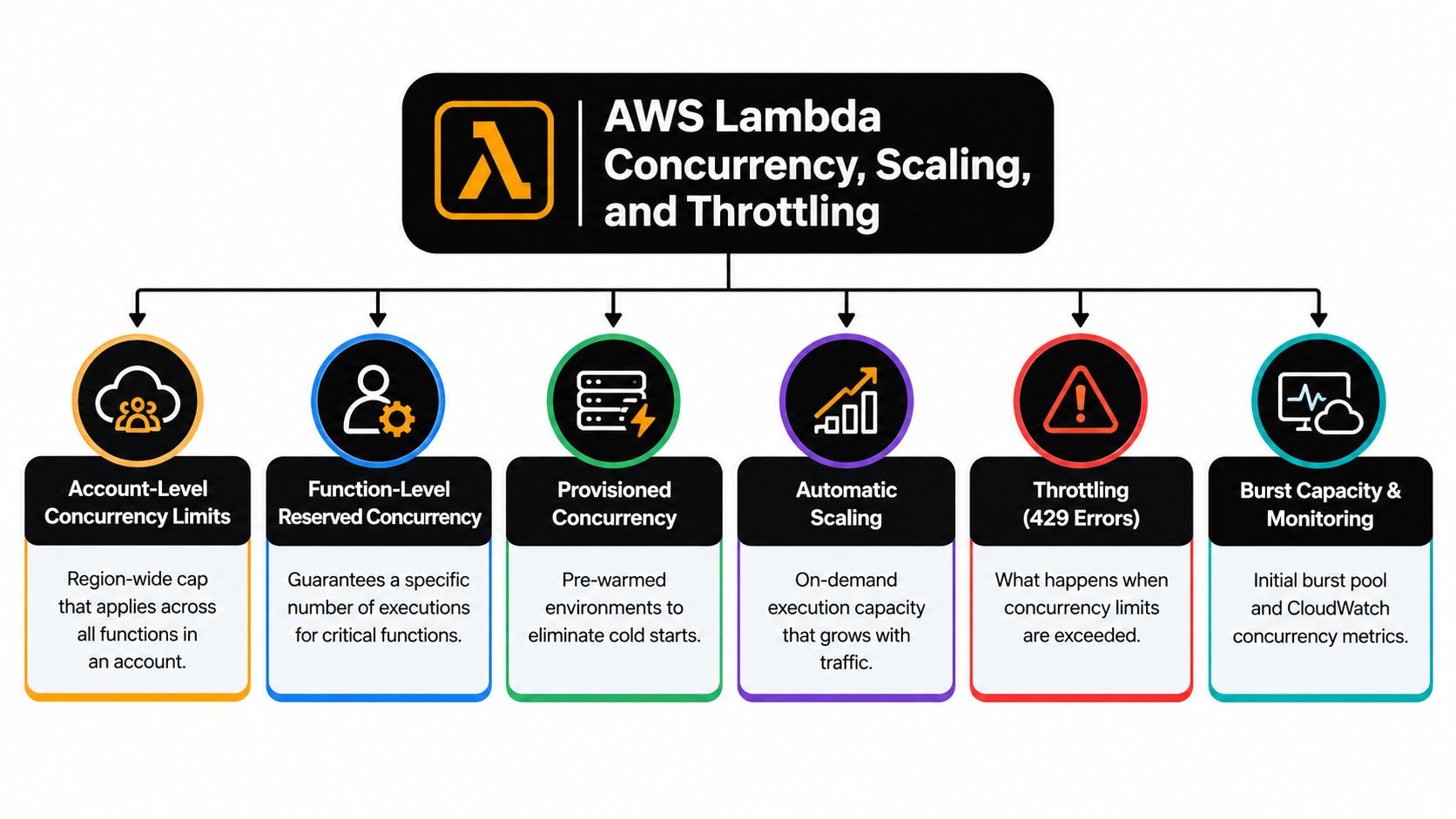
A strong answer explains that Lambda can create additional execution environments to handle concurrent work, but downstream systems may not scale at the same rate. Automatic scaling is not permission to ignore database connections, API quotas, account limits, or queue backlogs. The candidate should describe load testing, concurrency observation, timeout choices, and downstream protection.
Ask them to distinguish reserved concurrency from provisioned concurrency. Reserved concurrency limits and isolates a function's simultaneous executions, which can protect a critical dependency or guarantee capacity for a workload. Provisioned concurrency keeps execution environments ready for latency-sensitive paths, but it should be justified by a latency requirement and evaluated alongside operational cost.
Throttling is another useful follow-up. Ask, “What does a throttled invocation tell you, and what would you do next?” The candidate should inspect function and account concurrency, event-source behaviour, retry consequences, downstream saturation, and whether a queue can absorb the load. They shouldn't treat a higher limit as the automatic answer.
India-focused market coverage identifies Lambda use in high-throughput scenarios such as UPI integrations and mobile-first applications, and highlights cold-start mitigation, concurrency design, trigger orchestration, and latency trade-offs as practical concerns. This India serverless market research can help hiring teams create locally relevant scenarios without turning the interview into a trivia test.
Evaluation prompt
Ask the candidate to set a concurrency policy for:
- Checkout: Protect the payment and inventory dependencies.
- Notifications: Allow asynchronous work without starving checkout.
- Reporting: Let a queue smooth bursts and accept slower completion.
Score basic answers for recognising concurrency, applied answers for using limits and queues, and advanced answers for balancing latency, fairness, dependency capacity, retries, and failure isolation. Senior candidates should also explain which CloudWatch metrics and alarms they would use to validate the design.
6. Lambda Performance Optimization and Cost Optimization
Use a slow-function investigation to prevent this topic from becoming a list of tuning slogans:
Question: A Lambda function has inconsistent latency and a high execution cost. What would you measure before changing the code?
A credible answer starts with duration, memory use, error rate, concurrency, cold-start contribution, payload size, downstream calls, and log volume. The candidate should inspect traces and structured logs before increasing memory or adding provisioned concurrency. They should explain that memory allocation also affects available CPU, so a faster configuration may reduce duration while changing cost. The correct setting must come from measurement, not a universal recommendation.
Ask the candidate to review a function that creates a new database client on every invocation, imports a large dependency bundle, performs network calls serially, and logs full customer payloads. Strong candidates would reuse safe clients outside the handler, reduce unnecessary initialisation, parallelise only independent operations, keep packages focused, and remove sensitive or excessive logging. They should also consider connection limits and stale connections rather than treating reuse as automatically safe.
Cold-start mitigation can include smaller packages, efficient initialisation, appropriate runtimes, and provisioned concurrency where a predictable latency target justifies it. Lambda layers can support shared dependencies, but they also introduce versioning and compatibility considerations. A layer isn't a performance cure by itself.
Model-answer signals
- Measure first: Use CloudWatch, traces, logs, and representative load rather than guessing.
- Optimise the whole path: Include downstream APIs, databases, payloads, retries, and data transfer.
- Protect security and reliability: Don't trade away secret protection, timeout safety, or correctness for a faster benchmark.
- Validate the change: Compare cold and warm behaviour, error rates, latency distribution, and cost after deployment.
Treat a candidate as developing if they mention memory and package size only. A strong answer connects performance to architecture and cost, explains trade-offs, and proposes a controlled test. This domain is especially useful for mid-level and senior candidates because it reveals whether they can turn an operational symptom into a measurable investigation.
7. Deployment, Versions, Aliases, and Infrastructure as Code
A deployment question should reveal whether the candidate can move beyond console edits and operate a repeatable release process:
Question: How would you deploy a Lambda application safely across development, staging, and production?
Look for version control, Infrastructure as Code, automated tests, packaging, environment-specific configuration, and a CI/CD pipeline. Candidates may choose AWS SAM, CloudFormation, or Terraform, but they should explain how the selected tool defines the function, permissions, event sources, and supporting resources. For a deeper IaC screen, use AWS Infrastructure as Code interview questions. The repository should describe the desired infrastructure instead of leaving production settings in an individual's console history.
A strong candidate separates mutable function configuration from an immutable published version. They should explain how aliases direct environments or traffic to specific versions, then describe canary or blue-green deployment, health checks, rollback criteria, and rollback testing. Container images can suit complex dependencies, provided the team still handles image scanning, reproducible builds, and deployment controls.
Follow up with: “A new version works in staging but increases errors in production. What is your rollback path?” Strong answers include alias or traffic-shift rollback, preserved logs and metrics, an approval or automated alarm gate, and comparison of configuration and dependency differences. “Redeploy the previous code from a laptop” signals a serious process weakness.
India job listings commonly pair Lambda with Infrastructure as Code, CI/CD, Linux or Unix administration, and Python or Bash scripting. The AWS Lambda roles listing supports testing deployment and operations, not only event-trigger knowledge. Broader data-engineering openings also combine Lambda with S3, Glue, EMR, Redshift, Athena, Step Functions, SNS, SQS, and DynamoDB, as reflected in this Lambda jobs overview.
Interview format
Use a deployment diagram or small repository for a senior candidate. Reserve time for the primary deployment question, a rollback follow-up, and a brief review of the infrastructure definition. Score basic answers for version control and repeatability, capable answers for aliases and rollback, and strong answers for automated validation, progressive delivery, drift control, secrets, and failure recovery.
8. Monitoring, Logging, Debugging, and Observability
Finish the technical domains with an operational scenario:
Question: A Lambda-backed API is returning intermittent errors, but the function's average duration looks normal. How would you investigate?
A strong candidate won't stop at average duration. They should inspect invocation count, errors, throttles, timeout events, latency distribution, concurrency, cold-start indicators, downstream failures, and the request path across API Gateway and dependent services. AWS documentation describes Lambda metrics exposed through Amazon CloudWatch, including requests, concurrency usage, latency, errors, and throttled requests. This AWS and cloud context reference is useful when explaining why monitoring and scaling belong in the same interview conversation.
Structured JSON logs should include a correlation identifier, function version, relevant event metadata, outcome, and error context without exposing secrets or unnecessary personal data. CloudWatch Logs Insights can help find patterns, while X-Ray can show how a request moves through Lambda and services such as SQS or DynamoDB. Custom metrics should represent business outcomes, such as processed orders or failed transactions, not only infrastructure signals.
Ask the candidate to design alarms. They should choose thresholds that match the service's operational needs, alert on actionable symptoms, and link each alert to a runbook. An alarm that pages someone for every transient error creates fatigue. An alarm that ignores a growing dead-letter queue hides customer-impacting work.
Scoring the response
- Basic: Finds logs and checks errors.
- Applied: Correlates metrics, logs, traces, versions, and downstream dependencies.
- Production-ready: Defines useful alarms, protects sensitive data, controls log cost, and gives responders a clear recovery path.
For a coding assessment, provide a function with poor logging and ask the candidate to add correlation IDs, structured errors, safe retries, and a meaningful custom metric. For a senior interview, ask how they would debug a failure that appears only under concurrency. The best answers combine observability with a hypothesis-driven investigation instead of enabling every tool without a purpose.
AWS Lambda Interview Topics, 8-Point Comparison
| Topic | 🔄 Implementation complexity | ⚡ Resource & performance | 📊 Expected outcomes / Use cases | ⭐ Key advantages | 💡 Quick tip |
|---|---|---|---|---|---|
| Lambda Function Basics and Execution Model | Low → Beginner–Intermediate; core concepts and lifecycle | Minimal infra; pay-per-execution; cold starts affect latency | Event-driven APIs, scheduled jobs, ETL; solid foundational knowledge | No infra mgmt, automatic scaling, cost-effective | Test locally (SAM/LocalStack); monitor cold starts; use env vars |
| Lambda Event Sources and Invocation Patterns | Medium; multiple invocation types and mappings | Varies by source; polling (Kinesis/DynamoDB) can increase cost | Flexible triggers: sync APIs, async processing, streaming & batch | Built-in retries, DLQ support, event filtering | Implement idempotency; tune batch sizes; enable DLQs |
| Lambda Permissions, IAM Roles, and Security | Medium–High; detailed IAM and cross-account policies | Requires KMS, Secrets Manager, VPC (adds latency) | Secure access to resources, cross-account integrations, DB access in VPC | Fine-grained control, audit trails (CloudTrail), encryption | Apply least privilege; use Policy Simulator; audit permissions |
| Error Handling, Retry Logic, and Dead-Letter Queues | Medium–High; design idempotency and retry strategies | DLQs and monitoring add resources; retries may duplicate work | Resilient async processing, poison message handling, reliable pipelines | Improved reliability via retries, DLQs, partial-batch handling | Always implement idempotency; configure DLQs; monitor and runbooks |
| Lambda Concurrency, Scaling, and Throttling | Medium; understand limits, reserved/provisioned concurrency | Reserved/provisioned concurrency increases baseline cost; needs monitoring | Predictable performance for spikes; protect downstream services | Automatic scaling; reserved concurrency for critical functions; provisioned concurrency removes cold starts | Monitor concurrent executions; use reserved concurrency for critical flows |
| Lambda Performance & Cost Optimization | Medium–High; requires benchmarking and tuning | Memory <-> CPU trade-offs; provisioned concurrency costs; X-Ray/monitoring overhead | Lower latency and cost, improved SLAs, production efficiency | Right-sized memory reduces time/cost; layers reduce package size | Use Power Tuning; reuse connections outside handler; analyze X-Ray traces |
| Deployment, Versions, Aliases, & IaC | Medium–High; CI/CD, IaC, and traffic-shifting strategies | CI/CD tooling, IaC templates, ECR for container images | Safer rollouts, rollbacks, multi-environment management at scale | Versions & aliases enable traffic shifts and rollbacks; IaC repeatability | Use SAM/Terraform, aliases for envs, automate CI/CD and test rollbacks |
| Monitoring, Logging, Debugging, & Observability | Medium; requires instrumentation and dashboards | CloudWatch, X-Ray, Log Insights incur cost and latency | Visibility into performance, errors, distributed traces, operational health | End-to-end tracing, custom metrics, alerting for production support | Use structured JSON logs, enable X-Ray, add correlation IDs and retention policies |
Turn Questions Into Hiring Evidence
A useful Lambda interview isn't a longer list of trivia. It is a controlled way to gather evidence about how a candidate designs, deploys, secures, and operates software.
For junior candidates, begin with function basics, handlers, events, execution environments, and the difference between synchronous and asynchronous invocation. Add a small trigger-matching exercise, such as selecting an approach for an API request, an S3 upload, and a scheduled job. The candidate doesn't need to design a complete platform, but they should show that they understand inputs, outputs, configuration, logs, and basic failure behaviour.
For mid-level candidates, add IAM, idempotency, retry handling, concurrency, and deployment. Ask them to explain a real failure path, not just define a dead-letter queue. They should be able to describe how an SQS consumer handles a poison message, why a function might be throttled, how a role receives permissions, and how a failed release is rolled back. Include Terraform, CloudFormation, or AWS SAM if the role expects Infrastructure as Code.
Senior candidates need scenario depth. Give them an event-driven architecture involving API Gateway, Lambda, SQS, DynamoDB, S3, and Step Functions, then introduce a constraint. The constraint might be a slow dependency, a burst of traffic, a permission boundary, a regional requirement, or a production deployment that increases errors. Ask them to draw the flow, identify failure domains, choose retry boundaries, define observability, and explain where Lambda may not be the right compute choice.
Use a consistent rubric so interviewers record evidence rather than relying on confidence or familiarity. Rate each area using weak, developing, strong, or exceptional evidence:
- Technical correctness: Does the candidate describe Lambda behaviour accurately?
- Reasoning: Can they explain why a design fits the workload and its constraints?
- Production judgement: Do they account for retries, dependencies, latency, cost, rollback, and operational ownership?
- Communication: Can they explain a complex flow clearly and respond to follow-up changes?
- Security awareness: Do they apply least privilege, protect secrets, and distinguish identity, network, and resource controls?
A confident answer should not outrank a careful answer that identifies uncertainty, asks for missing context, and proposes a safe way to validate assumptions. Record the candidate's specific reasoning, the trade-offs they named, and the risks they missed. Avoid notes such as “good communicator” without an example of what they explained or how they handled a challenge.
A 15-minute recruiter screen can test whether the candidate has used Lambda and can describe one event-driven project in concrete terms. A 30-minute technical interview can cover the execution model, event sources, IAM, reliability, scaling, and deployment at an appropriate level. A 60-minute senior scenario or coding session can combine architecture, troubleshooting, implementation, observability, and a rollback discussion. These formats work because each adds evidence instead of repeating definitions.
Career Central can fit into this workflow as an AI-driven phone screening, first-round interview, and coding assessment option. Teams can use a job description to shape role-relevant prompts, then reserve human interviews for the candidates who demonstrate the required depth.
The strongest AWS Lambda interview questions reveal more than whether someone knows what a trigger is. They show how a candidate designs for duplicate events, secures permissions, protects downstream systems, responds to throttling, deploys safely, and investigates production failures. Build the interview around those decisions, and hiring teams will evaluate engineering judgement rather than memorised terminology.
Career Central offers AI-driven phone screening, first-round interviews, and coding assessments for organizations hiring cloud and software professionals. Use it to turn the Lambda domains in this guide into structured, role-relevant evaluation steps, and visit Career Central to explore the platform.