
A production release is waiting, and the candidate has to do more than name AWS services. They need to automate infrastructure, create a safe deployment path, restrict access, monitor the change, and explain how they'd recover if the release caused errors. That scenario exposes the difference between memorised definitions and operational judgement.
These AWS DevOps interview questions are organised by capability and seniority. Each one includes a model answer, signals that indicate real experience, a practical score guide, interviewer probes, and an AWS scenario to test under pressure. Use the difficulty tags to match questions to the role. Treat the model answers as direction, not scripts. Strong candidates will adapt them to your architecture, constraints, and risk profile.
The demand for applied AWS and DevOps knowledge is especially relevant in India. India's DevOps market is estimated at USD 3.81 billion in 2025 and projected to reach USD 10.80 billion by 2031, with a projected 18.96% CAGR from 2026 to 2031, according to India DevOps market analysis. Career Central is relevant for organisations that want to combine AI-driven phone screening, first-round interviews, and coding assessments before a hiring panel spends time on deeper technical evaluation.
1. Explain AWS CloudFormation and Infrastructure as Code Principles
Difficulty: Junior to mid-level
A strong answer should connect CloudFormation to the broader discipline of Infrastructure as Code, not merely define it as an AWS provisioning service. A candidate should explain that teams declare resources and their relationships in YAML or JSON, store those templates in version control, review changes, and deploy repeatable environments through an automated process.
Practical rule: Treat infrastructure changes like application changes. Review them, test them, record them, and make rollback or replacement behaviour explicit.
A credible answer might be: “I use CloudFormation to define resources such as VPCs, IAM roles, load balancers, and compute services in a versioned template. Parameters and mappings let the same template support multiple environments. Before production changes, I create a change set, inspect additions, replacements, and deletions, then deploy through an approved pipeline. I also separate reusable components into nested stacks or modules where that improves ownership and maintenance.”
The candidate should mention drift detection, stack dependencies, deletion policies, and the risk of replacing stateful resources. They should also know that a valid template can still produce an unsafe architecture. Template validation checks syntax, not whether the proposed network or IAM design is appropriate. More preparation is available in these AWS Infrastructure as Code interview questions.
Evaluation signals
- Strong: Explains declarative state, version control, change sets, drift, parameters, and stateful resource protection.
- Weak: Says CloudFormation “creates servers automatically” but can't explain review, dependencies, or failure handling.
- Score 4: Gives a production example and explains why a resource should be updated in place or replaced.
- Score 2: Defines IaC accurately but offers no implementation detail.
- Score 1: Confuses CloudFormation with a configuration management tool.
Interviewer probes
Ask, “A stack update fails after replacing a database-related resource. What would you inspect first?” Follow with, “How would you prevent a developer from deploying a template that opens a private subnet to the internet?”
2. Describe Your Experience with CI/CD Pipelines and AWS CodePipeline
Difficulty: Mid-level
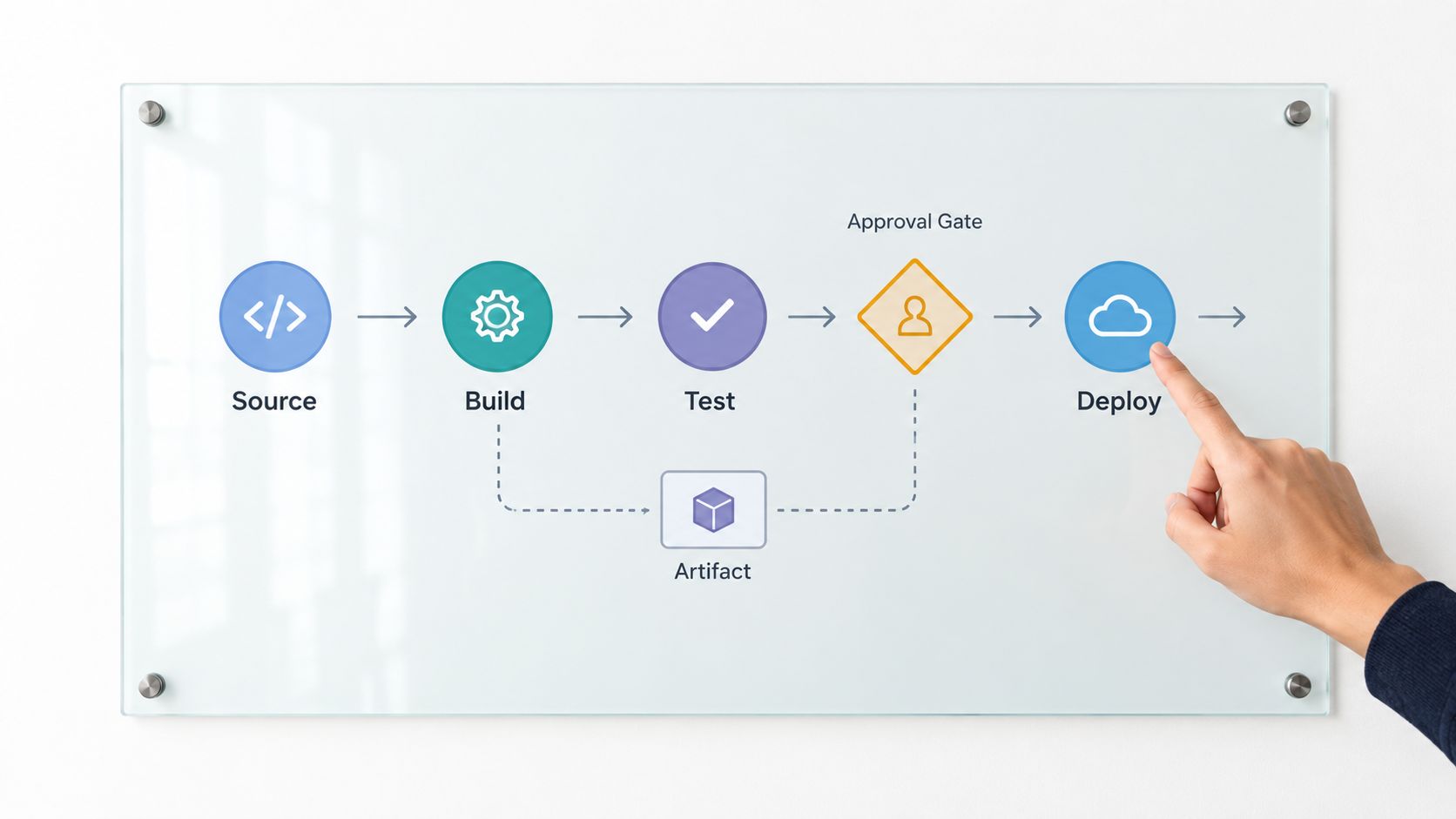
Look for a release design rather than a list of CodePipeline stages. A capable candidate can describe the path from commit to artifact, testing, approval, deployment, verification, and rollback. They should distinguish continuous delivery, where production promotion may require approval, from continuous deployment, where successful changes move forward automatically.
A good model answer is: “I've built pipelines that pull source from Git, run compilation and unit tests in CodeBuild, publish an immutable artifact, and promote that artifact through environments. I keep build and deployment concerns separate, use environment-specific configuration outside the artifact, and add approval gates where security or compliance requires them. For production, I'd use a deployment strategy such as rolling, blue-green, or canary, with CloudWatch alarms connected to rollback.”
The answer should include failure handling. A pipeline that turns green when the application is unavailable is not reliable. Ask how the candidate handles flaky tests, dependency caching, secrets, artifact integrity, database migrations, and a deployment that passes technical checks but breaks a key business transaction. The AWS deployment and CI/CD interview guide can help candidates prepare around CodePipeline, CodeBuild, and CodeDeploy.
Evaluation signals
- Strong: Describes immutable artifacts, automated tests, promotion controls, observability, and rollback.
- Weak: Lists CodePipeline, CodeBuild, and CodeDeploy without explaining how they interact.
- Score 4: Explains a real failed deployment and the control added afterward.
- Score 2: Can design a basic pipeline but misses rollback or release verification.
- Score 1: Treats a successful build as proof that production is healthy.
Interviewer probes
Ask, “The application deploys successfully, but error rates rise after traffic shifts. What automatically stops or reverses the release?” Then ask, “When would you choose platform-agnostic tooling over AWS-native pipeline services?”
3. Explain AWS Security Best Practices and IAM Policy Implementation
Difficulty: Mid-level
The expected answer starts with least privilege, but it shouldn't end there. Candidates should explain how identities receive permissions, how temporary credentials replace long-lived keys, and how teams detect excessive access. They should also connect IAM to network boundaries, encryption, secrets management, logging, and deployment controls.
A strong response could be: “I separate human access from workload access. Humans authenticate through a central identity system with MFA and assume roles. Applications use task, instance, or service roles rather than embedded keys. I grant only the actions and resources required, test policies before deployment, and review access through audit logs and permission analysis. Secrets belong in Secrets Manager or an equivalent service, not in source code or AMIs.”
The candidate should understand the difference between an identity policy, a resource policy, and an organisation-level service control policy. They should also recognise that an SCP limits what accounts can do, but doesn't grant permissions by itself. For network design, listen for private subnets, security groups, VPC endpoints, controlled egress, and a clear explanation of why a service needs internet access. Further practice is available in these AWS networking and security interview questions.
Security maturity appears in the boundaries a candidate designs, not in how many security services they can name.
Evaluation signals
- Strong: Uses roles, temporary credentials, MFA, explicit resource scope, CloudTrail, encryption, and policy testing.
- Weak: Recommends one broad administrator policy for convenience.
- Score 4: Can investigate an unintended access path and reduce permissions without breaking the workload.
- Score 2: Understands least privilege but can't explain implementation.
- Score 1: Stores access keys in repositories or application configuration.
Interviewer probes
Ask, “A deployment role can read every production database. How would you narrow it safely?” Then ask, “What evidence would you use to confirm that the revised policy still supports the deployment?”
4. How Do You Monitor and Log AWS Applications?
Difficulty: Mid-level
A strong candidate separates metrics, logs, traces, and audit events. CloudWatch metrics can show that latency is rising, logs can reveal an application error, traces can follow a request across services, and CloudTrail can show who changed an AWS resource. Each signal answers a different question.
A model answer might be: “I begin with service-level indicators such as availability, latency, error rate, saturation, and throughput. I create dashboards for operators and separate views for service owners. Application logs should be structured, include correlation identifiers, avoid secrets, and flow to a central destination with retention rules. CloudTrail records API activity, while CloudWatch alarms trigger notifications or automation. For distributed systems, tracing helps connect an external failure to the downstream dependency that caused it.”
Avoid rewarding candidates who create alarms for every metric. Excessive alerts produce noise and train operators to ignore them. Strong candidates connect alarms to runbooks and define what action the alarm requires. They should also discuss log volume, retention, sensitive data, metric dimensions, and the difference between an alert that indicates user impact and one that only predicts risk.
Evaluation signals
- Strong: Builds an observability plan around user impact, structured logs, traces, audit events, and actionable alarms.
- Weak: Mentions CloudWatch dashboards without explaining thresholds or response.
- Score 4: Can diagnose a multi-service failure using correlated evidence.
- Score 2: Knows the major AWS tools but lacks alert design experience.
- Score 1: Treats logs as the only source of operational truth.
Interviewer probes
Ask, “A release produces a surge in 503 responses through API Gateway. Which metrics, logs, and traces do you inspect first?” Then ask, “How do you stop a high-volume log stream from creating cost and signal problems?”
5. Explain Container Orchestration Using Amazon ECS and EKS
Difficulty: Mid-level to senior
The best answer compares ECS and EKS by operating model, not by declaring one universally better. ECS is often a simpler choice when a team wants AWS-integrated scheduling with less Kubernetes administration. EKS is appropriate when Kubernetes APIs, ecosystem compatibility, portability, or existing platform expertise justify the additional control and operational responsibility.
A candidate should explain the path from image build to workload deployment. “I'd build a versioned container image, scan it, push it to ECR, deploy it through a defined task or pod specification, and expose it through the appropriate load-balancing and service-discovery components. I'd set CPU and memory requests or limits, configure health checks, use workload-specific IAM, and send container logs to CloudWatch or the team's central platform.”
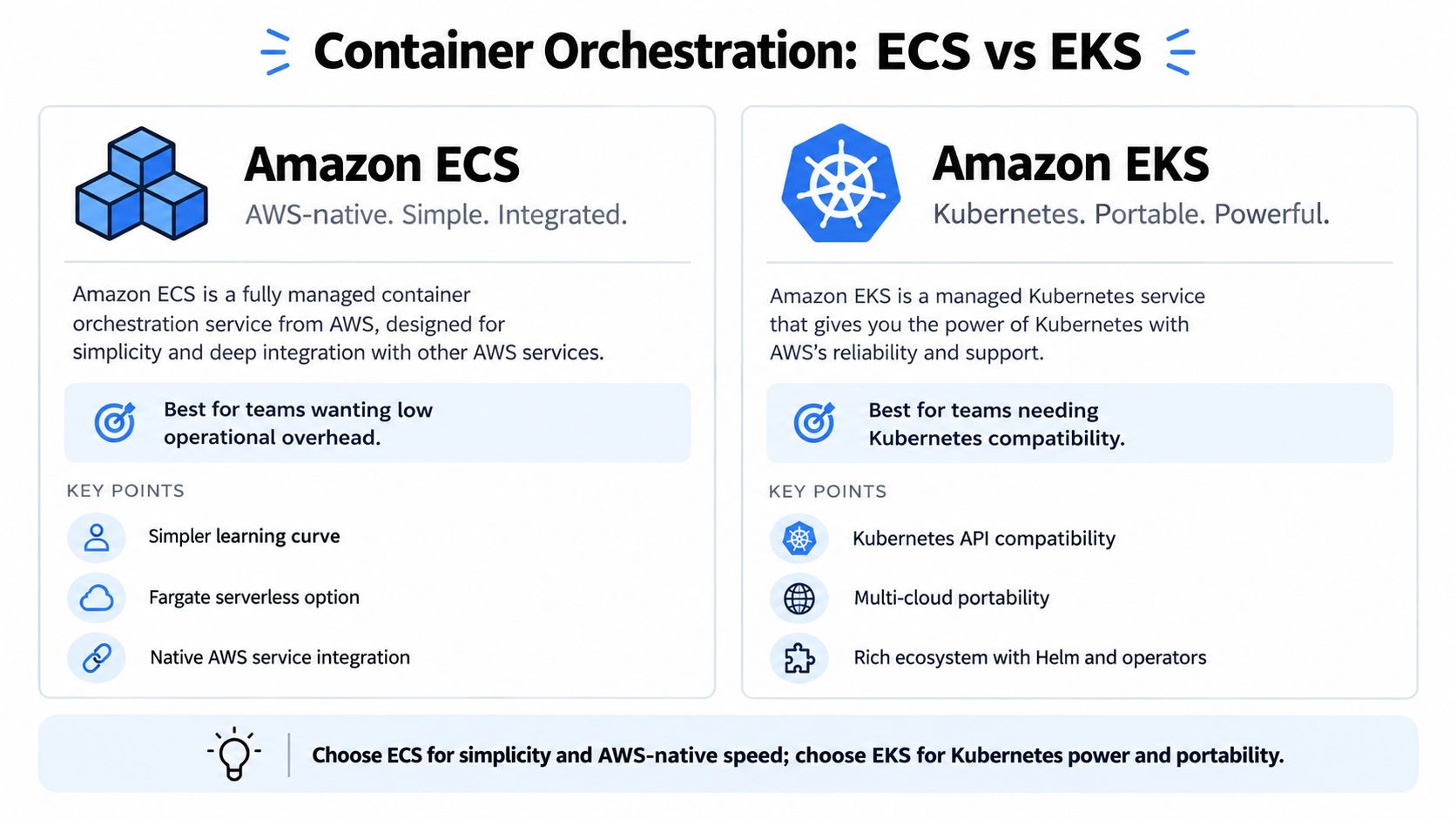
Probe the trade-offs. Kubernetes doesn't remove networking, capacity, security, or observability work. Fargate can reduce node management, but it doesn't eliminate workload sizing or cost governance. A strong candidate will mention deployment health, autoscaling signals, image lifecycle policies, secrets, service accounts, and the blast radius of a faulty task definition or Kubernetes manifest.
Evaluation signals
- Strong: Explains ECS and EKS trade-offs, image lifecycle, IAM, health checks, scaling, and networking.
- Weak: Says EKS is always more advanced or ECS is always cheaper.
- Score 4: Can troubleshoot a deployment where tasks start but fail health checks.
- Score 2: Understands container basics but not production orchestration.
- Score 1: Treats a container registry as an orchestrator.
Interviewer probes
Ask, “A new task starts successfully but is removed by the load balancer. What do you inspect?” Then ask, “What would make you reject EKS for a small team even if Kubernetes is popular?”
6. Describe Your Experience with Infrastructure Configuration Management
Difficulty: Mid-level to senior
This question should reveal whether the candidate understands the difference between provisioning infrastructure and configuring operating systems or applications. Terraform commonly manages cloud resources through a stateful workflow. Ansible, Chef, and Puppet can configure hosts, packages, services, and policies. Real environments may use more than one tool, but unclear ownership creates drift and conflicting changes.
A strong answer sounds like this: “I keep infrastructure definitions in Git, use reusable modules or roles, review changes through pull requests, and run validation in an isolated environment. Terraform state uses a protected remote backend with locking and controlled access. I separate environments and avoid manually changing resources that the code owns. Configuration tasks are designed to be idempotent, so repeated execution converges on the same state.”
The candidate should discuss state recovery, secrets in state, import of existing resources, module boundaries, and testing. They should also explain why Terraform may be selected for multi-cloud or platform-agnostic delivery, while CloudFormation can provide close AWS integration. India hiring signals increasingly mention Terraform and Kubernetes alongside CI/CD, suggesting that interviewers should test operational trade-offs rather than ask only for tool definitions, as reflected in India AWS DevOps role requirements.
Evaluation signals
- Strong: Explains state, idempotence, review, drift, remote backends, and ownership boundaries.
- Weak: Says “Terraform creates servers” without describing state or change control.
- Score 4: Has recovered from drift or a failed state operation safely.
- Score 2: Can write basic configurations but lacks production safeguards.
- Score 1: Stores state publicly or makes routine manual changes to managed resources.
Interviewer probes
Ask, “A resource exists in AWS but not in Terraform state. What are your options?” Then ask, “How would you prevent two teams from managing the same security group?”
7. How Would You Implement High Availability and Disaster Recovery in AWS?
Difficulty: Senior
A useful answer begins with business requirements, not a list of regions. The candidate should clarify acceptable data loss and recovery time, then design around those requirements. High availability protects against expected component or zone failures. Disaster recovery addresses larger disruptions and requires tested recovery procedures, data replication, dependencies, and clear ownership.
A model answer is: “I'd define RPO and RTO with the business, map critical dependencies, and remove single points of failure. Within a region, I'd distribute stateless services across Availability Zones and use health checks, load balancing, and automated replacement. For regional recovery, I'd choose backup, pilot-light, warm-standby, or active-active patterns based on recovery needs and cost. Database replication, object-storage replication, DNS failover, infrastructure automation, and documented runbooks would be tested rather than assumed to work.”
The candidate should distinguish backup from replication. Replication can copy corruption or accidental deletion, while backups provide recovery points. They should also mention secrets, certificates, container images, queues, third-party dependencies, and DNS propagation as part of the recovery plan.
Evaluation signals
- Strong: Starts with RPO and RTO, maps dependencies, tests failover, and explains recovery trade-offs.
- Weak: Says “deploy everything across multiple regions” without discussing data or operational complexity.
- Score 4: Can design and validate recovery for a stateful service.
- Score 2: Understands Multi-AZ but not regional recovery.
- Score 1: Confuses load balancing with disaster recovery.
Interviewer probes
Ask, “A regional outage occurs while the primary database is accepting writes. What happens to data and how do you communicate the recovery point?” Then ask, “How do you prove the runbook works?”
8. How Do You Approach Troubleshooting and Root Cause Analysis of Production Issues?
Difficulty: Senior
Production troubleshooting is a behaviour question disguised as a technical question. Strong candidates stabilise the service first, preserve evidence, communicate clearly, and investigate causes without blaming individuals. They don't jump straight to a permanent fix while users are still affected.
A credible response might be: “I first confirm impact, scope, and the timeline. I establish an incident lead, check recent changes, compare healthy and unhealthy components, and use metrics, logs, traces, and dependency health to form testable hypotheses. I reduce blast radius through rollback, traffic shifting, feature flags, or controlled isolation. After recovery, I document the timeline, contributing factors, detection gaps, and remediation owners in a blameless postmortem.”
Test the answer with a partial failure. India-facing AWS DevOps job content highlights debugging, CloudWatch, API Gateway, health metrics, and regional failure handling, while this Amazon DevOps Engineer role reflects the importance of operational troubleshooting in AWS environments.
The strongest RCA identifies why the system allowed the failure, why monitoring didn't prevent it, and which owner will close each gap.
Evaluation signals
- Strong: Separates mitigation from root cause, uses evidence, communicates impact, and assigns measurable follow-up work.
- Weak: Blames the last deployer or immediately restarts everything.
- Score 4: Explains a complete incident from detection through prevention.
- Score 2: Knows troubleshooting tools but lacks incident structure.
- Score 1: Has no rollback, escalation, or post-incident learning process.
Interviewer probes
Ask, “There is a sudden 503 surge in one region, but other regions are healthy. How do you distinguish an Availability Zone issue from a regional issue?” Follow with, “What belongs in the postmortem, and what does not?”
9. How Do You Handle Application Scaling and Performance Optimization?
Difficulty: Mid-level to senior
A strong candidate doesn't begin by adding instances. They establish a baseline, identify the bottleneck, test a hypothesis, and measure both user experience and infrastructure impact. Scaling the wrong tier can increase cost while leaving the actual constraint untouched.
A good response could be: “I start with latency, throughput, error rate, saturation, and workload characteristics. I use load tests that resemble real traffic, then inspect application traces, database queries, connection pools, cache performance, and downstream limits. Horizontal scaling works well for stateless services, while queues can absorb bursts and caching can reduce repeated reads. I configure autoscaling around meaningful signals, not CPU alone, and verify that health checks remove unhealthy capacity.”
The candidate should explain when vertical scaling is reasonable, when asynchronous processing is safer, and why database optimisation often precedes adding replicas. They should mention CloudFront for suitable static or cacheable content, but shouldn't propose caching data that requires immediate consistency without discussing invalidation and staleness.
Evaluation signals
- Strong: Uses baselines, load tests, bottleneck analysis, autoscaling, caching, and cost-aware validation.
- Weak: Recommends “increase instance size” for every performance problem.
- Score 4: Can connect a user-facing latency symptom to a constrained dependency.
- Score 2: Knows common scaling patterns but can't select between them.
- Score 1: Confuses high availability with performance optimisation.
Interviewer probes
Ask, “Response time rises while CPU remains low. What do you investigate?” Then ask, “How would you scale a service that depends on a database with a connection limit?”
10. Describe Your Experience with Version Control, Branching Strategies, and Git Workflows
Difficulty: Junior to mid-level
This question is more useful when it tests delivery behaviour rather than Git vocabulary. A candidate should choose a workflow based on release frequency, team size, risk, and deployment automation. Trunk-based development can support small, frequently integrated changes. A longer-lived release branch may suit a controlled release process, but it increases merge and divergence risk.
A model answer is: “I use protected main branches, pull requests, automated checks, focused commits, and tagged releases. For a team deploying frequently, I prefer short-lived branches or trunk-based development with feature flags. For a release process that needs stabilisation, I may use a release branch with strict ownership and a defined back-merge process. I revert public commits rather than rewriting shared history, and I keep infrastructure and application changes reviewable.”
Ask about merge conflicts, a bad commit already deployed, secret scanning, and branch protection. Strong candidates know that Git rules cannot replace deployment controls. They should explain how a pull request triggers tests, how an approved commit becomes an immutable artifact, and how the team identifies the exact source revision in production.
Evaluation signals
- Strong: Connects branching to deployment flow, review, testing, rollback, and traceability.
- Weak: Recites Git commands without explaining team workflow.
- Score 4: Can describe a production incident caused by a change and how Git supported recovery.
- Score 2: Uses Git competently but lacks release governance.
- Score 1: Rewrites shared history or bypasses protected branches casually.
Interviewer probes
Ask, “A faulty commit is already merged and deployed. How do you reverse it safely?” Then ask, “What controls prevent unreviewed infrastructure changes from reaching production?”
10-Point AWS DevOps Interview Topics Comparison
| Item | Implementation Complexity 🔄 | Resource Requirements ⚡ | Expected Outcomes 📊 | Ideal Use Cases 💡 | Key Advantages ⭐ |
|---|---|---|---|---|---|
| Explain AWS CloudFormation and IaC Principles | Medium–High, complex templates & drift management | Knowledge of YAML/JSON, CloudFormation, CI/CD, IAM | 📊 Declarative, reproducible infra, versioned deployments | Multi-environment provisioning, repeatable infra setups | ⭐ Reproducibility, rollback, CI/CD integration |
| Describe CI/CD Pipelines and AWS CodePipeline | Medium, pipeline orchestration and debugging | CodePipeline/Build/Deploy, test suites, IAM roles, artifact stores | 📊 Faster, consistent deployments with visibility | Automated delivery, frequent releases, gated production deploys | ⭐ Managed pipelines, native AWS integration, traceability |
| Explain AWS Security Best Practices and IAM Policy Implementation | Medium, policy syntax and cross-account governance | IAM, KMS, Secrets Manager, CloudTrail, monitoring | 📊 Reduced blast radius, auditability, compliance support | Sensitive data handling, multi-account governance, regulated environments | ⭐ Least-privilege, centralized secrets, audit trails |
| How Do You Monitor and Log AWS Applications? (CloudWatch, CloudTrail, etc.) | Medium, metric design, alerting and retention planning | CloudWatch, CloudTrail, X-Ray, log storage (S3), dashboards | 📊 Observability, real-time alerts, traceability for troubleshooting | Production reliability, incident detection & response | ⭐ Integrated AWS observability, real-time alerts, traceability |
| Explain Container Orchestration Using Amazon ECS and EKS | Varies, ECS: Low–Medium; EKS (Kubernetes): High | Container registry (ECR), clusters, networking, IAM, nodes | 📊 Scalable container deployments; portability with EKS | Microservices, containerized apps, choose ECS for simplicity, EKS for K8s portability | ⭐ Scalability; ECS = AWS-native simplicity; EKS = Kubernetes portability |
| Infrastructure Configuration Management (Ansible, Terraform, Chef, Puppet) | Medium–High, state & idempotency challenges | Tooling (Terraform/Ansible), state backends, testing infra | 📊 Consistent, repeatable configs; drift prevention | Multi-environment infra provisioning and config management | ⭐ Idempotency, versioned infra, automation |
| How Would You Implement High Availability and Disaster Recovery in AWS? | High, multi-AZ/region design and testing | Multi-AZ/region resources, replicas, backup services, Route 53, cost | 📊 Reduced downtime, defined RPO/RTO, failover readiness | Mission-critical services, compliance-driven systems | ⭐ Resilience, failover automation, business continuity |
| How Do You Approach Troubleshooting and Root Cause Analysis of Production Issues? | Medium, requires broad toolset and methodology | Logs, metrics, traces, runbooks, on-call processes | 📊 Faster MTTR, documented RCAs, preventive measures | Production incidents, post-incident learning, blameless reviews | ⭐ Systematic RCA, improved reliability, organisational learning |
| How Do You Handle Application Scaling and Performance Optimization? | Medium–High, requires testing and tuning | Auto Scaling, caching (ElastiCache/CloudFront), DB replicas, monitoring | 📊 Elastic capacity, lower latency, cost/perf trade-offs | Traffic spikes, growth planning, high-throughput services | ⭐ Elastic scaling, caching benefits, cost-efficient performance |
| Describe Your Experience with Version Control, Branching Strategies, and Git Workflows | Low–Medium, process discipline and tooling | Git hosting (GitHub/GitLab), CI hooks, branch protection | 📊 Traceability, safer merges, streamlined collaboration | Team development, CI/CD-driven workflows, release management | ⭐ Code review, rollback capability, clear history and collaboration |
Turn Answers into Consistent Hiring Decisions
A consistent interview sequence reduces the chance that one impressive answer overshadows a serious capability gap. Start with fundamentals, then test automation and security, followed by reliability, scale, and incident response. Version control can appear early for junior roles or serve as a bridge into CI/CD for experienced candidates.
For a junior candidate, begin with CloudFormation, Git, basic pipeline concepts, IAM roles, and CloudWatch fundamentals. Ask for a simple deployment path and listen for safe defaults. You don't need senior-level regional recovery design, but you should expect the candidate to understand version control, repeatable provisioning, secrets handling, and the difference between a successful build and a healthy application.
For a mid-level candidate, combine CI/CD with Terraform or CloudFormation, container deployment, observability, and troubleshooting. Give them a scenario such as a failed ECS rollout or a pipeline that produces inconsistent artifacts. Ask what they'd inspect, what they'd automate, and which decision they'd delay until they had more evidence.
For a senior candidate, focus on trade-offs and operating models. Ask them to design recovery for a stateful service, choose between ECS and EKS, explain a multi-account security boundary, or diagnose a partial regional failure. Seniority shows in how they handle ambiguity, dependencies, risk, cost, and communication. A senior engineer should also explain how they'd help other teams adopt the solution without creating a platform that only its authors can operate.
Score every answer against the same dimensions:
- Technical accuracy: Are the AWS services, security controls, and deployment patterns used correctly?
- Implementation detail: Does the candidate explain configuration, sequencing, testing, and failure handling?
- Trade-off awareness: Do they discuss complexity, cost, portability, operational burden, and business risk?
- Communication: Can they make a decision clear to engineering, security, HR, and business stakeholders?
A simple scoring scale can use 4 for strong evidence, 2 for partial evidence, and 1 for a serious gap. Don't award a high score because someone names more services. Ask for evidence, then probe the edge case. For example, if a candidate says they use blue-green deployment, ask how database migrations, background workers, alarms, and rollback are handled. If they claim least privilege, ask how they discovered unused permissions and validated the replacement policy.
Candidates can prepare by reviewing AWS identity and networking, CloudFormation or Terraform workflows, CodePipeline and CodeBuild, ECS or EKS, CloudWatch and CloudTrail, Git branching, rollback patterns, and incident response. They should be ready to explain one deployment they automated, one production issue they resolved, one security decision they changed, and one trade-off they made under constraint. India's cloud adoption signals reinforce the value of this practical focus. A survey reported 46.7% of organisations using AWS, compared with 41.7% using Microsoft Azure, while 62.0% were active cloud users and 27.3% were evaluating cloud adoption, according to the Cloud Adoption in India report.
The hiring process should measure applied capability, not recall alone. AWS-commissioned research found that 63% of workers in India expect to need cloud-related skills for career progression, and 45% of those needing cloud training specifically want to learn cloud-based tools for their work, as reported in this AWS digital skills research. That is a useful signal for interview design. Give candidates realistic operational prompts, ask them to justify choices, and verify whether they can turn an answer into a safe implementation.
Career Central can support repeatable AI-driven phone screening, first-round interviews, and coding assessments for DevOps hiring teams. HR and talent leaders can use structured screening to check role fundamentals before technical interviewers invest time in deeper AWS scenarios. The final decision should still reflect human review, but a consistent first stage makes comparisons clearer and reduces dependence on unstructured conversations.
A good AWS DevOps interview ends with a clear evidence trail. You should know what the candidate can build, what they can operate, how they respond when systems fail, and whether they can explain risk to people outside engineering. Those signals are more valuable than a perfect definition of any individual AWS service.
Career Central provides AI-driven phone screening, first-round interviews, and coding assessments for organisations hiring AWS DevOps professionals. Use it to standardise early evaluation around CI/CD, IAM, IaC, containers, reliability, and production troubleshooting, then visit Career Central to explore the interview workflow.